
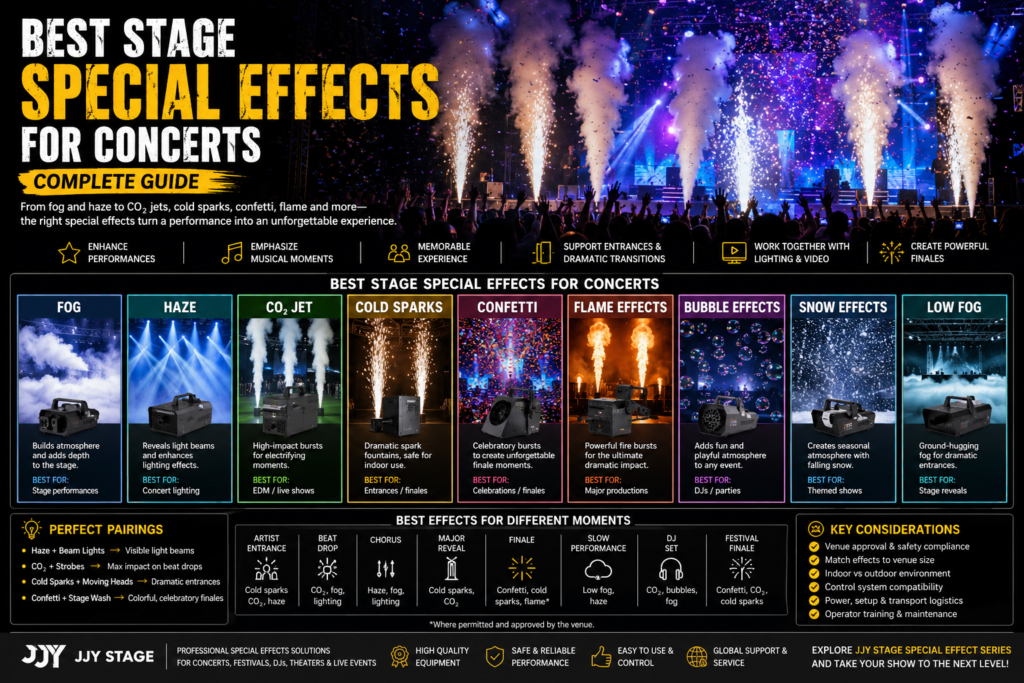
A great concert is never just about the music. It’s about the moment the lights drop, the crowd holds its breath, and the stage erupts into something unforgettable. That transformation is the job of stage special effects for concerts the fog, haze, sparks, jets, and bursts that turn a performance into an experience.
The right concert special effects can add energy to an entrance, build drama into a chorus, punctuate a beat drop, and turn a closing song into a moment the audience remembers long after they leave the venue. Used well, effects work hand-in-hand with lighting, sound, and staging to shape the emotional arc of a show. Used poorly or without the right planning they can feel random, distracting, or even unsafe.
This guide breaks down the most common stage effects for concerts, explains where each one works best, and walks through how concert organizers, event producers, DJs, stage designers, and production companies can choose the right special effects equipment for their next show. Along the way, we’ll cover fog, haze, CO₂ jets, cold sparks, confetti, flame effects, bubbles, snow, and low fog along with the safety and planning considerations that should shape every decision.
What Are Stage Special Effects for Concerts?
Concert special effects are equipment-driven visual elements that add atmosphere, motion, or impact to a live performance, separate from the stage’s standard lighting rig. While lighting shapes color, mood, and direction, special effects add a physical, often three-dimensional layer to what the audience sees clouds of fog rolling across the stage, a jet of CO₂ blasting skyward, or a shower of cold sparks cascading from a truss.
The most widely used categories of stage effects machines for concerts include:
- Fog — dense, atmospheric coverage
- Haze — a light, even fill that reveals beams
- CO₂ — high-pressure bursts for big impact moments
- Cold sparks — vertical fountains of spark-like effects
- Confetti — celebratory bursts of paper or film
- Flame effects — controlled bursts of fire for major productions
- Bubbles — a lighter, playful atmospheric effect
- Snow — falling artificial snow for themed shows
- Low fog — a dense, ground-hugging fog layer
Each of these effects serves a different purpose, and most professional concert productions combine several of them across a single show rather than relying on just one.
Why Are Special Effects Important for Concerts?
Special effects matter because they give a production tools to communicate emotion and energy that lighting and sound alone can’t fully deliver. Well-placed effects can:
- Enhance performances by adding a physical, visual dimension to key musical moments
- Emphasize musical moments like drops, key changes, or climactic choruses
- Support artist entrances, building anticipation before a performer even reaches center stage
- Create dramatic transitions between songs, acts, or sections of a show
- Improve the overall audience experience, making a concert feel more immersive and memorable
- Work together with lighting and video to build a cohesive visual story across the show
- Create memorable finales that leave the audience with a strong closing impression
None of this works in isolation, though effects are most powerful when they’re planned as part of the show’s overall visual design, not added as an afterthought.
Best Stage Special Effects for Concerts
Different effects suit different moments. Here’s a comparison of the most commonly used professional stage effects in live concert production:
| Effect | Best Use | Visual Impact | Typical Application |
| Fog | Atmosphere | High | Stage performances |
| Haze | Light beams | High | Concert lighting |
| CO₂ Jet | Beat drops | Very High | EDM/live shows |
| Cold Sparks | Entrances/finales | Very High | Concerts/events |
| Confetti | Celebrations | Very High | Finales |
| Flame Effects | Dramatic moments | Very High | Major productions |
| Bubble Effects | Fun atmosphere | Medium | DJs/parties |
| Snow Effects | Themed shows | Medium–High | Winter productions |
| Low Fog | Dramatic entrances | High | Stage reveals |
Fog and haze form the atmospheric backbone of most shows, making lighting more visible and giving the stage depth. CO₂ jets and cold sparks deliver sharp, high-energy bursts for peak moments. Confetti and flame effects are typically reserved for finales or major production moments, given their intensity and the planning they require. Bubbles and snow serve more thematic or lighter-atmosphere roles, while low fog is a favorite for entrances and reveals thanks to its ground-hugging, cinematic look.
Fog Effects for Concerts
Fog is one of the most foundational tools in live production. A layer of stage fog fills the air with fine particles that scatter light, making beams, gobos, and color washes far more visible and giving the whole stage a sense of depth and atmosphere.
Concert fog effects are commonly used for:
- Building general stage atmosphere before or during a set
- Increasing the visibility of lighting beams and effects
- Supporting dramatic transitions between songs or segments
- Framing artist entrances with a moody, immersive backdrop
- Adding texture to slower or more atmospheric musical performances
Because fog can be produced at different densities and dispersal rates, it’s often adjusted throughout a show — heavier during instrumental or transitional moments, lighter during vocal-focused sections where visibility of the performer matters more.
For a deeper look at how fog is used across different concert scenarios, see our guide to fog effects for concerts and our breakdown of the fog machine for stage.
Haze Effects for Concert Lighting
Haze is often confused with fog, but the two serve different purposes. Where fog creates a dense, visible cloud, haze produces a much finer, more evenly distributed particle field that’s often barely noticeable on its own — until the lighting rig turns on.
A haze machine for stage use is designed to reveal:
- Moving beams from moving-head fixtures
- Laser effects, where used and properly managed
- Spotlights and follow-spot beams
- General stage lighting texture
- Defined light rays cutting through the air
Because haze is subtler and longer-lasting in the air than fog, it’s frequently used to maintain a consistent, beam-revealing atmosphere across an entire set rather than for isolated bursts. Many productions run haze continuously in the background while layering fog, CO₂, or sparks on top for specific moments.
Learn more in our dedicated guide to the haze machine for stage lighting.
CO₂ Effects for Concerts
CO₂ stage effects are known for their sharp, high-pressure jets that shoot several meters into the air with an immediate, high-energy burst. This makes CO₂ a favorite for moments that need to hit hard and fast.
Common applications include:
- Beat drops in electronic and dance music sets
- High-energy DJ performances
- Artist entrances that call for an explosive first impression
- Music festival stages, where visual impact needs to compete with scale
- Concert finales, often paired with other effects like confetti or sparks
CO₂ effects are typically triggered precisely on a musical cue, which makes timing and coordination with the lighting and sound team essential for getting the full impact.
For a complete breakdown of how these systems work, see our guide: CO₂ Jet Machine for Concerts: Complete Guide to CO₂ Stage Effects.
Cold Spark Effects for Concerts
Cold spark machines produce a dramatic, vertical fountain of spark-like particles that can rise several meters in the air, creating one of the most visually striking effects available for live shows.
Cold spark machine effects are typically used for:
- Artist entrances, especially for headline moments
- Song finales, where a burst of sparks punctuates the final note
- Stage reveals, unveiling a performer or set piece
- Major musical drops
- Award-style or celebration moments within a show
It’s important to understand that “cold spark” describes the temperature profile of the effect relative to traditional pyrotechnics it does not mean the effect is risk-free. Cold spark systems still require venue approval, appropriate clearances, trained operation, and strict adherence to manufacturer requirements and local regulations. Never assume a cold spark effect is automatically permitted in a given venue without confirming first.
For a full walkthrough of how these systems work and what to consider before using them, read our Cold Spark Machine: Complete Guide to Indoor Spark Effects.
Confetti Effects for Concerts
Few effects create the same instant sense of celebration as confetti. A burst of paper or film confetti is one of the most reliable ways to punctuate a big moment and get an emotional reaction from the crowd.
Confetti tends to work best for:
- Final songs of a set
- Artist finales and encore moments
- Audience celebration moments, like anniversaries or milestone shows
- Festival closing sets
- Major announcements during a live event
Before choosing a confetti setup, production teams should think through several practical considerations:
- Venue size — how far the confetti needs to travel and disperse
- Confetti type — material, size, and biodegradability where required
- Cleanup — venue policies and turnaround time between shows
- Indoor/outdoor environment — wind and drainage can affect outdoor use
- Machine placement — positioning for even coverage without hitting performers or equipment
For more detail on selecting the right setup, see our Confetti Machine for Events: Complete Buying Guide.
Flame Effects for Concerts
Flame effects bring a level of visual intensity that few other tools can match, and they’re a signature element of many large-scale festival and arena productions. A well-timed burst of flame can punctuate a chorus, mark a finale, or anchor a dramatic transition in a way the audience feels physically.
Flame effects are typically used for:
- Major stage moments built around a specific musical or visual cue
- Concert finales, often as the closing visual statement of a show
- Festival performances where scale and impact are central to the production
- Dramatic transitions between segments of a longer set
Flame effects are among the most heavily regulated tools in live production. They require professional-grade equipment, trained and qualified operators, appropriate clearances, explicit venue approval, and full compliance with applicable fire-safety and local regulatory requirements. Flame effects should never be attempted without proper professional oversight.
Read more in our guide: Stage Flame Machines: How Professional Fire Effects Work.
Low Fog Effects for Concerts
Low fog effects produce a dense, ground-hugging cloud that stays close to the stage floor instead of filling the air, creating a striking, cinematic look that’s become a signature of high-production entrances and reveals.
Low fog is especially effective for:
- Artist entrances that need a slow, dramatic build
- Slow musical moments where atmosphere matters more than energy
- Dramatic reveals of a performer, set piece, or stage element
- Dance performances where visibility of movement above the fog layer matters
- Theatrical productions with a strong narrative or cinematic component
Because low fog stays close to the ground, it can be layered with regular fog, haze, or lighting effects without overwhelming the stage or obscuring performers.
For more on how this effect is created and used, see our guide to the Low Fog Machine: How to Create a Cloud-Like Stage Effect.
Bubble Effects for Concerts & DJ Events
Bubble effects bring a lighter, more playful energy to a stage or event space, and they’re particularly well suited to environments where fun and audience interaction matter more than dramatic intensity.
Bubbles work well for:
- DJ performances and club-style events
- Outdoor concerts, where bubbles catch sunlight and drift naturally
- Family-friendly entertainment and daytime festival stages
- Broader festival environments with open crowd areas
- Fun, high-energy performances that lean into a playful atmosphere
Unlike fog, haze, or CO₂, bubbles are generally a lower-intensity, ambient effect rather than a punctuation tool for specific musical cues — making them a good complement to, rather than a replacement for, higher-impact effects.
See our full breakdown in the Bubble Machine for Events: Complete Guide to Choosing the Right Bubble Machine.
Snow Effects for Themed Concerts
Artificial snow effects add a distinctive, seasonal atmosphere that’s hard to replicate with any other tool, making them a popular choice for concerts built around a winter or holiday theme.
Snow effects are commonly used for:
- Christmas concerts and holiday-themed shows
- Winter-themed productions and tours
- Holiday season promotional and brand events
- Theatrical performances with seasonal or narrative themes
Like bubbles, snow effects tend to work as a sustained atmospheric layer rather than a single punctuated burst, often running throughout a song or segment rather than being triggered on a single cue.
For more detail, read our Snow Machine for Events: Complete Guide to Stage Snow Effects.
Best Effects for Different Concert Moments
Matching effects to specific moments in a show is one of the most effective ways to build a cohesive production. Here’s a practical starting point:
| Concert Moment | Recommended Effects |
| Artist Entrance | Cold sparks, CO₂, haze |
| Beat Drop | CO₂, fog, lighting |
| Chorus | Haze, fog, lighting |
| Major Reveal | Cold sparks, CO₂ |
| Finale | Confetti, cold sparks, flame where permitted |
| Slow Performance | Low fog, haze |
| DJ Set | CO₂, bubbles, fog |
| Festival Finale | Confetti, CO₂, cold sparks |
These pairings are a useful starting point, but the final choice for any specific show always depends on the venue’s restrictions, the equipment actually available, the broader production design, and applicable safety requirements. What works for an arena tour may not be appropriate or even permitted in a smaller indoor club.
How to Combine Special Effects With Stage Lighting
Special effects rarely work in isolation on a professional stage. Their real power comes from how they’re synchronized with lighting, video, and the music itself.
Effects can be combined with:
- Moving heads — for dynamic, effect-highlighted beam movement
- Beam lights — sharp, focused beams that fog or haze make visible
- Wash lights — broad color fields that give effects like confetti or bubbles a colorful backdrop
- Strobes — quick, punchy flashes that pair naturally with CO₂ or spark bursts
- LED screens — visual content that can be timed to match effect cues
- Lasers, where appropriately managed and permitted
- Music cues — the backbone that ties every effect and lighting change together
A few practical combinations frequently used in live production:
- Haze + Beam Lights → makes moving light beams sharply visible in the air
- CO₂ + Strobes → intensifies the impact of a beat drop
- Cold Sparks + Moving Heads → builds a dramatic, layered entrance
- Confetti + Stage Wash → adds color and texture to a finale moment
Planning these combinations in advance and rehearsing the cues is what separates a polished production from one where effects feel disconnected from the rest of the show.
How to Choose Concert Special Effects Equipment
Selecting the right special effects equipment for a concert involves more than picking whichever effect looks the most impressive. Here’s what to evaluate.
1. Concert Size
A small club show, a theater production, an arena tour, and an outdoor festival all call for different scales of equipment, coverage, and output. Match the effect’s throw distance and volume to the actual size of the stage and audience area.
2. Indoor or Outdoor Location
Indoor and outdoor environments create very different conditions for effects — from wind dispersal outdoors to ceiling clearance and ventilation indoors. This should shape both the choice of effect and the equipment specification.
3. Desired Visual Impact
Think about the emotional tone you want to create. A high-impact CO₂ or cold spark moment serves a different purpose than a subtle haze layer meant to support the lighting design throughout a set.
4. Control System
Consider how the effect will be triggered:
- Manual control
- Remote control
- DMX integration
- Broader production-control systems
Only rely on DMX or system compatibility once it has been verified for the specific equipment and production setup — don’t assume compatibility across all models or systems.
5. Setup & Transport
Practical logistics matter as much as visual output. Consider:
- Equipment size and weight
- Power requirements
- Storage between shows
- Transport logistics, especially for touring productions
- Setup and teardown time within the venue’s schedule
6. Safety Requirements
Every effect brings its own safety considerations, including:
- Venue approval
- Required clearances
- Operator qualifications and training
- Fire-safety requirements
- Electrical requirements
- Emergency procedures
7. Maintenance & Support
Longer-term reliability depends on:
- Manufacturer support and documentation
- Availability of spare parts
- Access to consumables (fluids, gas, confetti material, etc.)
- Regular cleaning routines
- Ongoing maintenance requirements
Indoor vs Outdoor Concert Special Effects
Indoor and outdoor concerts present different challenges for special effects planning:
| Consideration | Indoor Concert | Outdoor Concert |
| Ceiling clearance | Important | Usually less restrictive |
| Wind | Limited concern | Major consideration |
| Drainage | Important | Site-dependent |
| Weather | Controlled | Must be monitored |
| Venue approval | Essential | Event/site requirements |
| Equipment protection | Important | Weather protection may be needed |
| Audience area | Defined | Often larger |
Every venue and outdoor site has its own specific rules, and permissions for a given effect can vary widely between locations. Always confirm what is and isn’t permitted with the specific venue or event authority before finalizing an effects plan never assume an effect is automatically allowed based on past experience at a different location.
Safety Considerations for Concert Special Effects
Safety should be treated as a core part of the production plan, not an afterthought. Key areas to address include:
- Venue approval for every effect being used
- Manufacturer instructions, followed exactly as specified
- Professional operation by trained personnel
- Equipment inspection before every use
- Electrical safety, including proper power supply and grounding
- Required clearances around each piece of equipment
- Audience separation from effects equipment and their discharge zones
- Fire safety, particularly for flame and spark effects
- Weather conditions, especially for outdoor events
- Emergency access that remains unobstructed at all times
- Cleanup procedures planned in advance
- Local regulations, which can vary significantly by city, venue, and event type
Flame and cold spark effects deserve particular attention. Both require trained operators, verified venue approval, appropriate clearances, and strict adherence to manufacturer and regulatory requirements. No special effect should ever be described or treated as completely risk-free, and safety systems or alarms should never be disabled to accommodate an effect.
Common Mistakes When Choosing Concert Effects
Production teams especially newer ones often run into the same avoidable issues:
- Choosing effects based only on price rather than fit for the show
- Selecting equipment without considering the actual venue size
- Ignoring ceiling clearance requirements
- Forgetting power requirements until load-in day
- Using too many effects at once, diluting their individual impact
- Ignoring cleanup requirements and venue turnaround time
- Failing to coordinate effects with lighting and music cues
- Not testing equipment before the show
- Ignoring venue approval processes until it’s too late to adjust
- Choosing equipment without considering transportation logistics
Avoiding these pitfalls is often less about the effects themselves and more about early, thorough production planning.
How to Build a Professional Concert Special Effects Setup
A structured approach helps ensure effects enhance the show rather than becoming a logistical liability.
Step 1 — Define the show’s key moments. Map out the entrance, key transitions, drops, and finale before selecting any equipment.
Step 2 — Assign the most suitable effect to each moment. Use the moment-by-moment guidance above as a starting point, adjusted for your specific show.
Step 3 — Coordinate effects with lighting and music. Work with the lighting and sound teams to align cues precisely.
Step 4 — Check venue and safety requirements. Confirm approvals, clearances, and any restrictions well ahead of the event.
Step 5 — Test and rehearse. Run through every effect cue during rehearsal, not just at showtime.
Step 6 — Operate the show according to manufacturer and production procedures. Follow documented procedures consistently, from setup through teardown.
FAQ
What are the best stage special effects for concerts?
There’s no single “best” effect — fog and haze support atmosphere and lighting, CO₂ and cold sparks deliver high-impact moments, and confetti and flame effects are often reserved for finales. The best choice depends on the specific moment in the show.
What is the best effect for a concert finale?
Confetti, cold sparks, and flame effects (where permitted) are commonly used for finales, often combined with lighting and music cues for maximum impact.
What effects are best for EDM concerts?
CO₂ jets, fog, and cold sparks are frequently used in EDM and dance music sets, especially timed to beat drops and high-energy transitions.
What is the difference between fog and haze?
Fog creates a dense, visible atmospheric cloud, while haze produces a much finer, more even particle field designed primarily to reveal lighting beams without being highly visible on its own.
Are cold sparks suitable for indoor concerts?
Cold spark effects can be used indoors in many cases, but this always depends on venue approval, required clearances, and compliance with manufacturer and local safety requirements — it should never be assumed without confirmation.
How do CO₂ effects work on stage?
CO₂ effects release pressurized gas that creates a rapid, high-visibility jet or burst of vapor, typically triggered on a precise musical cue.
What effects work best with concert lighting?
Haze is particularly effective at revealing beams and moving lights, while fog adds broader atmospheric depth that enhances color washes and general lighting design.
Are flame effects suitable for every concert?
No. Flame effects require professional equipment, trained operators, venue approval, and compliance with fire-safety regulations, and they are not appropriate or permitted for every venue or production.
How do I choose special-effects equipment for a concert?
Consider concert size, indoor/outdoor conditions, desired visual impact, control system compatibility, setup and transport logistics, safety requirements, and ongoing maintenance and support needs.
What safety requirements should concert organizers consider?
Venue approval, manufacturer instructions, trained operators, equipment inspection, electrical safety, required clearances, audience separation, and compliance with local regulations should all be addressed before any effect is used.
Conclusion
From fog and haze to CO₂, cold sparks, confetti, flame, bubbles, snow, and low fog, stage special effects for concerts give producers a powerful toolkit for shaping how an audience experiences a live show. But there is no single effect that works best for every concert the right combination always depends on the music, the venue, the audience, the stage design, the desired visual impact, the available equipment, and the safety requirements specific to that show.
The strongest productions treat effects as part of an integrated plan chosen deliberately for each moment, synchronized with lighting and music, and executed with proper safety planning from the start.
Explore JJY Stage’s Special Effect Series to discover professional equipment for concerts, festivals, DJs, theaters, and live events.