
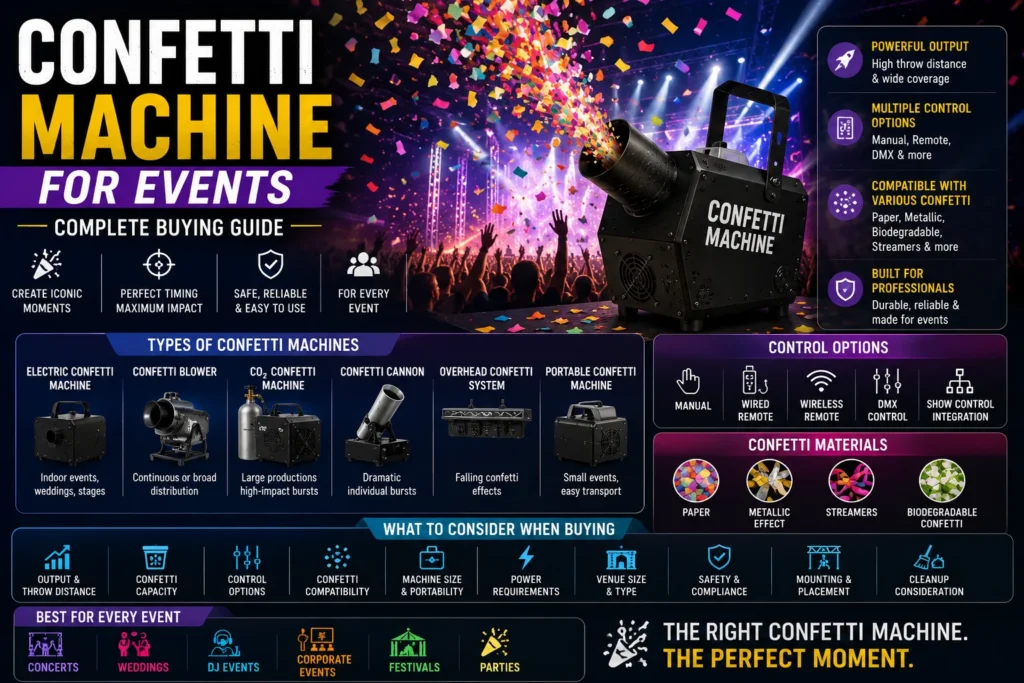
A well-timed burst of confetti can turn an ordinary moment into the one everyone remembers. A concert finale, a wedding entrance, a DJ drop, an award ceremony, a product launch, a New Year’s countdown, a festival closing set in every one of these, confetti is often what pushes a good moment into a genuinely memorable one.
But choosing the right confetti machine for events isn’t as simple as picking whichever unit looks the most powerful. The right choice depends on the event type, the venue, the visual effect you’re going for, how the machine will be controlled, what confetti material you plan to use, and the overall scale of the production. This guide walks through all of it, so you can compare options with a clear sense of what actually matters.
Explore our Stage Special Effects Guide to learn about popular effects used in concerts, theater productions, weddings, festivals, and live events. The guide covers options such as fog, haze, bubbles, and other stage effects, helping event planners and production teams choose the right effects for different venues and performances.
What Is a Confetti Machine?
A confetti machine is a special-effects device designed to project or distribute lightweight confetti into the air, typically as part of a stage or event production. Different machines use different mechanisms to achieve this, including:
- Electric blowers
- Fans
- Compressed air
- CO₂-based systems
- Other manufacturer-specific propulsion methods
Not every confetti machine uses the same technology, so it’s worth understanding what’s actually inside the unit you’re considering rather than assuming all confetti effect machines behave the same way. Whether you’re looking at a compact confetti effect machine for a small event or a full stage confetti machine for a concert production, the underlying propulsion method shapes what the effect will actually look like.
How Does a Confetti Machine Work?
The general process looks like this, regardless of the specific propulsion method:
- Confetti is loaded into the machine’s hopper or chamber.
- The machine activates its specified propulsion or airflow system.
- Confetti is projected or dispersed into the air.
- Air movement in the room or venue determines how the pieces travel.
- Stage lighting makes the falling confetti more visible.
- The confetti settles across the performance or event area.
Output, throw distance, coverage, and effect duration all vary by machine and by the confetti material being used a lightweight paper confetti will behave differently than a heavier metallic-effect piece even from the same machine. Because of that variation, it’s best to rely on a manufacturer’s rated specifications rather than assuming universal performance figures.
Types of Confetti Machines
| Machine Type | Best For | Main Advantage |
| Electric Confetti Machine | Indoor events, weddings, stages | Convenient powered operation |
| Confetti Blower | Continuous or broad distribution | Sustained airflow |
| CO₂ Confetti Machine | Large productions and high-impact bursts | Powerful projection |
| Confetti Cannon | Dramatic individual bursts | Strong visual impact |
| Overhead Confetti System | Falling confetti effects | Wide overhead coverage |
| Portable Confetti Machine | Small events | Easy transport |
Exact capabilities within each category depend on the individual model, so this table is best used as a starting point for narrowing down which category fits your event, not a substitute for checking specific product specifications.
Electric Confetti Machine vs CO₂ Confetti Machine
| Feature | Electric Confetti Machine | CO₂ Confetti Machine |
| Power source | Electrical | CO₂ supply + equipment power where required |
| Typical use | Indoor/general event production | Large/high-impact productions |
| Setup complexity | Generally simpler | Requires CO₂ logistics |
| Control | Model-dependent | Model-dependent |
| Venue considerations | Electrical/venue requirements | CO₂, ventilation, clearance, and venue requirements |
| Best use | Weddings, stages, corporate events | Concerts, festivals, major productions |
Neither type is universally better an electric confetti machine is often the simpler choice for weddings and corporate events, while a CO2 confetti machine tends to suit larger productions that need a more powerful burst. If you’re considering a CO₂-based system, always verify venue requirements around CO₂ supply, ventilation, and clearance before booking or purchasing.
Confetti Machine vs Confetti Cannon
These terms often get used loosely, but they generally point to two different production approaches.
Confetti Machine is generally designed for repeatable effects, controlled output, professional productions, larger event setups, and integration with show control systems.
Confetti Cannon is generally associated with focused bursts, smaller productions, one-off moments, and portable event effects.
Terminology varies between manufacturers, though one company’s “cannon” might be built for repeatable show-control use, while another’s “machine” might be a simple one-off unit. Because of that, it’s worth evaluating the actual specifications and operating method of a specific product rather than relying on the name alone.
What Should You Look for When Buying a Confetti Machine?
1. Output
Consider throw distance, output volume, coverage area, and effect duration. There’s no universal number that applies across all machines, so compare manufacturer-rated specifications under similar conditions rather than assuming two machines with similar prices will perform the same.
2. Confetti Capacity
A larger hopper or chamber can reduce how often you need to reload during a longer production. When evaluating capacity, think about:
- Event duration
- Number of shots planned
- Number of machines in use
- Reload time between shots
- Crew availability to handle reloads
3. Control Options
Confetti machines can be triggered through several methods:
- Manual control
- Wired remote
- Wireless remote
- DMX
- Other manufacturer-supported control systems
DMX control can be particularly valuable when confetti needs to be synchronized precisely with stage lighting and music, and professional production guides commonly recommend checking DMX capability specifically when precise cueing matters to the show. Not every machine supports DMX, so this is worth confirming directly with the manufacturer rather than assuming.
4. Machine Size and Portability
Weight, dimensions, carrying requirements, storage needs, transportation, and setup time all matter especially for event rental companies, touring productions, DJs, and mobile event crews who need to move equipment frequently.
5. Confetti Compatibility
Not every machine is designed for every type of confetti. Consider:
- Paper confetti
- Biodegradable confetti
- Metallic-effect confetti
- Streamers
- Different shapes and sizes
Always check the manufacturer’s compatibility requirements before use. Some professional equipment guides specifically note that heavier or oversized materials can affect airflow and overall machine performance, so matching your confetti choice to what the machine is actually built for is worth doing before the event, not during it.
How to Choose a Confetti Machine Based on Event Size
| Event Type | Suggested Approach |
| Small party | Compact/portable machine |
| Wedding | Electric or portable professional machine |
| Corporate event | Controlled electric/DMX system |
| DJ event | Burst-focused machine with suitable control |
| Concert | Professional stage confetti system |
| Festival | Multiple professional units or high-output system |
| Large production | Coordinated multi-machine setup |
Venue size is only one factor in this decision. Ceiling height, stage dimensions, audience position, airflow, confetti type, and the visual density you’re aiming for all shape which approach actually makes sense for your event.
Best Confetti Machine for Concerts
Concert productions typically use confetti to punctuate music drops, artist entrances, song finales, festival moments, audience celebrations, and encore performances. Because these moments are tied to specific beats in the show, concert productions often benefit from precise cueing rather than a single manually-triggered burst.
Concert confetti effects and broader stage confetti effects tend to work best when coordinated with:
- Music cues
- Moving heads
- LED screens
- Strobes
- Other stage effects running at the same moment
Best Confetti Machine for Weddings
Weddings call for a different set of priorities than concerts. Common moments for a confetti machine for weddings include the couple’s entrance, the first dance, the wedding exit, the reception finale, cake cutting, and photo moments.
Wedding planners should factor in venue approval, flooring, cleanup logistics, guest movement around the space, photography considerations, the confetti material being used, and any fire-safety requirements the venue may have.
Best Confetti Machine for Parties & DJ Events
For a confetti machine for parties, the moments that matter most are DJ drops, birthday parties, New Year’s celebrations, club events, private parties, and celebratory countdowns.
Timing is often more important than simply maximizing output here a well-timed burst on the exact beat can have more visual impact than constant confetti running throughout the set.
Best Confetti Machine for Corporate Events
Corporate productions product launches, brand reveals, award ceremonies, company milestones, grand openings, and conference finales tend to prioritize a different set of factors:
- Precise timing
- Clean visual presentation
- Brand colors
- Reliable control
- Repeatability across multiple performances or sessions
- Venue compliance
Choosing the Right Confetti for Your Machine
Tissue/Paper Confetti — lightweight material that moves easily in the air, giving a soft, floating visual.
Metallic-Effect Confetti — reflective appearance that stands out strongly under stage lighting.
Streamers — longer, more visible shapes that create a different movement pattern than standard confetti pieces.
Biodegradable Confetti — an option some event planners consider for environmental reasons, though specific environmental, flame-retardant, or non-toxic claims should always be verified with the manufacturer rather than assumed, and venue approval should be confirmed separately.
How Confetti Works With Stage Lighting
Lighting has a major effect on how confetti actually reads to an audience.
- White Light provides clear, straightforward visibility.
- RGB Lighting allows the confetti to visually match the event’s color palette.
- Moving Heads create dynamic visual movement across the falling confetti.
- Backlighting can silhouette falling confetti for a dramatic effect.
- Strobe Effects can emphasize rapid movement during high-energy moments.
- Beam Lighting can create strong visual interaction with airborne confetti.
The best results generally come from coordinating confetti, lighting, and music together rather than treating the confetti burst as a standalone effect.
How to Position a Confetti Machine
Common placement options include stage sides, front of stage, rear of stage, the DJ booth area, and elevated positions where the installation is specifically designed and professionally rigged for that purpose.
Placement affects throw direction, coverage, audience visibility, camera framing, how the lighting interacts with the effect, and how much cleanup will be needed afterward. Any overhead or elevated installation should use appropriate professional mounting or rigging methods and follow both the manufacturer’s and the venue’s requirements; this isn’t an area for improvised setups.
How Many Confetti Machines Do You Need?
There’s no universal number here. The right count depends on stage width, venue size, desired coverage, the number of effect zones in your show, machine output, overall event design, and budget.
A few conceptual approaches:
- Single Machine — suitable for a focused visual moment, like a single entrance or finale cue.
- Two Machines — can create a symmetrical effect on either side of a stage or focal point.
- Multiple Machines — useful for wider stage coverage and synchronized sequences across a larger production.
Professional production teams should determine the actual placement and quantity based on the specific equipment being used and the venue itself.
Confetti Machine Control and DMX Integration
Control matters more as productions get more complex. Common options include manual triggering, remote triggering, DMX control, and full show-control system integration.
DMX-compatible equipment can allow confetti cues to be integrated with stage lighting, music, video playback, and other special effects running in the same show, and professional production sources highlight DMX specifically for its usefulness in achieving repeatable timing across lighting and effects systems. That said, DMX isn’t a requirement for every event; a birthday party or small private event may not need it, while a touring concert production likely will.
Indoor vs Outdoor Confetti Machines
| Factor | Indoor | Outdoor |
| Airflow | HVAC/ventilation matters | Wind can strongly affect confetti |
| Ceiling | Important | Often less restrictive |
| Cleanup | Must be planned | Site cleanup still required |
| Venue rules | Critical | Event/site rules |
| Confetti material | Must meet venue requirements | Depends on site |
| Machine placement | More controlled | Wind direction matters |
Lightweight confetti can behave unpredictably in strong airflow or wind, which is worth factoring into both machine placement and expectations for how the effect will actually look outdoors.
Confetti Machine Safety Considerations
- Follow the manufacturer’s operating instructions.
- Keep the machine away from unauthorized access.
- Do not aim effects directly at people unless the equipment is specifically designed and approved for that use.
- Maintain appropriate clearances around the equipment.
- Check venue policies before the event.
- Consider proximity to nearby electrical equipment.
- Keep exits and walkways clear of both the machine and fallen confetti.
- Use compatible confetti as specified by the manufacturer.
- Check fire-safety requirements with the venue.
- Secure equipment properly, especially for elevated placements.
- Test the setup before the event.
- Plan for cleanup in advance.
Not every confetti machine is suitable for every indoor venue some venues have specific restrictions relating to fire alarms, sprinkler systems, flooring, cleanup requirements, or approved confetti materials, so checking with the venue directly is a necessary step, not an optional one.
Common Confetti Machine Buying Mistakes
- Buying based only on wattage — power rating alone doesn’t describe the complete effect.
- Ignoring confetti compatibility — the wrong material can affect performance and reliability.
- Ignoring venue size — a machine suited to a small venue may not create sufficient coverage on a large stage.
- Forgetting control requirements — if precise synchronization is needed, check the control system before purchasing, not after.
- Choosing too much output — an oversized effect can create unnecessary cleanup and visual problems.
- Ignoring cleanup — confetti always comes down eventually, and someone has to deal with it.
- Buying without testing — test the machine with the intended confetti and setup wherever possible before relying on it for a live event.
Buy or Rent a Confetti Machine?
| Buy | Rent |
| Frequent events | Occasional events |
| Rental business | One-off production |
| Long-term use | Short-term need |
| You control availability | Lower initial commitment |
| Maintenance responsibility | Rental company may handle service |
The right decision depends on how often you’ll use the equipment, your storage and maintenance capacity, and your overall budget. A venue or production company running regular shows may find ownership pays off quickly, while someone planning a single wedding or one-off event is often better served by renting.
Confetti Machine Buying Checklist
- ☐ Event type
- ☐ Venue size
- ☐ Stage dimensions
- ☐ Indoor/outdoor
- ☐ Desired effect
- ☐ Throw distance
- ☐ Coverage
- ☐ Confetti capacity
- ☐ Confetti compatibility
- ☐ Control method
- ☐ DMX requirement
- ☐ Power requirements
- ☐ Machine weight
- ☐ Portability
- ☐ Mounting/placement
- ☐ Venue approval
- ☐ Safety requirements
- ☐ Cleanup plan
- ☐ Manufacturer support
- ☐ Pre-event testing
Frequently Asked Questions
What is a confetti machine?
A confetti machine is a special-effects device that projects or distributes lightweight confetti into the air, using mechanisms like electric blowers, fans, compressed air, or CO₂-based systems depending on the model.
How does a professional confetti machine work?
Confetti is loaded into the machine, which then uses its propulsion or airflow system to project it into the air. Air movement, lighting, and the confetti material all affect how the pieces travel and appear.
What is the best confetti machine for concerts?
Concerts typically benefit from a professional stage confetti system with precise control options, since confetti cues are often synchronized with music drops, entrances, and finales alongside lighting and other effects.
What is the best confetti machine for weddings?
Weddings often work well with an electric or portable professional confetti machine, chosen based on venue approval, cleanup considerations, and the specific moment like an entrance or reception finale it’s being used for.
What is the difference between a confetti machine and a confetti cannon?
A confetti machine is generally built for repeatable, controlled effects in professional productions, while a confetti cannon is typically associated with a focused, one-off burst. Terminology varies by manufacturer, so specifications matter more than the name.
Do confetti machines support DMX?
Some confetti machines support DMX control, which allows cues to be synchronized with lighting and music, but not all models do. DMX compatibility should be verified with the specific manufacturer.
What type of confetti can be used in a machine?
Common options include paper confetti, biodegradable confetti, metallic-effect confetti, and streamers. Compatibility varies by machine, so check the manufacturer’s requirements before use.
How many confetti machines do I need for an event?
There’s no fixed number it depends on stage width, venue size, desired coverage, and event design. A single machine can suit a focused moment, while larger productions often use multiple synchronized units.
Can confetti machines be used indoors?
Yes, but indoor use requires checking venue policies around fire alarms, sprinklers, flooring, cleanup, and approved confetti materials, since not every machine or material is suitable for every indoor venue.
How do I choose the right confetti machine for my event?
Start with your event type, venue size, and desired effect, then compare output, confetti capacity, control options, and confetti compatibility across models before making a decision.
Conclusion
The right confetti machine for events depends on the event itself, the venue, the desired visual effect, the control requirements, the confetti material, and the overall scale of the production. As a general guide: a small event calls for a portable or compact solution, a wedding usually benefits from a controlled electric system, a concert needs a professional stage system, a festival often requires a high-output or multi-machine setup, and any production that needs precise show synchronization should prioritize a suitable DMX or control-compatible system.
Explore JJY Stage’s Special Effect Series to find confetti equipment suited to concerts, weddings, parties, corporate events, and professional productions of every scale.