
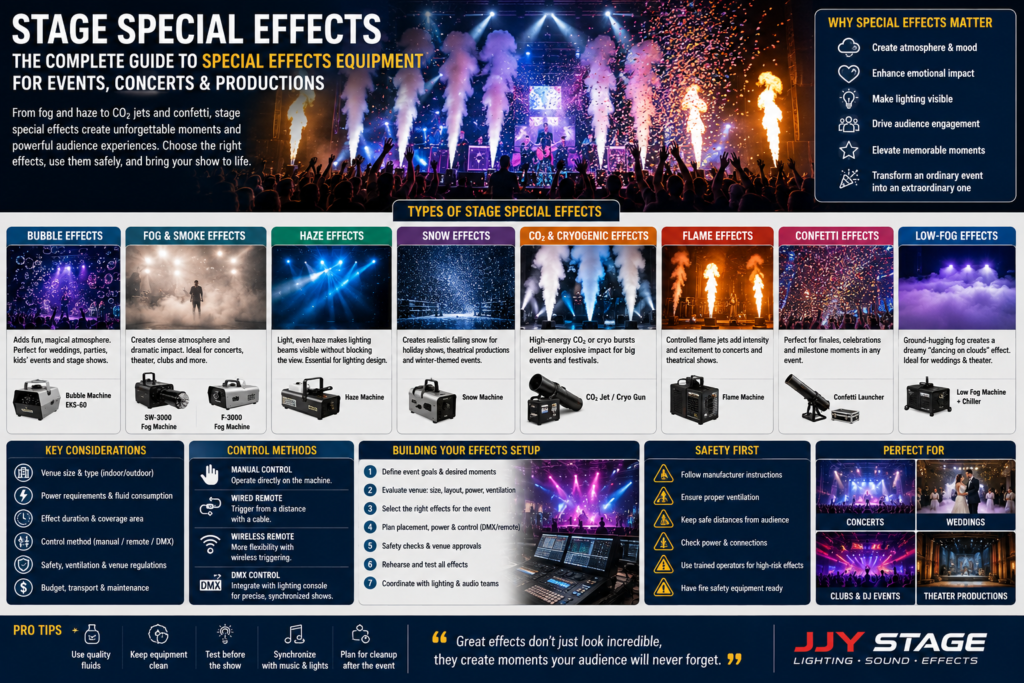
Walk into any unforgettable concert, theatrical performance, or wedding reception, and you’ll notice something beyond the music, the actors, or the toast. There’s fog rolling low across the floor. Beams of light cut through a hazy room. Confetti bursts overhead at just the right moment. These moments don’t happen by accident; they’re the result of carefully planned stage special effects guide.
Stage special effects have become a core part of modern live production. What used to be reserved for major touring concerts and Broadway shows is now common at weddings, nightclubs, corporate galas, and school theater productions. As audiences have come to expect more immersive, visually dynamic experiences, event professionals have turned to special effects equipment to deliver moments that lighting and sound alone can’t create.
This guide is designed for event planners, concert production teams, theater professionals, DJs, nightclub operators, wedding planners, and AV rental companies who want a clear, practical understanding of stage special effects what they are, how they work, where they’re best used, and how to choose the right equipment for a specific venue and event type.
We’ll cover the major categories of special effects equipment, including bubble machines, fog and smoke, haze, snow, CO₂ and cryogenic effects, flame effects, confetti, and low-fog systems. We’ll also look at how these effects are used across different event types concerts, weddings, clubs, and theaters along with control methods, safety considerations, and a practical framework for building a professional effects setup.
Whether you’re planning your first event with special effects or refining a production workflow you’ve used for years, this guide is meant to serve as a complete reference for understanding stage special effects equipment.
What Are Stage Special Effects?
Stage special effects refer to equipment and techniques used to create visual, atmospheric, or sensory moments during a live performance or event. Unlike stage lighting, which primarily controls color, brightness, and direction, special effects add a physical or visual element to the environment itself fog fills the air, bubbles float through the crowd, confetti falls from above, or a controlled flame effect punctuates a musical climax.
It helps to think of the relationship this way: lighting shapes what the audience sees, while special effects shape what the audience experiences. The two work together constantly. Haze, for example, is technically a special effect, but its entire purpose is to make lighting beams visible in the air. Fog interacts with colored light to create depth and mood. Flame effects are often timed precisely with lighting cues and music hits.
Typical equipment used in professional productions includes fog and haze machines, bubble machines, snow machines, CO₂ jets, cryo guns, flame projectors, confetti launchers, and low-fog chillers. Most professional-grade equipment is designed for repeated use, connects to standard power sources, and can be operated manually, via wired or wireless remote, or through DMX control integrated with a lighting console.
For event professionals, understanding stage special effects means understanding both the visual outcome each machine produces and the practical requirements power, fluid, ventilation, and safety needed to use it correctly.
Why Special Effects Matter in Live Events
Special effects matter because they change how an audience feels, not just what they see. A well-timed burst of fog during a dramatic entrance, or a wash of low fog rolling across the floor during a wedding’s first dance, adds a layer of emotional weight that lighting or music alone often can’t achieve.
Here’s how stage effects typically contribute to a live event:
Atmosphere. Fog and haze fill empty air space, giving a stage or dance floor a sense of depth and texture instead of feeling flat under lighting.
Emotional impact. A cryo burst during a chorus, or a flame effect at the peak of a performance, reinforces the emotional high point of a song or scene.
Dramatic entrances. Performers, wedding parties, and keynote speakers often use fog or haze to create a sense of anticipation before they appear.
Visual transitions. In theater, fog and lighting changes are commonly used together to signal a shift in scene, time, or mood without dialogue.
Audience engagement. Confetti drops and bubble effects are inherently interactive — audiences reach for them, react to them, and remember them.
Better interaction with stage lighting. Many effects, especially haze and fog, exist specifically to make lighting design more visible and dimensional.
Consider a touring concert: a haze machine keeps the air consistently textured throughout the show so that every beam of moving light is visible from the back row. Compare that to a wedding reception, where a single burst of low fog during a first dance creates a soft, cinematic moment without haze lingering over dinner tables. Same underlying technology — fog and haze — used with very different goals in mind.
Types of Stage Special Effects
There are several major categories of stage special effects equipment, each producing a distinct visual result and suited to different venues and event types. The table below offers a quick comparison before we look at each category in more detail.
| Effect Type | Visual Result | Typical Applications | Indoor or Outdoor | Setup Considerations |
| Bubble Effects | Floating bubbles | Weddings, kids’ events, stage shows | Both | Low skill, easy cleanup |
| Fog & Smoke | Dense atmospheric fill | Concerts, theater, clubs | Both (ventilation needed indoors) | Moderate; requires fluid and ventilation |
| Haze | Light, even air texture | Concerts, theater lighting design | Indoor (best) | Moderate; needs HVAC awareness |
| Snow | Falling artificial snow | Holiday shows, theater, festivals | Both | Moderate; cleanup required |
| CO₂ & Cryo | High-pressure vapor bursts | Large concerts, festivals | Outdoor preferred | High; trained operators required |
| Flame Effects | Controlled flame bursts | Concerts, theatrical productions | Both, with permits | High; venue approval and licensing required |
| Confetti | Falling or launched paper/foil | Finales, celebrations, corporate events | Both | Low-moderate; cleanup required |
| Low-Fog | Ground-hugging fog layer | Weddings, theater entrances | Indoor (best) | Moderate; needs a chiller unit |
Each of these effects serves a different purpose, and most professional productions combine two or three of them rather than relying on just one. Let’s look at each in detail.
Bubble Effects
Bubble machines are among the most versatile and audience-friendly special effects equipment available. They work by pumping bubble fluid through a rotating wheel or fan-driven wand fitted with small nozzles, producing a steady stream of bubbles that drift outward and upward into the room.
Bubble fluid is typically a water-based solution formulated to produce durable bubbles that hold together longer than homemade soap solutions. Most professional bubble machines use fluid reservoirs that require periodic refills, and fluid consumption depends on the output volume and runtime.
Coverage area varies by machine size, but most professional units can fill a moderate stage area or dance floor with a continuous bubble stream, making them suitable for both up-close interaction and stage-level visual effect.
Bubble machines are a strong fit for weddings, where they’re often used during exits or first dances, family-friendly events, children’s shows, where audience interaction is part of the appeal, and stage performances looking for a lighter, whimsical visual moment.
Indoor vs. outdoor use: Bubbles perform best indoors or in low-wind outdoor settings. Strong wind can scatter bubbles before they create a visible effect, and outdoor heat can cause bubbles to pop faster.
Maintenance tips: Bubble solution can leave residue on machine components over time, so regular cleaning of nozzles and fluid lines helps maintain consistent bubble output. Using manufacturer-recommended fluid, rather than substitute solutions, typically produces more reliable results.
If you’re building out a bubble effect setup for an upcoming event, our dedicated guide on choosing a bubble machine for events goes deeper into machine types, output specs, and fluid options.
For events that need an engaging visual effect, the 60W Bubble Machine EKS-60 is a practical option for creating a steady stream of bubbles during stage shows, parties, weddings, KTV venues, and other live events. With a 0.6L fluid tank, 50 m³ coverage, and optional remote control, it can add atmosphere without requiring a complex setup.
Looking to add bubbles to your next event? Our guide to Bubble Machines for Events explains how to choose the right machine for weddings, concerts, parties, and stage productions.
Fog and Smoke Effects
Fog machines are one of the most widely used pieces of special effects equipment in live production. A fog machine heats fog fluid typically a water and glycol or glycerin-based mixture until it vaporizes, then releases it into the air as a visible fog cloud.
For large-scale stage shows, concerts, theaters, and events that need a powerful atmospheric effect, the SW-3000 3000W Water-Based Fog Machine is designed for high-output fog production. It offers a 100–150 m²/min coverage rate, a 12L water tank, and multiple control options including DMX, remote control, LCD display, timer, and quantity settings.
Fog vs. smoke: In stage production, “fog” and “smoke effects” are often used interchangeably, though fog generally refers to the dense, theatrical output of a heater-based fog machine, while “smoke” is sometimes used more loosely to describe the same visual category.
Why fog creates atmosphere: Fog fills the air with a visible medium that light can bounce off of, pool within, and cut through. Without fog or haze, most stage lighting simply illuminates surfaces; with fog in the air, lighting becomes a visible, three-dimensional element of the show itself.
Fog is popular in concerts, where dense bursts are timed with musical drops or dramatic moments, and in theater, where fog is used for everything from ghostly effects to simple scene atmosphere.
Fluid considerations: Different fog fluids are formulated for different fog density, hang time, and dissipation speed. Using the correct fluid for your specific machine and desired effect matters both for visual quality and equipment longevity.
Ventilation: Because fog fills enclosed air space, indoor venues need adequate ventilation or air handling to prevent fog from over-accumulating, triggering smoke detectors, or causing visibility issues for staff and performers.
Interaction with lighting beams: Fog is especially effective with moving-head fixtures and beam-heavy lighting rigs, since the fog gives beams a visible, sculptural quality in the air.
For concerts, stage performances, theaters, clubs, and large-scale events that require powerful atmospheric effects, the F-3000 3000W Direct-Output Fog Machine delivers high-volume fog with an output of up to 20,000 cu. ft./min and a 12-meter output distance. It supports wired manual control, remote control, and DMX512, making it suitable for professional stage and entertainment setups.
If fog is central to your production plans, our Fog Machine for Stage guide covers machine types, output ratings, and fluid selection in more depth.
Haze Effects
Haze is often confused with fog, but the two effects serve different purposes. Haze is a much finer, more even atmospheric effect that fills a room subtly without the dense, rolling visual quality of fog. Haze machines typically use oil-based or water-based haze fluid dispersed through a fan or pressurized system, producing a light, consistent texture in the air that can last for extended periods.
Fog vs. haze the key difference: Fog is designed to be seen directly, often in bursts, and dissipates relatively quickly. Haze is designed to be subtle and long-lasting, filling a room evenly so that lighting beams and aerial effects become visible without the audience necessarily noticing the haze itself.
This is exactly why haze is a staple in professional lighting design. Touring concerts, theatrical productions, and television broadcasts rely on haze to make moving lights, spotlights, and laser effects visible and sharp on camera and in person. Without haze, many lighting designs would appear flat or invisible beyond their direct beam.
Haze’s best applications are concerts, where consistent air texture is needed throughout an entire show, and theatrical productions, where subtlety matters and dense fog would be distracting or inappropriate for the scene.
If you’re specifying haze equipment for a lighting-focused production, our guide to haze machines for stage lighting breaks down output types, fluid options, and coverage planning.
Snow Effects
Snow machines create the visual effect of falling snow using specially formulated snow fluid, which is turned into small, lightweight flakes or foam particles and dispersed into the air, where they drift down similarly to real snowfall.
How snow fluid works: Snow fluid is typically a biodegradable, water-based solution that’s aerated and expelled through a nozzle or fan mechanism, creating flakes that are visually convincing without the moisture or cold temperature of real snow.
Snow effects are widely used for winter-themed productions, Christmas and holiday events, and theatrical scenes that call for a seasonal atmosphere think holiday markets, winter-themed corporate parties, and stage productions of seasonal classics.
Cleanup considerations: Snow fluid residue can leave surfaces slightly damp or sticky depending on the formulation, so venues typically want advance notice before a snow effect is used, and some venues restrict use to specific flooring types or require protective coverings.
If a winter or holiday event is on your calendar, our snow machine for events guide covers coverage area, fluid types, and venue planning tips.
CO₂ and Cryogenic Effects
CO₂ jets and cryogenic effects (often called “cryo”) are high-impact visual effects that release a burst of pressurized, cold vapor into the air, creating a dramatic plume that shoots upward or outward from the stage.
CO₂ jet effects work by rapidly releasing pressurized liquid CO₂, which expands and cools instantly upon release, creating a dense, fast-dissipating cloud. Cryogenic effects operate on a similar principle, often using specialized cryo fluid to produce a similar high-impact vapor burst.
These effects are common at large concerts, where a synchronized row of CO₂ jets firing during a chorus or drop creates a powerful visual and audible moment, and at outdoor festivals, where the effect needs to be strong enough to read clearly across a large crowd.
Safety requirements: CO₂ and cryo systems involve pressurized gas and extremely cold output, both of which carry real risk if mishandled. Proper distance from performers and audience, secure mounting, and correct fluid handling are essential.
Why trained operators are important: Because these systems involve pressurized components and require precise timing and placement, CO₂ and cryo effects should only be operated by individuals trained on the specific equipment being used, following the manufacturer’s setup and operating instructions. This is not equipment suited to improvised or untrained operation.
Flame and Fire Effects
Flame effects add a level of visual intensity that few other effects can match, and they’re used carefully across concerts and theatrical productions to punctuate major moments — a chorus hit, a dramatic reveal, or a finale.
Flame effect machines are purpose-built devices that project a controlled burst of flame using regulated fuel and ignition systems, distinct from open pyrotechnics. In some larger productions, stage pyrotechnic-style visuals are used, but these fall under a much stricter regulatory category and require licensed pyrotechnic operators.
Flame effects appear in concerts, often synchronized precisely with lighting and music cues, and in theatrical productions, where they might be used sparingly for a specific dramatic beat.
Professional safety standards: Flame effects are one of the most heavily regulated categories of stage special effects. They typically require adherence to local fire codes, use of appropriate fuel types, safe clearance distances, and functioning suppression equipment on-site.
Venue approval requirements: Almost every venue requires advance approval, permits, or a fire marshal review before flame effects can be used. This process should be started well ahead of the event date, since approval timelines vary by jurisdiction.
Given the risks involved, flame effects are an area where professional operation, proper licensing, and strict adherence to manufacturer instructions and local regulations are non-negotiable.
Confetti Effects
Confetti effects are a go-to choice for celebratory moments finales, countdowns, product reveals, and milestone celebrations. Confetti machines and confetti launchers release paper or foil confetti into the air, either as a gentle fall or a forceful burst, depending on the equipment used.
Confetti machines typically use a fan-driven mechanism to blow confetti upward and outward in a continuous or timed burst, while confetti launchers (often CO₂ or compressed-air powered) shoot confetti or streamers a significant distance for a more dramatic effect.
Confetti effects are common at celebrations and finales award shows, milestone anniversaries, product launches, and concert encores and work well in both indoor and outdoor settings, provided cleanup is planned for.
Cleanup and venue considerations: Confetti requires post-event cleanup, and many venues have specific rules about confetti type (some require flame-retardant or biodegradable confetti) or may restrict confetti use entirely in certain spaces. Confirming venue policy before the event avoids surprises.
If confetti is part of your event plan, our confetti machine guide compares launcher types, confetti materials, and coverage distances.
Low-Fog Effects
Low-fog, sometimes called ground fog, is a specialized effect that produces a dense fog layer that stays close to the floor rather than filling the room’s air space. It’s created using a standard fog machine combined with a chiller unit that cools the fog output, causing it to sink and hug the ground.
How it differs from standard fog: Regular fog disperses upward and outward into the room, while low fog is deliberately cooled so it rolls along the floor in a dramatic, layered cloud, often just a foot or two off the ground.
Low fog is especially popular for first dances at weddings, where a couple appears to be dancing on a cloud, for theater productions needing an eerie or otherworldly floor-level effect, and for dramatic entrances, where a performer emerging from a low-fog layer creates a strong visual moment.
Venue considerations: Low fog requires enough floor space to pool effectively and benefits from minimal air disturbance (fans, open doors, HVAC drafts can break up the layer). Venues with good climate control and a stable indoor environment tend to produce the best low-fog results.
For weddings or theatrical productions planning a low-fog moment, our low fog machine guide covers chiller requirements, coverage timing, and setup tips.
For concerts, theaters, clubs, large events, and professional stage productions, the SW-3000 3000W Water-Based Fog Machine provides powerful atmospheric effects with coverage of up to 100–150 m² per minute. It features a 12L water tank, 2L fluid tank, and flexible control options including DMX, remote control, LCD display, timer, and quantity settings.
Choosing Special Effects Equipment
Selecting the right special effects equipment comes down to matching the machine to the venue, the event type, and the practical constraints you’re working within. Here are the key factors to weigh:
Venue size. Larger venues need higher-output machines to produce a visible effect, while smaller venues may only need compact, lower-output units.
Indoor or outdoor use. Some effects, like haze and low fog, perform best indoors in controlled air conditions. Others, like CO₂ jets and snow, can work well outdoors if output is strong enough.
Event type. A wedding calls for different effects than a concert or nightclub — subtlety and elegance often matter more than raw visual impact.
Effect duration. Some effects (fog, haze) are meant to run continuously, while others (CO₂, confetti, flame) are designed for short, timed bursts.
Power requirements. Higher-output machines, especially CO₂ jets and larger fog systems, often require dedicated power circuits. Confirm your venue’s electrical capacity in advance.
Fluid consumption. Understand how much fluid a machine uses per hour of operation, and budget fluid costs accordingly for longer events.
DMX control. If you’re integrating effects with a lighting console, confirm the machine supports DMX control for synchronized cueing.
Budget. Balance upfront equipment cost against rental frequency, fluid costs, and maintenance needs.
Transport and setup. Consider machine size, weight, and setup time, especially for events with tight load-in windows.
Maintenance. Factor in cleaning, fluid line maintenance, and periodic servicing to keep equipment performing reliably over time.
A quick buyer’s checklist:
- Confirm venue power availability and circuit capacity
- Check indoor/outdoor suitability for the chosen effect
- Verify fluid type and availability for the specific machine
- Confirm DMX or remote control compatibility if needed
- Review venue policies on fog, haze, confetti, and flame effects
- Plan transport, setup time, and storage
- Budget for fluid and routine maintenance
Special Effects for Concerts
Concerts typically combine multiple special effects working together with lighting and music to build a layered, high-energy visual experience. Common combinations include:
- Haze, running throughout the show to keep lighting beams visible
- Fog, used in bursts for dramatic entrances or key musical moments
- CO₂ effects, fired during choruses or drops for high-impact visual punctuation
- Confetti, reserved for finales or major peak moments
- Flame effects, used sparingly at the most intense points of a show, where permitted and properly licensed
These effects are almost always programmed to sync with lighting cues and music timing, often through a show control system or DMX-integrated console, so that a CO₂ burst or confetti drop lands precisely on a downbeat or lyric.
Special Effects for Weddings and Parties
Weddings and private events call for a different approach effects should feel elegant and intentional rather than overwhelming. Common choices include:
- Bubble machines, often used for exits or as a playful accent during a reception
- Low fog, most popular for first dances, creating a soft, cinematic floor effect
- Confetti, used for celebratory moments like a grand entrance or cake cutting
- Snow effects, a favorite for winter and holiday-season weddings
- Safe indoor options, since most weddings take place indoors, effects that work well in controlled environments low fog, haze, bubbles tend to be the most reliable choices
The goal at a wedding or private party is usually to create one or two standout moments rather than layering multiple effects throughout the entire event.
Special Effects for Clubs and DJs
Nightclubs and DJ events rely on special effects to keep energy high and reinforce the rhythm of the music. Typical setups include:
- Haze, to give club lighting rigs and lasers a consistently visible texture
- Fog, for periodic atmosphere bursts during set peaks
- CO₂-style effects, used at drops and high-energy moments
- Confetti, for special nights, anniversaries, or headline performances
- Lighting synchronization, tying effects directly into the DJ booth’s lighting and sound system
Why timing and control matter: In a club environment, effects need to fire precisely with the music a CO₂ burst that’s a beat late loses its impact. This is why many club installations use DMX-controlled or remote-triggered systems rather than manual operation.
Special Effects for Theaters
Theatrical productions use special effects with a strong focus on storytelling rather than spectacle for its own sake. Common applications include:
- Fog, for atmosphere, scene transitions, or supernatural elements
- Haze, to keep stage lighting visible and dimensional without distracting the audience
- Snow, for winter scenes or seasonal productions
- Flame simulations, used carefully and typically under strict fire safety protocols
- Scene transitions, where fog or lighting changes signal a shift without dialogue
- Audience visibility, ensuring effects don’t obstruct sightlines from any seating section
Rehearsal requirements: Because theatrical effects are usually tied to specific cues within a script, they require rehearsal time to dial in timing, output level, and safety checks alongside the full cast and crew not just a lighting or effects team working in isolation.
Indoor vs Outdoor Special Effects
Indoor and outdoor environments create very different conditions for special effects equipment, and understanding these differences helps in both equipment selection and event planning.
| Factor | Indoor | Outdoor |
| Wind | Minimal, effects hold shape | Can scatter or dissipate effects quickly |
| Ventilation | Requires HVAC awareness and airflow management | Generally not a concern |
| Power Supply | Usually readily available | May require generators or extended cabling |
| Effect Visibility | Strong, contained environment | Can be reduced by ambient light and wind |
| Fluid Consumption | Often lower due to contained space | Often higher to maintain visible effect |
| Safety Requirements | Smoke detector and ventilation compliance | Weather and terrain considerations |
Indoor venues offer more control but require attention to ventilation and fire safety systems, while outdoor venues offer more flexibility but demand higher-output equipment and weather contingency planning.
Safety Considerations
Safety is not optional when working with stage special effects equipment, and this section deserves careful attention regardless of event size.
Follow manufacturer instructions. Every piece of special effects equipment comes with specific operating guidelines from the manufacturer. These instructions exist for a reason and should always be followed exactly, without improvisation.
Understand venue regulations. Many venues have specific rules about fog, haze, confetti, flame effects, and even snow or bubble fluid. Confirm these rules well before the event, not on load-in day.
Fire safety. Flame effects, and even fog machines in some cases, may need to be reviewed by venue staff or a fire marshal. Ensure suppression equipment is accessible and staff know evacuation procedures.
Electrical safety. High-output machines can draw significant power. Avoid overloading circuits, use appropriately rated cabling, and keep electrical connections away from fluid or moisture sources.
Ventilation. Enclosed spaces need adequate airflow to prevent excessive fog or haze buildup, which can affect visibility, air quality, and smoke detector systems.
Slip hazards. Fluid-based effects like bubbles, snow, and low fog can leave surfaces damp or slick. Warn staff and performers, and consider protective flooring where needed.
Audience distance. Effects like CO₂ jets, flame effects, and confetti launchers should maintain a safe distance from audience members, following manufacturer-specified clearance guidelines.
Trained operators. High-risk effects flame, CO₂, cryo should only be operated by individuals trained specifically on that equipment.
Routine equipment inspection. Regularly inspect hoses, nozzles, electrical connections, and pressure systems for wear or damage before each use.
None of the equipment discussed in this guide should be operated outside of manufacturer instructions or without appropriate training, particularly for higher-risk categories like flame and CO₂ effects.
How to Control Special Effects
Special effects can be triggered and controlled in several ways, depending on the complexity of the production and the level of synchronization needed with lighting and music.
Manual control. The simplest method an operator to manually activate the effect at the right moment. Common for smaller events or standalone effects like bubble machines.
Wired remotes. A physical remote connected to the machine by cable, allowing an operator to trigger the effect from a short distance without being at the machine itself.
Wireless remotes. Similar to wired remotes but without a physical cable connection, offering more flexibility in operator positioning.
DMX control. The professional standard for integrating special effects with a lighting console. DMX allows effects to be programmed into a show’s cue stack, triggered automatically alongside lighting changes, and timed precisely to music or script cues.
Integration with lighting consoles. Many modern special effects machines are designed to communicate directly with lighting consoles, allowing a single operator to control lighting and effects from one interface.
Show cue synchronization. In larger productions, effects are built into a full show cue system, so that fog, haze, CO₂, confetti, and lighting all fire in coordinated sequence without manual triggering during the live show.
Why DMX matters for professional productions: DMX control removes the guesswork and timing risk of manual triggering. It allows effects to be rehearsed, refined, and repeated with consistent precision critical for touring shows, theatrical productions, and any event where exact timing matters.
How to Build a Professional Stage Effects Setup
Putting together a reliable special effects setup follows a fairly consistent planning process, regardless of event size:
- Define the event. Understand the event type, audience, and the emotional or visual goals for each effect.
- Evaluate the venue. Check indoor/outdoor conditions, ceiling height, ventilation, power access, and any venue restrictions.
- Select the effects. Choose equipment that matches the venue and event type, referencing the comparisons in this guide.
- Confirm power and control. Verify circuit capacity and decide on manual, remote, or DMX control based on complexity.
- Plan placement. Position machines for both visual effect and audience safety, considering sightlines and clearance distances.
- Conduct safety checks. Review manufacturer guidelines, venue rules, and fire safety requirements before setup is finalized.
- Test during rehearsal. Run each effect at planned output levels and timing before the live event to catch any issues.
- Coordinate with lighting and audio teams. Make sure effects timing aligns with the broader show plan, especially for DMX-integrated productions.
Quick setup checklist:
- Event goals and effect list confirmed
- Venue power, ventilation, and space confirmed
- Equipment matched to indoor/outdoor requirements
- Control method (manual, remote, DMX) decided
- Safety checks and venue approvals completed
- Rehearsal or test run completed
- Coordination with lighting/audio teams confirmed
Frequently Asked Questions
What are stage special effects?
Stage special effects are equipment and techniques such as fog, haze, bubbles, snow, CO₂, flame, confetti, and low fog used to create visual and atmospheric moments during live performances and events, working alongside lighting and sound.
What equipment is used for stage special effects?
Common equipment includes fog machines, haze machines, bubble machines, snow machines, CO₂ jets, cryo guns, flame effect machines, confetti launchers, and low-fog chiller systems.
What is the difference between fog and haze?
Fog is dense and often used in visible bursts that dissipate relatively quickly, while haze is a finer, more even atmospheric effect designed to linger longer and make lighting beams visible without being noticeable on its own.
Which special effects are best for concerts?
Concerts commonly use haze for continuous atmosphere, along with fog, CO₂ effects, confetti, and flame effects timed to specific musical moments.
Are stage special effects suitable for indoor events?
Many effects, including haze, low fog, and bubbles, are well suited to indoor use, provided the venue has adequate ventilation and the equipment is used according to manufacturer guidelines and venue policy.
How are special effects controlled during a show?
Effects can be triggered manually, through wired or wireless remotes, or through DMX control integrated with a lighting console for precise, synchronized cueing.
What should I consider before buying special effects equipment?
Key factors include venue size, indoor/outdoor use, event type, power requirements, fluid consumption, control compatibility, budget, and ongoing maintenance needs.
Can special effects be synchronized with stage lighting?
Yes. Many professional special effects machines support DMX control, allowing them to be programmed into the same cue system as stage lighting for precise, repeatable timing.
Which effects are best for weddings?
Bubble machines, low fog, confetti, and snow effects (for winter weddings) are popular choices, generally favored for their elegance and suitability in indoor venues.
How should professional stage effects equipment be maintained?
Routine maintenance includes cleaning fluid lines and nozzles, using manufacturer-recommended fluids, inspecting electrical and pressure components, and following the manufacturer’s service schedule.
Conclusion
Stage special effects have become an essential part of how live events are designed and experienced, from major concert tours to intimate weddings. Understanding the major categories bubble effects, fog and smoke, haze, snow, CO₂ and cryogenic effects, flame effects, confetti, and low fog gives event professionals the foundation needed to choose equipment that fits their venue, audience, and creative goals.
Choosing the right stage special effects equipment isn’t just about visual impact. It requires matching each effect to the venue’s indoor or outdoor conditions, planning for power and fluid needs, and integrating control methods like DMX for precise, professional execution. Just as important is a firm commitment to safety following manufacturer instructions, securing venue approvals, and relying on trained operators for higher-risk effects like flame and CO₂.
Whether you’re planning a concert, a wedding, a theatrical production, or a night at the club, the right combination of stage special effects can turn a good event into a memorable one. Explore JJY Stage’s Special Effect Series to find professional-grade equipment built for concerts, theaters, events, and productions of every scale.