
Bubbles have a way of making any event feel a little more magical. They add movement to a room, catch the light in ways that photograph beautifully, and give guests something playful to interact with whether that’s a flower girl chasing bubbles down the aisle or a crowd reaching upward during a stage performance. It’s no surprise that a bubble machine for events has become a go-to piece of equipment for wedding planners, stage producers, DJs, and party hosts alike.
Bubble effects bring several things to an event at once: visual interest, atmosphere, a sense of playfulness, and genuine photo and video appeal. But not every bubble machine is built for the same job. Choosing the right one depends on the type of event, the venue, how much coverage you need, how long the machine needs to run, and the overall effect you’re going for. This guide walks through everything event professionals and hosts need to know before choosing a bubble machine.
For a deeper look at the equipment used to create immersive event experiences, explore our Stage Special Effects Guide. It covers fog, haze, bubbles, snow, CO₂ effects, confetti, low fog, and other special effects, along with practical tips for choosing and using the right equipment for concerts, weddings, theaters, clubs, and live productions.
What Is a Bubble Machine?
A bubble machine is a piece of equipment designed to produce a continuous stream of bubbles automatically, without someone standing there blowing them by hand. At its core, a bubble effect machine combines a reservoir of bubble solution with a mechanism, usually a rotating wheel or a fan-driven wand that pulls fluid from the reservoir and pushes it through small openings to form bubbles, which are then released into the air.
The basic components of most bubble machines include a fluid tank, a motor-driven bubble-forming mechanism, and a housing that directs airflow to help bubbles leave the machine and drift outward. Some machines use multiple wands or wheels to increase bubble volume, while others rely on a single rotating element.
The difference between a bubble machine and manually creating bubbles is largely about consistency and scale. A person blowing bubbles by hand can only produce so many at a time, and output naturally varies. A machine can produce a steady, continuous stream for extended periods without needing a break which matters a lot when you’re trying to fill a stage or dance floor with a consistent visual effect.
This is exactly why professional bubble machines are useful for events. Event production isn’t about occasional bubbles here and there; it’s about a reliable, repeatable effect that performs the same way at every show or every wedding, regardless of who’s operating it.
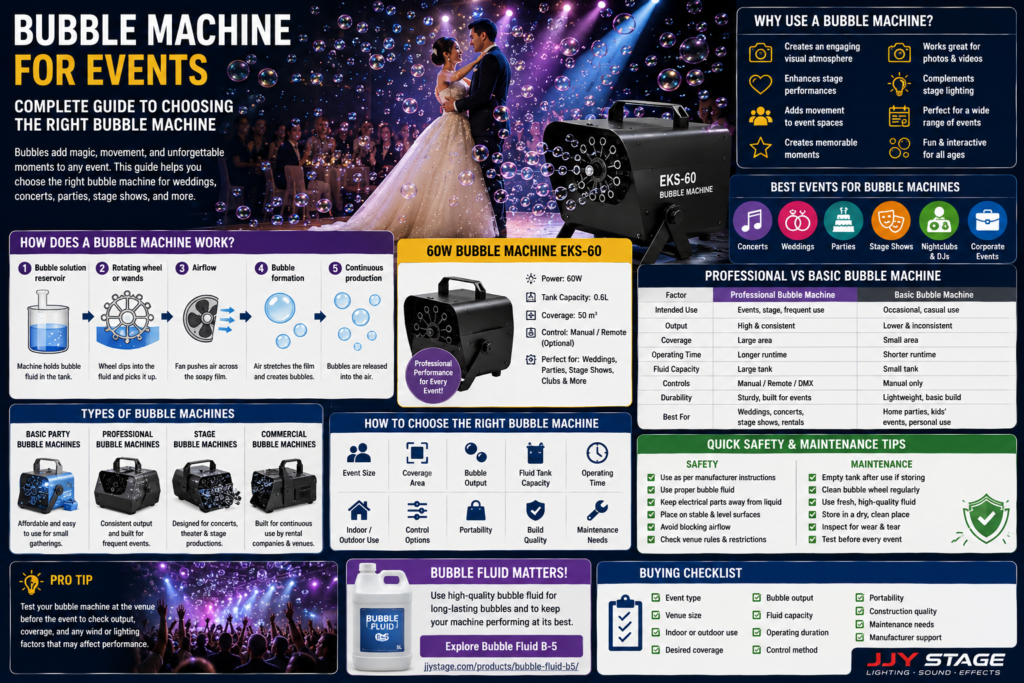
How Does a Bubble Machine Work?
The operating principle behind most bubble machines is fairly simple, even though the visual result feels elaborate.
Bubble solution reservoir. The machine holds a supply of bubble fluid in a tank. This fluid is typically water-based and formulated specifically to create durable, long-lasting bubbles rather than ones that pop instantly.
Rotating bubble wheels or wands. Most machines use a wheel or wand fitted with small loops or openings. As this component rotates or oscillates, it dips into the fluid reservoir and picks up a thin film of solution.
Airflow. A built-in fan or airflow system pushes air across the fluid-coated openings, stretching the liquid film into a bubble and pushing it off the wheel or wand into the surrounding air.
Bubble formation. As this cycle repeats dip, stretch, release bubbles form continuously rather than one at a time.
Continuous bubble production. Because the wheel or wand keeps rotating and the fan keeps running, the machine produces a steady stream of bubbles for as long as it has fluid and power, rather than requiring manual re-triggering.
This cycle repeats dozens of times per minute, which is what creates that recognizable “stream” of bubbles rather than a scattered handful. For readers who want a deeper technical breakdown, our upcoming article on how a bubble machine works covers the mechanics in more detail.
Why Use a Bubble Machine for Events?
Bubble machines offer a few clear, practical benefits for event production, without needing to oversell what they do:
- Creates an engaging visual atmosphere by adding movement and texture to a space that might otherwise feel static, especially under stage lighting.
- Enhances stage performances by supporting choreography, musical moments, or theatrical scenes with a soft, floating visual layer.
- Adds movement to event spaces, keeping a room or stage feeling alive rather than static.
- Works well for photography and video, since bubbles catch light attractively during golden-hour outdoor events or under colored stage lighting.
- Creates memorable moments when timed well during an exit, entrance, or performance highlight.
- Can complement stage lighting, since backlit or color-lit bubbles add depth to a lighting design.
- Suitable for different types of events, scaling from intimate parties to large concerts.
Results depend on venue conditions, machine quality, and setup a bubble machine isn’t a guarantee of audience engagement or event success on its own, but rather one tool among many for creating atmosphere.
Best Events for Bubble Machines
Bubble machines show up across a wide range of events, each with its own considerations.
| Event Type | Why Bubble Effects Work | Recommended Considerations |
| Concerts | Complements stage lighting and adds visual texture to performances | Coordinate timing with lighting cues and stage blocking |
| Weddings | Enhances entrances, first dances, and photography | Check venue rules, wind conditions, and floor surfaces |
| Parties | Adds playfulness for birthdays, kids’ parties, and themed events | Consider guest interaction and safe placement |
| Stage Shows | Supports dance, theater, and musical performances | Sync with lighting and performance blocking |
| Nightclubs and DJs | Works alongside lighting and music for dance floor atmosphere | Consider timing with music and other effects |
| Corporate and Promotional Events | Adds a memorable visual element to activations or receptions | Match tone to brand and audience expectations |
At concerts, a bubble machine for stage use can add a soft, floating counterpoint to more intense effects like haze or CO₂, especially during slower or more intimate musical moments. For weddings, a bubble machine for wedding events is one of the most popular applications think a couple’s exit, a walk-down-the-aisle bubble tunnel, or bubbles drifting through outdoor photos. At parties, including birthdays, kids’ parties, and themed celebrations, a bubble machine for parties adds an interactive element that guests, especially younger ones, tend to enjoy without requiring much setup.
For stage shows, dance performances, children’s shows, theater productions, and musical numbers can all use bubble effects to add a visual layer that supports the performance without overwhelming it. In nightclubs and DJ events, bubbles can work alongside stage lighting, music, and other special effects to add variety to a dance floor’s visual experience. For corporate and promotional events, used thoughtfully, bubble effects can add a memorable touch to a product launch or reception though the effect should match the tone and professionalism of the event.
Types of Bubble Machines
Not all bubble machines are built for the same purpose. Broadly, they fall into a few categories based on intended use.
Basic Party Bubble Machines. These are typically smaller, lower-output machines designed for casual or occasional use at a backyard party or small home celebration. They’re generally easy to use but aren’t built for the demands of repeated professional use.
Professional Bubble Machines. Designed for events where reliability matters, professional bubble machines typically offer more consistent output, sturdier construction, and controls suited to production environments. They’re built to be used repeatedly across many events rather than occasionally.
Stage Bubble Machines. These are suited specifically for concerts, theater, and other performance settings where the bubble effect needs to integrate with a broader production lighting, sound, and choreography.
Commercial Bubble Machines. Commercial-grade machines are built for frequent, sustained use by rental companies, venues, and production companies that need equipment to perform reliably show after show, rather than consumer-oriented machines designed for occasional personal use.
No single category is universally “better” the right choice depends entirely on how often the machine will be used, in what setting, and to what standard of reliability.
Professional Bubble Machine vs Basic Bubble Machine
| Factor | Professional Bubble Machine | Basic Bubble Machine |
| Intended Use | Events, stage production, frequent use | Occasional personal or casual use |
| Construction | Sturdier housing, built for repeated setup/teardown | Lighter, consumer-grade materials |
| Bubble Output | Generally more consistent | Can vary, less consistent |
| Coverage | Suited to larger spaces | Best for small, close-range use |
| Operating Time | Designed for extended run times | May not be designed for long continuous use |
| Fluid Capacity | Often larger tanks for less frequent refills | Smaller tanks requiring more frequent refills |
| Controls | May include manual, remote, or advanced control options | Typically manual on/off only |
| Portability | Designed with event transport in mind | Varies, often lightweight but less durable |
| Event Suitability | Weddings, concerts, stage shows, commercial use | Small home gatherings, casual use |
| Maintenance | Built for easier ongoing maintenance | Minimal maintenance features |
| Price Considerations | Higher upfront cost, built for durability and repeated use | Lower cost, suited to infrequent use |
In general, professional equipment is designed to hold up to the demands of a busy event calendar, while smaller machines can be perfectly adequate for occasional, low-stakes use. Neither is inherently “wrong” — it comes down to matching the equipment to how it will actually be used.
How to Choose the Right Bubble Machine for Events
Choosing the right bubble machine comes down to a handful of practical factors:
- Event size — larger venues, like concert stages or big reception halls, often need higher-output machines or multiple units to fill the space.
- Coverage area — think about the actual area you want bubbles to fill rather than defaulting to the highest-output machine available.
- Bubble output — consistent production matters more than sheer volume; a steady, even stream looks better than bursts followed by gaps.
- Fluid tank capacity — a larger tank means fewer refill interruptions, especially for longer events or continuous stage use.
- Operating time — a few minutes for a wedding exit is very different from hours of continuous festival use.
- Indoor vs outdoor use — wind, temperature, and humidity all affect how bubbles form and how long they last.
- Control options — machines may offer manual controls, remote operation, or DMX control; confirm exactly what a specific machine supports before assuming it fits your production.
- Portability — machine size, weight, and ease of transport matter for professionals moving equipment between venues.
- Construction quality — solid housing and components matter most for frequent professional use rather than occasional personal use.
- Maintenance requirements — consider how easy the machine is to clean, since fluid residue can affect performance over time.
Bubble Machine for Weddings
A bubble machine for wedding events is one of the most requested applications in event production, and for good reason bubbles add a soft, romantic visual element that works across several wedding moments:
- Wedding entrances — a dreamy backdrop as the couple or wedding party enters.
- First dance — a gentle bubble effect adds a cinematic quality to photos and video without overwhelming the moment.
- Couple photography — bubbles add movement and visual interest that static backdrops can’t offer.
- Outdoor ceremonies — bubbles enhance an aisle walk or ceremony backdrop in soft lighting.
- Reception areas — a machine running quietly can add ambience without competing with conversation or dining.
- Exit celebrations — one of the most popular uses, whether guests hold bubble wands or a machine creates a bubble tunnel as the couple exits.
Before booking a bubble machine for a wedding, check a few practical details: venue rules (some restrict fluid-based effects), floor surfaces (fluid can make certain flooring slippery), wind (a major factor outdoors), the bubble fluid being used (confirm it won’t stain fabric or florals), and cleanup expectations after the event.
Bubble Machine for Stage Shows and Concerts
For stage production, a stage bubble machine serves a different purpose than a party-oriented one it needs to integrate cleanly into a broader performance. Dance performances often use bubble effects to add a floating visual layer that complements choreography. Concerts may use bubbles during softer musical moments as a contrast to more intense effects like haze or CO₂. Theater productions can use them for whimsical or dreamlike scenes, children’s performances rely on them to keep young audiences engaged, and music videos often use bubbles as a stylistic element that reads well on camera.
A bubble machine for stage use also needs to interact well with the broader lighting design. Bubbles catch backlighting beautifully, creating a glowing, textured look; moving lights sweeping across a bubble stream create dynamic movement; and color-changing lights add variation throughout a performance. Because of this interaction, a professional bubble machine used on stage is often positioned and timed carefully in coordination with the lighting design, not just placed and left running.
Bubble Machine for Parties and Nightclubs
Outside of weddings and formal stage productions, a bubble machine for parties covers a wide range of casual and semi-formal settings. Birthday parties and children’s parties are among the most common uses, since bubbles are visually fun and safe for younger guests to interact with. DJ events and nightclubs can use bubble effects alongside lighting to add variety to a dance floor. Theme parties and festivals often incorporate bubbles into a broader décor plan, and family entertainment venues frequently run them as a standing feature rather than a one-time effect.
In club and DJ settings, bubble effects are often combined with lighting and music to add a layer of atmosphere that’s distinct from haze or fog softer, more playful, and effective in shorter bursts rather than continuous use throughout a set.
For reliable bubble effects at concerts, weddings, parties, and stage productions, Bubble Fluid B-5 is designed for professional bubble machines and provides long-lasting, lightweight bubbles that work well with stage and moving-head lighting. Its 5L capacity makes it a practical choice for event organizers and production teams looking for consistent bubble output during longer events.
60W Bubble Machine: Example of a Professional Event Machine
To illustrate what a professional-grade bubble machine looks like in practice, consider the 60W Bubble Machine EKS-60 from JJY Stage — one example of equipment built for event and stage use.
The EKS-60 is rated at 60W of power, which indicates the machine’s power draw and gives event planners a reference point for electrical planning. It has a 0.6L fluid tank, giving it a defined fluid capacity that determines how long it can run before needing a refill. Its coverage is rated at approximately 50 m³, which helps event planners understand the general size of space the machine is intended to fill.
These specifications matter in practical terms: the power rating helps with circuit planning, the tank size helps estimate refill frequency during an event, and the coverage figure helps match the machine to an appropriately sized venue or stage area.
The EKS-60 is presented here as one example of a professional bubble machine suited to event use not as a universal best option for every scenario. The right machine ultimately depends on your specific venue, coverage needs, and event type, as outlined earlier in this guide.
How Much Bubble Fluid Does a Bubble Machine Use?
Fluid consumption varies from machine to machine and depends on several factors, so it’s difficult to state an exact rate that applies universally.
Machine design affects how efficiently a machine uses fluid to produce bubbles. Operating duration is a straightforward factor longer run times mean more fluid used. Output level, if a machine offers adjustable output, higher settings will typically consume fluid more quickly. Bubble wheel design influences how much fluid is picked up and used per rotation. Fluid type matters too, since different formulations may be used at different rates depending on viscosity and concentration. Environmental conditions, such as wind and humidity, can affect how much fluid is needed to maintain a visible effect, particularly outdoors.
Rather than relying on a generic consumption estimate, it’s best to follow the specific manufacturer’s recommended fluid specifications for your machine, and to do a test run before a major event to get a practical sense of how long a full tank lasts under your specific conditions.
Bubble Machine Maintenance Tips
Keeping a bubble machine in good working condition helps ensure consistent performance across events.
- Empty the fluid reservoir when appropriate — for storage periods or between different fluid types, to prevent residue buildup.
- Follow manufacturer cleaning instructions specific to your machine rather than generic cleaning methods.
- Keep the machine free from residue, since dried bubble solution can affect wheel or wand performance over time.
- Inspect moving components periodically for wear, buildup, or damage.
- Check the fluid before an event to confirm it’s fresh and at an appropriate level.
- Store the machine properly, protected from dust, moisture, and extreme temperatures between uses.
- Test equipment before use, ideally the day before or during setup, rather than discovering an issue during the event itself.
For any electrical or mechanical issue beyond routine cleaning, always refer to the manufacturer’s manual or contact qualified technical support rather than attempting repairs independently.
Common Bubble Machine Problems and Solutions
| Problem | Possible Cause | General Solution |
| Few or no bubbles | Low fluid level or clogged wheel/wand | Check fluid level and clean the bubble-forming components |
| Uneven bubble output | Residue buildup or worn components | Clean thoroughly; inspect for wear following manufacturer guidance |
| Excessive fluid consumption | Incorrect fluid type or high output setting | Confirm correct fluid is being used and check output settings |
| Machine not starting | Power connection issue | Check power source and connections; consult manufacturer manual |
| Bubbles popping too quickly | Environmental conditions or fluid quality | Check for wind/heat exposure and confirm fluid is fresh and appropriate |
For issues involving electrical components or internal mechanical failure, follow the manufacturer’s troubleshooting guide or contact qualified technical support rather than attempting a DIY repair.
Indoor vs Outdoor Bubble Machine Use
| Factor | Indoor Use | Outdoor Use |
| Wind | Minimal, bubbles hold together well | Can scatter or pop bubbles quickly |
| Temperature | Generally stable and controllable | Heat can cause faster popping |
| Humidity | Often controlled | Variable, affects bubble durability |
| Floor Surfaces | Fluid residue may affect certain flooring | Grass or pavement generally more forgiving |
| Ventilation | Not typically a major factor for bubbles | Not applicable |
| Bubble Visibility | Strong with good lighting | Can be excellent in natural light, weaker in strong wind |
| Cleanup | May require attention to flooring | Often simpler outdoors |
| Venue Restrictions | Some indoor venues restrict fluid-based effects | Outdoor spaces may have fewer restrictions, but check local rules |
Indoor settings generally offer more consistent bubble performance thanks to controlled air conditions, while outdoor settings offer flexibility but require more attention to wind and temperature.
Bubble Machine Safety and Venue Considerations
- Use equipment according to manufacturer instructions at all times.
- Use appropriate bubble fluid designed for your specific machine.
- Keep electrical equipment protected from liquids, including the bubble fluid itself.
- Consider slippery surfaces created by fluid residue and plan placement accordingly.
- Keep equipment positioned safely, away from high-traffic pathways where possible.
- Follow venue requirements, including any restrictions on fluid-based effects.
- Test equipment before the event to confirm proper operation.
- Keep cables and equipment organized to reduce trip hazards.
- Consider audience and performer movement when placing the machine, especially on stage.
Bubble Machine Buying Checklist
Use this checklist when evaluating a bubble machine for your event:
- ☐ Event type
- ☐ Venue size
- ☐ Indoor or outdoor use
- ☐ Desired coverage
- ☐ Bubble output
- ☐ Fluid capacity
- ☐ Operating duration
- ☐ Control method
- ☐ Portability
- ☐ Construction quality
- ☐ Maintenance requirements
- ☐ Manufacturer support
Frequently Asked Questions
What is the best bubble machine for events?
The best choice depends on your event type, venue, and coverage needs. Professional bubble machines generally suit events better than basic party machines due to their consistency and durability.
How does a bubble machine work?
A bubble machine uses a fluid reservoir combined with a rotating wheel or wand and airflow to continuously form and release bubbles into the air.
Can I use a bubble machine indoors?
Yes, many bubble machines work well indoors, though it’s worth checking venue policies on fluid-based effects and considering floor surfaces.
What type of bubble machine is best for weddings?
A professional bubble machine suited to the specific wedding moment entrance, first dance, or exit generally works best, with attention paid to venue rules and weather if used outdoors.
Are professional bubble machines better than party bubble machines?
Professional machines are generally built for more consistent output and repeated use, making them better suited to events, while basic machines can be sufficient for occasional personal use.
How long can a bubble machine run?
Run time depends on the specific machine’s fluid tank capacity and output level; check manufacturer specifications for your model.
What bubble fluid should I use?
Use the fluid type recommended by your machine’s manufacturer to ensure proper performance and avoid damaging the equipment.
Can bubble machines be used on stage?
Yes, stage bubble machines are commonly used in concerts, theater, and dance performances, often coordinated with lighting design.
How do I choose a bubble machine for a large event?
Consider venue size, desired coverage area, and whether a higher-output machine or multiple machines will be needed to fill the space effectively.
How do I maintain a professional bubble machine?
Follow manufacturer cleaning and storage instructions, inspect components regularly, and test the machine before each event.
Conclusion
Choosing the right bubble machine for events comes down to matching the equipment to your specific needs event type, venue, coverage area, operating time, output consistency, fluid capacity, and control requirements all play a role. What works well for a small birthday party won’t necessarily hold up to the demands of a concert stage or a full wedding day, which is why understanding the difference between basic and professional equipment matters.
For event professionals who need reliable, repeatable bubble effects across weddings, concerts, stage productions, and parties, exploring JJY Stage’s Special Effect Series is a good next step. Whatever your next event or production looks like, the right bubble machine can add a simple, memorable touch of atmosphere to the experience.