
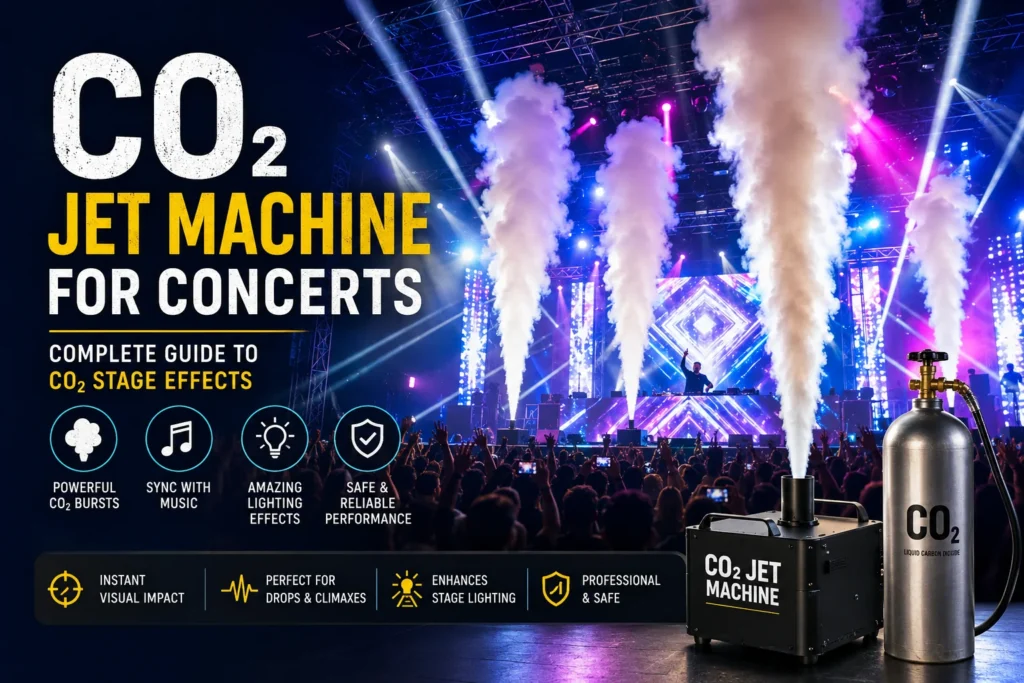
The lights drop to black. The bass hits. And from either side of the stage, two columns of dense white vapor shoot skyward, catching the beam lights and vanishing almost as fast as they appeared. That split-second burst is one of the most recognizable tools in modern live production, and it’s produced by a CO₂ jet machine for concerts.
Unlike traditional fog, which is designed to linger and build atmosphere over time, CO₂ jets are built for the opposite job: a short, high-impact visual burst tied to a specific moment a drop, an entrance, a chorus, a finale. This guide breaks down how CO₂ stage effects work, why they’ve become a staple at concerts, festivals, and club shows, and what production teams should know before adding them to a show.
What Is a CO₂ Jet Machine?
A CO₂ jet machine is a stage effects device that releases pressurized liquid CO₂ through a nozzle to create a fast, dense burst of white vapor. The core system generally includes a supply of pressurized liquid CO₂, a hose or delivery line connecting that supply to the machine, and a nozzle that controls the direction and release of the effect.
Here’s the part that surprises a lot of people: CO₂ gas itself is invisible. The dramatic white plume that audiences see isn’t the CO₂ itself it’s produced when the rapid expansion of the released gas causes moisture already present in the surrounding air to condense into a visible cloud. That’s why CO₂ effects can look different depending on ambient humidity and temperature, even when the equipment and settings are identical.
Within the broader category of CO₂ stage effects, CO₂ jet machines are the tool most associated with sudden, punctuation-style moments rather than continuous coverage which is exactly what makes them so useful for concerts.
How Does a CO₂ Jet Machine Work?
The process behind every CO₂ burst follows the same general sequence, even though specific machines vary in design and capability.
Step 1: CO₂ Is Stored Under Pressure Liquid CO₂ is kept in a pressurized cylinder or tank suited to the equipment being used. The gas stays in liquid form because of this pressure.
Step 2: CO₂ Travels Through the System When the effect is triggered, the liquid CO₂ moves from the storage tank through a compatible high-pressure hose and fittings toward the jet nozzle.
Step 3: The Jet Is Triggered Depending on the equipment, activation may be manual, via a control system, or both. The specific triggering options depend entirely on the manufacturer’s design.
Step 4: CO₂ Expands Rapidly As the liquid CO₂ exits the nozzle, it undergoes a sudden pressure drop and expands rapidly, which also causes a sharp cooling effect.
Step 5: The Visible Plume Appears That rapid expansion and cooling causes moisture in the surrounding air to condense instantly, producing the dense white burst the audience sees.
Step 6: The Effect Dissipates The plume is designed to be a short-duration visual event rather than a lingering atmosphere, so it disperses quickly after release.
Plume height, burst duration, and CO₂ consumption all vary depending on the specific machine, tank pressure, nozzle design, and ambient conditions so these figures should always come from the manufacturer’s own specifications rather than general assumptions.
Why Are CO₂ Jets Popular at Concerts?
From a production standpoint, CO₂ jets solve a specific problem: how do you visually mark one exact moment in a show without changing the atmosphere for the rest of the set? A few reasons they’ve become a go-to tool:
- Instant visual impact — the effect appears rapidly, making it well suited to punctuating a specific beat or cue.
- Strong audience response — a sudden burst draws the eye and reinforces high-energy moments.
- Music synchronization — the effect can be built into programmed production cues alongside lighting and pyrotechnics.
- Lighting interaction — the white plume becomes highly visible when lit, giving designers a strong visual canvas.
- Short-duration use — because the burst is brief, it doesn’t create the same continuous atmosphere as fog or haze, so it can be reserved for specific moments without affecting visibility throughout the show.
These qualities are why CO₂ jets show up across EDM, rock, hip-hop, pop, and dance music shows, as well as festival main stages and DJ sets anywhere a production wants to emphasize drops, transitions, entrances, and climaxes.
Best Concert Moments for CO₂ Jet Effects
| Concert Moment | CO₂ Effect Opportunity |
| DJ drop | Short synchronized burst |
| Artist entrance | Dramatic reveal |
| Chorus | Emphasize musical peak |
| Beat transition | Visual punctuation |
| Song finale | Large visual moment |
| Festival climax | Multiple synchronized jets |
| Crowd interaction | High-energy visual cue |
| Encore | Dramatic closing effect |
In practice, timing is usually more important than volume. A single, well-placed burst on the exact beat often reads as more professional than firing CO₂ throughout an entire song.
CO₂ Jet Machine vs Fog Machine
| Feature | CO₂ Jet | Fog Machine |
| Main purpose | Instant visual burst | Atmospheric effect |
| Appearance | Dense white plume | Fog/smoke-like atmosphere |
| Typical use | Drops and dramatic cues | Continuous atmosphere |
| Duration | Short bursts | Can persist longer |
| Concert use | High-impact moments | Lighting atmosphere |
| Lighting interaction | Strong | Strong |
| Best role | Visual punctuation | Background atmosphere |
These two effects aren’t competing for the same job they’re complementary. A production might run a fog machine to build a general atmosphere and layer CO₂ jets on top for individual highlight moments. For more on atmospheric fog, see our fog machine for stage guide.
CO₂ Jet vs Haze Machine
CO₂ jets and haze machines also serve different roles:
- CO₂ Jet: Creates a dramatic, highly visible burst tied to a specific moment.
- Haze Machine: Creates a fine, even atmospheric layer that helps reveal light beams and gives the stage visual depth throughout the show.
Many concert productions run both: haze for continuous lighting atmosphere, and CO₂ for dramatic impact moments layered on top. See our guide on haze machine for stage lighting for more detail on how haze enhances beam visibility.
How CO₂ Jets Work With Concert Lighting
Lighting is what turns a CO₂ burst from a visible cloud into a genuine production moment, which makes this pairing central to how designers plan CO₂ cues.
- White Light — makes the plume highly visible and clean, often used for a classic, bright burst.
- Blue Light — can give the effect a cool, energetic feel suited to electronic and dance sets.
- RGB Lighting — lets the plume visually match the concert’s overall color palette for that section of the show.
- Moving Heads — can track and illuminate the plume dynamically as it expands.
- Beam Lights — can emphasize the shape and upward movement of the burst.
- Strobes — can create an intense visual spike when synchronized with the CO₂ trigger.
Lighting designers typically coordinate CO₂ cues directly with their lighting cues so the burst and the light change land together not every CO₂ machine includes integrated lighting, so this coordination usually happens at the console rather than in the effect unit itself.
How to Synchronize CO₂ Effects With Music
Getting a CO₂ burst to feel intentional rather than random comes down to a fairly standard production workflow:
- Identify musical cues — map out drops, beat changes, choruses, entrances, and finales in the set.
- Create effect cues — decide the exact moment each CO₂ burst should fire relative to the music.
- Coordinate lighting — line up moving heads, beams, strobes, and color changes with the same cue points.
- Test timing — run the effect during rehearsal to confirm it lands where intended.
- Adjust cue density — avoid triggering every effect at once throughout the performance.
Selective use is usually what makes the effect land a CO₂ burst that appears in every chorus loses its impact by the second time it happens.
CO₂ Jet Machine Setup for Concerts
A CO₂ jet system generally involves several components working together:
- CO₂ jet machine
- An appropriate CO₂ cylinder or tank
- Compatible high-pressure hose and fittings
- A control system, where supported by the equipment
- Electrical power
- Appropriate mounting or placement hardware
The exact configuration always depends on the manufacturer’s specifications and any applicable local requirements. Pressurized gas systems should only be assembled, connected, or adjusted according to the manufacturer’s instructions modifying pressure systems, valves, regulators, hoses, or cylinders outside of those instructions is not something this guide covers or recommends.
Where Should CO₂ Jets Be Positioned on a Concert Stage?
Positioning is a production design decision as much as a technical one. Common placements include:
- Stage sides
- Behind performers
- Around a DJ booth
- Along the rear stage
- Symmetrical positions on either side of the stage
Where the jets sit affects visual symmetry, audience sightlines, performer clearance, how the plume interacts with lighting, the direction the plume travels, and overall stage composition.
CO₂ outlets should never be aimed directly at people, and the manufacturer’s required clearance distances must always be followed. Professional safety guidance for live events also emphasizes keeping people clear of concentrated CO₂ output and accounting for ventilation when planning outlet placement.
How Many CO₂ Jets Does a Concert Need?
There’s no universal number the right count depends on stage width, the visual coverage the production wants, overall design intent, budget, how many cues are planned, the number of performers on stage, symmetry requirements, and the output of the specific machine being used.
A few conceptual approaches production teams commonly consider:
- Single Jet — often suited to smaller productions or a single focused effect point.
- Pair of Jets — commonly used to create symmetry around a performer or DJ booth.
- Multiple Jets — typically reserved for larger stages or festival productions that need coordinated, wide-coverage bursts.
The actual number and placement should be determined by qualified production professionals based on the specific equipment, venue, and show design.
Choosing a CO₂ Jet Machine for Concerts
A short checklist for evaluating equipment:
Output Characteristics — Understand the manufacturer’s specified effect output rather than assuming performance.
Control Options — Check whether the machine supports manual triggering, DMX, or other control protocols. Only rely on control compatibility that’s verified for that specific model.
Number of Units — Decide whether the show needs a single machine or a synchronized multi-unit system.
Compatibility — Confirm CO₂ supply requirements, connection types, hose compatibility, and control requirements line up with the rest of the production’s equipment.
Physical Design — Consider size, weight, portability, and how it will be mounted or placed.
Venue Requirements — Factor in ceiling height, ventilation, stage layout, audience distance, and any venue-specific rules.
Maintenance — Check the manufacturer’s recommended inspection and servicing schedule before committing to regular use.
CO₂ Jet Machine for Different Types of Concerts
- EDM Concerts — bursts timed to drops and other high-energy peaks.
- Rock Concerts — used during choruses, standout guitar moments, and finales.
- Hip-Hop Concerts — often placed at artist entrances and beat drops.
- Pop Concerts — carefully timed within choreography and staged transitions.
- DJ Performances — used to emphasize drops and crowd-energy peaks.
- Music Festivals — multiple synchronized units can build larger stage visuals when planned by the production team.
CO₂ Effects for Nightclubs and DJ Events
CO₂ jets aren’t limited to full concert productions. CO₂ effects for DJs and CO₂ effects for events show up regularly in nightclub settings timed to drops, dance-floor peaks, club entrances, event countdowns, and special performances. In these smaller, often more enclosed spaces, venue size, ventilation, audience proximity, and equipment requirements need particularly careful evaluation before the effect is used.
CO₂ Jet Machine for Indoor vs Outdoor Concerts
| Factor | Indoor Concert | Outdoor Concert |
| Ventilation | Critical | Still important |
| Wind | Limited, but airflow still matters | Can strongly affect the plume |
| Ceiling clearance | Important | Usually different considerations |
| Audience placement | Must be carefully evaluated | Must be carefully evaluated |
| Venue rules | Important | Site/event requirements |
| Weather | Controlled | Variable |
Outdoor wind can noticeably change the shape and direction of the plume, which is worth accounting for during cue planning. Indoor venues call for particular attention to ventilation, since CO₂ is heavier than air and can accumulate in low-lying or enclosed areas if airflow isn’t adequate.
CO₂ Stage Effects Safety Considerations
CO₂ stage effects are widely used in live production, but they involve pressurized gas and require the same level of care as any other technical stage effect. Key considerations include:
- CO₂ is stored under pressure and should be handled according to manufacturer instructions.
- CO₂ can displace oxygen in enclosed or poorly ventilated spaces.
- CO₂ is heavier than air and can accumulate in low areas.
- Outlets should never be aimed directly at people.
- Manufacturer-specified clearance distances must be maintained.
- Venue rules and local regulations should always be followed.
- Equipment should be operated by trained or qualified personnel.
- Equipment should be inspected before each use.
- Only compatible equipment and connections should be used.
- Unauthorized people should be kept away from the equipment.
- Performers who work close to the stage floor need particular consideration.
- Pre-event testing should be conducted whenever possible.
- Ventilation should be appropriate for the venue and effect volume.
- The equipment manufacturer’s operating instructions should always be followed.
This guide does not provide instructions for modifying tanks, valves, pressure settings, hoses, or regulators that work should only be performed according to the manufacturer’s documentation and by qualified personnel. Live-event safety guidance consistently points to ventilation, low-lying accumulation areas, oxygen and CO₂ balance, equipment placement, and pre-event testing as the core considerations when working with liquid CO₂ effects.
Explore our Stage Special Effects Guide to learn about popular effects used in concerts, theater productions, weddings, festivals, and live events. The guide covers options such as fog, haze, bubbles, and other stage effects, helping event planners and production teams choose the right effects for different venues and performances.
Common Mistakes When Using CO₂ Jets at Concerts
- Using the effect too often — constant CO₂ bursts reduce their impact over the course of a show.
- Ignoring lighting — even a strong burst can look flat without the right light behind it.
- Poor positioning — incorrect placement can undercut visual impact or sightlines.
- Ignoring airflow — air movement, indoors or out, can change how the plume behaves.
- Insufficient clearance — CO₂ effects need appropriate separation from performers and audience.
- Ignoring ventilation — especially important in indoor and enclosed venues.
- No rehearsal — the actual production setup should always be tested before the show.
- Choosing equipment on output alone — control options, placement, compatibility, and venue requirements matter just as much as raw effect size.
How to Create a Professional CO₂ Concert Effect
A simple way to think about what makes a CO₂ moment work:
CO₂ Jet + Music Cue + Stage Lighting + Correct Positioning + Timing = High-Impact Concert Effect
- CO₂ Jet provides the visual burst itself.
- Music Cue creates the synchronization point.
- Lighting makes the plume more visible and dramatic.
- Positioning creates visual balance across the stage.
- Timing is what ultimately creates the audience impact.
Can CO₂ Jets Be Combined With Other Stage Effects?
- CO₂ + Haze — haze builds the overall atmosphere while CO₂ adds the dramatic burst on top.
- CO₂ + Moving Heads — creates dynamic, illuminated plumes that shift with the lighting design.
- CO₂ + LED Stage Lighting — allows the plume’s appearance to be color-coordinated with the show.
- CO₂ + Fog — can create layered atmospheric effects when planned appropriately.
- CO₂ + Confetti — sometimes used together for finales, depending on the production’s requirements.
These combinations sit within the broader world of stage special effects, where CO₂, fog, haze, and other tools are typically planned together as part of one production design.
CO₂ Jet Machine Buying Checklist
- ☐ Event type
- ☐ Venue size
- ☐ Indoor/outdoor
- ☐ Stage dimensions
- ☐ Ceiling/clearance requirements
- ☐ Audience location
- ☐ CO₂ supply requirements
- ☐ Control options
- ☐ Number of machines
- ☐ Lighting integration
- ☐ Placement
- ☐ Ventilation
- ☐ Manufacturer requirements
- ☐ Local venue requirements
- ☐ Professional operation
- ☐ Pre-event testing
Frequently Asked Questions
What is a CO₂ jet machine for concerts?
A CO₂ jet machine for concerts is a stage effects device that releases pressurized liquid CO₂ to create a short, dense burst of white vapor, typically used to punctuate drops, entrances, and other key moments in a live show.
How does a CO₂ stage effect work?
Pressurized liquid CO₂ travels through a hose to a nozzle, where it’s released and expands rapidly. That expansion cools the surrounding air, causing moisture to condense into the visible white plume audiences see.
What is the difference between a CO₂ jet and a fog machine?
A CO₂ jet creates a short, high-impact burst for specific moments, while a fog machine produces a continuous atmospheric effect. They serve different purposes and are often used together in the same production.
Are CO₂ jets good for concerts?
Yes — CO₂ jets are widely used at concerts because they create instant visual impact, respond well to lighting, and can be synchronized precisely with music cues like drops, entrances, and finales.
Can CO₂ jets be synchronized with music?
Yes. CO₂ jets can be built into programmed production cues so bursts align with specific beats, drops, or transitions, similar to how lighting and pyrotechnic cues are programmed.
How do CO₂ jets work with stage lighting?
The white CO₂ plume becomes highly visible when illuminated, so lighting designers often coordinate moving heads, beams, strobes, and color changes with CO₂ cues to make the burst more visually dramatic.
Can CO₂ jets be used indoors?
CO₂ jets can be used indoors, but indoor venues require particular attention to ventilation, since CO₂ is heavier than air and can accumulate in low or enclosed areas without adequate airflow.
How many CO₂ jets does a concert need?
There’s no fixed number — it depends on stage size, desired visual coverage, budget, and show design. The right count should be determined by qualified production professionals based on the specific equipment and venue.
What equipment is required for a CO₂ jet system?
A typical setup includes the CO₂ jet machine, a compatible pressurized CO₂ supply, appropriate hose and fittings, a control system where supported, power, and suitable mounting hardware though exact requirements depend on the manufacturer.
What safety considerations apply to CO₂ stage effects?
Key considerations include proper ventilation, maintaining manufacturer-specified clearance from people, avoiding low-lying accumulation, using trained operators, inspecting equipment before use, and following the manufacturer’s operating instructions.
Conclusion
CO₂ jet machines are built for one job: creating a short, unmistakable visual moment rather than a continuous atmosphere. Used well, that single burst timed to a drop, an entrance, or a finale can be one of the most memorable seconds of a show.
Getting there follows a fairly consistent path: choose the right CO₂ equipment, plan its placement carefully, coordinate it with the lighting design, synchronize it with the music, test it before the show, and operate it according to both the manufacturer’s and the venue’s requirements.
Explore JJY Stage’s professional stage special effects equipment, including its Special Effect Series, to find the right CO₂ solution for concerts, festivals, DJ performances, and live events.