
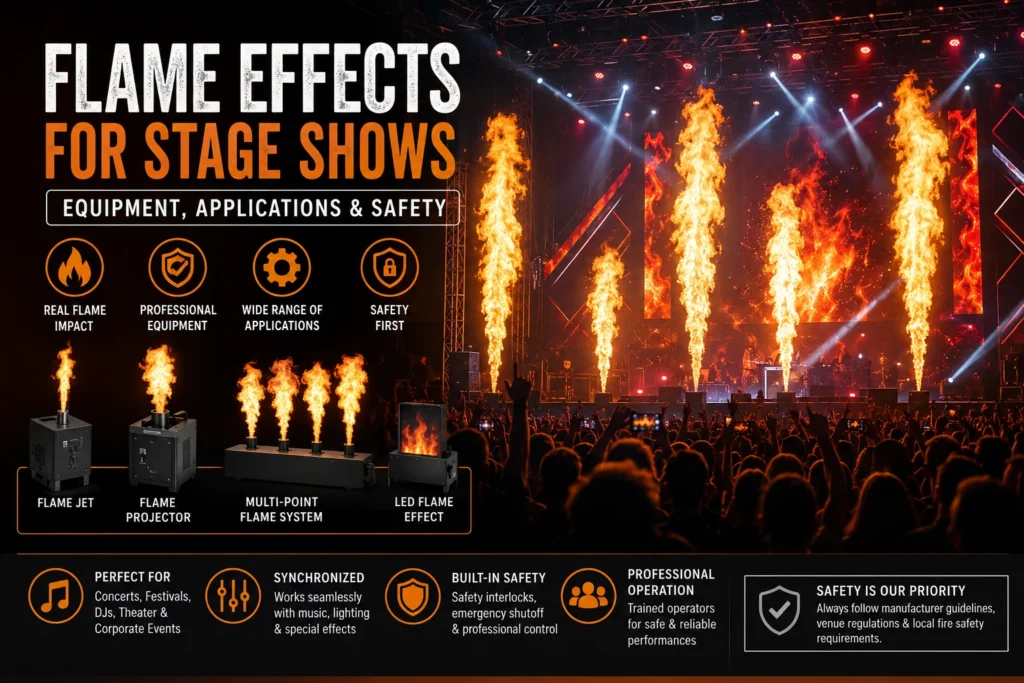
Few stage effects command attention the way a burst of real flame does. Timed to a beat drop, an artist’s entrance, or a show-closing moment, flame effects for stage shows can turn a good performance into an unforgettable one the kind of visual that makes a concert, festival set, or theatrical scene feel bigger than the room it’s happening in. Synchronized with music, lighting, video, and choreography, a well-placed flame effect adds a layer of intensity that few other production tools can match.
But it’s worth saying clearly up front: flame effects are professional special-effects equipment, not decorative flames or novelty devices. They require purpose-built systems, trained operators, venue approval, and full compliance with applicable fire-safety requirements. This guide walks through what flame effects are, how they’re used across different event types, how they compare to other stage effects, and what buyers and producers need to think through before bringing real fire into a production.
Explore our Stage Special Effects Guide to learn how special effects can add excitement, atmosphere, and visual impact to concerts, festivals, theatrical performances, and live events. The guide covers popular effects such as CO₂ jets, fog machines, confetti, haze, and other stage effects, along with key considerations for choosing the right equipment and creating professional event experiences.
What Are Flame Effects for Stage Shows?
Professional flame effects are specialized systems designed to create controlled bursts or appearances of real flame as part of a live production. They’re built and operated very differently from anything you’d find in a home or backyard setting, and they’re designed around production needs like timing, repeatability, and integration with a show’s other cues.
It’s useful to separate flame effects into three broad categories:
Real flame effects use actual combustion. Because they involve fire and fuel, they require specialized equipment, trained operators, and strict safety controls at every stage from installation to operation to shutdown.
LED flame effects create the appearance of flame using lighting technology rather than combustion. There’s no real fire involved, which changes the safety profile significantly, though venue rules and general electrical safety still apply.
Other simulated flame effects can include projection, fabric-based effects, or atmospheric lighting techniques that suggest fire without producing it.
This distinction matters because not everything marketed as a “flame effect” actually uses fire and the equipment, planning, and safety requirements are completely different depending on which category you’re working with.
Types of Flame Effects Used in Stage Productions
Within the “real flame” category alone, there are several distinct types of professional equipment, each suited to different production goals.
Flame jets are systems designed to produce controlled vertical or directional flame bursts, often used to punctuate a specific musical or dramatic moment.
Flame projectors are built to produce a visually prominent flame effect, often used as a stronger focal point in larger productions.
Flame bars and multi-point systems use multiple effect points to create synchronized visual patterns across a stage, useful when a production wants flame to move or repeat across a wider area.
Low flame effects are designed for productions that want a smaller, lower visual profile rather than a large burst.
Simulated flame effects LED and projection-based recreate the look of fire without combustion, and are often the go-to choice for indoor or fire-restricted venues.
| Effect Type | Uses Real Flame? | Typical Application |
| Flame Jet | Yes | Concerts/festivals |
| Flame Projector | Yes | Large stage productions |
| Multi-Point Flame System | Yes | Major productions |
| LED Flame Effect | No | Indoor/sensitive venues |
| Projection Flame Effect | No | Theater/stage design |
Keep in mind that exact equipment categories, naming conventions, and capabilities vary by manufacturer always compare actual specifications rather than assuming two products in the same category behave identically.
How Do Professional Stage Flame Effects Work?
At a high level, professional flame-effect systems generally involve several components working together:
- Specialized flame-effect equipment built for the purpose
- An approved fuel source or fuel system, where applicable
- A controlled ignition method
- Electronic or manufacturer-specific control systems
- Safety interlocks
- Emergency shutoff mechanisms
- Professional positioning within the stage design
- Trained, qualified operation
That’s about as far as this article or any responsible resource should go in describing the mechanism. This is intentionally high-level: fuel formulas, gas pressures, valve or ignition modifications, construction details, DIY burner designs, and any method for bypassing safety systems fall outside what should ever be shared publicly. The exact operating process varies by equipment and manufacturer, and anyone working with real flame effects should rely entirely on the manufacturer’s documentation and a qualified operator’s training never on general instructions found online.
Why Are Flame Effects Popular in Concerts?
Flame effects have become a staple of concert production because of how effectively they land with an audience at the right moment.
- Artist entrances — a flame burst can emphasize a performer’s arrival on stage in a way that lighting alone often can’t.
- Music drops — a precisely timed flame burst can visually reinforce a major beat drop, giving the moment extra physical weight.
- Song finales — flame effects are frequently used to create a dramatic ending to a set or a specific song.
- Festival performances — larger stages can incorporate multiple synchronized flame-effect positions for a bigger, more immersive moment.
- DJ performances — flame effects can emphasize high-energy sections of a set, working alongside lighting and sound to build peaks in the show.
Flame Effects for Different Types of Events
Concerts
Flame effects commonly appear at artist entrances, drops, choruses, finales, and encore moments points in a show where the production wants to add a visual exclamation point.
Festivals
Large festival stages often use flame effects as part of main-stage productions, incorporating multiple effect positions across a wide stage and syncing bursts to the music for a large-scale visual moment.
DJ Events
DJs frequently use flame effects around beat drops, countdown moments, and other crowd-energy sections of a set.
Theater
In theatrical productions, flame effects can support dramatic scenes, transitions, and storytelling moments where a controlled visual effect reinforces what’s happening on stage.
Corporate Events
Product launches, brand reveals, award ceremonies, and grand openings sometimes use flame effects to add drama to a key reveal moment. For corporate events in particular, venue rules and fire-safety approvals deserve early attention corporate venues, hotels, and convention spaces often have stricter policies than dedicated concert venues.
Flame Effects and Stage Lighting
Flame effects rarely work in isolation they’re most effective when integrated into the overall lighting design rather than treated as a standalone element.
- Warm lighting can reinforce the natural appearance of fire, making the effect feel more cohesive with the rest of the stage.
- RGB lighting can create contrast between the flame and the surrounding color palette, making the burst stand out visually.
- Backlighting can make flames visually pop against a darker background.
- Moving heads can add dynamic movement around the effect as it fires.
- Strobes can emphasize the short, intense nature of a flame burst.
A simple way to think about it: flame + lighting + music + timing adds up to a much stronger stage impact than any one of those elements on its own.
Flame Effects vs LED Flame Effects
| Feature | Real Flame Effect | LED Flame Effect |
| Real fire | Yes | No |
| Heat | Yes | No combustion heat |
| Visual realism | Very high | Can be highly convincing |
| Safety complexity | Higher | Generally lower |
| Venue restrictions | More significant | Often fewer, but venue rules still apply |
| Indoor suitability | Highly venue-dependent | Often easier |
| Maintenance | Specialized | Generally simpler |
| Best use | Professional productions requiring real flame | Indoor/sensitive venues |
It’s worth being precise about the safety language here: LED flame effects generally carry lower fire risk because there’s no combustion involved, but that doesn’t make them risk-free or automatically approved for every venue. Electrical safety, mounting, and general venue rules still apply.
Flame Effects vs CO₂ Effects
Flame effects and CO₂ effects are both used to create high-impact stage moments, but the mechanisms and safety considerations are entirely different.
| Feature | Flame Effects | CO₂ Effects |
| Visual | Real flame | White vapor/plume |
| Heat | Yes | Cold discharge |
| Main purpose | Fire/energy visual | Dramatic burst |
| Safety considerations | Fire/heat/fuel | CO₂/pressure/clearance |
| Concert use | High-impact moments | High-impact moments |
| Lighting interaction | Strong | Strong |
| Venue requirements | Significant | Significant |
Both effects can create a powerful moment in a show, but they require completely different safety planning one centers on fire and fuel handling, the other on pressurized gas and clearance requirements. For a deeper look at how CO₂ systems work, see our guide to CO₂ stage effects.
Flame Effects vs Fog Effects
Flame and fog serve very different purposes in a production, and many shows use both.
Flame provides heat, real fire, strong visual impact, and works best for short, dramatic moments.
Fog provides atmosphere, depth, and improves the visibility of lighting beams, and is typically used for longer-lasting environmental effects rather than a single burst.
For more detail on fog systems, see our guide to fog machine for stage effects.
Flame Effects for Indoor vs Outdoor Events
| Factor | Indoor | Outdoor |
| Fire regulations | Critical | Critical |
| Ventilation | Important | Natural airflow varies |
| Ceiling clearance | Very important | Site-dependent |
| Wind | Usually controlled | Major factor |
| Audience distance | Carefully planned | Carefully planned |
| Venue approval | Required where applicable | Event/site approval |
| Emergency planning | Essential | Essential |
Real flame effects should never be assumed safe or permitted simply because a venue is large or an event is outdoors. The actual requirements depend on the specific equipment, fuel type, venue, local regulations, fire authority requirements, event organizer policies, and manufacturer specifications every one of those needs to be confirmed for the specific event, not assumed from a similar past show.
Flame Effect Equipment Buying Guide
Buyers evaluating flame-effect equipment should work through several key considerations before making a decision.
- Effect type. Determine whether the production needs a single flame, multiple flames, short bursts, a simulated flame effect, or another specialized configuration.
- Control system. Confirm whether the system supports the control method the production requires — options may include manual control, remote control, DMX, or a broader show-control system. Only rely on specific protocol compatibility once it’s been verified for the exact equipment in question.
- Number of effect points. Consider stage width, visual symmetry, the overall production design, the number of performers, and the coverage the show is aiming for.
- Safety features. Look for manufacturer-documented features such as emergency shutdown, safety interlocks, flame monitoring, fault detection, and approved control systems. Never assume a safety feature is present — confirm it directly against the manufacturer’s documentation for that specific product.
- Fuel system. Make sure you fully understand the manufacturer’s approved fuel requirements and system configuration before purchase or rental. This is not something to guess at or improvise.
- Installation requirements. Think through stage position, required clearances, mounting, access, ventilation, and emergency access before the equipment arrives on site.
- Venue compatibility. Confirm venue rules, fire authority requirements, insurance requirements, and any necessary event permits well ahead of the event date.
How Many Flame Effect Units Does a Stage Need?
There’s no universal number here — quantity depends on stage dimensions, the type of effect, the production design, the number of cue points, desired symmetry, audience position, and the specifications of the equipment itself.
- A single unit creates a focused visual effect, often used for one specific moment.
- Two units can create a symmetrical effect across a stage.
- Multiple units support large-scale, synchronized productions with effects spread across a wider area.
The final number and placement of flame-effect units should always be determined by qualified professionals based on the specific equipment, venue, and applicable safety requirements not estimated from a general rule of thumb.
How to Integrate Flame Effects With Music
Getting a flame effect to land well with an audience is as much about planning as it is about the equipment itself.
- Identify key musical moments — the intro, drop, chorus, breakdown, or finale where the effect will have the most impact.
- Coordinate with lighting — plan color, intensity, position, and timing so the flame effect works with the lighting design rather than against it.
- Coordinate with stage direction — make sure performers know exactly where and when effects will fire so they can stay clear and move naturally around them.
- Rehearse — conduct professional testing and full rehearsal before the audience enters the venue.
- Maintain safety zones — confirm the production design keeps the required clearances intact through every cue, not just the first run-through.
Flame Effect Safety Considerations
This is the section every producer, technician, and buyer should read most carefully. Professional flame effects require specialized training, a proper risk assessment, approved equipment, appropriate fire-safety planning, and full compliance with local regulations. None of that is optional.
Fire risk. Real flame can ignite combustible materials nearby, including set pieces, drapes, and decorations.
Heat. Flames generate real heat around the effect, which needs to be accounted for in staging and performer positioning.
Fuel. Fuel systems require professional handling and manufacturer-approved equipment — this is not an area for improvisation.
Clearance. Maintain the manufacturer- and authority-specified separation between the flame effect and performers, audience, curtains, set pieces, rigging, lighting fixtures, and any other combustible materials.
Ventilation. Indoor productions need to account for heat buildup, combustion products, and adequate ventilation.
Emergency shutdown. Professional systems should include appropriate emergency procedures and shutdown mechanisms, and everyone on site should know how they work.
Fire protection. Event organizers should coordinate directly with venue safety personnel and relevant fire authorities well before the event.
Operator training. Only appropriately trained personnel should ever operate professional flame-effect systems.
Pre-event testing. Controlled testing and rehearsal should follow manufacturer and venue procedures exactly.
Weather. Outdoor flame effects need to account for wind, rain, temperature, and general site conditions, all of which can change how an effect behaves.
Permits and insurance. Confirm applicable local permits, venue approvals, insurance requirements, and fire regulations before committing to a flame effect in a production.
None of this guide provides or should be treated as a substitute for operational instructions from a manufacturer or qualified safety professional.
Flame Effects Safety Checklist
☐ Manufacturer-approved equipment
☐ Qualified operator
☐ Venue approval
☐ Fire authority requirements checked
☐ Required permits obtained
☐ Appropriate insurance confirmed
☐ Safety distances established
☐ Combustible materials evaluated
☐ Emergency shutdown procedure established
☐ Fire protection available as required
☐ Fuel system professionally inspected
☐ Performer positions confirmed
☐ Audience distance confirmed
☐ Weather conditions checked
☐ Pre-event testing completed
☐ Emergency response plan prepared
Common Mistakes When Using Flame Effects
- Using flame effects without venue approval. Never assume approval confirm it directly with the venue and relevant authorities.
- Ignoring clearances. Stage design must account for the equipment’s required safety zones from the start, not as an afterthought.
- Placing effects near combustible materials. Set pieces, drapes, props, and decorations all need careful evaluation before final placement.
- Treating flame effects like lighting fixtures. They involve completely different hazards and require separate planning.
- Skipping rehearsal. Timing and performer movement around the effect must be tested, not assumed.
- Ignoring weather. Outdoor flame effects can be significantly affected by wind and other conditions on the day.
- Using unqualified operators. Professional flame effects require appropriate, verifiable training — this isn’t a role to assign casually.
- Modifying equipment. Never bypass or alter a manufacturer’s safety systems under any circumstances.
When Should You Choose LED Flame Effects Instead?
Simulated flame effects are often the better choice when:
- Real flame is prohibited by the venue.
- The venue has strict fire restrictions.
- The event is indoors, especially in a space with limited clearance or ventilation.
- Performers will be positioned very close to the effect.
- A lower-risk visual alternative is preferred for the production.
- Continuous, flame-like visuals are needed rather than short bursts.
Options include LED flame fixtures, video or projection-based flame visuals, fabric flame effects, and other lighting-based simulations. It’s worth being clear that these alternatives reduce fire risk by removing combustion they aren’t automatically risk-free, and general electrical and rigging safety still applies.
How to Choose Professional Flame Effects for Your Event
Choose real flame effects when:
- Real fire is essential to the creative concept.
- The venue permits it.
- Appropriate professional equipment is available.
- Qualified operators are involved.
- Required safety approvals are in place.
Choose simulated flame effects when:
- Real flame isn’t permitted.
- Fire risk needs to be minimized.
- Indoor venue restrictions make real flame impractical.
- The creative goal can be achieved through lighting or projection instead.
Consider other special effects when:
- You want atmospheric effects rather than fire — see our guide to fog effects.
- You want dramatic bursts without heat — see our guide to CO₂ stage effects.
- You need effects suited to more restricted venues.
Frequently Asked Questions
What are flame effects for stage shows?
Flame effects are specialized systems that create controlled bursts or appearances of real flame during a live production, used to add visual drama to concerts, festivals, theater, and other events.
What equipment is used for stage flame effects?
Common equipment includes flame jets, flame projectors, and multi-point flame systems, along with simulated alternatives like LED flame fixtures. Exact equipment varies by manufacturer and production need.
Are stage flame effects real fire?
Real flame effects use actual combustion, while LED and projection-based flame effects simulate the appearance of fire without any real flame or combustion heat.
Can flame effects be used indoors?
It depends entirely on the venue, equipment, ventilation, clearances, and applicable fire regulations. Indoor use should never be assumed safe or approved without confirming these factors directly.
Are flame effects suitable for concerts?
Yes, flame effects are commonly used in concerts for entrances, drops, and finales, provided the venue approves their use and proper safety planning is in place.
What is the difference between flame effects and CO₂ effects?
Flame effects use real fire and heat, while CO₂ effects create a cold vapor plume through pressurized gas. Both create dramatic visual moments but involve very different safety considerations.
Are LED flame effects an alternative to real fire?
Yes, LED flame effects simulate the look of fire using lighting technology rather than combustion, which generally lowers fire risk, though venue and electrical safety rules still apply.
What safety precautions are required for stage flame effects?
Precautions include manufacturer-approved equipment, qualified operators, venue approval, established clearances, emergency shutdown procedures, and compliance with local fire regulations and permits.
How do flame effects work with stage lighting?
Flame effects are often paired with warm lighting, backlighting, or moving heads to enhance visibility and impact, and are typically planned as part of the overall lighting design rather than as a standalone effect.
How do I choose flame-effect equipment for an event?
Consider the effect type, required control system, number of effect points, documented safety features, fuel system, installation requirements, and venue compatibility before selecting equipment.
Conclusion
Flame effects can create some of the most powerful visual moments in live production but they demand far more careful planning than most other stage effects, precisely because they involve real fire, heat, fuel, and specialized equipment. Doing it well comes down to a clear formula: the right equipment, qualified operators, venue approval, thorough safety planning, proper clearances, and professional rehearsal, all working together.
If your production is exploring flame effects, CO₂, fog, or other stage special effects, explore JJY Stage’s professional stage special-effects equipment for concerts, festivals, theater productions, DJ events, and live entertainment.