
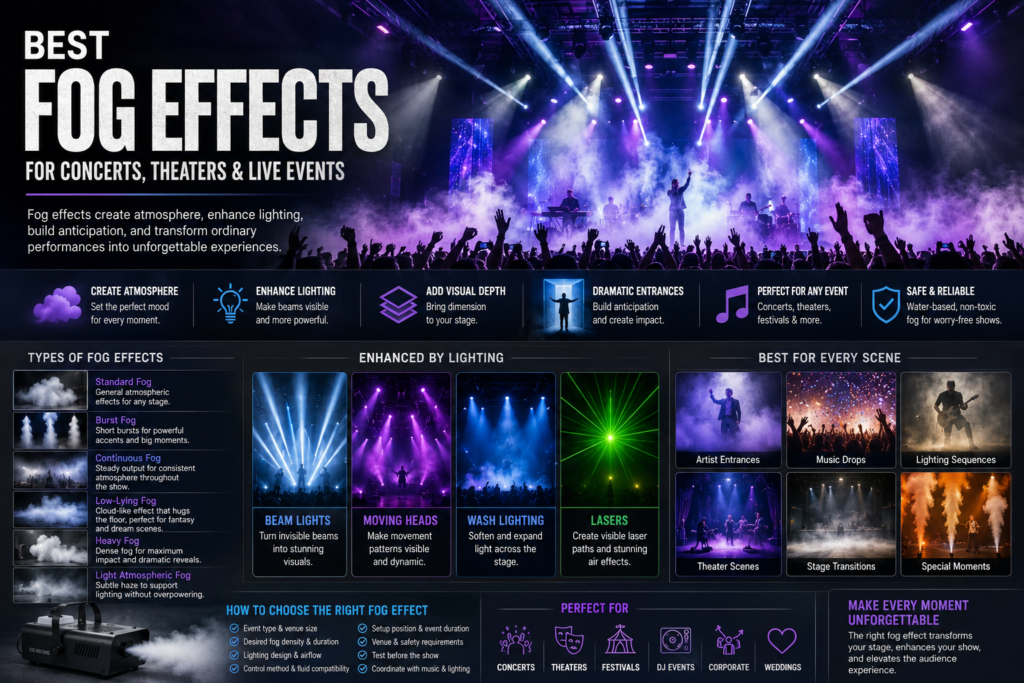
Few atmospheric effects are as instantly recognizable in live entertainment as fog. From the moment a beam of light cuts through a hazy stage to a full artist entrance wrapped in a rolling cloud, fog effects for concerts have become one of the most reliable tools for building energy and visual drama. Fog can add atmosphere, make lighting beams visible, create dramatic entrances, enhance music performances, support theatrical storytelling, and add depth to an otherwise flat stage.
But not every fog effect works for every situation. The best fog effect for a show depends on the event type, the desired visual result, the venue, the lighting design, the airflow in the room, and the equipment available. This guide breaks down how fog effects are used across concerts, theater, and live events and how to choose the right approach for your production.
What Are Fog Effects?
Stage fog effects are atmospheric visuals created by dispersing a fine, visible vapor into the air above or across a stage. This vapor is typically produced by heating a water-based fog fluid until it vaporizes, then releasing it into the room where it cools and becomes visible as a soft, drifting cloud.
Fog machines work by pumping fluid through a heat exchanger, converting it into a dense vapor that behaves differently depending on the machine’s output, the fluid used, and the room’s temperature and airflow. The result is a controllable atmospheric layer that production teams can use to shape how a stage looks and feels.
Fog is used in entertainment because it gives lighting designers, directors, and performers a way to add a physical, visible layer to a scene something that static lighting alone cannot achieve. Unlike ordinary smoke, professional stage fog is designed to be safe for repeated use in performance environments, dissipate in a controlled way, and avoid the acrid smell and residue associated with combustion-based smoke.
Stage Special Effects Guide is a comprehensive resource covering popular stage effects such as fog, haze, bubbles, confetti, CO₂, snow, and flame effects, with guidance on applications, equipment selection, safety, and event requirements.
Why Are Fog Effects Popular in Live Events?
Fog effects remain a staple of live production because of the range of visual and practical benefits they offer:
- Creating atmosphere — a subtle layer of fog can instantly change the mood of a stage.
- Enhancing lighting — beams, washes, and moving lights become far more visible and defined.
- Increasing visual depth — fog adds a sense of dimension to an otherwise flat stage picture.
- Supporting dramatic moments — fog can build anticipation before a reveal or entrance.
- Creating scene transitions — a burst of fog can help mask set changes or shift the tone between segments.
- Highlighting performers — fog around a performer can make them stand out against the background.
- Enhancing audience experience — atmospheric effects contribute to the overall sense of spectacle.
Fog is not a guaranteed upgrade for every production, though. Its impact depends heavily on how it’s used, and poorly planned fog can distract from a performance rather than enhance it.
Best Fog Effects for Concerts
Concerts are one of the most common environments for fog effects, and there are several specific moments where fog tends to have the greatest impact.
Artist Entrances
A burst or wall of fog right before an artist walks onstage can build anticipation and create a dramatic visual transition, especially when paired with a lighting cue or blackout.
Music Drops
In genres built around big musical moments, fog is often synchronized with drops, key beats, or chorus hits to add visual punctuation to the sound.
Instrumental Performances
During extended instrumental sections, a steady layer of atmospheric fog can enhance the stage environment without pulling focus from the performers.
Lighting Sequences
Fog effects for concerts are especially powerful when paired with lighting hardware such as:
- Moving head lights
- Beam lights
- Wash lights
- LED stage lighting
- Lasers
The fog gives these fixtures something to interact with, turning invisible light paths into visible, sculptural beams across the stage.
Stage Transitions
Fog can help visually separate different parts of a performance, softening the transition between songs, sets, or production segments.
Best Stage Fog Effects for Theater
Theatrical fog effects serve a different purpose than concert fog. Instead of amplifying energy and spectacle, theater fog is usually used to support storytelling and mood. Common applications include:
- Drama
- Mystery
- Suspense
- Fantasy
- Dream sequences
- Scene transitions
- Special effects
- Children’s theater
Because theater productions rely heavily on dialogue, blocking, and visibility, fog must be used with more restraint than in a concert setting. A theatrical fog machine needs to be positioned and timed carefully to avoid interfering with:
- Performer visibility — actors need to be seen clearly by the audience.
- Audience visibility — sightlines to the stage should remain clear.
- Stage movement — fog shouldn’t obscure entrances, exits, or blocking.
- Effect timing — cues need to align precisely with the script or score.
- Venue ventilation — theaters often have different airflow patterns than concert venues, affecting how fog settles or disperses.
Fog Effects for Live Events
Beyond concerts and theater, fog effects for events show up across a wide range of live productions, including:
- Corporate events
- Product launches
- Award shows
- Fashion shows
- Festivals
- DJ performances
- Nightclubs
- Weddings
- Private events
In these settings, fog can be used as an occasional dramatic effect such as a reveal moment during a product launch or as part of a broader atmospheric design that runs throughout the event, like continuous low fog on a dance floor.
Different Types of Fog Effects
Not all fog looks or behaves the same way. Understanding the different types helps production teams choose the right approach.
Standard Stage Fog Conventional fog output used for general atmospheric effects across a stage or performance area.
Burst Fog Short, controlled bursts of fog timed to specific moments, useful for creating dramatic accents rather than a continuous atmosphere.
Continuous Fog A steady, controlled output designed to maintain consistent atmosphere throughout a scene or performance segment.
Low-Lying Fog A denser-than-air fog effect that hugs the floor, creating a cloud-like look. This effect is popular for dream sequences, fantasy scenes, and dramatic stage entrances. For a closer look at how this effect is achieved, see our guide on the low fog machine and how it creates a cloud-like stage effect.
Heavy Fog A denser visual effect appropriate for moments that call for maximum atmosphere, such as a dramatic reveal or an intense musical climax.
Light Atmospheric Fog A lighter, more subtle amount of fog designed to support lighting design without overwhelming the stage picture.
Not every fog machine is capable of producing all of these effects output, fluid type, and machine design all play a role in which effects are achievable.
How Fog Effects Enhance Stage Lighting
One of the most valuable applications of stage fog effects is how they interact with lighting. Light traveling through clean air is largely invisible except where it lands. Once airborne fog particles are introduced, that same light becomes visible as a defined beam, transforming flat lighting into a dynamic visual element.
Beam Lights Narrow, focused beams become far easier to see and track as they move through fog-filled air.
Moving Head Lights The sweeping motion of moving heads becomes more visually defined, turning simple movement into a visible pattern across the stage.
Wash Lighting Fog can soften and extend the visible reach of wash lighting, adding atmosphere around performers rather than just illuminating them.
LED Stage Lighting Colored LED light interacts visually with fog, allowing color washes to fill the air rather than just the surfaces they hit.
Laser Effects Atmospheric particles can make laser paths significantly more visible, though this always depends on the venue, the equipment used, and applicable safety requirements for laser operation.
These stage lighting effects are a major reason fog remains a staple in professional lighting design; it turns a two-dimensional lighting plot into a three-dimensional visual experience.
Fog Effects for Different Music Genres
The right fog application often depends on the type of performance. These are general examples, not universal requirements.
| Music/Event Type | Possible Fog Application |
| Rock concerts | Dramatic entrances and transitions |
| EDM | Drops and lighting sequences |
| Pop concerts | Performer entrances and visual transitions |
| Hip-hop | Atmospheric stage moments |
| Live bands | Lighting enhancement |
| DJ performances | Dance-floor atmosphere |
| Festivals | Stage transitions and major moments |
Fog Effects for Different Theater Productions
| Production Type | Possible Fog Application |
| Drama | Mystery and atmosphere |
| Horror | Suspense |
| Fantasy | Magical environments |
| Musical | Scene transitions |
| Children’s theater | Fantasy effects |
| Dance | Visual movement |
| Experimental theater | Abstract atmosphere |
How to Choose the Right Fog Effect
Selecting the right fog effect comes down to a handful of key factors:
- Event Type — concerts, theater, weddings, and corporate events often call for different fog approaches.
- Venue Size — larger rooms require more careful planning to achieve even atmospheric distribution.
- Desired Density — a subtle atmospheric layer creates a very different effect than a dramatic burst of dense fog.
- Duration — burst effects and continuous operation serve different creative goals.
- Airflow — HVAC systems, ventilation, fans, doors, and outdoor wind can all significantly change how fog behaves.
- Lighting Design — the lighting system in use should influence which fog approach makes the most visual sense.
- Control Requirements — professional productions typically need precise timing and coordination between fog, lighting, and music.
Fog Machine for Concerts: What Should You Consider?
Before selecting a fog machine for concerts, it helps to run through a practical checklist:
- ☐ Venue size
- ☐ Desired fog density
- ☐ Continuous or burst effect
- ☐ Lighting system
- ☐ Airflow
- ☐ Control method
- ☐ Fluid compatibility
- ☐ Setup position
- ☐ Event duration
- ☐ Venue requirements
- ☐ Safety requirements
Each of these factors affects how well the fog effect will translate into the finished production. A machine that works well in a small club, for example, may not produce enough output for a large festival stage, while a high-output unit could be overwhelming in an intimate theater setting.
Fog Effects vs Haze Effects
Fog and haze are often confused, but they serve different visual purposes.
| Feature | Fog | Haze |
| Visual density | Generally stronger | Generally subtler |
| Main purpose | Dramatic atmosphere | Lighting atmosphere |
| Light beam visibility | Strong | Excellent for subtle beam definition |
| Typical use | Special moments | Continuous atmosphere |
| Concert use | Entrances, drops, transitions | Ongoing beam visibility throughout the show |
| Theater use | Scene-specific dramatic effects | Subtle, consistent atmosphere |
The exact visual result depends on the specific machine, the fluid used, and the operating conditions. For a deeper comparison, see our guide on the difference between a fog machine vs haze machine.
How to Coordinate Fog With Music and Lighting
Professional productions rarely fire fog effects randomly they’re coordinated with the rest of the show. Fog is commonly timed to:
- Music cues
- Lighting cues
- Performer entrances
- Scene transitions
- Drops
- Finale moments
A simple coordination workflow often looks like this:
Music cue → Lighting cue → Fog cue → Performer action
Pre-programmed or carefully coordinated effects tend to produce more consistent, repeatable results than manually triggered fog, especially across multiple show dates. The exact control method will depend on the specific equipment being used, so it’s worth confirming compatibility with your show control system in advance.
Indoor vs Outdoor Fog Effects
| Factor | Indoor | Outdoor |
| Airflow | Controlled but variable | Highly variable |
| Wind | Limited | Major factor |
| Fog persistence | Often longer | Can disperse quickly |
| Venue control | Higher | Lower |
| Equipment planning | Standard setup often sufficient | May require repositioning or additional units |
| Weather considerations | Minimal | Wind, temperature, and humidity all matter |
Outdoor fog effects are generally harder to control because wind and temperature swings can disperse fog far faster than in an enclosed space. Productions planning outdoor fog effects should build in extra testing time and flexibility.
Common Mistakes When Using Fog Effects
Using Too Much Fog Excessive fog can reduce visibility for both the audience and the performers, undermining the effect it was meant to create.
Ignoring Airflow HVAC systems, open doors, and fans can move fog in unexpected directions or disperse it before it has the intended visual impact.
Choosing the Wrong Effect A dense fog burst may not be the right choice for a subtle, continuous lighting atmosphere haze or low fog could be a better fit.
Ignoring Lighting Design Fog looks different depending on the color, angle, and intensity of the lighting used with it, so the two should be planned together.
Skipping Pre-Event Testing Testing ahead of time helps identify unexpected airflow patterns or visibility issues before they affect a live show.
Ignoring Venue Requirements Many venues have specific policies around atmospheric effects, including fire alarm considerations and ventilation requirements. Confirming these in advance helps avoid last-minute issues.
Safety Considerations for Stage Fog Effects
Using fog responsibly is essential for any professional production:
- Follow manufacturer instructions.
- Use compatible fog fluid.
- Maintain appropriate ventilation.
- Follow venue policies.
- Consider performer and audience visibility.
- Keep emergency exits clear.
- Position equipment securely.
- Protect cables and electrical connections.
- Test equipment before the event.
- Use trained operators for professional productions when appropriate.
How to Create Professional Fog Effects for a Concert
A structured planning process helps ensure fog effects support the show rather than distract from it.
Step 1: Define the Visual Goal Determine whether the fog should be subtle, dramatic, or reserved for specific moments only.
Step 2: Evaluate the Venue Consider stage dimensions, ceiling height, airflow, and audience position.
Step 3: Evaluate Lighting Identify which lighting fixtures need atmospheric visibility to have their full impact.
Step 4: Select Appropriate Equipment Match the fog machine’s output and features to the production’s specific requirements.
Step 5: Test the Effect Run the fog effect ahead of the event to see how it distributes and dissipates in the actual venue.
Step 6: Program or Coordinate Cues Align fog timing with lighting, music, and performer movements.
Step 7: Monitor During the Performance Adjust output where the equipment allows, based on real-time venue conditions such as crowd size and airflow changes.
Best Fog Effects by Event Type
| Event | Recommended Fog Approach | Main Goal |
| Concert | Burst fog for entrances/drops, light fog for lighting visibility | Energy and visual impact |
| Theater | Controlled, scene-specific fog | Storytelling and atmosphere |
| DJ event | Continuous light fog or haze | Sustained beam visibility |
| Festival | Burst fog for key transitions | Big visual moments |
| Corporate event | Light fog for reveals | Polished, professional impact |
| Wedding | Low fog for entrances or first dance | Elegant, romantic atmosphere |
| Dance performance | Controlled continuous fog | Visual depth for movement |
| Nightclub | Continuous atmospheric fog | Ongoing lighting enhancement |
These are general starting points the right approach for any specific event should be adjusted based on venue, lighting, and equipment.
Frequently Asked Questions
What are fog effects for concerts?
Fog effects for concerts are atmospheric visuals created by fog machines to enhance lighting, build anticipation for entrances, and add drama to key musical moments like drops and transitions.
What is the best fog effect for a stage?
There’s no single best option; the right effect depends on the venue, lighting design, and the mood the production is trying to create, ranging from light atmospheric fog to dense bursts.
How do fog effects enhance stage lighting?
Fog gives light something to interact with in the air, making beams, moving lights, and lasers visible as defined shapes rather than just points of light on a surface.
What is the difference between fog and haze?
Fog is generally denser and used for dramatic, specific moments, while haze is subtler and designed for continuous, consistent beam visibility throughout a show.
Are fog machines suitable for concerts?
Yes, fog machines are widely used in concerts to support entrances, drops, and lighting design, though output and placement should be matched to the venue.
Can fog machines be used in theaters?
Yes, but theatrical fog use typically requires more precise control to protect performer and audience visibility and align with scene timing.
How long does stage fog last?
Fog persistence varies based on room airflow, ceiling height, and ventilation; it can range from a few seconds in a well-ventilated space to much longer in a still, enclosed room.
Can fog effects be used outdoors?
Yes, but outdoor fog is harder to control due to wind and temperature changes, often requiring extra testing and equipment planning.
What type of fog machine is best for live events?
The right machine depends on the event size, desired density, and whether the production needs burst effects, continuous atmosphere, or both.
Are fog effects safe for stage performances?
When used according to manufacturer instructions, with proper ventilation and venue compliance, fog effects are a standard and widely used part of professional live production.
Conclusion
Fog effects remain one of the most versatile tools in live production, with applications spanning concerts, theater, festivals, DJ events, live performances, corporate events, and weddings. Whether it’s a burst of fog behind a headlining artist or a controlled, low-lying cloud drifting across a theater stage, fog effects give lighting designers and directors a powerful way to shape mood, depth, and drama.
The best fog effect for any production ultimately depends on the desired visual effect, the venue, the lighting design, airflow conditions, the type of event, and the capabilities of the equipment being used.
For productions looking to explore professional-grade atmospheric equipment, JJY Stage’s Special Effect Series offers a range of fog and atmospheric solutions built for the entertainment industry. Explore the lineup to find the right fit for your next concert, theater production, or live event.