
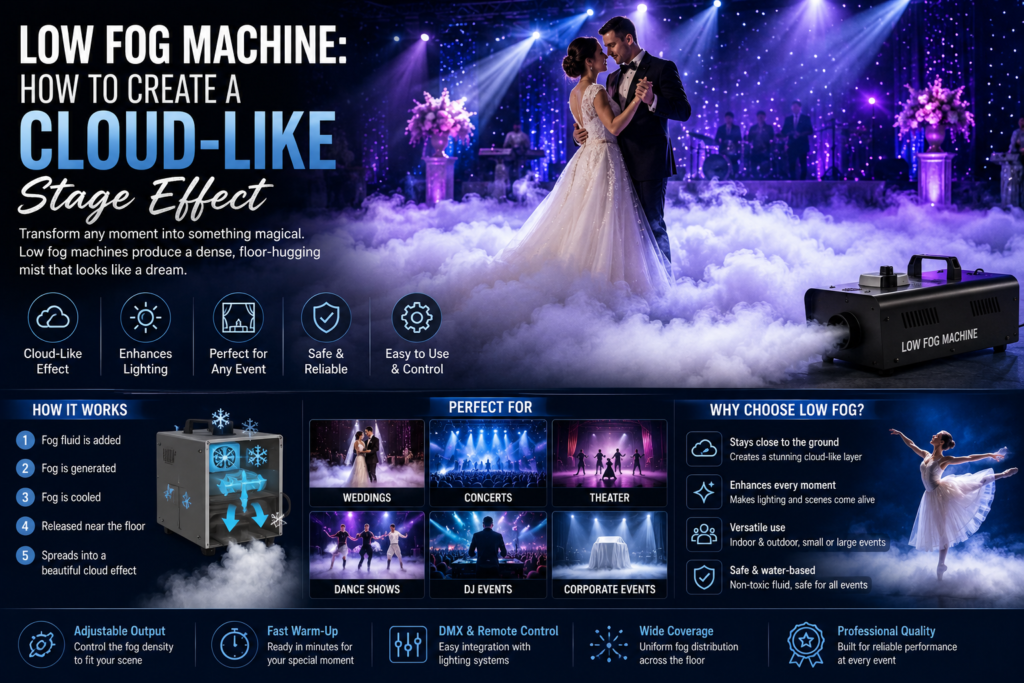
Picture a bride and groom sharing their first dance as a soft, rolling cloud drifts across the floor around their feet — or a performer stepping through a low-lying mist as a spotlight catches every curl of vapor. That distinctive, ground-hugging look is the signature of a low fog machine, and it’s become one of the most requested atmospheric effects in live entertainment and event production.
Low fog is popular for weddings, stage shows, concerts, theater, dance performances, live events, and photography because it creates a visual that feels cinematic and controlled. Unlike ordinary fog, which tends to fill a room and rise as it warms, low fog is designed to stay close to the ground, forming a distinct cloud-like layer rather than a general atmospheric haze. This guide explains how low fog machines work, where they’re used, and how to choose the right one for your event.
What Is a Low Fog Machine?
A low fog machine is a type of atmospheric effects machine designed to produce fog that remains near the floor rather than dispersing upward and throughout a room. The goal is a dense, cloud-like layer that spreads horizontally across a stage, dance floor, or performance area the kind of effect often seen at wedding first dances or dramatic stage entrances.
This ground-level behavior is what separates a low lying fog machine from a standard fog machine. While regular fog machines are built to fill a space with atmospheric vapor, low fog machines are engineered to keep the effect concentrated near the ground for as long as possible.
It’s worth noting that not every low fog machine achieves this in the same way. Different manufacturers use different designs and methods to encourage the fog to stay low, so output, coverage, and behavior can vary between models.
Low fog effects are commonly used at:
- Weddings
- Concerts
- Theater productions
- Dance performances
- Corporate events
- Photography sessions
What Is a Cloud Effect Machine?
You may also hear low fog machines referred to as a cloud effect machine. This isn’t a different category of equipment so much as a different way of describing the same visual goal: a dense, floor-level fog that looks like a drifting cloud rather than a diffuse haze.
Event professionals use several interchangeable terms to describe this effect, including:
- Cloud effect
- Dancing cloud
- Floor fog
- Ground fog
- Low-lying fog
While these terms generally describe a similar visual result, the equipment behind them can differ. Some machines are purpose-built for this cloud-like look, while others may achieve a similar effect through positioning, fluid choice, or venue conditions.
How Does a Low Fog Machine Work?
Understanding the basic process behind low fog helps explain why it behaves so differently from standard atmospheric fog.
Step 1: Fog Fluid Is Added The process starts with a compatible fog fluid, which the machine uses to generate the atmospheric effect. Using the fluid recommended by the manufacturer is important for both performance and equipment longevity.
Step 2: Fog Is Generated The machine converts the fluid into fog according to its internal design, typically using a heating element to vaporize the fluid into a visible vapor.
Step 3: Fog Is Cooled or Otherwise Conditioned Many low-fog systems use cooling or another conditioning method to help the fog remain closer to the ground once it’s released. It’s important to understand that not every low fog machine uses the same technology to achieve this — some rely on cooling chambers, while others use different mechanical or design approaches.
Step 4: Fog Is Released Near the Floor Once conditioned, the fog is released at or near floor level, allowing it to spread horizontally across the stage or performance area rather than immediately rising.
Step 5: Airflow Determines Distribution From there, ventilation, fans, HVAC systems, doors, and even foot traffic all influence how the fog spreads, how long it lingers, and how “clean” the cloud-like layer looks.
Why Does Low Fog Stay Close to the Ground?
Low fog stays near the floor primarily because of temperature and density. Cooler fog is generally denser than the surrounding air, which causes it to sink and spread horizontally rather than rise. Several factors influence how well this effect holds:
- Temperature — cooler fog tends to stay lower for longer.
- Density — denser fog resists rising into warmer air above it.
- Air movement — even light air currents can disrupt the low-lying layer.
- Cooling — many machines use a cooling process to encourage this behavior.
- Floor-level airflow — drafts near the ground can push fog in unpredictable directions.
- Venue conditions — room temperature, humidity, and ventilation all play a role.
It’s important to set realistic expectations: low fog is designed to remain close to the floor, but it will not stay at a perfectly fixed height indefinitely. Environmental conditions can cause it to disperse, drift, or gradually rise over time.
Low Fog vs Standard Fog
| Feature | Low Fog | Standard Fog |
| Main effect | Cloud-like floor effect | General atmospheric fog |
| Typical position | Near floor | Can rise throughout venue |
| Visual appearance | Dense/cloud-like | Atmospheric/diffused |
| Best for | Weddings, stage entrances, dramatic scenes | Concerts, theater, lighting effects |
| Floor coverage | Strong | Variable |
| Lighting interaction | Emphasizes floor-level beams and backlighting | Enhances beams throughout the air |
| Environmental sensitivity | Highly sensitive to airflow and temperature | Sensitive, but generally more forgiving |
Low fog tends to work best when the goal is a contained, visually striking effect in a specific area, such as a dance floor or entrance point. Standard fog, covered in our stage fog machine guide, is often better suited to filling a larger space or enhancing lighting throughout an entire performance.
Low Fog Machine vs Haze Machine
Low fog is also frequently compared to haze, another common atmospheric effect. While they share some visual overlap, they serve different purposes.
| Feature | Low Fog | Haze |
| Main purpose | Floor-level cloud effect | Subtle atmospheric layer |
| Typical location | Near floor | Throughout the performance space |
| Visual style | Dense/cloud-like | Fine/subtle |
| Lighting purpose | Dramatic atmosphere | Beam visibility |
| Common applications | Weddings, theater, entrances | Concert lighting, DJs, stage lighting |
For a more detailed breakdown of these differences, see our guide on fog machine vs haze machine.
Low Fog Machine for Weddings
Weddings are one of the most popular applications for low fog, and it’s easy to see why — the effect adds a soft, romantic, almost dreamlike quality to key moments.
First Dance A layer of floor-level fog around the couple during the first dance creates a cloud-like atmosphere that photographs and films beautifully.
Wedding Entrance Low fog can be used to create a dramatic entrance, with the couple appearing to walk through a soft cloud as they enter the reception.
First Look Photography Many couples use low fog during first-look or portrait sessions, as it adds visual depth and a soft, atmospheric quality to photographs.
Ceremony Some couples incorporate low fog into the ceremony itself, though appropriate use depends heavily on venue policies and floor conditions.
Wedding Exit A low fog effect during the couple’s exit can create a memorable, cinematic final image for guests and photographers.
Before booking a low fog effect for a wedding, it’s worth considering several practical factors:
- Venue approval
- Floor surface
- Guest movement
- Dress or trailing fabric
- Ventilation
- Cleanup
Not every wedding venue will be suitable for a low fog machine for weddings some spaces have strict policies around atmospheric effects, sensitive fire alarm systems, or floor surfaces that aren’t ideal for fog use. Confirming these details with the venue in advance is an important step.
Low Fog Machine for Stage Shows
On stage, low fog is a popular tool for dance performances, theater, musical productions, children’s shows, fantasy scenes, dramatic entrances, and scene transitions.
Because the effect stays near the floor, performers can walk, dance, or move through it for a striking visual something that’s much harder to achieve with fog that fills the entire air. This makes low fog machine for stage applications especially popular in choreography-heavy productions, where the fog interacts directly with the performers’ movement across the stage.
Low Fog for Concerts and Live Events
Low fog for concerts shows up in several key moments:
- Artist entrances
- Music drops
- Stage transitions
- Dance performances
- Festival stages
- DJ performances
Low fog can also be coordinated with lighting fixtures to enhance the overall visual, including:
- Moving head lights
- Beam lights
- LED stage lighting
- Backlighting
When paired thoughtfully with lighting cues, low fog can turn a simple stage entrance into a much more memorable moment.
Theatrical Low Fog Effects
In theater, theatrical low fog is often used to build mystery, fantasy, dream sequences, magical scenes, dramatic transitions, and atmospheric environments. A low-lying fog bank can visually signal a shift in setting or tone without requiring elaborate set changes.
That said, theater productions require careful control when using this effect. Performer visibility and safe movement across the stage are essential, so fog density, timing, and placement all need to be planned around the blocking and pacing of the production.
How Lighting Enhances Low Fog Effects
Lighting design plays a major role in how a low fog effect actually looks on stage. The fog itself provides the physical medium, but lighting determines how dramatic or subtle that cloud appears to the audience.
Backlighting Placing light behind the fog layer can create strong silhouettes and emphasize the cloud’s shape and movement.
Beam Lights Narrow beams cutting across a low fog layer can create sharp, visible lines just above the floor.
Moving Heads Moving fixtures can sweep across the fog layer, adding dynamic movement to an otherwise static cloud effect.
LED Lights Color-changing LED fixtures can wash the fog in different hues, shifting the mood of the effect throughout a performance.
Color-Changing Lights Gradual color transitions can make the fog layer feel like part of a larger visual story rather than a standalone effect.
Spotlights A single spotlight aimed at a performer moving through low fog can create a strong, focused visual moment.
The direction of the light matters as much as the color. Low-angle lighting or backlighting tends to emphasize the cloud-like layer more than lighting from directly above, though the exact result will vary by venue, fixture, and fog density. This kind of lighting integration is central to the broader approach covered in our stage special effects guide.
Best Events for a Low Fog Machine
| Event | Low Fog Application |
| Wedding | First dance and entrance |
| Concert | Artist entrance and music drops |
| Theater | Fantasy and dramatic scenes |
| Dance show | Choreography and stage atmosphere |
| DJ event | Dance-floor atmosphere |
| Festival | Stage transitions |
| Corporate event | Product launches and presentations |
| Photography | Dramatic visual backgrounds |
How to Choose a Low Fog Machine
- Desired Coverage Think about the size of the stage, dance floor, or area you want the fog to fill.
- Fog Output Output should match the desired visual density a small first-dance area needs far less output than a full stage.
- Low-Fog Technology Since different machines use different methods to create low-lying fog, it’s worth understanding how a specific model achieves the effect before purchasing.
- Fluid Compatibility Always use the fluid recommended by the manufacturer to ensure consistent performance and protect the equipment.
- Control Options Depending on the model, control may include manual operation, remote control, or timer and control-system integration. Only rely on control features that are confirmed and verified for the specific machine you’re considering.
- Portability For touring productions or events with multiple setups, consider the machine’s weight, dimensions, and ease of transport and setup.
- Venue Conditions HVAC systems, ventilation, temperature, airflow, doors, and outdoor wind can all significantly affect how well low fog performs in a given space.
What Affects Low Fog Performance?
Low fog performance can vary significantly from one venue to the next. Key factors include:
- Room temperature
- Floor temperature
- Air conditioning
- Ventilation
- Fans
- Open doors
- Stage height
- Audience movement
- Machine position
- Fluid characteristics
Because so many variables are involved, the same machine can produce noticeably different results in two different venues which is why testing ahead of time is so valuable.
Indoor vs Outdoor Low Fog
| Factor | Indoor | Outdoor |
| Airflow | More controllable | Highly variable |
| Wind | Usually limited | Major factor |
| Fog persistence | Often longer | Can disperse quickly |
| Temperature | More stable | Variable |
| Equipment placement | Easier | More challenging |
| Weather | Less important | Critical |
Outdoor low fog effects require careful planning, since even light wind can disperse the cloud-like layer far faster than it would disappear indoors. Productions planning outdoor low fog should build in extra setup and testing time, and stay flexible about timing if weather conditions change.
How to Create a Professional Cloud-Like Stage Effect
Step 1: Define the Visual Goal Decide whether you want a thin floor mist, a dense cloud, a dramatic entrance effect, or full-stage atmosphere.
Step 2: Evaluate the Venue Check the floor, stage size, ceiling height, HVAC system, ventilation, and audience location.
Step 3: Choose Appropriate Equipment Match the machine’s output and low-fog technology to the specific application.
Step 4: Position the Machine Place the unit where the fog can spread safely and effectively across the intended area.
Step 5: Test Before the Event Run the effect in the actual venue ahead of time to see how it behaves under real conditions.
Step 6: Coordinate With Lighting Synchronize the fog with lighting cues, music, performer entrances, and scene transitions.
Step 7: Monitor During the Event Adjust operation where the equipment allows, especially if conditions like crowd size or HVAC settings change during the event.
Common Low Fog Machine Mistakes
Expecting Low Fog to Stay Completely Still Airflow will always affect how the fog moves, even in a well-controlled indoor space.
Ignoring HVAC Air conditioning and heating systems can dramatically change how fog distributes and how long it lasts.
Using Too Much Fog Excessive output can reduce visibility and overwhelm the intended visual effect.
Choosing the Wrong Machine A machine built for small, contained effects may struggle to cover a large stage, while an oversized unit may be difficult to control in an intimate setting.
Skipping Testing Without a test run in the actual venue, it’s difficult to predict exactly how the fog will behave.
Ignoring the Floor Some floor surfaces can become slippery when fog condenses, which is an important safety consideration, especially for dance performances and wedding first dances.
Safety Considerations for Low Fog Effects
- Follow manufacturer instructions.
- Use compatible fluid.
- Keep electrical connections protected.
- Place equipment securely.
- Protect cables.
- Consider floor conditions.
- Maintain appropriate visibility.
- Keep emergency exits clear.
- Follow venue policies.
- Test equipment before the event.
Operators should always consider the safety and experience of everyone involved — performers, guests, photographers, and venue staff alike.
Low Fog Machine Buying Checklist
- ☐ Desired cloud effect
- ☐ Stage/floor size
- ☐ Coverage requirement
- ☐ Fog output
- ☐ Low-fog technology
- ☐ Fluid compatibility
- ☐ Control method
- ☐ Weight and dimensions
- ☐ Indoor/outdoor environment
- ☐ HVAC and airflow
- ☐ Venue requirements
- ☐ Safety considerations
Frequently Asked Questions
What is a low fog machine?
A low fog machine is designed to produce fog that stays close to the ground, creating a cloud-like layer rather than filling the entire room like standard atmospheric fog.
How does a low lying fog machine work?
It generates fog from compatible fluid, then cools or conditions it so the vapor remains denser than the surrounding air, allowing it to spread near the floor instead of rising.
Why does low fog stay close to the floor?
Cooler, denser fog naturally sinks and spreads horizontally, though room temperature, airflow, and ventilation all affect exactly how long it stays low.
What is a cloud effect machine?
Cloud effect machine” is another term often used for low fog equipment, referring to the same goal of creating a dense, floor-level fog layer.
Can a low fog machine be used at weddings?
Yes, low fog is a popular choice for first dances, entrances, and photography, though venue approval and floor conditions should always be confirmed first.
Is low fog suitable for stage shows?
Yes, low fog is widely used in theater, dance, and musical productions for dramatic entrances, scene transitions, and fantasy or dream sequences.
What is the difference between low fog and regular fog?
Low fog is designed to stay near the floor for a cloud-like look, while regular fog is intended to fill a larger space and rise more freely throughout a room.
Can low fog be used outdoors?
Yes, but wind and temperature changes make outdoor low fog harder to control, often requiring extra testing and flexible timing.
How does lighting enhance low fog?
Backlighting, beam lights, and color-changing fixtures can all emphasize the shape, movement, and mood of a low fog layer, though results vary by venue and equipment.
What should I consider when buying a low fog machine?
Key factors include desired coverage, fog output, the specific low-fog technology used, fluid compatibility, control options, portability, and the venue’s airflow and HVAC conditions.
Conclusion
A low fog machine offers a distinctive, cloud-like effect that standard fog simply can’t replicate a dense, floor-hugging layer that adds drama, romance, or mystery depending on how it’s used. From wedding first dances to concert entrances, theatrical dream sequences, and dance performances, low fog has become a go-to tool for creating memorable visual moments.
Getting the most out of a low fog effect comes down to choosing the appropriate equipment, understanding venue conditions, managing airflow, matching fog output to the space, positioning the machine correctly, coordinating with lighting design, and planning ahead with proper testing.
For productions looking to add this effect to their toolkit, JJY Stage’s stage special effects includes low-fog and atmospheric equipment built for professional use. Explore the lineup to find the right fit for your next wedding, concert, or stage production.