
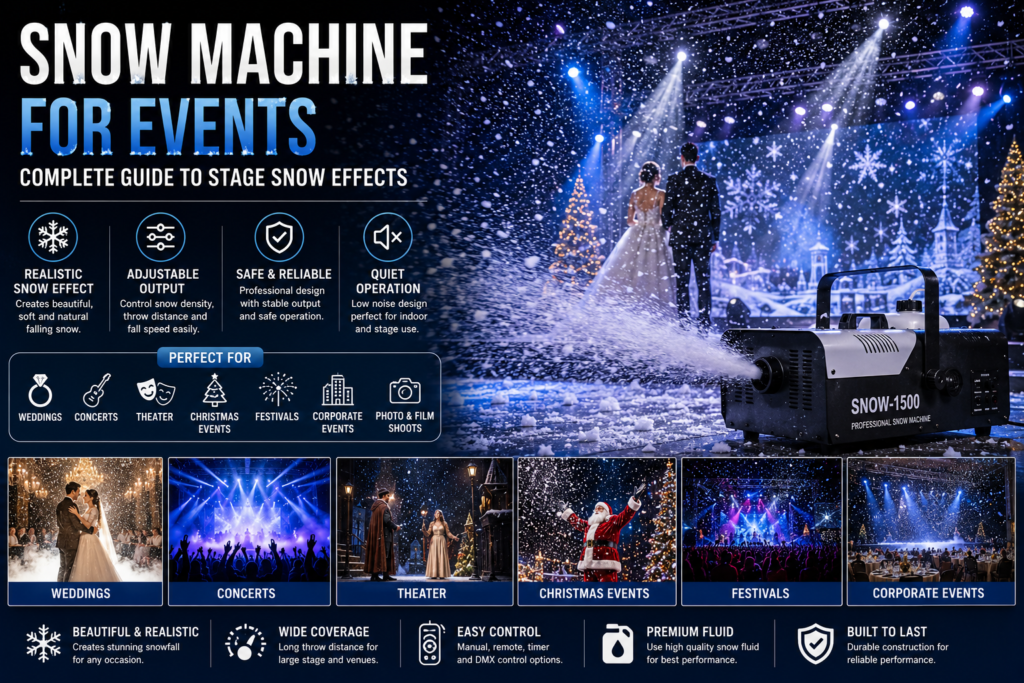
There’s a reason falling snow stops people in their tracks, even indoors, even in July. A single beam of light catching drifting white flakes over a stage or dance floor turns an ordinary room into a moment guests remember. That’s the appeal of a snow machine for events it lets event producers, wedding planners, and stage designers create a winter-themed atmosphere on cue, without waiting on the weather.
Snow effects show up in more places than most people expect: Christmas parties, winter weddings, concert finales, theater productions, festival stages, shopping center holiday displays, corporate product launches, and film or photography shoots. In every one of these settings, the goal is the same a professional event snow machine creates a visual snowfall effect, not an attempt to replicate actual winter weather. It’s a production tool, built for atmosphere, timing, and visual impact.
Explore our Stage Special Effects Guide to learn about popular effects used in concerts, theater productions, weddings, festivals, and live events. The guide covers options such as fog, haze, bubbles, and other stage effects, helping event planners and production teams choose the right effects for different venues and performances.
What Is a Snow Machine?
A snow machine is a piece of special effects equipment designed to produce a falling-snow visual for entertainment, events, and stage productions. Depending on the system, it converts or disperses a snow fluid or snow media into lightweight, snow-like particles, then uses airflow to project those particles into the performance space, where they drift down over the stage, dance floor, or audience area.
Some products in this category are marketed as a snow effect machine, which generally refers to the same category of equipment: gear built to generate a theatrical snowfall look rather than a physical snow surface.
It’s worth drawing a clear line here: event snow machines are not the same as snowmaking equipment used at ski resorts. Resort snowmaking systems are engineered to produce a skiable snow surface outdoors under specific temperature conditions. Event and stage snow machines are built for something different a visual, theatrical effect that can be triggered indoors or outdoors, on demand, as part of a show or celebration. They aren’t designed to build up a surface of snow you could ski or sled on.
What Is an Artificial Snow Machine?
The term artificial snow machine is often used interchangeably with “snow machine” in the events and stage lighting industry, but it’s a useful phrase because it emphasizes what the equipment actually produces: an artificial approximation of snowfall, not natural snow.
Different manufacturers use different methods and different snow media to create this effect, which means the appearance, flake size, and behavior of the “snow” can vary quite a bit from one system to another. Some systems are designed to work only with a specific, manufacturer-formulated fluid; others may use different consumables entirely. Because of that variation, buyers should always check the manufacturer’s specifications and recommended fluid or media before assuming one machine will behave like another. What looks like light, drifting flakes on one system might look and behave differently on a different brand’s equipment.
How Does a Snow Machine Work?
While not every artificial snow machine uses identical technology, most professional systems follow a similar general process.
Step 1: Snow Fluid or Snow Media Many professional theatrical snow machines rely on a specially formulated snow fluid designed for that system. Other systems may use different types of snow media entirely. This is the starting material the machine converts into the visual effect.
Step 2: Snow Generation The machine processes the fluid or media into snow-like particles or flakes, using its internal mechanism to break it down into a lightweight form suitable for airborne distribution.
Step 3: Airflow A fan or blower helps push and distribute the generated particles outward and into the air above the performance area.
Step 4: Snowfall Because the particles are lightweight, they drift and fall gradually through the air, mimicking the visual motion of real snowfall rather than dropping straight down.
Step 5: Visual Effect Stage lighting interacts with the falling particles as they move through the air, which is a major part of what makes the effect read as convincing snowfall to an audience.
<cite index=”1-49″>Current professional snow-machine descriptions commonly emphasize fluid or media, fan-assisted distribution, output, and control as important parts of the system.</cite> It’s important not to assume every artificial snow machine on the market uses the exact same internal mechanism output method, particle size, and control options can differ meaningfully between products.
What Does Artificial Snow Look Like?
The visual character of stage snow depends on several interacting factors:
- Flake size — smaller particles tend to drift more gently; larger ones can feel heavier and more dramatic
- Fall speed — how quickly the particles descend through the air
- Density — how much snow is being produced at once
- Throw distance — how far the effect projects from the machine
- Lighting — how visible the falling particles are against the stage or room
- Airflow — how much the surrounding air movement redirects the fall pattern
Broadly, the effect can be tuned toward a few different looks:
- Light Snowfall — a gentle, atmospheric effect, often used for ambiance without overwhelming the scene
- Moderate Snowfall — a more noticeable winter atmosphere, suited to key moments like an entrance or a chorus
- Heavy Snowfall — a dramatic, blizzard-style visual, typically reserved for finales or high-impact moments
The actual result always depends on the specific equipment, its settings, the fluid or media used, and the conditions inside the venue two different machines set to “moderate” won’t necessarily look the same.
Snow Machine vs Real Snow
| Feature | Artificial Stage Snow | Natural Snow |
| Temperature dependence | Generally designed for event environments | Requires suitable weather |
| Control | Controlled by equipment | Weather dependent |
| Timing | Can be triggered for a performance | Unpredictable |
| Production use | Stage/event effect | Natural weather |
| Visual consistency | Can be planned | Variable |
| Indoor use | Some systems are designed for indoor use | Not practical |
| Lighting interaction | Designed for theatrical presentation | Naturally variable |
Artificial snow is primarily a production effect a tool for shaping atmosphere and timing a visual moment. It isn’t meant to replace real snowfall in every context, but it gives event producers something real snow can’t offer: control.
Stage Snow Machine for Events
A stage snow machine earns its place in event production because falling snow does several things at once. It adds movement to an otherwise static stage. It creates atmosphere that instantly signals “winter” or “celebration.” It gives a seasonal event a strong visual identity. It adds depth to a stage picture, especially under lighting. It creates strong photography and video moments. And it engages an audience in a way that’s hard to replicate with static decor.
<cite index=”1-79″>Current event-production sources highlight falling snow as a memorable visual effect for seasonal events, stage productions, retail activations, and themed experiences.</cite> That combination visual impact plus flexibility across event types is why snow effects show up so often in event design.
Snow Machine for Weddings
A snow machine for weddings is one of the more popular applications of this technology, largely because it lets couples create artificial snow for events even when a winter wedding falls on a mild or snow-free day.
Winter-Themed Weddings Snow effects let couples build a seasonal atmosphere for the ceremony or reception regardless of what’s actually happening outside.
First Dance A gentle snowfall triggered during the first dance can add a quiet visual drama to one of the most photographed moments of the night.
Wedding Entrance Some couples use a snow effect as part of their entrance, timed to music or applause for a memorable first impression.
Photography Falling snow creates a strong, dynamic background for wedding photography and videography — a detail photographers often plan around in advance.
Wedding Exit Snow can also be used during the couple’s exit, adding a final visual moment as guests send them off.
Practical considerations for wedding use:
- Venue permission — confirm the venue allows special effects equipment before booking
- Floor conditions — check how the fluid or media may affect flooring
- Guest movement — plan snowfall timing around where guests will be standing or walking
- Dress and footwear — consider how the effect interacts with gowns, suits, and shoes
- Photography equipment — coordinate with photographers on timing and positioning
- Cleanup — plan for post-event cleanup with the venue
- Ventilation — confirm the space has adequate airflow for indoor use
It’s worth being direct here: not every artificial snow system is residue-free, and not every system is suitable for every venue or flooring type. These details vary by manufacturer, so confirm compatibility before the big day rather than assuming.
Snow Machine for Concerts
A snow machine for concerts is a staple of live music production, particularly for holiday tours and winter-themed shows. Common uses include:
- Artist entrances
- Song transitions
- Holiday concerts
- Music drops and beat-synced moments
- Finale moments
- Winter-themed performances
- Festival stages
Stage snow effects hit differently under concert lighting. A moving-head light sweeping through falling snow, or a backlit haze of drifting particles behind a performer, adds a layer of visual texture that static stage design can’t produce on its own. Timing the snow effect to a specific beat or lighting cue is often what separates a forgettable moment from a genuinely memorable one.
Snow Machines for Theater Productions
A theatrical snow machine supports a different kind of storytelling. In theater, snow isn’t just decoration — it’s often part of the narrative. Common uses include:
- Winter scenes
- Christmas productions
- Fairy tales
- Fantasy scenes
- Dramatic transitions
- Seasonal performances
- Musical theater
Theater productions need to think through a few things that a one-night event might not: performer visibility (can actors still be clearly seen through the effect), stage movement (does the snow interfere with choreography or blocking), costume interaction, floor conditions across multiple performances, sound levels (some machines produce more fan noise than others), lighting design, and venue-specific requirements for effects equipment.
Snow Machine for Christmas Events & Parties
Christmas and holiday programming is where snow effects get the most use. Applications include:
- Christmas parties
- Holiday celebrations
- Corporate Christmas events
- Shopping malls
- Winter festivals
- Theme parks
- Santa photo areas
- Retail displays
A Christmas snow machine doesn’t need to run continuously to make an impression. A short, well-timed burst of snowfall during a countdown, a tree lighting, or a Santa photo session can create a strong seasonal atmosphere without overwhelming the space. This is especially true for snow machine for parties use, where the effect is often just one part of a broader decor and lighting plan.
Indoor Snow Machine vs Outdoor Snow Effects
| Factor | Indoor | Outdoor |
| Airflow | More controllable | Highly variable |
| Wind | Limited | Major consideration |
| Coverage | Easier to control | May require greater planning |
| Temperature | Usually more stable | Variable |
| Venue requirements | Important | Weather/site requirements |
| Cleanup | Must be planned | Depends on location |
| Snow distribution | More predictable | Wind can alter trajectory |
An indoor snow machine generally offers more predictable results because the surrounding air is more stable. Outdoor snow effects, on the other hand, are heavily influenced by wind since artificial snow particles are lightweight, even a moderate breeze can carry them off their intended path or disperse them faster than planned. Outdoor setups typically require more planning and, often, more testing before the actual event.
How Stage Lighting Enhances Artificial Snow
This is where snow effects go from “nice” to genuinely striking. Falling snow only reads clearly to an audience when there’s enough light interacting with it — and different types of lighting create very different moods.
Snow effects commonly interact with:
- LED stage lighting
- Moving head lights
- Beam lights
- Spotlights
- Backlighting
- Wash lights
- Color-changing lights
Light reflecting and scattering off falling particles is what makes snowfall visible and photogenic in the first place — snow drifting through a dark, unlit space is far less impactful than the same snow catching a beam of light.
- Backlighting can help illuminate falling flakes from behind, making them stand out clearly against the stage.
- Colored lighting can shift the entire mood of the snowfall, from icy blue to festive red and green.
- Moving beams create dynamic interaction with the particles as they fall, adding motion on top of motion.
- Warm lighting tends to create a cozy, Christmas-card atmosphere.
- Cool lighting leans into a winter or icy look, often used for more dramatic or fantasy-style scenes.
Coordinating snow effects with the right stage lighting setup is one of the most effective ways to maximize the visual payoff of the equipment.
How to Choose a Snow Machine for Events
A useful buying guide should cover the following:
- Venue Size — match the equipment’s coverage to the actual area that needs snowfall.
- Desired Snowfall Density — decide whether you’re aiming for light flurries, moderate snowfall, or heavy snowfall.
- Throw Distance — consider how far the machine needs to project the effect across the space.
- Output Control — look for appropriate control over how much snowfall is produced where it’s needed.
- Control Options — depending on the product, this might include manual control, remote control, a built-in timer, or DMX/lighting-control integration. Only rely on control features that are actually supported by the specific machine you’re considering.
- Noise Level — an important factor for theater, film, presentations, and any live performance where fan noise could be distracting.
- Fluid or Media Compatibility — always use the manufacturer-recommended consumables for the specific machine.
- Portability — weight, dimensions, handles, ease of setup, and transportation all matter for touring or multi-event use.
- Maintenance — follow the manufacturer’s maintenance instructions to keep the equipment performing reliably over time.
Snow Machine Coverage and Output
One of the most common mistakes buyers make is choosing equipment based on wattage alone. Wattage is only one part of the picture. Real-world performance depends on:
- Output rate
- Throw distance
- Fan performance
- Nozzle design
- Flake characteristics
- Venue airflow
- Mounting position
- Desired density
A larger venue may need different equipment altogether, or multiple units, depending on the manufacturer’s specifications for that particular model. <cite index=”1-186″>Professional snow-machine guidance commonly considers output, throw distance, reservoir capacity, noise, control, and placement when matching equipment to productions.</cite> There’s no universal coverage number that applies across all machines always check verified specifications for the specific product you’re evaluating rather than assuming general figures apply.
Where Should You Place a Snow Machine?
Placement has a real effect on how convincing the snowfall looks. General considerations include:
- Elevated positions, which can help create a more natural falling-snow appearance
- Stage edges
- Rear of stage
- Side positions
- Truss-mounted equipment, where properly rated and installed
- Audience-facing placement, depending on the desired effect
Elevated placement tends to give the particles more distance to drift and spread before reaching the audience or performance area, which often reads as more natural. That said, airflow and venue layout still determine the actual trajectory even well-placed equipment can behave differently depending on the room. For any rigging or truss-mounted setup, always follow manufacturer instructions and venue safety requirements; don’t improvise rigging solutions.
Snow Machine and Airflow
Airflow is one of the most underestimated variables in snow effect planning. Several sources of air movement can affect how snowfall behaves:
- HVAC systems
- Fans
- Doors opening and closing
- Outdoor wind
- Stage ventilation
- Audience movement
Because artificial snow particles are lightweight, they’re easily redirected by air currents. This is exactly why testing the effect in the actual venue not just in a showroom or a different space matters so much. The same machine, at the same settings, can behave noticeably differently in a room with strong HVAC airflow compared to a still, closed space.
Common Snow Machine Mistakes
- Choosing based only on wattage — power alone doesn’t tell the complete story about output or coverage.
- Ignoring venue size — a machine should be matched to the actual coverage area, not chosen generically.
- Ignoring airflow — HVAC and fans can significantly change the snowfall’s direction and density.
- Using the wrong fluid — only use products compatible with the specific machine.
- Overusing the effect — too much snow can reduce visibility on stage or create unwanted cleanup.
- Skipping a test run — always test the effect in the actual venue whenever possible, before the live event.
- Ignoring lighting — snow effects become far more visually effective when coordinated with the right lighting design.
Safety Considerations for Artificial Snow Effects
- Follow manufacturer instructions for setup, operation, and consumables.
- Use only approved snow fluid or media for the specific machine.
- Check venue requirements before bringing in special effects equipment.
- Keep electrical connections protected from moisture and foot traffic.
- Secure equipment appropriately, especially in elevated or rigged positions.
- Manage cables safely to avoid trip hazards.
- Maintain suitable visibility for performers and audience members throughout the effect.
- Consider floor conditions, especially in high-traffic areas.
- Keep emergency exits clear at all times.
- Check whether the snow medium is suitable for the specific costumes, flooring, and equipment involved.
- Test before the event to catch issues in advance.
Be cautious about specific safety claims: don’t assume a snow fluid is non-slip, non-staining, biodegradable, residue-free, or safe for all surfaces unless that’s explicitly verified by the manufacturer. These characteristics vary by product, and treating one system’s properties as universal can lead to problems on event day.
Snow Machine vs Other Stage Effects
| Effect | Best For |
| Snow | Winter and seasonal atmosphere |
| Fog | Dramatic atmospheric effects |
| Haze | Enhancing light beams |
| Low Fog | Floor-level cloud effect |
| Bubble | Playful and celebratory atmosphere |
| Confetti | Celebrations and finales |
Snow is often just one tool in a broader effects toolkit. For dramatic atmosphere beyond snowfall, see our guide on fog vs haze vs smoke to understand which effect fits your production. If you’re after a grounded, floor-level cloud look rather than falling particles, our low fog machine guide covers that effect in detail.
How to Create a Professional Snow Effect
Step 1: Define the Scene Decide what the snowfall needs to communicate — subtle atmosphere, a dramatic entrance, or a full finale moment.
Step 2: Choose the Appropriate Snow Machine Match the equipment to the venue size and the visual effect you’re aiming for.
Step 3: Evaluate Airflow Check HVAC systems, fans, doors, and outdoor wind conditions ahead of time.
Step 4: Position the Machine Place it according to manufacturer guidance and venue requirements.
Step 5: Test the Snowfall Review coverage, density, fall pattern, visibility, and how it interacts with the lighting.
Step 6: Program the Lighting Coordinate the snow effect with music cues, lighting design, performer entrances, or scene transitions.
Step 7: Monitor During the Event Make adjustments where the equipment allows, since live conditions can shift throughout the event.
Best Events for a Snow Machine
| Event | Snow Effect Application |
| Christmas Party | Winter atmosphere |
| Wedding | First dance and entrance |
| Concert | Song transitions and finales |
| Theater | Winter scenes |
| Festival | Seasonal stage design |
| Corporate Event | Product launches and themed events |
| Shopping Mall | Holiday attraction |
| Photography | Winter-themed backgrounds |
| Film Production | Controlled snowfall scenes |
| Theme Park | Seasonal experiences |
Snow Machine Buying Checklist
- ☐ Venue size
- ☐ Desired snowfall density
- ☐ Throw distance
- ☐ Output control
- ☐ Control method
- ☐ Noise level
- ☐ Fluid/media compatibility
- ☐ Indoor/outdoor application
- ☐ Airflow conditions
- ☐ Mounting/placement
- ☐ Portability
- ☐ Maintenance requirements
- ☐ Venue policies
- ☐ Floor and costume considerations
- ☐ Lighting integration
Frequently Asked Questions
What is a snow machine for events?
A snow machine for events is special effects equipment that produces an artificial falling-snow visual for weddings, concerts, theater, and other productions. It creates atmosphere on cue rather than depending on real weather.
How does an artificial snow machine work?
Most systems convert a snow fluid or snow media into lightweight, snow-like particles, then use fan-driven airflow to project and distribute those particles into the performance space, where they drift down like snowfall.
Is artificial stage snow real snow?
No. Artificial stage snow is a produced visual effect made from snow fluid or snow media, designed to look like snowfall for theatrical and event purposes not actual frozen precipitation.
Can a snow machine be used indoors?
Some systems are specifically designed for indoor use, but performance depends on the specific machine, venue airflow, and manufacturer guidance. Always check the product’s intended use before setup.
Can snow machines be used outdoors?
Yes, though outdoor use requires more planning, since wind can significantly affect how lightweight artificial snow particles travel and disperse.
What is the best snow machine for events?
There’s no single “best” machine the right choice depends on venue size, desired snowfall density, throw distance, noise requirements, and control options for your specific event.
Can a snow machine be used at weddings?
Yes. Snow machines are commonly used for wedding entrances, first dances, photography, and exits, particularly for winter-themed celebrations.
Can snow machines be used for concerts?
Yes. They’re frequently used for artist entrances, song transitions, holiday shows, and finale moments, especially when paired with stage lighting.
How does stage lighting enhance artificial snow?
Lighting makes falling snow visible and dramatic by reflecting off the particles. Backlighting, colored lighting, and moving beams all change how the effect looks and feels.
What should I consider when buying a stage snow machine?
Key factors include venue size, snowfall density, throw distance, control options, noise level, fluid compatibility, portability, and maintenance requirements.
Conclusion
A snow machine for events can turn a wedding, concert, theater production, Christmas party, festival, corporate event, or photography session into something visually memorable creating a winter atmosphere that doesn’t depend on the weather outside. But the right equipment isn’t one-size-fits-all. Venue size, coverage, output, snowfall density, airflow, control options, lighting integration, safety considerations, and the specific application all play a role in choosing the right machine for the job.
For event producers and venues looking to add professional snow effects to their productions, JJY Stage’s Special stage lighting Effect Series offers a range of stage effects equipment worth exploring as part of a broader special effects setup always matched to verified specifications and the actual needs of your event.