
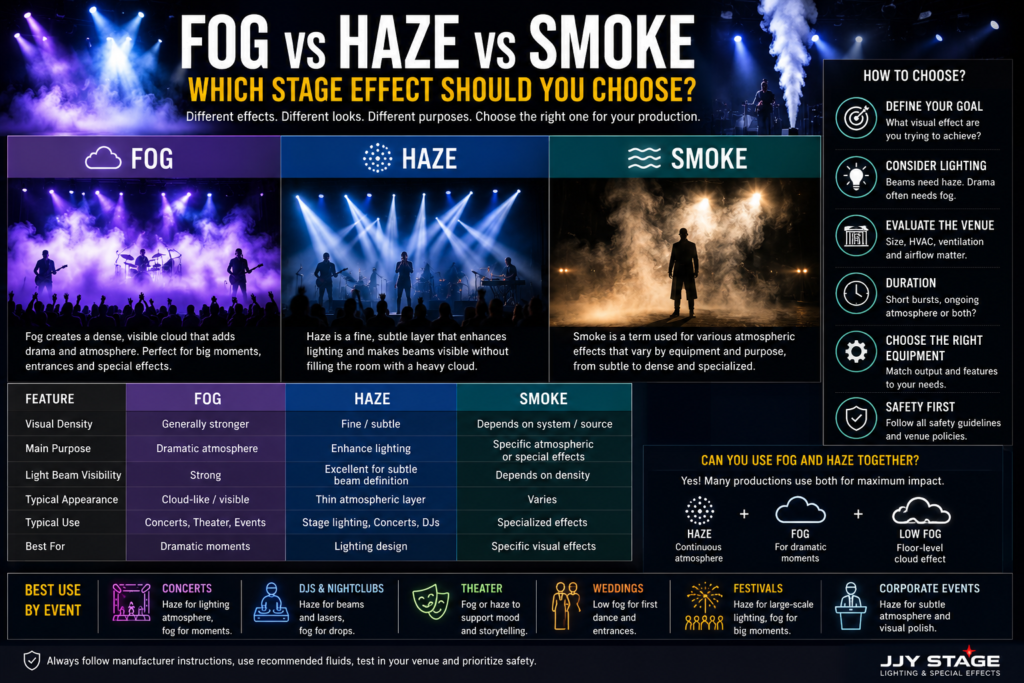
A production team wants to add atmosphere to a stage, but isn’t sure whether they actually need fog, haze, or smoke. It’s a common problem, and an understandable one in photos and video clips, these effects can look remarkably similar. In practice, though, fog vs haze vs smoke comes down to different equipment, different visual results, and different production purposes.
The right choice depends on several things at once:
- The visual effect you actually want
- Your lighting design
- The venue you’re working in
- The type of event
- How long the effect needs to last
- Airflow and ventilation conditions
- What your equipment is capable of
This guide walks through each effect, how they compare, and how to decide which one fits your production.
Fog vs Haze vs Smoke at a Glance
| Feature | Fog | Haze | Smoke |
| Visual density | Generally stronger | Fine/subtle | Depends on system/source |
| Main purpose | Dramatic atmosphere | Enhance lighting | Specific atmospheric/special effects |
| Light beam visibility | Strong | Excellent for subtle beam definition | Depends on density |
| Typical use | Concerts, theater, events | Stage lighting, concerts, DJs | Specialized effects |
| Typical appearance | Cloud-like/visible | Thin atmospheric layer | Varies |
| Best for | Dramatic moments | Lighting design | Specific visual effects |
One thing worth keeping in mind: terminology varies between manufacturers and markets. Two companies might use “fog” and “smoke” to describe fairly similar equipment. Rather than relying on the name alone, it’s worth looking at the actual output characteristics and intended application of a specific machine.
What Is Stage Fog?
Stage fog is a visible atmospheric cloud effect commonly used to add drama and presence to a stage. Fog effects are typically produced by a fog machine that heats or otherwise processes a fog fluid to generate a dense, visible output that billows outward and dissipates over time.
Fog has been a staple of live entertainment for decades because it’s an efficient way to create instant visual impact. It works especially well for:
- Concerts — big entrances and dramatic musical moments
- Theater — mood-setting for dramatic or suspenseful scenes
- Festivals — large-scale atmospheric moments across a stage
- DJ performances — bursts synced with music drops
- Live events — general atmospheric enhancement
- Dramatic entrances — building anticipation before a performer appears
When paired with stage lighting, fog scatters light strongly enough that beams become highly visible, often creating a bold, cloud-filled look rather than a subtle one.
What Is Stage Haze?
Stage haze is a fine, thin atmospheric effect designed to hang in the air for extended periods without creating a dense visual cloud. Where fog is meant to be noticed, haze is meant to work quietly in the background, mainly by interacting with light rather than by being visually obvious on its own.
Haze effects are useful because they scatter light from stage fixtures just enough to make beams visible, without filling the room with a heavy atmosphere. This makes haze a strong fit for lighting design that depends on visible beams, movement, and depth think moving heads, beam lights, and LED washes.
Because haze is generally less visually dominant than dense fog, it tends to work well as a consistent atmospheric layer throughout an entire performance, rather than something used in isolated bursts.
What Is Stage Smoke?
“Stage smoke” is a term that gets used a bit more loosely than fog or haze. In casual conversation, people often use it to describe almost any theatrical atmospheric effect sometimes meaning something closer to fog, and sometimes referring to specialized effects equipment built for a specific visual result.
Not all equipment marketed around “smoke” uses the same technology or produces the same output, so it’s not accurate to treat stage smoke as a single, standardized category. Smoke effects can vary widely depending on the system generating them and what visual result the production is aiming for.
Because of this variation, the most reliable approach is to evaluate any smoke-type equipment based on its actual operating method, output characteristics, and manufacturer-stated intended use not just the word “smoke” on the box.
Explore our Stage Special Effects Guide to learn about popular effects used in concerts, theater productions, weddings, festivals, and live events. The guide covers options such as fog, haze, bubbles, and other stage effects, helping event planners and production teams choose the right effects for different venues and performances.
Fog vs Haze: What’s the Difference?
| Factor | Fog | Haze |
| Density | Generally higher | Generally lower |
| Visual impact | Dramatic | Subtle |
| Main purpose | Atmospheric/special effect | Lighting enhancement |
| Beam definition | Strong | Excellent |
| Typical duration | Often controlled bursts or periods | Often maintained atmospherically |
| Best applications | Dramatic effects | Concert lighting, DJs, theater |
Both effects can make light beams visible, but they do it differently. Fog tends to produce a stronger, more obvious visual statement, while haze tends to support the lighting design without becoming the visual focus itself. Machine design and environmental conditions — venue size, airflow, ventilation will always shape the actual result. For a deeper look at this specific comparison, see fog machine vs haze machine.
Fog vs Smoke: What’s the Difference?
Fog and smoke are probably the two terms most often confused with each other, largely because they can look similar in photos, especially under stage lighting.
A few things separate them in practice:
- Visual appearance — fog usually produces a recognizable billowing cloud; “smoke” effects can vary from similar clouds to different visual textures depending on the system.
- Production methods — fog machines typically use a fairly consistent method of generating output; smoke-labeled equipment can use different mechanisms depending on the manufacturer.
- Typical applications — fog is broadly used across concerts, theater, and events; smoke-type effects are often chosen for more specific or specialized visual goals.
- Equipment terminology — “smoke machine” is not always a precise technical category, so the name alone doesn’t guarantee a particular result.
- Density — this can vary significantly between products in both categories.
- Lighting interaction — both can scatter light, but the degree depends on output density and particle characteristics.
Given this overlap, it’s worth reading the manufacturer’s actual description of the equipment and its intended application rather than assuming based on the product name.
Haze vs Smoke: What’s the Difference?
From a stage-production standpoint, the practical difference usually comes down to subtlety versus visual statement.
- Subtle atmospheric haze is built to support lighting design quietly, staying in the background while beams and fixtures do the visual work.
- More pronounced smoke-like effects are chosen specifically because the production wants that visual texture or density to be noticeable.
- Lighting interaction differs too haze is optimized for consistent, gentle light scattering, while smoke-type effects can range from subtle to heavy depending on the system.
- Event applications vary haze is common in ongoing lighting-heavy environments like concerts and DJ sets, while smoke-type effects are often reserved for specific moments or specialized productions.
- Equipment selection should always come back to the intended visual result rather than assuming one option is inherently superior.
Neither is universally “better” the right one depends entirely on what the production is trying to achieve.
Which Effect Is Best for Stage Lighting?
Choose haze when:
- Your main goal is visible light beams
- You want subtle atmosphere rather than a heavy cloud
- Moving heads are a major part of your lighting design
- You want lighting depth without overwhelming the stage visually
This is where stage lighting haze earns its reputation it’s built specifically to support beam-based lighting design.
Choose fog when:
- You want a dramatic atmospheric effect
- You need a stronger, more visible cloud
- You’re planning fog bursts for entrances or big musical moments
- You want the atmospheric effect itself to be a visible special effect
Choose smoke-type effects when:
- The production specifically calls for that particular visual style
- The equipment is designed and verified for the intended application
- Venue and production requirements permit that type of effect
Which Effect Is Best for Concerts?
| Concert Requirement | Recommended Effect |
| Visible moving light beams | Haze |
| Dramatic artist entrance | Fog |
| Music drop | Fog or atmospheric effect |
| Continuous lighting atmosphere | Haze |
| Dense stage atmosphere | Fog |
| Specialized visual effect | Appropriate dedicated effect equipment |
Many professional concert productions don’t rely on a single effect for the whole show. It’s common to run haze continuously for lighting atmosphere while reserving fog for specific high-impact moments a combination that gives lighting designers more range for concert fog effects and continuous atmospheric support at the same time.
Which Effect Is Best for Theater?
Theatrical productions often use atmospheric effects to reinforce storytelling, not just to look impressive:
- Drama — fog can support a heavier, more dramatic atmosphere for intense scenes.
- Mystery — atmospheric effects can help build suspense and uncertainty on stage.
- Fantasy — fog or low fog can help create a magical, otherworldly visual environment.
- Lighting design — haze can help define theatrical lighting beams without overwhelming the scene.
- Scene transitions — fog is sometimes used as a visual transition tool between scenes.
Theater productions generally need to weigh a few additional considerations that concerts don’t always face to the same degree: keeping performers clearly visible, maintaining audience sightlines, managing effects during active stage movement, and following venue ventilation requirements. This is one reason theatrical fog and haze tend to be used more deliberately and selectively in theater than in some other event types.
Which Effect Is Best for DJs and Nightclubs?
DJ sets and nightclub environments typically lean heavily on atmospheric effects to make dynamic lighting visible:
- Haze combined with moving heads for continuous, sweeping beam visibility
- Beam lighting that relies on atmosphere to read clearly across a dance floor
- LED fixtures that gain depth and dimension from a haze layer
- Laser effects that need atmospheric particles to trace visible paths
- Fog bursts for occasional dramatic accents during peak moments
Because sets often run for hours, a haze machine for DJs is frequently favored for its ability to maintain a consistent atmosphere without becoming visually overwhelming over an extended period.
Which Effect Is Best for Weddings & Events?
Weddings
For weddings, the goal is usually to enhance a moment rather than dominate it visually. First dances, entrances, and photography often benefit from a floor-level effect rather than a room-filling cloud. This is where low fog tends to stand out it can create a soft, cloud-like effect close to the floor without obscuring the couple or the room above waist height. For a full breakdown of this specific effect, see our guide on the low fog machine.
Corporate Events
Subtle atmospheric effects, often haze, can add polish to staging and product displays without becoming distracting in a professional setting.
Product Launches
Fog is often used to support dramatic reveals, paired with lighting cues timed to a product unveiling.
Festivals
Large-scale festival stages often combine atmospheric lighting with more dramatic effects, given the scale of the lighting rigs and audience distance involved.
Fog vs Haze vs Low Fog
| Effect | Main Visual |
| Standard Fog | General atmospheric cloud |
| Haze | Fine atmospheric layer |
| Low Fog | Cloud-like effect close to the floor |
Low fog is worth calling out specifically because it behaves differently from standard fog rather than filling a room, it’s designed to stay low, hugging the floor to create a cloud-like visual without obscuring the stage above it. Low fog tends to be preferred for:
- Weddings
- First dances
- Dramatic entrances
- Dance performances
- Theater
- Fantasy scenes
How Fog, Haze and Smoke Interact With Lighting
Regardless of which atmospheric effect is used, the underlying optical principle is the same: atmospheric particles in the air scatter light from stage fixtures, making the light’s path more visible from the audience’s viewing angle rather than only visible where it lands on a surface.
This interaction plays out across several fixture types:
- Beam lights — narrow beams become sharp, visible lines
- Moving head lights — sweeping movement becomes traceable through the air
- LED stage lights — colored washes gain depth and dimension
- Spotlights — the beam path itself becomes part of the visual, not just the lit subject
- Backlighting — silhouettes and rim lighting become more defined
- Laser effects — beam paths become visible rather than just the projected pattern
The density of the atmospheric effect determines how strong this scattering looks haze produces a subtle version of this effect, while fog produces a stronger, more visible version. Together, these interactions make up much of what’s generally referred to as stage lighting effects in modern productions.
How to Choose Between Fog, Haze and Smoke
Step 1: Define your desired visual Ask whether you want subtle atmosphere, visible beams, dense fog, a floor-level cloud, or a specialized smoke-like effect.
Step 2: Consider your event A concert, theater production, wedding, DJ event, and festival can all call for different atmospheric approaches, even with similar lighting rigs.
Step 3: Consider the lighting Think about which fixtures are central to the design beam-heavy rigs generally benefit more from haze, while dramatic moments often call for fog.
Step 4: Evaluate the venue Factor in size, HVAC, ventilation, airflow, and ceiling height before finalizing equipment choices.
Step 5: Consider duration Decide whether you need short bursts, occasional accents, or continuous atmosphere throughout the show.
Step 6: Choose appropriate equipment Match the machine’s output and capabilities to the effect you actually need, rather than choosing based on price or wattage alone.
Can You Use Fog and Haze Together?
Yes where the equipment, venue requirements, and production planning support it, fog and haze are frequently used together, each handling a different job.
A typical concert setup might look like this:
- Haze running continuously to support the overall lighting atmosphere
- Fog triggered specifically for the artist’s entrance
- Low fog reserved for a specific performance moment, like a featured dance sequence
Combining effects isn’t necessary for every production plenty of shows run well on a single atmospheric effect but for productions with varied lighting moments, layering effects can add more range without over-relying on any one machine.
What Factors Affect Fog, Haze and Smoke Effects?
- Venue size — larger spaces require different equipment and planning than small rooms
- Temperature — can affect how atmospheric particles behave and disperse
- HVAC — active systems can move or clear atmospheric effects unpredictably
- Ventilation — can reduce concentration faster than expected
- Fans — can help distribute effects evenly or disperse them too quickly
- Outdoor wind — a major factor for festival and outdoor stages
- Machine position — placement affects how evenly an effect spreads
- Output — determines overall density and coverage
- Lighting design — shapes how the effect visually reads to an audience
- Airflow — general air movement throughout the venue
- Fluid characteristics — different fluids behave differently depending on the equipment and manufacturer
Real-world performance always varies by venue, which is why on-site testing is repeatedly recommended throughout this guide.
Common Mistakes When Choosing Stage Atmospheric Effects
- Choosing based only on price — the cheapest machine may not deliver the visual effect a production actually needs.
- Choosing fog when you need haze — fog’s density can overwhelm a lighting design built around subtle beam visibility.
- Choosing haze when you need a dramatic cloud — haze may not provide the visual density a production is expecting for a big moment.
- Ignoring venue conditions — airflow can dramatically affect how any of these effects distribute.
- Ignoring lighting design — atmospheric effects work best when planned alongside the lighting concept, not added afterward.
- Skipping testing — always test effects in the actual venue when possible, since results can differ significantly from expectations.
Safety Considerations
- Follow manufacturer instructions at all times.
- Use only compatible, manufacturer-recommended fluids.
- Follow venue-specific policies and regulations.
- Maintain suitable visibility, especially near exits and walkways.
- Keep emergency exits clear and visible.
- Secure equipment properly to prevent tipping or obstruction hazards.
- Protect electrical connections from moisture and foot traffic.
- Manage cables safely to avoid trip hazards.
- Test equipment before the event.
- Use trained operators for professional productions where appropriate.
Quick Decision Guide
| If You Want… | Consider… |
| Visible light beams | Haze |
| Dramatic cloud effect | Fog |
| Floor-level cloud | Low fog |
| Subtle lighting atmosphere | Haze |
| Dramatic entrance | Fog |
| Wedding first dance | Low fog |
| Concert lighting atmosphere | Haze |
| Theater atmosphere | Fog or haze |
| DJ lighting | Haze |
| Specialized visual effect | Dedicated effect equipment |
Frequently Asked Questions
What is the difference between fog, haze and smoke?
Fog produces a visible, dense atmospheric cloud; haze produces a fine, subtle layer built mainly to enhance lighting; smoke is a looser term that varies by equipment and intended effect.
Is haze better than fog for stage lighting?
Neither is universally better. Haze tends to suit subtle, continuous beam visibility, while fog suits more dramatic, visually dense moments.
What is the best effect for visible light beams?
Haze is generally the strongest choice for making light beams visible without creating a heavy, room-filling cloud.
Is fog or haze better for concerts?
Many concerts use both haze for continuous lighting atmosphere and fog for dramatic, high-impact moments like entrances.
What is the difference between fog and smoke?
Fog typically refers to a fairly consistent, visible atmospheric cloud, while “smoke” is used more loosely and can refer to different equipment types and visual results.
Can fog and haze be used together?
Yes, when the venue and equipment allow it. Many productions run haze continuously and add fog for specific cued moments.
What is the best effect for theater?
It depends on the scene fog often supports dramatic or fantastical moments, while haze helps define lighting without obscuring performers.
What is the best effect for weddings?
Low fog is often preferred for weddings because it creates a floor-level cloud effect without obscuring the couple or the room.
What is a low fog machine?
A low fog machine produces a cloud-like effect that stays close to the floor, commonly used for weddings, dance performances, and dramatic entrances.
How do I choose the right stage effect machine?
Start with the visual effect you want, then factor in your event type, lighting design, venue conditions, and how long the effect needs to run.
Conclusion
There’s no single best atmospheric effect for every production the right choice depends on the visual result you’re after, your event type, your lighting system, your venue, airflow conditions, how long the effect needs to last, and what your equipment can actually deliver.
As a general guide:
- Haze — best for lighting enhancement and visible beams
- Fog — best for dramatic atmospheric effects
- Low fog — best for floor-level cloud effects
- Smoke-type effects — best reserved for specialized visual applications where the equipment is verified for that use
If you’re weighing these options for an upcoming production, JJY Stage’s Special Effect Series covers fog, haze, and low fog equipment built to work alongside professional stage lighting. Explore JJY Stage’s atmospheric effects equipment to find the right fit for your venue and event.