
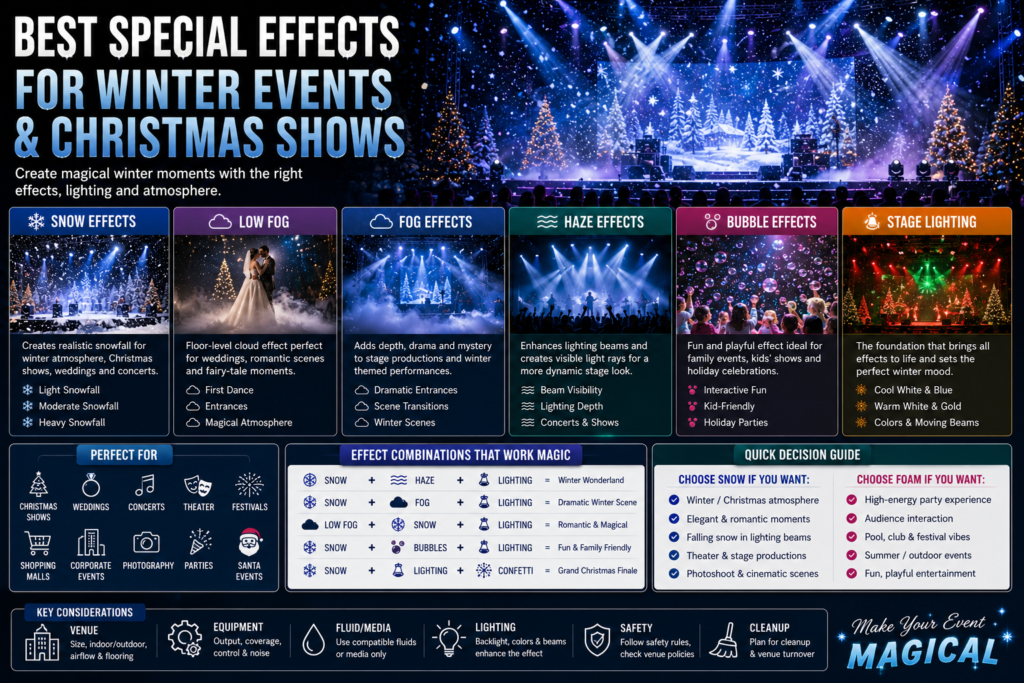
There’s a particular kind of magic that happens when a venue transforms into a winter wonderland snow drifting through colored light, fog rolling across a stage, and a room that suddenly feels like the middle of December no matter what season it actually is. Creating that feeling isn’t about flipping on one machine and hoping for the best. The right special effects for winter events come from combining atmosphere, lighting, timing, and set design into a single, cohesive experience.
Winter and Christmas productions can lean in very different directions depending on the mood you’re going for: realistic snowfall, an elegant winter atmosphere, a dramatic theatrical scene, a high-energy holiday concert, a joyful Christmas party, or a romantic winter wedding. This guide walks through the effects that work best for each of these goals, how to combine them, and how to choose equipment that actually fits your production.
Explore our Stage Special Effects Guide to learn about popular effects used in concerts, theater productions, weddings, festivals, and live events. The guide covers options such as fog, haze, bubbles, and other stage effects, helping event planners and production teams choose the right effects for different venues and performances.
What Makes a Great Winter-Themed Event?
A convincing winter atmosphere is rarely created by a single effect. It’s usually the result of several elements working together:
- Snow
- Fog
- Haze
- Stage lighting and color
- Music
- Set design
- Timing and cues
- Projection
- Props and decor
The goal is for special effects to support the overall theme rather than overwhelm the audience. A single, well-timed snowfall during a first dance can be more memorable than a stage full of competing effects with no coordination behind them. The best winter productions treat effects as one piece of a larger design, not the whole show.
Best Special Effects for Winter Events at a Glance
| Special Effect | Best For | Visual Result |
| Snow | Christmas and winter atmosphere | Falling snowfall |
| Low Fog | Weddings and theatrical scenes | Floor-level cloud |
| Fog | Dramatic winter scenes | Dense atmosphere |
| Haze | Lighting enhancement | Visible light beams |
| Bubbles | Family/party events | Playful atmosphere |
| Stage Lighting | All winter events | Color and atmosphere |
| Confetti | Christmas finales | Celebration |
The best combination for any given show depends on the event type, the venue, and the mood you’re building. The sections below break each effect down in more detail.
1. Artificial Snow Effects
Artificial snow is one of the most recognizable snow effects for events, and for good reason falling snow is an almost universal symbol of winter and Christmas, which makes it an easy way to communicate “this is a winter scene” the moment it starts.
Artificial snow effects show up across a wide range of productions:
- Christmas shows and holiday concerts
- Winter festivals
- Weddings, especially winter-themed ceremonies
- Theater productions
- Concerts and finale moments
- Shopping center displays
- Corporate holiday events
- Photography and content shoots
Snowfall can generally be adjusted to different visual styles, depending on the machine and the production’s goals:
- Light Snowfall — elegant and subtle, often used for weddings, ambient atmosphere, or ongoing background effect during a scene.
- Moderate Snowfall — a clearly visible winter atmosphere, suitable for most Christmas shows and general holiday events.
- Heavy Snowfall — dramatic and theatrical, typically reserved for big moments like finales or dramatic scene changes.
It’s worth being clear that the actual result depends on several factors together: the machine itself, the compatible snow fluid or media, output level, placement height, airflow in the venue, and how the effect is lit. The same machine can look completely different in a drafty outdoor tent versus a controlled indoor stage.
2. Snow Machine for Christmas Shows
A Christmas snow machine can be worked into almost every stage of a holiday production, not just as a background effect but as a scripted production element. Common integrations include:
- Christmas concerts
- Holiday stage shows
- Santa appearances and meet-and-greets
- Christmas parties
- Winter festivals
- Shopping mall holiday displays
A snow machine for Christmas events works best when it’s timed intentionally rather than left running continuously. Snowfall can be cued to:
- Specific songs or musical moments
- Performer entrances
- Santa’s arrival
- Finale sequences
- Lighting changes
Timing the snow to a specific cue rather than running it as constant background atmosphere tends to create a bigger reaction from the audience because it reads as a deliberate “moment” rather than ambient scenery. For a deeper look at machine types, fluid options, and setup planning, see the full snow machine for events guide.
3. Low Fog for Winter Weddings and Magical Scenes
Low fog behaves differently from standard fog instead of filling the air, it stays close to the ground, creating a cloud-like layer that rolls across the floor. That floor-hugging quality makes it a popular choice for winter wedding special effects, since it adds a fairy-tale visual without obscuring guests, decor, or lighting.
Typical low fog applications include:
- A couple’s first dance
- Wedding entrances and processionals
- Winter wedding photography
- Fairy-tale or fantasy stage scenes
- Theatrical productions with a dreamlike quality
The floor-level cloud effect from low fog is different from the way conventional fog fills an entire room — it’s a more contained, controlled look that works especially well when the goal is elegance rather than atmosphere-heavy drama. For more detail on how the effect is created and how to plan for it, see the low fog machine guide.
4. Fog Effects for Christmas Shows
Standard fog fills more of the room and is generally used for bigger, more dramatic moments. Fog effects for Christmas shows are commonly used to create:
- Dramatic performer entrances
- A sense of mystery
- General winter atmosphere
- Fantasy or storybook environments
- Scene transitions between acts
Fog tends to work particularly well when paired with directional lighting, including:
- Backlighting
- Moving heads
- Beam lights
- Spotlights
The combination of fog and light beams is what creates that dense, almost cinematic winter look often seen in professional Christmas productions. Fog density should always be matched to the venue a small indoor stage needs far less fog than a large hall or arena, and too much can obscure performers rather than enhance them. For more on machine types and output levels, see the fog machine for stage guide.
5. Haze for Christmas Stage Lighting
Haze is a lighter, more evenly distributed atmospheric effect than fog, and it’s especially valuable in productions where lighting design is a major part of the show. Haze effects for winter events are typically used to make light beams themselves visible in the air, rather than to create a visible “cloud.”
Haze pairs well with:
- Moving head fixtures
- LED lighting rigs
- Spotlights
- Lasers, where appropriate for the venue
- Backlighting
Without haze (or fog), many lighting effects only show up on the surfaces they hit the beams themselves stay invisible. Adding haze lets the audience see the actual light beams cutting through the air, which is a big part of what makes concert-style lighting look so dramatic. For a closer look at how this works, see the haze machine for stage lighting guide.
6. Bubble Effects for Christmas & Family Events
Bubbles bring a lighter, more playful energy than the atmospheric effects above, and they tend to work best for family-oriented productions rather than dramatic or elegant scenes. Bubble effects for events are common at:
- Children’s Christmas shows
- Family-focused holiday events
- Shopping center activations
- Holiday parties
- Interactive stage performances
Bubbles are generally more playful than realistic winter effects like snow or fog, but that’s exactly what makes them useful in fantasy or family-oriented productions where the goal is fun and engagement rather than a convincing winter illusion.
7. Stage Lighting for Winter-Themed Events
Lighting is what ties every other effect together, and it deserves just as much planning as the special effects themselves. Different colors and lighting techniques create very different winter moods:
- Cool White — creates an icy winter atmosphere.
- Blue — reinforces a cold, wintry mood.
- Warm White — creates a cozy, inviting Christmas environment.
- Red & Green — traditional Christmas colors, useful for festive moments.
- Purple — useful for fantasy or theatrical scenes.
- Moving Beams — add dynamic movement to snowfall and haze.
- Backlighting — makes artificial snow far more visible as it falls.
Lighting should be coordinated with special effects from the start of production planning, not added afterward. A snow machine running without supporting light can be almost invisible in a dim room, while the same snowfall under the right backlight becomes the visual centerpiece of the scene.
Best Special Effects for Different Christmas Events
| Event | Recommended Effects |
| Christmas Concert | Snow + Haze + Moving Heads |
| Christmas Theater | Snow + Fog + Lighting |
| Winter Wedding | Low Fog + Snow + Lighting |
| Christmas Party | Snow + Bubbles + Lighting |
| Shopping Mall Event | Snow + Lighting + Bubbles |
| Corporate Christmas Event | Snow + Haze + Lighting |
| Winter Festival | Snow + Lighting + Fog |
| Children’s Christmas Show | Snow + Bubbles + Colorful Lighting |
| Santa Event | Snow + Lighting + Bubbles |
| Christmas Finale | Snow + Lighting + Confetti |
These combinations are a practical starting point, but they should always be adapted to the specific venue’s requirements and the production’s actual goals.
Best Special Effects for Christmas Concerts
A well-planned Christmas concert often builds its effects around the structure of the show rather than using the same combination throughout. A sample production sequence might look like:
- Opening — haze with cool-toned lighting to set the mood before the show begins.
- Artist Entrance — fog paired with moving lights for a dramatic first appearance.
- Winter Song — snow with blue or white lighting to reinforce the seasonal theme.
- High-Energy Christmas Song — color-changing lights matched with an appropriate special effect for the song’s energy.
- Finale — snow combined with lighting and a celebratory effect like confetti.
Timing and coordination between music, lighting, and effects is what separates a memorable concert moment from a machine that just happens to be running in the background.
Best Special Effects for Winter Weddings
Weddings call for a more restrained, intentional approach than concerts or festivals. A typical winter wedding effects plan might include:
- Ceremony — subtle lighting and light atmosphere, kept understated.
- Couple Entrance — light fog or haze for a soft, dramatic arrival.
- First Dance — low fog combined with gentle snowfall and soft lighting.
- Photography — a controlled snowfall effect timed for photos.
- Wedding Exit — snowfall paired with lighting for a memorable send-off.
Wedding planning also requires extra attention to a few practical details: venue flooring, the wedding dress and other fabrics, guest movement through the space, photography and video considerations, cleanup requirements, and venue approval for any special effects equipment.
Best Special Effects for Christmas Theater
Theatrical productions often need more range than a single-mood event, since a script can move through multiple scenes and emotional beats. Common theatrical winter applications include:
- Winter scenes
- Snowstorm sequences
- Fantasy environments
- Christmas village settings
- Dramatic scene transitions
- Musical performance numbers
Theater productions are also where combining effects tends to matter most. Christmas stage effects productions can layer snow, fog, haze, and lighting together to create distinct environments as the story moves from scene to scene — a quiet snowy village in one act, a dramatic snowstorm in the next, and a warmly lit Christmas Eve scene to close the show.
How to Combine Snow, Fog, Haze and Lighting
A few practical combinations tend to come up again and again in winter productions:
Combination 1: Winter Atmosphere Snow + cool white lighting
Combination 2: Magical Christmas Snow + low fog + blue/white lighting
Combination 3: Dramatic Winter Scene Fog + backlighting + snow
Combination 4: Christmas Concert Haze + moving heads + snow
Combination 5: Children’s Christmas Event Snow + bubbles + colorful lighting
More effects running at once do not automatically make a better production in fact, stacking too many effects without coordination can muddy the visual and make it harder for any single element to stand out. The goal is coordination, not quantity.
How Lighting Changes the Appearance of Snow
The same snow machine, at the same output, can look completely different depending on how it’s lit:
- Backlighting makes individual snow particles stand out clearly against a darker background.
- Side Lighting adds depth and dimension to the falling snow.
- Blue Light reinforces an icy, cold winter mood.
- White Light creates a more natural, realistic snowfall appearance.
- Warm Light shifts the feeling toward a cozy Christmas atmosphere rather than a cold winter one.
- Moving Beams add dynamic movement, making the snowfall feel more alive and less static.
Choosing the right lighting approach is just as important as choosing the snow machine itself a strong effect with weak lighting will underperform, while a modest effect with well-planned lighting can look far more impressive.
How to Choose Special Effects Equipment for a Winter Event
- Define the Theme Decide whether you’re going for winter, Christmas, fantasy, elegant, dramatic, or party energy.
- Choose the Main Effect Snow, fog, haze, low fog, bubbles, or some combination of these.
- Consider the Venue Indoor or outdoor, room size, airflow, flooring, and ventilation all affect how equipment will perform.
- Consider the Audience Children, families, wedding guests, concert crowds, and corporate audiences all respond differently to different effects.
- Evaluate Equipment Requirements Check output, coverage area, control options, compatible fluid or media, noise level, portability, power needs, and placement requirements.
- Plan Lighting Match lighting colors and beam effects to whichever special effect you’ve chosen — they should be planned together, not separately.
- Test Before the Event Always test the effect under the actual venue conditions when possible, since results can vary significantly from one space to another.
Indoor vs Outdoor Winter Special Effects
| Factor | Indoor | Outdoor |
| Airflow | HVAC is important | Wind is a major factor |
| Snow distribution | More controllable | Wind can redirect snow |
| Fog | Can accumulate | Disperses faster |
| Haze | More controllable | Wind reduces persistence |
| Flooring | Important | Ground conditions matter |
| Cleanup | Must be planned | Depends on location |
| Venue rules | Critical | Site/weather requirements |
Outdoor winter effects generally require more environmental planning than indoor ones, since wind, temperature, and ground conditions are outside the production team’s control and can change on the day of the event.
Safety Considerations for Christmas & Winter Special Effects
- Follow manufacturer instructions for every piece of equipment.
- Use only compatible fluids or media.
- Check venue-specific requirements before booking equipment.
- Secure all equipment correctly, especially anything rigged overhead.
- Protect electrical connections from moisture, especially with fog and low fog.
- Keep emergency exits clear at all times.
- Maintain performer visibility so effects don’t obscure safety-critical sightlines.
- Consider floor conditions, particularly slip risk from fog condensation.
- Manage cables safely to avoid trip hazards.
- Test every effect before the actual show.
- Follow appropriate professional rigging practices for any elevated equipment.
No specific effect or fluid should be assumed safe for every venue or surface always verify with the manufacturer and the venue directly.
Common Mistakes When Planning Winter Special Effects
Using too many effects. More effects running simultaneously do not necessarily create a better production, and can actually distract from the moment you’re trying to build.
Ignoring lighting. Snow in particular can be difficult to see without the right lighting behind or around it.
Ignoring airflow. HVAC systems indoors and wind outdoors can both significantly change how an effect behaves.
Choosing equipment based only on price. Equipment should be matched to the effect the production actually needs.
Forgetting cleanup. Always plan around the venue’s flooring and cleanup requirements in advance.
Skipping a full venue test. Effects can look noticeably different during the actual production than they did in a demo or showroom.
Poor timing. Special effects should be synchronized with music and stage cues rather than run continuously in the background.
Winter Special Effects Production Checklist
- ☐ Define the winter/Christmas theme
- ☐ Choose the main special effect
- ☐ Select suitable equipment
- ☐ Check venue requirements
- ☐ Evaluate airflow
- ☐ Plan equipment placement
- ☐ Plan lighting
- ☐ Check compatible fluids/media
- ☐ Test the effect
- ☐ Coordinate music and lighting cues
- ☐ Plan cleanup
- ☐ Prepare backup equipment where appropriate
Frequently Asked Questions
What are the best special effects for winter events?
Snow, fog, haze, low fog, and bubbles are the most common winter event effects, usually combined with coordinated stage lighting. The right mix depends on the event type, venue, and desired atmosphere.
What is the best effect for a Christmas show?
Artificial snow is generally the most recognizable Christmas effect, often paired with haze or fog and warm or cool lighting depending on whether the show is going for a cozy or dramatic feel.
Is a snow machine good for Christmas events?
Yes, a snow machine is one of the most effective ways to create a Christmas atmosphere, especially when the snowfall is timed to music, performer entrances, or key moments in the show.
What special effects work best for winter weddings?
Low fog and gentle snowfall paired with soft lighting are popular choices for winter weddings, particularly for first dances, entrances, and photography moments.
Can fog and snow be used together?
Yes, fog and snow are often combined to create dramatic winter scenes, especially in theatrical productions, though the combination should be planned around venue size and airflow.
Is haze useful for Christmas stage lighting?
Haze makes light beams visible in the air, which is especially valuable for Christmas productions that rely heavily on moving heads, LED fixtures, or beam lighting.
What lighting is best for artificial snow?
Backlighting tends to make falling snow the most visible, while blue light adds an icy mood and warm light creates a cozier Christmas feeling.
Can snow machines be used indoors?
Snow machines can be used indoors depending on the specific equipment, venue policies, ventilation, and flooring, so it’s important to confirm indoor suitability in advance.
What effects work best for Christmas concerts?
Christmas concerts often combine snow, haze, and moving head lighting, with different combinations used for different moments in the set, such as ballads versus high-energy songs.
How do I choose special effects equipment for a winter event?
Start by defining your theme and main effect, then evaluate your venue, audience, and equipment requirements, plan your lighting alongside the effect, and test everything under real venue conditions before the event.
Conclusion
Successful winter-themed events almost always combine multiple special effects and lighting elements rather than relying on a single machine to carry the entire production. Snow builds a general winter atmosphere, low fog adds a magical floor-level effect ideal for weddings, fog brings drama and depth, haze enhances lighting beams, bubbles add a playful family-friendly touch, and stage lighting ties everything together into a complete visual environment.
The right setup for your event depends on the event type, theme, venue, audience, lighting design, the visual effect you’re going for, and the actual capabilities of the equipment available to you. Special Stage lighting Effect Series covers snow, fog, haze, and low fog equipment built for professional event use reviewing verified specifications against your production’s real requirements is the best way to find the right combination for your winter or Christmas show.