
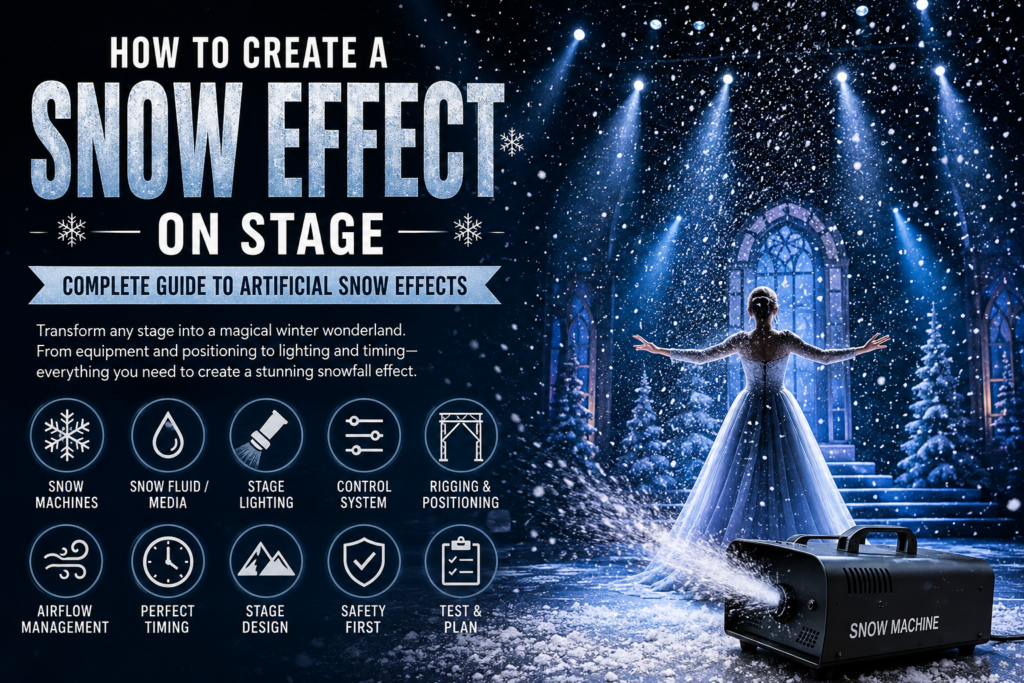
Artificial snowfall can turn a plain stage into a full winter environment in seconds but a convincing stage snow effect takes more than just switching on a snow machine and hoping for the best. The final result depends on a combination of factors working together: the snow machine itself, the snow fluid or media it uses, where the machine is positioned, the airflow in the venue, the stage lighting, the surrounding stage design, how dense the snowfall is, and when it’s triggered during the performance.
This guide walks through exactly how to create a snow effect on stage, step by step from choosing equipment to positioning it, testing it, lighting it, and timing it to a live performance. It covers applications across theater, concerts, weddings, Christmas productions, festivals, corporate events, and photography or film work, so you can plan the right approach for your specific production.
Explore our Stage Special Effects Guide to learn about popular effects used in concerts, theater productions, weddings, festivals, and live events. The guide covers options such as fog, haze, bubbles, and other stage effects, helping event planners and production teams choose the right effects for different venues and performances.
What Is a Stage Snow Effect?
A stage snow effect is an artificial snowfall effect designed to visually recreate falling snow during a live performance, event, production, or themed experience. It’s built to look like snow is falling through the performance space, without relying on actual weather or a real winter environment.
The key thing to understand is that a stage snow effect sometimes called an artificial snow effect is designed primarily for visual presentation. It’s a production tool aimed at audience impact, not an attempt to produce real outdoor snow conditions or a surface you could walk or ski on. That distinction shapes everything about how the effect is planned, from equipment choice to lighting design.
How Is Artificial Snow Created on Stage?
While the exact mechanism varies by manufacturer, most professional systems follow a similar general sequence.
- Snow Machine A specialized snow effect machine generates or disperses the snow-like material that forms the visual effect.
- Snow Fluid or Media Depending on the machine, this involves a compatible snow fluid or a different type of artificial snow medium always specific to that system.
- Airflow The machine uses a fan or blower to distribute the generated particles out into the performance area.
- Falling Snow Because the particles are lightweight, they travel through the air and drift down toward the stage rather than dropping straight down.
- Stage Lighting Lighting interacts with the falling particles, making them more visible and enhancing the overall winter atmosphere.
It’s worth repeating: not every snow machine uses the same technology or the same consumable. The exact mechanism of how the material is generated, how it’s dispersed, what fluid or media is compatible depends entirely on the specific equipment. Always check the manufacturer’s documentation for your machine rather than assuming it works like another brand’s system.
What Equipment Do You Need to Create a Snow Effect?
| Equipment | Purpose |
| Snow effect machine | Produces/distributes artificial snow |
| Compatible snow fluid/media | Creates the snow-like material |
| Stage lighting | Illuminates falling snow |
| Control system | Controls timing/output where supported |
| Rigging/stand | Positions equipment safely |
| Power supply | Operates equipment |
| Stage/set design | Completes the winter environment |
The exact setup depends heavily on the venue and the production: a small wedding reception and a full theatrical production will call for different combinations of this equipment. For productions that need reliable, purpose-built snow equipment, JJY Stage’s Special Effect Series is worth exploring as part of a broader stage effects setup.
Step-by-Step: How to Create a Snow Effect on Stage
Step 1: Decide What Kind of Snow Effect You Want
Before choosing equipment, decide what the scene actually calls for:
- Light snowfall
- Moderate snowfall
- Heavy snowfall
- Dramatic snowfall
- Gentle winter atmosphere
The appearance you’re going for determines almost everything downstream equipment settings, placement, and even which machine is appropriate for the job. A gentle, romantic first-dance moment calls for a very different setup than a blizzard-style concert finale.
Step 2: Choose the Right Snow Effect Machine
When evaluating a snow effect machine, consider:
- Venue size
- Output
- Throw distance
- Snowfall density
- Control options
- Noise level
- Portability
- Fluid/media compatibility
A snow machine for stage use in a small theater has different requirements than one used for an outdoor festival stage. Don’t recommend or choose a specific product based on assumptions only rely on specifications the manufacturer has actually verified for that machine.
Step 3: Evaluate the Venue
Before positioning anything, take stock of the space itself:
- Stage dimensions
- Ceiling height
- HVAC systems
- Ventilation
- Fans
- Doors
- Audience location
- Performer movement
Airflow is one of the biggest variables in how artificial snow behaves. A venue with strong HVAC output or frequently opening doors can significantly change the direction and distribution of the falling particles sometimes in ways that aren’t obvious until you actually run the effect.
Step 4: Position the Snow Machine
General placement options include:
- Elevated positions
- Stage sides
- Rear-stage positions
- Overhead positions, where properly rated and installed
Elevated placement may create a more natural falling effect, since it gives particles more room to drift before reaching the stage or audience. That said, the actual results still depend on the specific machine and the venue’s airflow the same placement won’t produce identical results in every space. Always follow the manufacturer’s instructions and the venue’s requirements for mounting and rigging equipment; this isn’t an area to improvise.
Step 5: Test the Snow Output
Before relying on the effect for a live performance, test:
- Density
- Fall pattern
- Coverage
- Throw distance
- Visibility
- Interaction with lighting
Testing in the actual venue not just in a warehouse or showroom is what catches problems before they show up in front of an audience. A machine that looked perfect in one space can behave differently once airflow, ceiling height, and lighting change.
Step 6: Add Stage Lighting
Lighting is one of the most important parts of creating a convincing artificial snow effect. Without enough light interacting with the falling particles, even a well-calibrated snow machine can look underwhelming. Useful lighting tools include:
- Backlighting
- Side lighting
- Moving beams
- Spotlights
- LED stage lights
- Cool-colored lighting
Lighting can make otherwise subtle artificial snow far more visible often the difference between an effect the audience barely notices and one that defines the whole scene.
Step 7: Coordinate the Snow With the Performance
Timing matters as much as the visual itself. Common cues to coordinate with include:
- Music
- Performer entrances
- Scene transitions
- First dance
- Christmas moments
- Finales
- Dramatic reveals
Controlled, well-timed snowfall often produces a stronger impact than snow that runs continuously throughout an event. A burst of snow at exactly the right musical beat or narrative moment tends to land more powerfully than a constant background effect.
How to Make Artificial Snow Look More Realistic
Use Appropriate Snow Density Too little snow can be hard to see, especially under weak lighting. Too much can overwhelm the stage and reduce visibility.
Use the Right Lighting Angle Backlighting and side lighting tend to make falling particles more visible than front lighting alone.
Use Appropriate Machine Placement Where the machine sits directly affects how natural the fall pattern looks — placement and airflow work together here.
Consider Airflow HVAC and fans can change snowfall direction significantly, so account for them before finalizing your setup.
Match Snowfall to the Scene Gentle snowfall tends to suit romantic or quiet scenes, while heavier snowfall supports more dramatic moments.
Combine With Stage Design Winter backdrops, cool lighting, white set pieces, and winter-themed props can all reinforce the effect and make the snow feel like part of a cohesive environment rather than an isolated effect.
Keep in mind that not every snow fluid behaves identically appearance, fall speed, and density can vary between manufacturers and products, so what works for one system won’t necessarily transfer directly to another.
Best Lighting for a Stage Snow Effect
| Lighting Type | Effect on Artificial Snow |
| Backlight | Helps illuminate falling particles |
| Side light | Adds depth and visibility |
| Beam light | Makes snowfall visible within the light path |
| Spotlight | Highlights specific snowfall areas |
| LED wash | Creates overall winter atmosphere |
| Moving head | Adds dynamic lighting movement |
Color temperature and color choice also shape the mood of the effect:
- Cool White / Blue — creates a winter and icy atmosphere
- Warm White — creates a Christmas and cozy winter atmosphere
- Colored Lighting — suits fantasy, theatrical, or musical productions
How to Create a Snow Effect for Theater
Theatrical productions use snow to support storytelling as much as spectacle. Common applications include:
- Winter scenes
- Christmas plays
- Musicals
- Fairy tales
- Fantasy productions
- Dramatic transitions
For a theatrical snow effect, productions need to plan around performer visibility, stage movement and choreography, costume interaction, flooring conditions across repeated performances, sound levels from the equipment, audience visibility, and post-show cleanup. These considerations become more important the longer a production runs, since the effect needs to hold up consistently night after night.
How to Create a Snow Effect for Concerts
A snow effect for concerts typically shows up around:
- Artist entrances
- Song transitions
- Christmas concerts
- Winter-themed performances
- Finales
- Special effects moments
Concert production benefits from synchronizing snow with moving heads, beam lights, LED fixtures, and music cues, so the effect lands precisely with a chorus, drop, or key lyric rather than running independently of the show.
How to Create a Snow Effect for Weddings
A snow effect for weddings is often built around a handful of key moments:
- First dance
- Bride/groom entrance
- Wedding exit
- Winter-themed photography
- Christmas weddings
Practical planning matters just as much as the visual here: confirm venue approval before booking the effect, check floor conditions, consider how the effect interacts with dresses and formalwear, plan around guest movement, coordinate timing with photographers, and plan for cleanup afterward. Avoid assuming a particular snow fluid is safe for every wedding venue flooring types and venue policies vary, so this should always be confirmed rather than assumed.
How to Create a Christmas Snow Effect
A Christmas snow effect works well across a wide range of settings:
- Christmas concerts
- Holiday parties
- Shopping centers
- Santa events
- Corporate Christmas parties
- Winter festivals
- Seasonal stage shows
Combining artificial snow with lighting, music, and seasonal set design tends to create a noticeably stronger experience than the snow effect on its own. The snow becomes one piece of a larger seasonal atmosphere rather than the entire effect.
Stage Snow Effect vs Real Snow
| Feature | Stage Snow Effect | Real Snow |
| Temperature dependent | Generally designed for event environments | Yes |
| Indoor use | Some systems are designed for indoor applications | Generally impractical |
| Timing | Controlled | Weather dependent |
| Visual consistency | Can be planned | Variable |
| Production use | Excellent | Limited |
| Lighting control | Can be coordinated | Natural |
| Venue requirements | Must be checked | Weather dependent |
Artificial snow is a theatrical effect a production tool for controlled, repeatable atmosphere. It isn’t necessarily a substitute for natural snow in every context, but for live events, its controllability is exactly why it’s used.
How Airflow Affects a Stage Snow Effect
Airflow from several sources can reshape how a snow effect actually performs:
- HVAC
- Fans
- Ventilation
- Doors
- Outdoor wind
- Audience movement
These factors can cause artificial snow to drift sideways, fall faster than expected, spread wider than planned, or concentrate unevenly in specific areas of the stage. This is exactly why testing in the actual venue matters a snow effect that looks perfect in a controlled test space can behave quite differently once real venue conditions come into play.
Common Mistakes When Creating Artificial Snow
- Using too much snow — can reduce visibility and create unwanted buildup on the stage or floor.
- Ignoring airflow — can make the snowfall pattern uneven or unpredictable.
- Choosing equipment based only on wattage — output and distribution characteristics matter just as much as raw power.
- Poor machine placement — can result in an unnatural-looking snowfall pattern.
- Insufficient lighting — the snow may be difficult for the audience to see at all.
- No test run — the effect may look noticeably different once you’re in the actual performance.
- Using incorrect snow fluid — always use manufacturer-approved or compatible material for your specific machine.
Can You Combine Snow With Other Stage Effects?
Snow can be layered with other effects where it makes sense for the production:
- Snow + Haze — creates atmospheric depth and helps lighting become more visible throughout the space.
- Snow + Fog — can create a dramatic winter environment.
- Snow + Low Fog — can create a layered winter scene, with snow falling above a grounded cloud layer.
- Snow + Bubble Effects — can create playful or fantasy-themed environments.
- Snow + Stage Lighting — generally creates the strongest overall visual effect on its own.
If you’re weighing snow against other atmospheric options, our guide on fog vs haze vs smoke breaks down which effect fits which situation, and our haze machine for stage lighting article covers how haze specifically interacts with light beams. For the fundamentals of snow machine equipment itself, see our companion guide, snow machine for events.
How to Choose a Snow Effect Machine
- ☐ Venue size
- ☐ Desired snowfall density
- ☐ Throw distance
- ☐ Output
- ☐ Control options
- ☐ Noise
- ☐ Portability
- ☐ Fluid/media compatibility
- ☐ Indoor/outdoor use
- ☐ Airflow
- ☐ Placement
- ☐ Maintenance
- ☐ Venue policies
- ☐ Lighting requirements
Compare machines against your actual event requirements rather than relying on a single spec, like wattage or tank size, to make the decision. The right machine for a wedding first dance may be entirely wrong for a touring concert production, even if both are technically “snow machines.”
Safety Considerations for Stage Snow Effects
- Follow manufacturer instructions for setup and operation.
- Use compatible snow fluid or media for your specific machine.
- Check venue requirements before bringing in effects equipment.
- Secure equipment properly, especially in elevated positions.
- Protect electrical connections from moisture and foot traffic.
- Manage cables safely to prevent trip hazards.
- Maintain performer visibility throughout the effect.
- Maintain audience visibility as well.
- Keep exits clear at all times.
- Consider floor conditions, particularly in high-traffic areas.
- Test before the event to catch issues early.
- Follow professional rigging requirements where applicable.
Avoid making unsupported claims about a particular snow product being non-slip, non-staining, residue-free, or safe for all surfaces. These properties vary by manufacturer and should only be stated when actually verified for that specific product.
Professional Stage Snow Effect Checklist
Before the Event
- ☐ Select the appropriate snow machine
- ☐ Check compatible fluid/media
- ☐ Inspect equipment
- ☐ Evaluate airflow
- ☐ Plan machine placement
- ☐ Plan lighting
- ☐ Test the effect
During Setup
- ☐ Secure equipment
- ☐ Connect power safely
- ☐ Test output
- ☐ Check snowfall direction
- ☐ Adjust lighting
- ☐ Coordinate timing
During the Event
- ☐ Monitor snowfall
- ☐ Monitor visibility
- ☐ Watch performer movement
- ☐ Adjust when appropriate
- ☐ Monitor venue conditions
Frequently Asked Questions
How do you create a snow effect on stage?
Creating a stage snow effect involves choosing the right snow machine, positioning it appropriately for the venue, testing the output, and pairing it with stage lighting timed to the performance for maximum visual impact.
What machine is used to create artificial snow?
A snow effect machine or artificial snow machine is used, typically working with a compatible snow fluid or media specific to that system. The exact type of machine depends on the production’s needs.
How does a snow effect machine work?
Most systems generate or disperse a snow fluid or media into lightweight particles, then use fan-driven airflow to distribute the effect through the performance space, where it drifts down like falling snow.
Is artificial stage snow real snow?
No. It’s a visual effect made from snow fluid or media designed to look like falling snow not actual frozen precipitation, and not intended to replicate real winter weather.
How do you make artificial snow look realistic?
Realistic-looking stage snow depends on appropriate density, correct lighting angle (especially backlighting), thoughtful machine placement, and accounting for venue airflow, which can all change how convincing the effect appears.
What lighting is best for stage snow?
Backlighting and side lighting are especially effective at making falling snow visible. Moving heads, beam lights, and cool-colored LEDs can further enhance the atmosphere depending on the scene.
Can snow machines be used indoors?
Some systems are designed specifically for indoor use, though performance still depends on the machine, venue airflow, and manufacturer guidance for that product.
Can snow effects be used at weddings?
Yes. Snow effects are commonly used for wedding entrances, first dances, exits, and photography, particularly for winter or Christmas-themed weddings.
Can snow machines be used at concerts?
Yes. They’re often synchronized with lighting and music cues for artist entrances, song transitions, and finale moments during concerts.
How do I choose a stage snow machine?
Consider venue size, desired snowfall density, throw distance, control options, noise level, fluid compatibility, portability, and maintenance requirements matched to your specific production rather than a single spec.
Conclusion
A convincing stage snow effect comes down to a clear process: choose the right snow machine, evaluate the venue, position the equipment thoughtfully, test the snowfall, add appropriate lighting, and coordinate the effect with the performance itself. None of these steps works in isolation a great machine with poor lighting, or perfect placement with no test run, rarely produces the result you’re after. A successful effect is really a combination of equipment, lighting, airflow, timing, and stage design working together.
Explore JJY Stage’s professional special effects equipment to find the right solution for your next stage, concert, wedding, or live event.