
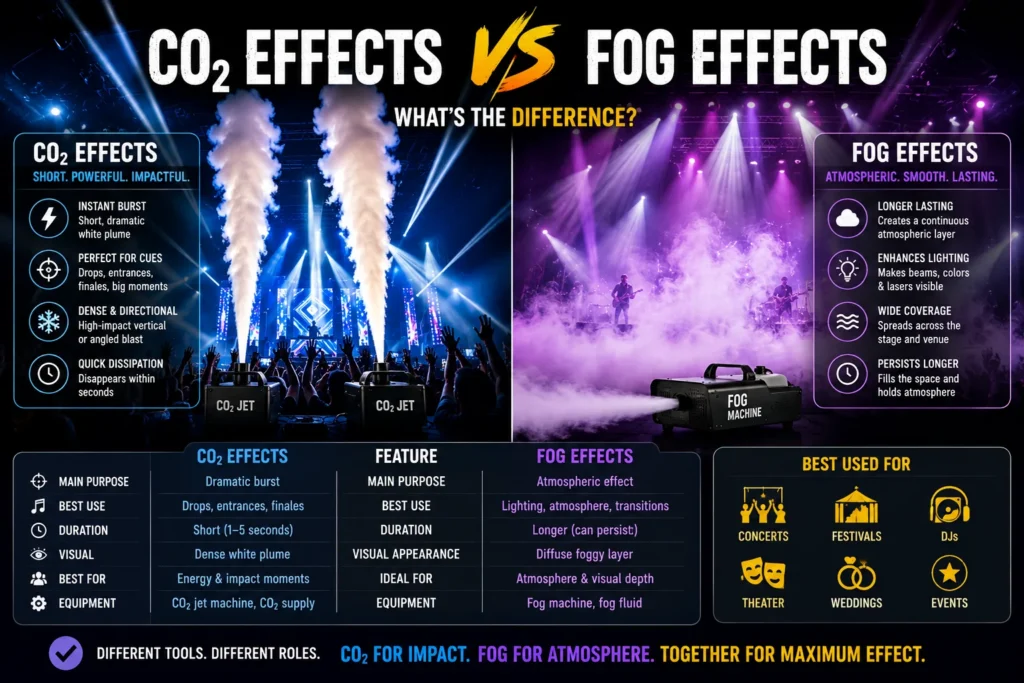
Both CO₂ effects vs fog effects can transform a stage into something dramatic and memorable, but they’re built to solve two very different production problems. A CO₂ jet is generally used to create a short, powerful visual burst tied to a specific moment, while fog is primarily used to build a longer-lasting atmospheric layer that helps make lighting visible across an entire performance.
Understanding that distinction matters because these effects show up in nearly every kind of live production concerts, festivals, DJ sets, nightclubs, theater, weddings, and corporate events and choosing the wrong one for the moment can undercut a show’s visual impact instead of enhancing it. This guide breaks down how each effect works, where each one excels, and when it makes sense to use both.
CO₂ Effects vs Fog Effects at a Glance
| Feature | CO₂ Effects | Fog Effects |
| Main purpose | Dramatic burst | Atmospheric effect |
| Appearance | Dense white plume | Foggy atmosphere |
| Typical duration | Short burst | Can persist longer |
| Best use | Drops, entrances, finales | Lighting atmosphere |
| Concert use | High-impact moments | Continuous atmosphere |
| Lighting interaction | Strong | Strong |
| Music synchronization | Excellent for cue-based bursts | Often used continuously or in cues |
| Best for | Energy and impact | Atmosphere and depth |
| Equipment | CO₂ jet system | Fog machine + compatible fluid |
| Venue considerations | CO₂ supply, ventilation, clearance | Ventilation, fluid, visibility |
Actual performance for both effects varies by machine, venue, operating conditions, and setup the table above reflects general roles, not fixed specifications.
What Are CO₂ Stage Effects?
CO₂ stage effects — sometimes called CO₂ jet machines, CO₂ cannons, or CO₂ blasters use pressurized liquid CO₂ systems to release a fast, dense burst of white vapor. It’s worth noting that the visible plume isn’t simply “white CO₂.” The gas itself is invisible; the white cloud appears because rapid expansion and cooling cause moisture already present in the surrounding air to condense.
This is why CO₂ effects tend to produce a bright, fast, directional burst rather than a soft, spreading cloud. For a deeper look at how these systems work and how they’re used in live shows, see our full guide on the CO₂ jet machine for concerts.
What Are Fog Effects?
Theatrical fog effects rely on fog machines and compatible fog fluid, processed through heating or another machine-specific mechanism to produce a visible atmospheric layer. Rather than creating one short vertical burst, fog is generally designed to spread across a performance area and stay visible for longer, which is what makes it useful for supporting stage visibility and lighting design over the course of a set.
Stage fog effects and theatrical fog effects are staples in concerts, theater, and events precisely because of this atmospheric quality. For a complete breakdown, see our guide to the fog machine for stage.
How Do CO₂ Effects Work?
At a high level, CO₂ effects follow this sequence:
- CO₂ is stored in an appropriate pressurized container.
- The system delivers CO₂ through compatible hosing to the jet.
- A controlled release occurs at the nozzle.
- Rapid expansion produces a strong cooling effect.
- Moisture in the surrounding air condenses.
- A visible white plume appears.
- The effect dissipates quickly.
Equipment must always be used according to the manufacturer’s specifications, and this guide doesn’t provide instructions for modifying pressure systems, valves, regulators, cylinders, or hoses that’s manufacturer and qualified-technician territory.
How Does a Fog Machine Work?
The general process, though specific mechanisms vary by machine design:
- Fog fluid is supplied to the machine.
- The machine processes the fluid to create a visible aerosol.
- Visible fog is produced and released.
- The fog spreads through the performance area.
- Lighting makes the fog more visually noticeable.
Not every fog machine works identically heating methods, output volume, and fluid requirements can differ between models, so manufacturer documentation is the best source for how a specific unit performs.
CO₂ vs Fog: Visual Difference
CO₂ Effect — typically dense, bright white, fast-moving, short-lived, directional, and dramatic.
Fog Effect — typically diffuse, atmospheric, longer-lasting, spread across an area, and useful for creating visual depth.
The exact visual result for either effect depends heavily on the specific equipment, the environment, airflow, and how it’s lit.
CO₂ Effects vs Fog Effects for Concerts
CO₂ is useful for:
- Bass drops
- Artist entrances
- Chorus moments
- Song finales
- DJ drops
- Festival climaxes
Fog is useful for:
- Overall atmosphere
- Lighting visibility
- Scene transitions
- Continuous stage atmosphere
- Background effects
Many professional productions use both, because they solve different visual problems rather than competing for the same role. Fog builds the world the audience sees throughout the set; CO₂ marks the moments they’ll remember.
CO₂ vs Fog for Stage Lighting
CO₂ + Lighting CO₂ bursts can become highly visible when illuminated with moving heads, beam lights, LED fixtures, backlighting, and strobes the plume gives lighting designers a bright, temporary canvas to work with.
Fog + Lighting Fog can help reveal beam paths, moving head effects, laser effects where appropriate, backlighting, and other volumetric-looking lighting effects across the whole stage.
The practical distinction: fog or haze is generally the better choice when the goal is to maintain an atmospheric lighting environment throughout a performance, while CO₂ is better suited to a single, sudden visual accent.
CO₂ vs Fog for Music Synchronization
CO₂ is best suited for precise, short cues a beat drop, an artist entrance, a chorus peak, or a finale.
Fog can be used continuously, intermittently, scene-based, or cue-controlled. It can absolutely be synchronized to music as well, but because it remains in the environment longer, its visual behavior reads differently than a CO₂ burst even when it’s triggered on a specific cue.
CO₂ Effects vs Fog Effects for DJs
| DJ Application | Better Option |
| Bass drop | CO₂ |
| Continuous atmosphere | Fog |
| Crowd-energy moment | CO₂ |
| Lighting visibility | Fog |
| DJ entrance | CO₂ |
| Background atmosphere | Fog |
| Festival-style visual punch | CO₂ |
CO2 effects for DJs often get paired with fog running in the background, so the production has both a consistent atmosphere and a tool for punctuating the set’s biggest moments.
CO₂ vs Fog for Festivals
CO₂ is good for main-stage drops, artist entrances, large visual moments, and high-energy performances.
Fog is good for stage atmosphere, lighting visibility, transitions, and background visual depth.
Outdoor conditions add another variable: wind can affect both effects, but differently. A CO₂ burst may lose its shape or dissipate faster in strong wind, while fog can spread unevenly or drift away from the intended coverage area.
CO₂ vs Fog for Theaters
Theater productions often prioritize atmosphere and controlled storytelling over sudden bursts, which shapes how each effect gets used.
Fog can support mystery, dream sequences, transitions, and atmospheric scenes that need to hold for a while.
CO₂ can support dramatic entrances, short visual moments, and special climaxes where a single burst reinforces a specific beat in the story.
Both fall under the broader category of stage special effects that theatrical productions draw on, and theatrical fog effects in particular remain one of the most common tools for building scene atmosphere.
CO₂ vs Fog for Weddings & Private Events
CO₂ is useful for a couple’s entrance, dance-floor moments, DJ performances, and celebration finales.
Fog is useful for atmospheric lighting, the first dance, stage decoration, and entrance effects that need to hold for longer than a few seconds.
For private events, venue policies, flooring, ventilation, and guest proximity should always be checked before booking either effect many venues have their own rules about what’s permitted indoors.
CO₂ vs Fog: Which Effect Lasts Longer?
Fog generally provides a longer-lasting atmospheric effect, while CO₂ is usually designed as a short-duration burst. That difference comes down to purpose: fog is built to occupy space in the room over time, while CO₂ is built to expand, become visible, and disperse quickly. Exact durations aren’t universal they depend on the machine, the environment, airflow, and how the equipment is operated so specific timing should come from the manufacturer’s documentation.
Which Is Better for Creating a Dramatic Effect?
CO₂ is generally better suited to sudden visual impact, think beat drops, entrances, concert finales, DJ moments, and festival climaxes, where the goal is one unmistakable instant rather than an ongoing effect.
Fog, by contrast, is better when the goal is to build the atmosphere gradually rather than deliver a single dramatic spike.
Which Is Better for Creating a Stage Atmosphere?
Fog is generally the better choice for a persistent stage atmosphere supporting lighting beams, adding scene depth, building background atmosphere, and shaping theatrical environments over the length of a performance.
It’s also worth noting that haze can sometimes be a better fit than conventional fog when the primary goal is lighting visibility rather than a visible atmospheric layer. For a full breakdown of when to use each, see fog vs haze vs smoke.
CO₂ vs Fog Equipment Requirements
CO₂ System may involve a CO₂ jet machine, an appropriate CO₂ supply, compatible high-pressure components, a control system where supported, electrical power, and appropriate placement hardware.
Fog System may involve a fog machine, compatible fog fluid, electrical power, a control system where supported, and appropriate placement.
Exact requirements always depend on the specific manufacturer’s equipment always confirm compatibility before assembling a system.
CO₂ vs Fog Safety Considerations
CO₂ Considerations
- Pressurized gas requires careful handling.
- Discharge is cold and should never be directed at people.
- Manufacturer-required clearances must be maintained.
- Ventilation matters, since CO₂ can accumulate in enclosed spaces.
- Equipment should be operated by trained personnel following manufacturer instructions.
Fog Considerations
- Venue ventilation affects how fog behaves and disperses.
- Fog can reduce visibility if overused, which matters for performer and crew safety.
- Fluid must be compatible with the specific machine.
- Floor conditions can be affected by fog residue in some cases.
- Fog can trigger fire alarm and smoke detection systems, so venue approval and any alarm-related requirements should be confirmed in advance.
Theatrical fog is not automatically harmless or compatible with every venue, and CO₂ effects are not risk-free simply because they’re widely used both require checking venue rules, approved fluids or supplies, ventilation, and alarm systems before an event.
Can You Use CO₂ and Fog Together?
Yes — in appropriately designed professional productions, CO₂ and fog are frequently used together because they perform different roles rather than overlapping ones.
Concert: Haze/fog establishes atmosphere → beat drop → CO₂ burst → lighting cue reveals both.
DJ Event: Fog atmosphere runs continuously → music builds → CO₂ burst fires on the drop.
Theater: Fog establishes the scene → performer entrance → short CO₂ effect punctuates the moment.
Before combining effects, equipment placement, ventilation, clearance, and each manufacturer’s requirements should all be evaluated together — running two effects systems at once means both sets of requirements apply.
How to Choose Between CO₂ and Fog Effects
Choose CO₂ if:
- You need a short, dramatic burst.
- You want to emphasize a music drop.
- You need a powerful entrance effect.
- You want a strong concert or festival visual.
- You want a high-energy effect.
Choose Fog if:
- You need atmospheric coverage.
- You want to enhance lighting.
- You need a longer-lasting effect.
- You’re creating a theatrical environment.
- You need background atmosphere.
Choose Both if:
- You want atmosphere plus impact.
- Your production requires multiple visual layers.
- Your venue and equipment setup can support both effects.
CO₂ vs Fog: Quick Decision Table
| If Your Goal Is… | Choose |
| Bass-drop effect | CO₂ |
| Dramatic entrance | CO₂ |
| Concert finale | CO₂ |
| DJ drop | CO₂ |
| Continuous atmosphere | Fog |
| Lighting beam visibility | Fog |
| Theater atmosphere | Fog |
| Scene transition | Fog |
| High-energy festival moment | CO₂ |
| Atmosphere + dramatic burst | Both |
Common Mistakes When Choosing CO₂ or Fog
- Choosing based only on appearance rather than the effect’s actual role.
- Using CO₂ when an atmospheric effect is what’s really needed.
- Using fog when a short dramatic burst would land better.
- Ignoring lighting design when planning either effect.
- Ignoring airflow, indoors or outdoors.
- Ignoring venue requirements and approval processes.
- Ignoring ventilation needs for either effect.
- Choosing equipment based only on price.
- Using incompatible consumables (wrong fluid, wrong CO₂ supply).
- Failing to test the effect before the event.
Frequently Asked Questions
What is the difference between CO₂ effects and fog effects?
CO₂ effects create a short, dramatic burst of white vapor, while fog effects create a longer-lasting atmospheric layer. CO₂ is built for impact moments; fog is built for sustained atmosphere and lighting visibility.
Is CO₂ better than fog for concerts?
Neither is universally “better” CO₂ is better for high-impact moments like drops and entrances, while fog is better for continuous atmosphere. Many concerts use both for different purposes.
Is a CO₂ jet the same as a fog machine?
No. A CO₂ jet releases pressurized CO₂ to create a fast, directional burst, while a fog machine processes fog fluid to create a spreading atmospheric effect. They use different equipment and consumables.
Which lasts longer, CO₂ or fog?
Fog generally lasts longer and spreads through a space, while CO₂ is designed as a short-duration burst that dissipates quickly. Exact duration depends on the specific equipment and venue conditions.
Which is better for stage lighting?
Both interact well with lighting, but they serve different roles: fog is generally better for revealing beams and creating atmosphere, while CO₂ is better for a bright, temporary visual accent.
Can CO₂ and fog be used together?
Yes. Professional productions often layer fog for atmosphere with CO₂ for dramatic moments, coordinated through lighting cues, as long as ventilation, clearance, and manufacturer requirements are evaluated for both systems.
Is CO₂ suitable for indoor concerts?
CO₂ can be used indoors, but indoor venues require careful attention to ventilation and clearance, since CO₂ is heavier than air and can accumulate in enclosed or low-lying areas.
Is fog suitable for indoor events?
Fog is commonly used indoors, but venues may have specific requirements around ventilation, approved fluids, visibility, and fire alarm systems that need to be confirmed in advance.
Which is better for DJs, CO₂ or fog?
CO₂ tends to work best for drops and crowd-energy peaks, while fog works best for continuous atmosphere and lighting visibility. Many DJ productions use both for different parts of the set.
How do I choose the right stage effect?
Start with the goal: choose CO₂ for a short, high-impact moment, fog for sustained atmosphere, or both if the production needs layered visuals. Venue, lighting design, and equipment compatibility should also guide the decision.
Conclusion
The core difference comes down to this: CO₂ delivers a short, powerful visual impact, while fog delivers a longer-lasting atmospheric effect and in many professional productions, the two work best as complementary tools rather than competing choices.
The right decision ultimately depends on the event type, the desired visual result, the venue, the lighting design, the music cues, audience location, equipment capabilities, and safety requirements. Working through those factors rather than picking an effect based on appearance alone is what separates a show that looks intentional from one that doesn’t.
Explore our Stage Special Effects Guide to learn about popular effects used in concerts, theater productions, weddings, festivals, and live events. The guide covers options such as fog, haze, bubbles, and other stage effects, helping event planners and production teams choose the right effects for different venues and performances.
Explore JJY Stage’s Special Effect Series to find CO₂ and fog equipment suited to concerts, festivals, DJ performances, theater, and live events.