
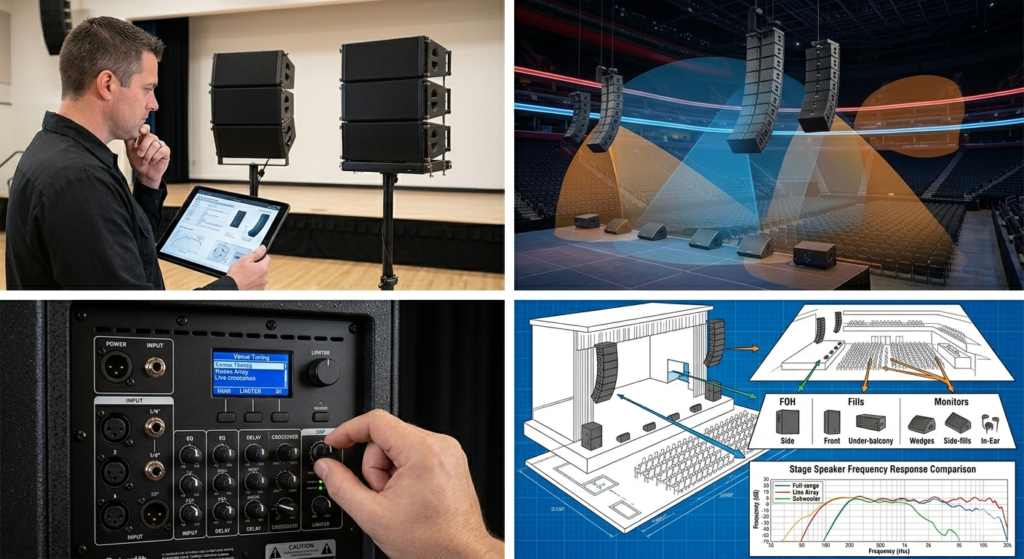
When it comes to live performances, conferences, concerts, churches, or public speaking events, stage speakers are the backbone of the entire audio experience. No matter how talented the performer is or how powerful the message may be, poor sound quality can quickly ruin audience engagement. That’s why choosing the right stage speakers is one of the most important decisions for event organizers, musicians, DJs, and venue managers.
Modern stage speakers have evolved dramatically over the past decade. Today’s systems deliver crystal-clear audio, powerful bass response, advanced digital processing, and exceptional reliability. Whether you’re setting up a small indoor venue or managing sound for a large outdoor festival, understanding how stage speakers work can help you make smarter purchasing decisions and achieve professional-quality results.
In this guide, we’ll explore everything you need to know about stage speakers, including their types, benefits, key features, applications, and tips for selecting the best system for your needs.
What Are Stage Speakers?
Stage speakers are professional loudspeakers specifically designed to project sound to an audience during live events. Unlike home audio speakers, stage speakers are engineered to produce higher sound pressure levels, cover larger areas, and withstand demanding operating conditions.
These speakers are commonly used in:
- Live music concerts
- DJ performances
- Corporate events
- Conferences and seminars
- Houses of worship
- Theater productions
- Outdoor festivals
- Sporting events
The primary purpose of stage speakers is to ensure that every audience member hears the performance clearly, regardless of where they are located within the venue.
Think of stage speakers as the bridge between the performer and the audience. Without them, even the best performance would struggle to make an impact.
Why Stage Speakers Are Essential for Live Events
Audio quality plays a major role in audience satisfaction. People can tolerate minor visual imperfections, but poor sound immediately affects the overall experience.
Imagine attending a concert where vocals are muffled, instruments sound distorted, or certain sections of the audience can barely hear the performance. Frustration quickly replaces enjoyment.
Quality stage speakers provide:
- Clear vocal reproduction
- Balanced music playback
- Consistent sound coverage
- Enhanced audience engagement
- Professional event presentation
- Improved performer confidence
When audiences hear every word and note clearly, they remain connected to the performance. This connection is what transforms an ordinary event into a memorable experience.
Types of Stage Speakers
Not all stage speakers serve the same purpose. Different systems are designed to handle specific roles within a live sound setup.
Front-of-House Speakers
Front-of-House (FOH) speakers are the main speakers facing the audience. These speakers deliver the primary sound mix and are responsible for audience coverage.
FOH speakers are typically mounted on stands, flown from rigging systems, or integrated into line arrays depending on venue size.
Their main goals include:
- High output capability
- Wide audience coverage
- Accurate sound reproduction
- Consistent performance
For most events, FOH speakers represent the largest and most visible component of the sound system.
Stage Monitor Speakers
Stage monitor speakers face performers instead of the audience.
Musicians and presenters need to hear themselves clearly during performances. Monitor speakers provide customized audio mixes that help performers stay in sync and maintain confidence.
Without proper monitoring, singers may struggle with pitch, and musicians may have difficulty maintaining timing.
Monitor speakers are available in several forms:
- Floor wedge monitors
- Side-fill monitors
- Drum monitors
- In-ear monitoring systems
Each solution offers unique benefits depending on the event requirements.
Subwoofers
Subwoofers reproduce low-frequency sounds, typically below 100 Hz.
They handle:
- Bass guitar
- Kick drums
- Electronic music basslines
- Sound effects
- Low-end reinforcement
Subwoofers add depth and impact to a sound system. They create the physical sensation audiences often associate with powerful live performances.
Without subwoofers, music can sound thin and lifeless.
Line Array Speakers
Line arrays are commonly used for large concerts, arenas, and outdoor festivals.
Instead of using a few large speakers, line arrays consist of multiple speaker modules stacked vertically.
Benefits include:
- Long-distance sound projection
- Controlled sound dispersion
- Consistent audience coverage
- Reduced reflections
- Scalable configurations
Many major touring artists rely on line array systems because they can effectively cover audiences of thousands or even tens of thousands of people.
Active vs Passive Stage Speakers
One of the most important decisions buyers face is choosing between active and passive stage speakers.
Active Stage Speakers
Active speakers contain built-in amplifiers.
Everything is integrated into one enclosure, making setup faster and easier.
Advantages include:
- Simple installation
- Fewer cables
- Built-in DSP processing
- Optimized amplifier matching
- Reduced equipment requirements
Powered speakers have become extremely popular among DJs, event companies, and small venues because of their convenience.
Passive Stage Speakers
Passive speakers require external amplifiers.
While setup is more complex, passive systems offer greater flexibility and customization.
Benefits include:
- Easier amplifier upgrades
- Centralized system management
- Flexible system design
- Better scalability for large venues
Large venues and professional touring companies often prefer passive systems because they allow engineers to customize every aspect of the sound system.
Key Features to Look for in Stage Speakers
Choosing stage speakers involves more than simply selecting the loudest option.
Several important factors influence overall performance.
Power Handling
Power handling indicates how much electrical energy a speaker can safely manage.
Higher wattage generally means greater output potential, but wattage alone does not determine sound quality.
A well-designed 500-watt speaker may outperform a poorly designed 1,000-watt speaker.
Frequency Response
Frequency response describes the range of sounds a speaker can reproduce.
A wider frequency range generally provides more natural and detailed sound.
Look for speakers capable of delivering balanced low, mid, and high frequencies.
Maximum SPL
SPL stands for Sound Pressure Level.
This specification indicates how loud a speaker can become before distortion occurs.
For larger venues, higher SPL ratings are essential.
Coverage Pattern
Coverage patterns determine how sound spreads throughout a venue.
Proper coverage ensures every audience member receives a similar listening experience.
Poor coverage can create:
- Dead zones
- Excessive volume differences
- Inconsistent audio quality
Durability
Stage speakers experience significant wear and tear.
Important durability features include:
- Reinforced enclosures
- Protective metal grilles
- Weather-resistant finishes
- Strong handles
- Quality connectors
Reliable construction ensures long-term performance and reduces maintenance costs.
How to Choose the Right Stage Speakers
Selecting the ideal stage speakers depends on several factors.
Consider Venue Size
Venue size significantly influences speaker requirements.
| Venue Type | Recommended Speaker Setup |
|---|---|
| Small Room (50–150 People) | Pair of 10″ or 12″ Powered Speakers |
| Medium Hall (200–500 People) | 12″ or 15″ Speakers with Subwoofers |
| Large Venue (500–2,000 People) | Multiple FOH Speakers and Subs |
| Festival or Stadium | Professional Line Array System |
Matching the system to the venue prevents both underperformance and overspending.
Determine Event Type
Different events have different audio priorities.
A conference may prioritize speech clarity, while a concert requires powerful bass and high output levels.
Always consider:
- Audience size
- Content type
- Venue acoustics
- Indoor vs outdoor use
Set a Realistic Budget
Stage speakers are available across a wide price range.
Budget systems may be suitable for occasional use, while professional applications often justify premium investments.
Remember that audio equipment should be viewed as a long-term investment rather than a short-term expense.
Best Applications for Stage Speakers
Live Music Performances
Musicians rely on stage speakers to deliver their performances accurately.
From local bands to international touring artists, professional speakers ensure audiences hear every detail.
DJ Events
DJs require speakers capable of delivering powerful bass and high output.
Modern powered speakers and subwoofers have become standard equipment for mobile DJs.
Corporate Events
Corporate environments emphasize clarity and professionalism.
Stage speakers help presenters communicate effectively while enhancing audience engagement.
Houses of Worship
Churches and worship centers require balanced sound for both speech and music.
Modern speaker systems help create immersive worship experiences while maintaining intelligibility.
Theater Productions
Theaters demand precise audio reproduction.
Actors, musicians, and sound effects must be heard clearly throughout the venue without distracting audience members.
Common Mistakes to Avoid
Many buyers make costly mistakes when purchasing stage speakers.
Choosing Based Only on Wattage
Wattage alone does not determine performance.
Factors such as efficiency, SPL, and speaker design often matter more.
Ignoring Room Acoustics
Even the best speakers can perform poorly in challenging acoustic environments.
Always consider:
- Ceiling height
- Wall materials
- Audience placement
- Reverberation levels
Buying Too Small
Undersized systems often struggle to provide adequate coverage.
Operating speakers at maximum capacity for extended periods can also shorten their lifespan.
Neglecting Future Expansion
Many organizations underestimate future growth.
Choosing scalable systems can save money by allowing upgrades without replacing the entire setup.
Future Trends in Stage Speaker Technology
The stage speaker industry continues to evolve rapidly.
Several innovations are shaping the future of professional audio.
Smart DSP Systems
Digital Signal Processing is becoming increasingly sophisticated.
Modern DSP technology can:
- Optimize sound automatically
- Protect speakers from damage
- Improve clarity
- Simplify setup
Wireless Control
Engineers can now manage speaker systems remotely using smartphones, tablets, and computers.
Wireless control improves flexibility and efficiency during live events.
AI-Powered Audio Optimization
Artificial intelligence is beginning to assist with:
- Room analysis
- System tuning
- Feedback suppression
- Acoustic optimization
These technologies help achieve professional results with less manual adjustment.
Sustainable Design
Manufacturers are increasingly focusing on:
- Energy-efficient amplifiers
- Lightweight materials
- Recyclable components
- Reduced environmental impact
Sustainability is expected to become a major factor in future speaker development.
Final Thoughts
Stage speakers are much more than simple audio devices. They are the foundation of every successful live event, connecting performers with audiences through powerful and immersive sound. Whether you’re hosting a corporate seminar, performing in a local venue, running a house of worship, or organizing a large music festival, choosing the right stage speaker system can dramatically influence the overall experience.
The best stage speakers combine clarity, power, reliability, and coverage to deliver exceptional results. By understanding different speaker types, evaluating key specifications, and matching equipment to your specific needs, you can build a sound system that performs consistently and professionally.
As technology continues advancing, stage speakers will become even more intelligent, efficient, and adaptable. Yet their primary mission will remain unchanged: ensuring every voice, instrument, and message reaches the audience exactly as intended.
Frequently Asked Questions
1. What size stage speaker is best for live music?
For small live performances, 12-inch powered speakers are often sufficient. Larger venues may require 15-inch speakers, subwoofers, or line array systems.
2. Are powered stage speakers worth it?
Yes. Powered speakers simplify setup, include built-in amplification, and often feature integrated DSP for optimized performance.
3. Do I need subwoofers with stage speakers?
If your events include music with strong bass content, subwoofers significantly improve overall sound quality and audience impact.
4. What is the difference between FOH speakers and monitor speakers?
FOH speakers project sound toward the audience, while monitor speakers help performers hear themselves on stage.
5. How long do professional stage speakers last?
With proper maintenance and reasonable usage, high-quality stage speakers can provide reliable service for 10 years or more.