
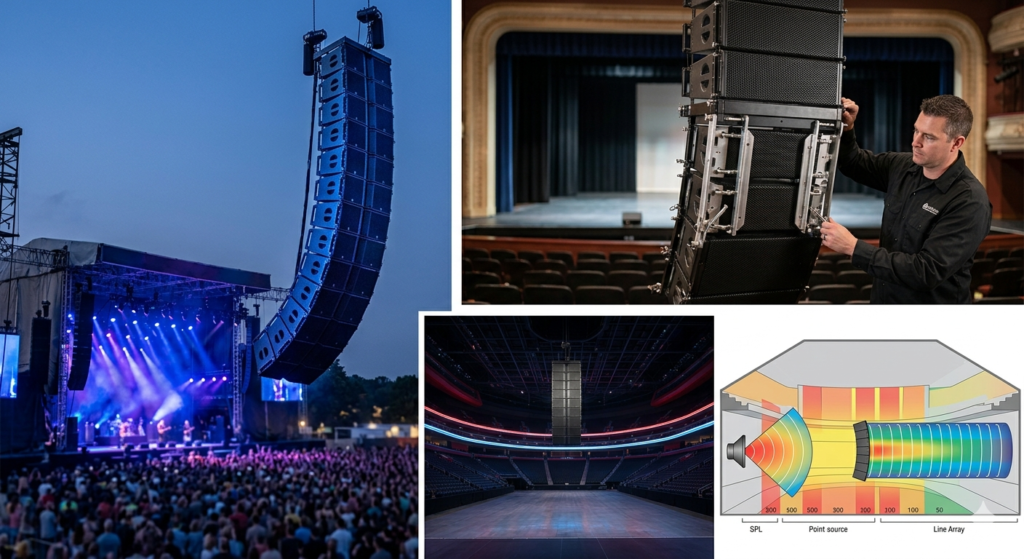
Line array speakers
Linear Sound Column and Bass Series

Linear Sound Column and Bass Series: Elegant Audio Solutions with Powerful Bass Performance

Professional Column Speaker and Bass Systems for Clear, Powerful Audio Performance The Linear Sound Column and Bass Series combines elegant column speaker technology with powerful bass reinforcement to deliver exceptional sound clarity, wide coverage, and deep low-frequency performance. Designed for houses of worship, conference centers, hotels, restaurants, auditoriums, retail spaces, educational institutions, and live event venues, these systems provide professional-grade audio with a sleek and modern appearance. Featuring advanced acoustic engineering, high-efficiency drivers, and integrated DSP technology, the Linear Sound Column and Bass Series offers balanced sound reproduction, superior speech intelligibility, and immersive music performance for a wide range of applications. What Is a Linear Sound Column and Bass System? A Linear Sound Column and Bass System consists of a vertical column speaker paired with a dedicated bass module or subwoofer. The column speaker delivers precise mid and high frequencies with controlled sound dispersion, while the bass unit provides powerful low-frequency reinforcement for a full-range audio experience. This configuration is ideal for venues requiring excellent speech clarity, consistent audience coverage, and aesthetically pleasing audio solutions. Key Features Slim Column Design Modern and elegant appearance that integrates seamlessly into commercial and architectural environments. Wide Sound Coverage Provides consistent horizontal coverage and controlled vertical dispersion for uniform sound distribution. Powerful Bass Performance Dedicated bass modules deliver deep, impactful low frequencies for music and live performances. High Speech Intelligibility Optimized for announcements, presentations, and spoken-word applications. Integrated DSP Technology Advanced digital signal processing ensures optimal sound quality and system protection. Energy-Efficient Operation Modern amplifier technology provides powerful performance with reduced power consumption. Product Categories Active Column Speaker Systems Built-in amplifiers and DSP processing offer plug-and-play convenience and easy installation. Passive Column Speaker Systems Flexible configurations for custom audio installations with external amplification. Column Speakers with Bass Modules Complete full-range solutions for professional sound reinforcement. Portable Column Audio Systems Ideal for mobile events, presentations, and temporary installations. Installation Column Systems Designed for permanent installations in commercial and public venues. Applications Houses of Worship Deliver clear speech and balanced music reproduction throughout the venue. Conference Rooms Ensure professional audio quality for meetings, seminars, and presentations. Hotels and Banquet Halls Provide elegant audio solutions for events and hospitality environments. Restaurants and Retail Spaces Create comfortable background music and public announcement systems. Educational Institutions Support lectures, assemblies, and multi-purpose facilities. Live Events Deliver portable, professional sound reinforcement for performances and presentations. Benefits of Linear Sound Column and Bass Series Excellent Speech Clarity Enhances intelligibility for presentations and announcements. Uniform Audience Coverage Ensures consistent sound quality across listening areas. Compact and Stylish Design Maintains venue aesthetics while providing professional performance. Deep and Powerful Bass Adds warmth and impact to music playback and live sound. Easy Installation Simplified setup for both portable and permanent applications. Reliable Performance Designed for continuous operation in professional environments. Typical Technical Specifications Frequency Response: 45Hz–20kHz Maximum SPL: Up to 135dB DSP Processing: Integrated Digital Signal Processing Amplifier Type: Class D Connectivity: XLR, RCA, Bluetooth, Ethernet Coverage Pattern: Wide Horizontal Dispersion Cabinet Material: Aluminum and High-Strength Composite System Configuration: Column Speaker + Bass Module Why Choose Our Linear Sound Column and Bass Series? Our Linear Sound Column and Bass Series delivers an ideal combination of elegant design, exceptional speech clarity, powerful bass performance, and professional reliability. Whether used in hospitality venues, conference facilities, houses of worship, or live event environments, these systems provide superior audio quality while maintaining a clean and modern appearance. Conclusion The Linear Sound Column and Bass Series offers a professional audio solution for venues requiring high-quality sound, wide coverage, and stylish design. With advanced DSP technology, powerful bass reinforcement, and exceptional speech intelligibility, these systems provide outstanding performance for commercial, corporate, and entertainment applications.

Read More »
Linear Array Series

Linear Array Series: Professional Sound Reinforcement for Large Venues

Professional Line Array Speaker Systems for Concerts, Stadiums, and Large Venues The Linear Array Series is engineered to deliver powerful, high-definition sound reinforcement for concerts, stadiums, theaters, arenas, convention centers, houses of worship, and large-scale outdoor events. Featuring advanced acoustic technology, precision waveguide design, and scalable system configurations, these line array speakers provide exceptional sound clarity, long-distance coverage, and consistent audio performance across large audiences. Designed for professional touring productions and permanent installations, the Linear Array Series offers outstanding reliability, flexible deployment options, and superior sound quality for demanding audio environments. What Is a Linear Array System? A linear array, commonly known as a line array speaker system, consists of multiple loudspeaker modules arranged vertically to create controlled sound dispersion and extended coverage. This design allows sound engineers to deliver uniform audio levels over long distances while minimizing unwanted reflections and sound loss. Line array systems are widely used in professional sound reinforcement applications where high output and even audience coverage are essential. Key Features Advanced Acoustic Design Optimized waveguide technology ensures precise sound distribution and superior audio performance. Long-Throw Sound Coverage Delivers clear and powerful sound over extended distances without compromising audio quality. High Sound Pressure Levels (SPL) Capable of producing powerful output for large audiences and demanding event environments. Scalable System Configuration Modules can be combined to create customized systems for venues of all sizes. Lightweight Cabinet Design Engineered for efficient transportation, installation, and rigging. Durable Construction Built with premium materials to withstand rigorous touring and permanent installation applications. Product Categories Active Line Array Speakers Integrated amplifiers and DSP processing provide simplified setup and optimized performance. Passive Line Array Speakers Offer flexible system design with external amplification and processing options. Line Array Subwoofers Deliver deep, impactful low-frequency performance for concerts and large events. Touring Line Array Systems Designed specifically for live productions and mobile sound reinforcement. Installation Line Array Systems Ideal for theaters, arenas, stadiums, and fixed venue applications. Applications Live Concerts Provide powerful and consistent audio coverage for audiences of all sizes. Stadiums and Arenas Ensure clear sound distribution across large seating areas. Theaters Deliver exceptional speech intelligibility and musical performance. Houses of Worship Support worship services with balanced and immersive sound. Festivals and Outdoor Events Maintain high-quality audio performance in open-air environments. Convention Centers Enhance presentations, conferences, and large-scale corporate events. Benefits of Linear Array Series Uniform Sound Coverage Ensures every audience member experiences consistent audio quality. Superior Speech Intelligibility Improves clarity for announcements, presentations, and live performances. Reduced Sound Distortion Advanced engineering minimizes distortion at high output levels. Flexible Deployment Supports a wide range of venue sizes and event requirements. Professional Performance Trusted by sound engineers for demanding live productions. Long-Term Reliability Designed for continuous operation in professional environments. Typical Technical Specifications Frequency Response: 50Hz–20kHz Maximum SPL: Up to 145dB Driver Configuration: Multi-Way System DSP Processing: Integrated (Model Dependent) Amplifier Type: Class D Coverage Pattern: Controlled Horizontal and Vertical Dispersion Cabinet Material: High-Strength Plywood Rigging System: Professional Flying Hardware Why Choose Our Linear Array Series? Our Linear Array Series combines advanced acoustic engineering, powerful output, and professional-grade reliability to deliver exceptional sound reinforcement solutions. Whether for touring productions, stadium installations, theaters, or houses of worship, these systems provide the performance and flexibility required by modern audio professionals. Conclusion The Linear Array Series offers a professional audio solution for concerts, arenas, theaters, festivals, and large venues. With superior sound coverage, high output capability, and reliable performance, these line array systems help create immersive audio experiences while ensuring consistent sound quality throughout the audience area.

Read More »
Mixing Console Series

Mixing Console Series: Professional Audio Control for Live Sound & Studio Applications

Professional Digital and Analog Mixing Consoles for Live Sound, Broadcasting, and Studio Applications The Mixing Console Series is designed to deliver precise audio control, advanced signal processing, and professional sound management for concerts, theaters, broadcast studios, conference centers, houses of worship, recording studios, and live event productions. Combining intuitive operation, high-quality preamps, powerful DSP capabilities, and flexible connectivity, these mixing consoles provide exceptional audio performance for demanding professional environments. Whether used for live sound reinforcement, studio recording, streaming, podcasting, or large-scale event production, the Mixing Console Series offers reliable control and superior sound quality. What Is a Mixing Console? A mixing console, also known as an audio mixer or soundboard, is the central control system of an audio setup. It receives audio signals from microphones, instruments, playback devices, and other sources, allowing operators to adjust levels, equalization, effects, routing, and output signals. Modern mixing consoles support both analog and digital workflows, offering advanced processing features for professional audio production. Key Features High-Quality Audio Processing Professional-grade circuitry delivers clear, low-noise sound reproduction with exceptional fidelity. Advanced DSP Technology Integrated digital signal processing provides: Equalization (EQ) Compression Gate Processing Reverb Effects Delay Effects Feedback Suppression Multi-Channel Capability Available in various channel configurations to support small venues and large-scale productions. Flexible Connectivity Supports: XLR Inputs TRS Inputs USB Audio Interface Ethernet Networking Digital Audio Protocols Intuitive User Interface Touchscreens, motorized faders, and customizable layouts simplify operation. Reliable Performance Engineered for continuous use in professional live and studio environments. Product Categories Digital Mixing Consoles Offer advanced DSP processing, scene recall, remote control, and flexible routing capabilities. Analog Mixing Consoles Provide traditional hands-on control with simple and reliable operation. Compact Mixers Ideal for portable sound systems, small events, and content creators. Live Sound Consoles Designed for concerts, festivals, and large venue productions. Broadcast Mixing Consoles Optimized for television, radio, podcasting, and streaming applications. Studio Recording Mixers Provide precise audio control for music production and recording environments. Applications Live Concerts Manage multiple audio sources and deliver professional sound reinforcement. Recording Studios Support music production, mixing, and mastering workflows. Broadcast Studios Enable high-quality audio management for television and radio productions. Houses of Worship Provide clear speech and music reproduction during services and events. Corporate Events Support conferences, presentations, and business meetings. Streaming and Podcasting Deliver professional audio quality for digital content creation. Benefits of Mixing Console Series Superior Audio Quality Maintains clarity, balance, and accuracy across all audio channels. Enhanced Workflow Efficiency Advanced controls simplify audio management and system operation. Flexible Signal Routing Supports complex audio setups and multi-zone applications. Scalable Solutions Available for small installations and large production environments. Reliable Operation Built to withstand demanding professional use. Comprehensive Control Provides complete management of audio sources, effects, and outputs. Typical Technical Specifications Channel Count: 8–128+ Channels DSP Processing: Integrated Professional DSP Equalization: Parametric EQ Effects: Reverb, Delay, Compression, Gate Connectivity: XLR, USB, Ethernet, Digital Audio Recording Support: Multi-Track Recording Control Interface: Touchscreen and Motorized Faders Power Supply: Universal AC Input Why Choose Our Mixing Console Series? Our Mixing Console Series combines professional audio performance, advanced technology, and user-friendly operation to meet the needs of sound engineers, broadcasters, musicians, production companies, and venue operators. Designed for reliability and flexibility, these consoles provide exceptional control over every aspect of audio production. Conclusion The Mixing Console Series delivers professional-grade audio control solutions for live sound, broadcasting, recording, and commercial installations. With advanced DSP processing, flexible connectivity, and outstanding sound quality, these mixing consoles help audio professionals achieve superior performance in any environment.            

Read More »
Sound Audio

Sound Audio Series: Professional Audio Solutions for Events & Entertainment

Professional Sound Audio Solutions for Stage, Events, and Entertainment Venues The Sound Audio Series is designed to deliver exceptional audio performance for concerts, theaters, conference centers, houses of worship, stadiums, clubs, hotels, exhibition halls, and large-scale entertainment venues. Combining advanced acoustic technology, powerful amplification, and reliable system integration, these audio solutions provide crystal-clear sound, deep bass response, and outstanding coverage for professional applications. Whether used for live performances, public address systems, broadcasting, corporate events, or permanent installations, the Sound Audio Series ensures superior sound quality and dependable operation. What Is the Sound Audio Series? The Sound Audio Series includes a comprehensive range of professional audio equipment designed to deliver high-quality sound reinforcement and audio distribution. The series features speakers, line arrays, subwoofers, amplifiers, digital processors, mixers, and wireless audio systems that work together to create immersive listening experiences. These systems are engineered to meet the demands of modern entertainment, commercial, and public venue applications. Key Features High-Fidelity Sound Performance Advanced acoustic engineering delivers clear vocals, balanced frequencies, and powerful sound reproduction. Powerful Audio Output Designed for small venues, medium-sized events, and large-scale productions requiring high sound pressure levels. Digital Signal Processing (DSP) Integrated DSP technology enhances sound quality, system control, and audio optimization. Wide Coverage Provides consistent sound distribution across large audience areas. Flexible System Integration Compatible with modern audio networks, digital mixers, and professional control systems. Durable Construction Built with premium materials to ensure reliability in demanding environments. Product Categories Professional Speakers Full-range loudspeakers designed for clear and powerful sound reinforcement. Line Array Systems Ideal for concerts, arenas, and large venues requiring long-distance sound coverage. Subwoofers Deliver deep, impactful bass frequencies for enhanced audio experiences. Power Amplifiers Provide reliable power and performance for professional sound systems. Digital Mixers Offer advanced audio control, routing, and processing capabilities. Wireless Microphone Systems Enable clear and reliable wireless audio transmission. Audio Processors Optimize sound quality and system performance through intelligent signal management. Applications Concerts and Live Performances Deliver powerful sound reinforcement for audiences of all sizes. Theaters and Performing Arts Centers Ensure clear dialogue and balanced audio throughout the venue. Conference and Convention Centers Support professional presentations, meetings, and corporate events. Houses of Worship Provide clear speech intelligibility and music reproduction. Nightclubs and Entertainment Venues Create immersive sound environments with powerful audio systems. Sports Arenas and Stadiums Ensure wide-area sound coverage for announcements and events. Benefits of Sound Audio Series Exceptional Sound Clarity Provides accurate audio reproduction across all frequency ranges. Reliable Performance Engineered for continuous professional use. Scalable Solutions Suitable for both portable and permanent installations. Easy System Management Modern DSP and digital controls simplify operation. Enhanced Audience Experience Delivers immersive and engaging sound environments. Long Service Life Built for durability and minimal maintenance. Typical Technical Specifications Frequency Response: 20Hz–20kHz Audio Power Output: Various Models Available DSP Processing: Integrated Digital Signal Processing Connectivity: XLR, RCA, Ethernet, Wireless Amplifier Class: Class D / Professional Grade System Control: Digital and Network-Based Control Cabinet Material: High-Strength Wood or Composite Construction Why Choose Our Sound Audio Series? Our Sound Audio Series combines professional-grade performance, advanced technology, and reliable construction to meet the demands of modern audio applications. Designed for sound engineers, event organizers, venue operators, and system integrators, these solutions deliver outstanding sound quality and operational efficiency. Conclusion The Sound Audio Series provides professional audio solutions for concerts, theaters, conference centers, entertainment venues, and commercial installations. With powerful performance, advanced processing technology, and exceptional reliability, these systems help create memorable audio experiences while ensuring consistent sound quality in every environment.            

Read More »
Peripheral Equipment Series

Peripheral Equipment Series: Professional Control & Support Equipment for Entertainment Systems

Professional Peripheral Equipment Solutions for Stage, Entertainment, and Lighting Systems The Peripheral Equipment Series includes a comprehensive range of supporting equipment designed to enhance the performance, reliability, and efficiency of professional lighting, stage, audiovisual, and entertainment systems. These essential accessories and control devices ensure seamless operation, simplified installation, and optimized system management for theaters, concerts, television studios, event venues, cultural tourism projects, and architectural lighting applications. Engineered for professional use, the Peripheral Equipment Series delivers dependable performance, intelligent control capabilities, and compatibility with modern entertainment technologies. What Is the Peripheral Equipment Series? The Peripheral Equipment Series consists of auxiliary devices and support equipment that work alongside lighting fixtures, stage systems, and audiovisual installations. These products help distribute power, manage signals, control lighting systems, improve safety, and streamline event operations. From DMX controllers and signal processors to power distribution units and networking equipment, peripheral devices play a vital role in ensuring professional system performance. Key Features Professional System Integration Designed for compatibility with stage lighting, moving heads, LED displays, sound systems, and special effects equipment. Reliable Signal Transmission Provides stable communication between lighting fixtures, controllers, and control networks. Intelligent Control Support Compatible with: DMX512 Art-Net RDM Ethernet Networks Wireless Control Systems Durable Construction Built with industrial-grade components for long-term reliability and professional applications. Easy Installation User-friendly interfaces and flexible mounting options simplify deployment and maintenance. High Operational Stability Ensures continuous performance in demanding entertainment and event environments. Product Categories DMX Controllers Professional lighting control consoles for managing complex lighting systems and programmed shows. DMX Splitters and Amplifiers Distribute and strengthen DMX signals for large lighting installations. Power Distribution Units Provide safe and efficient power management for lighting and stage equipment. Wireless DMX Systems Enable cable-free communication between controllers and fixtures. Signal Converters Support protocol conversion between different control systems and equipment. Network Processors Manage advanced Art-Net and Ethernet-based lighting networks. Rigging and Mounting Accessories Provide secure installation solutions for lighting fixtures and equipment. Control Interfaces Simplify system operation through intuitive control panels and touch-screen interfaces. Applications Concert Productions Support lighting, video, and special effects systems during live performances. Theaters and Performing Arts Centers Ensure reliable control and communication across stage technologies. Television Studios Facilitate professional lighting and broadcast production environments. Event Venues Enable efficient setup and management of temporary and permanent installations. Architectural Lighting Projects Support large-scale lighting networks for buildings, bridges, and public spaces. Cultural Tourism Lighting Provide control and power solutions for immersive lighting attractions. Benefits of Peripheral Equipment Series Improved System Reliability Ensures stable operation of connected devices and control networks. Enhanced Operational Efficiency Simplifies system management and reduces setup complexity. Flexible Expansion Capability Allows lighting systems to scale with project requirements. Increased Safety Supports safe power distribution and equipment protection. Reduced Downtime Professional-grade components minimize maintenance issues and system interruptions. Broad Compatibility Works seamlessly with industry-standard lighting and control technologies. Typical Technical Specifications Protocol Support: DMX512, Art-Net, RDM Input Voltage: AC 100–240V Communication Ports: XLR, RJ45, Ethernet Signal Processing: High-Speed Data Transmission Mounting Options: Rack Mount, Desktop, Portable Operating Temperature: Professional Industrial Grade Protection Features: Overload and Surge Protection Why Choose Our Peripheral Equipment Series? Our Peripheral Equipment Series is designed to provide the foundation for reliable and professional entertainment technology systems. With advanced control capabilities, durable construction, and broad compatibility, these products help lighting designers, event organizers, production companies, and system integrators achieve maximum performance and operational efficiency. Conclusion The Peripheral Equipment Series delivers essential support solutions for stage lighting, entertainment technology, audiovisual systems, and architectural installations. By ensuring reliable control, efficient power distribution, and seamless system integration, these products help create professional, stable, and high-performing entertainment environments.    

Read More »
Special Effect Series

Special Effect Series: Advanced Visual Effects Lighting for Events & Entertainment

Professional Special Effects Lighting for Stage, Events, and Entertainment Productions The Special Effect Series is designed to create stunning visual experiences for concerts, theaters, television productions, nightclubs, festivals, theme parks, and large-scale entertainment events. Combining advanced lighting technology, dynamic effects, and intelligent control systems, these fixtures help transform ordinary performances into unforgettable productions. From laser effects and strobe lighting to atmospheric effects and dynamic beam projections, the Special Effect Series delivers powerful performance, creative flexibility, and reliable operation for professional lighting designers and event organizers. What Is the Special Effect Series? The Special Effect Series includes a range of professional lighting fixtures engineered to produce unique visual effects that enhance stage performances and entertainment environments. These products are designed to create excitement, energy, and audience engagement through synchronized lighting effects, color changes, motion effects, and atmospheric enhancements. Suitable for indoor and outdoor applications, these fixtures integrate seamlessly with modern lighting control systems. Key Features Advanced Visual Effects Create eye-catching lighting displays with dynamic beams, patterns, color effects, and atmospheric enhancements. Intelligent DMX Control Supports: DMX512 Art-Net Master-Slave Mode Auto Programs Sound Active Mode High-Brightness LED Technology Delivers exceptional output with low energy consumption and extended lifespan. Dynamic Color Mixing Available in: RGB RGBW RGBWA+UV for unlimited creative possibilities. Programmable Effects Customize scenes, sequences, and synchronized shows for unique productions. Durable Construction Built for demanding professional environments with reliable performance and long-term durability. Product Types Strobe Lights Produce high-intensity flashes for dramatic visual impact. Laser Effect Lights Generate vibrant laser beams, patterns, and aerial effects. LED Effect Lights Create colorful animations, pixel effects, and dynamic displays. Blinder Lights Deliver powerful audience lighting and stage impact effects. Atmospheric Effect Fixtures Enhance performances with visual depth and immersive environments. Multi-Effect Systems Combine several effects into a single fixture for maximum versatility. Applications Concerts and Live Events Create energetic visual experiences that enhance performances. Theater Productions Support dramatic scenes and immersive storytelling. Television Studios Deliver professional visual effects for broadcasts and recordings. Nightclubs and Entertainment Venues Generate dynamic lighting environments that engage audiences. Festivals and Outdoor Events Provide large-scale visual effects for memorable experiences. Theme Parks and Attractions Enhance visitor engagement through immersive lighting displays. Benefits of the Special Effect Series Increased Audience Engagement Creates memorable experiences through dynamic visual effects. Creative Flexibility Supports a wide range of production styles and event requirements. Energy Efficiency Modern LED technology reduces power consumption. Easy Integration Compatible with professional lighting control systems. Reliable Performance Designed for continuous operation in demanding environments. Low Maintenance Long-lasting components minimize service requirements. Typical Technical Specifications Light Source: High-Power LEDs / Laser Modules Control Protocol: DMX512 Dimming: 0–100% Effects: Strobe, Laser, Beam, Pixel, Animation Input Voltage: AC 100–240V Lifespan: Up to 50,000 Hours Housing: Aluminum Alloy Construction Protection Rating: IP20–IP65 (Model Dependent) Why Choose Our Special Effect Series? Our Special Effect Series combines innovative lighting technology, intelligent control capabilities, and professional-grade performance to deliver extraordinary visual experiences. Designed for lighting professionals, event organizers, production companies, and entertainment venues, these fixtures help create unforgettable shows and immersive environments. Conclusion The Special Effect Series provides powerful and creative lighting solutions for concerts, theaters, television productions, festivals, and entertainment venues. With advanced effects, intelligent controls, and reliable performance, these fixtures help transform any event into a spectacular visual experience.  

Read More »

Line Array Speakers: The Ultimate Guide to Professional Sound Reinforcement in 2026

What Are Line Array Speakers?

Gemini Generated Image bo2qb1bo2qb1bo2q
Line Array Speakers: The Ultimate Guide to Professional Sound Reinforcement in 2026 2

Line array speakers have become the gold standard in professional audio reinforcement, especially in venues where thousands of people need to hear the same sound with equal clarity. If you’ve attended a major concert, sports event, music festival, or corporate convention recently, you’ve almost certainly seen large curved columns of speakers hanging beside the stage. Those are line array systems, and they represent decades of acoustic engineering designed to solve one critical challenge: delivering consistent sound across massive spaces.

Unlike traditional loudspeaker setups that radiate sound from a single point source, line array speakers use multiple speaker cabinets stacked vertically. This arrangement allows sound waves to interact in a controlled manner, creating a more focused audio projection. The result is improved coverage, reduced sound loss over distance, and better audience experiences regardless of seating position.

The growing popularity of line arrays is reflected in industry trends. Market analyses published in 2025 and 2026 estimate continued annual growth rates between 7.5% and 8.5%, driven by increasing demand for high-quality live entertainment, corporate events, stadium installations, and immersive audio experiences.

For event organizers and sound engineers, line arrays are more than just speakers. They are sophisticated acoustic tools capable of transforming a venue into an immersive listening environment. Whether you’re managing a touring concert production or designing audio systems for a worship center, understanding line array technology is essential in today’s professional audio landscape.

How Line Arrays Differ from Traditional Speakers

Traditional speaker systems behave like flashlights. They project sound outward from a single location, causing audio levels to decrease significantly as listeners move farther away. This often results in uneven coverage where front-row audiences experience overwhelming volume while those in the back struggle to hear clearly.

Line array systems function more like a laser beam. By arranging multiple speaker elements vertically, sound energy becomes concentrated and directed toward the audience. This controlled directivity minimizes wasted energy and ensures a more uniform listening experience.

The difference becomes especially noticeable in large venues. Traditional point-source speakers may perform exceptionally well in smaller spaces, but once audience sizes increase into the thousands, maintaining consistent coverage becomes difficult. Line arrays solve this problem through advanced wavefront coupling techniques that allow sound to travel greater distances while preserving clarity and intelligibility.

Professional sound engineers frequently note that deployment and tuning matter just as much as equipment quality. Industry discussions among audio professionals consistently emphasize that a properly configured system often outperforms more expensive equipment installed incorrectly.

The Science Behind Line Array Technology

At first glance, a line array may look like a simple stack of speakers. The reality is far more fascinating. These systems rely on complex acoustic principles that manipulate sound waves to achieve extraordinary performance.

The core concept involves combining multiple loudspeaker elements into a vertical line. When properly designed, the individual outputs merge into a coherent wavefront. Instead of producing scattered sound energy, the array projects audio in a controlled pattern that covers large areas with remarkable consistency.

This engineering approach addresses one of the biggest challenges in live sound: distance. Sound naturally loses energy as it travels. In large venues, this can create significant differences in volume levels between audience sections. Line arrays reduce these inconsistencies through controlled dispersion and directional projection.

Vertical Sound Dispersion

One defining characteristic of line arrays is narrow vertical dispersion. By limiting sound spread vertically, more energy reaches the audience instead of bouncing off ceilings or floors. This reduces reflections and improves overall clarity.

Think of it like watering a garden with a hose. A traditional speaker sprays water in multiple directions, while a line array focuses the stream exactly where it needs to go. The result is greater efficiency and better coverage.

Wavefront Coupling and Coverage

Wavefront coupling occurs when adjacent speaker cabinets work together to create a unified sound field. Engineers carefully design cabinet angles, waveguides, and driver placement to ensure smooth interaction between elements.

This process minimizes destructive interference while maximizing coherent output. Audience members experience balanced frequency response and consistent sound pressure levels across wider seating areas.

Why Sound Travels Further

Because sound energy remains concentrated, line arrays can project audio farther than many conventional systems. Industry reports indicate that their ability to maintain coverage over long distances is one reason they dominate concerts, festivals, and stadium installations worldwide.

Main Components of a Line Array System

A professional line array system is much more than a collection of speaker cabinets. It represents a complete ecosystem of interconnected technologies working together to produce exceptional audio performance.

Speaker Cabinets

The speaker cabinet is the heart of any line array. Each enclosure contains drivers responsible for reproducing specific frequency ranges. High-frequency compression drivers handle treble content, while larger woofers reproduce midrange and bass frequencies.

Manufacturers carefully engineer cabinet dimensions, waveguides, and internal components to ensure smooth integration when multiple cabinets are combined into an array.

Amplifiers and DSP

Modern systems increasingly incorporate built-in amplification and advanced Digital Signal Processing (DSP). DSP allows engineers to optimize performance through equalization, crossover management, delay alignment, and real-time system monitoring.

One of the most significant trends in recent years has been the integration of DSP and networked control systems, enabling remote monitoring and centralized management of large-scale audio deployments.

Rigging Hardware and Suspension Systems

Line arrays are frequently suspended above audiences. Specialized rigging hardware ensures safe installation while allowing engineers to adjust coverage angles precisely.

Proper rigging affects more than safety. The curvature of the array influences sound distribution, making deployment decisions critical to overall system performance.

Types of Line Array Speakers

The line array market offers multiple system categories designed to meet varying performance requirements and budget levels.

Active Line Arrays

Active line arrays feature built-in amplifiers and DSP. These systems simplify setup because external amplifier racks are unnecessary. Touring productions increasingly favor active designs due to faster deployment and streamlined cabling.

Recent market studies indicate continued growth in the active line array segment as users prioritize convenience, integrated processing, and improved operational efficiency.

Passive Line Arrays

Passive systems require external amplifiers and signal processing. While installation complexity may increase, passive arrays provide greater flexibility for large-scale custom configurations.

Many major touring companies continue using passive systems because they allow centralized amplifier management and extensive customization options.

Compact Line Arrays

Compact arrays address smaller venues where full-scale touring systems would be excessive. They deliver many benefits of traditional line arrays while remaining portable and easier to deploy.

Recent product launches have focused heavily on compact designs featuring lightweight materials, improved weather resistance, and enhanced scalability.

Type Advantages Best Use Cases
Active Line Array Easy setup, integrated DSP Corporate events, touring
Passive Line Array Greater flexibility Large concerts, stadiums
Compact Line Array Portable, space-saving Small venues, churches

Advantages of Line Array Speakers

The widespread adoption of line arrays isn’t driven by marketing hype alone. Their benefits are tangible, measurable, and highly valuable in professional environments.

Consistent Sound Coverage

Perhaps the greatest advantage is coverage consistency. Audience members receive similar sound quality whether standing near the stage or seated hundreds of feet away.

This consistency enhances listener satisfaction and reduces complaints about uneven audio levels.

Scalability for Different Venues

Line arrays are remarkably scalable. Engineers can add or remove cabinets depending on venue size, audience capacity, and coverage requirements.

A system that serves a corporate conference one weekend can potentially support a major outdoor festival the next simply by expanding the array configuration.

Improved Speech Intelligibility

Clear communication is critical in theaters, houses of worship, educational institutions, and conference centers. Controlled dispersion reduces reflections and improves speech clarity.

Reduced Acoustic Problems

By directing sound precisely where it is needed, line arrays minimize unwanted reflections and reverberation. This contributes to cleaner mixes and more enjoyable listening experiences.

Industry experts increasingly emphasize directional control, scalability, and frequency consistency as defining advantages of modern line array systems.

Common Applications of Line Array Systems

Line arrays have expanded far beyond concert stages. Today they serve a wide range of industries requiring reliable and high-quality sound reinforcement.

Concerts and Music Festivals

Large-scale live events remain the most recognizable application. Festivals often deploy extensive arrays capable of covering audiences numbering in the tens of thousands.

The technology’s ability to maintain consistent sound pressure levels across vast outdoor environments makes it indispensable for touring productions.

Stadiums and Sports Arenas

Sports venues present unique acoustic challenges due to their size and architecture. Line arrays provide focused coverage that improves announcements, music playback, and spectator engagement.

Theaters and Performing Arts Centers

Theaters require exceptional speech intelligibility and musical accuracy. Compact line arrays have become increasingly popular because they offer high performance without visually dominating the venue.

Houses of Worship

Many worship facilities rely on line arrays to deliver clear sermons and impactful musical performances. Modern systems provide scalable solutions suitable for congregations of varying sizes.

Corporate Events

Corporate presentations, conferences, and trade shows demand reliable audio reproduction. Line arrays help ensure every attendee hears presentations clearly regardless of seating location.

Industry reports consistently identify live events, theaters, stadiums, corporate venues, and houses of worship as primary growth segments for line array deployment.

How to Choose the Right Line Array Speaker System

Selecting the ideal system involves balancing performance requirements, venue characteristics, budget constraints, and operational needs.

Begin by evaluating venue size and audience capacity. Larger audiences generally require longer arrays with greater output capabilities. Acoustic conditions also matter significantly. Highly reflective spaces may benefit from systems with advanced directivity control.

Budget considerations should extend beyond initial equipment costs. Installation, rigging, transportation, maintenance, and training expenses can significantly impact total ownership costs.

Consider future scalability as well. A modular system capable of expansion often provides greater long-term value than a fixed solution.

When comparing products, focus on measurable specifications such as maximum SPL, frequency response, coverage patterns, DSP capabilities, and network integration features. Industry trends suggest growing demand for lightweight, networked, and DSP-enhanced systems capable of adapting to diverse applications.

Future Trends in Line Array Technology

The future of line arrays looks remarkably innovative. Manufacturers continue pushing boundaries in acoustics, materials science, digital processing, and connectivity.

Artificial intelligence is beginning to influence system tuning and optimization. Advanced algorithms can analyze acoustic environments and recommend configuration adjustments automatically.

Networked audio systems are becoming increasingly common. Engineers can monitor amplifier status, temperature, signal levels, and performance metrics remotely from centralized control platforms.

Lightweight composite materials continue reducing transportation and installation costs. This trend benefits touring companies that regularly move equipment between venues.

Recent product developments also emphasize compact footprints, improved directivity control, weather resistance, and installation-friendly designs. New-generation arrays are increasingly tailored to both temporary and permanent installations.

Market forecasts suggest sustained growth throughout the next decade, supported by rising investments in entertainment infrastructure and increasing expectations for immersive audio experiences.

Conclusion

Line array speakers have transformed the professional audio industry by solving one of sound reinforcement’s most persistent challenges: delivering consistent, high-quality audio across large audiences. Their unique design enables controlled sound dispersion, extended coverage, improved clarity, and remarkable scalability.

From massive music festivals and stadiums to theaters, houses of worship, and corporate venues, line arrays continue proving their value across countless applications. Advances in DSP, networking, lightweight materials, and intelligent system optimization are making these systems more powerful and accessible than ever before.

As audience expectations continue rising, line array technology remains at the forefront of professional sound reinforcement. Organizations investing in modern audio solutions will likely find line arrays playing a central role in delivering unforgettable listening experiences for years to come.

FAQs

1. What is the main purpose of a line array speaker?

A line array speaker system is designed to provide consistent sound coverage over large areas while minimizing volume differences between audience sections.

2. Are line array speakers better than traditional speakers?

For large venues, line arrays often outperform traditional point-source speakers because they offer better coverage, improved directivity, and enhanced scalability.

3. Can line array speakers be used indoors?

Yes. They are commonly installed in theaters, conference centers, churches, arenas, and auditoriums where clear and controlled sound distribution is required.

4. What is the difference between active and passive line arrays?

Active systems include built-in amplifiers and DSP, while passive systems require external amplification and signal processing equipment.

5. How many speakers are needed in a line array?

The number depends on venue size, audience capacity, coverage requirements, and frequency goals. Larger venues typically require longer arrays with more cabinets.