
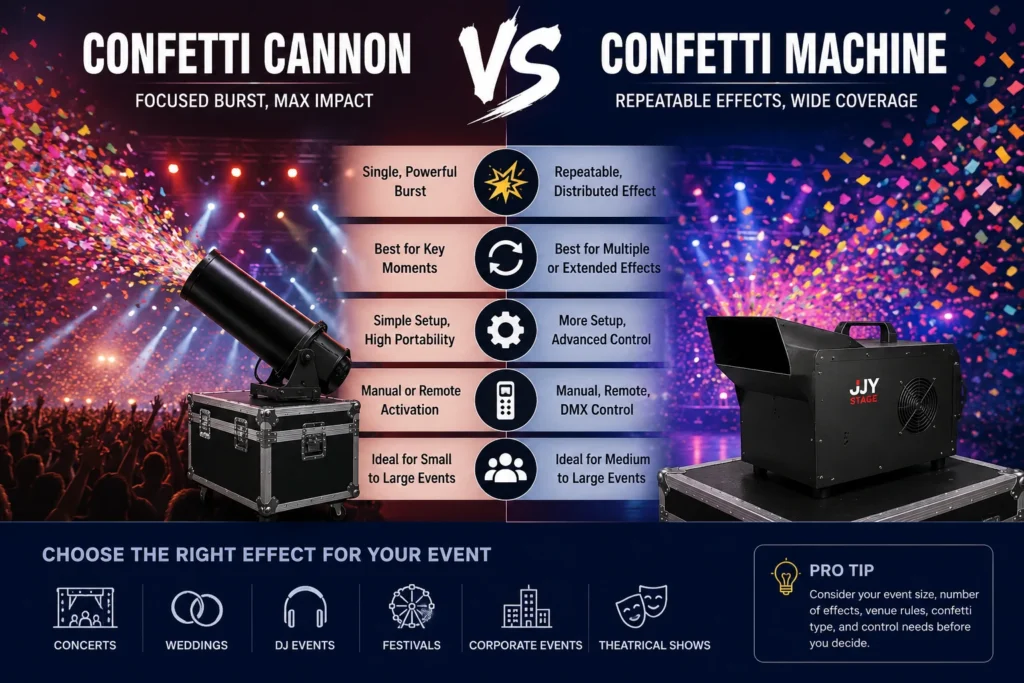
A wedding planner is finalizing the reception timeline. A DJ is building out a set list for a Saturday night show. A concert producer is mapping cues for the encore. All three have landed on the same idea: they want a confetti effect. And all three are stuck on the same question should this be a confetti cannon vs confetti machine decision, or does it even matter which one they pick?
Both types of equipment can create a memorable visual moment, but they’re built around different production needs. A confetti cannon is generally the stronger choice for a focused, dramatic burst tied to a single moment. A confetti machine is generally the stronger choice when an event calls for repeatable, controllable, or more widely distributed confetti effects. That said, this isn’t an absolute rule product designs vary widely within both categories, so the right pick always depends on the specific event, venue, and equipment in front of you.
Explore our Stage Special Effects Guide to learn how special effects can add excitement, atmosphere, and visual impact to concerts, festivals, theatrical performances, and live events. The guide covers popular effects such as CO₂ jets, fog machines, confetti, haze, and other stage effects, along with key considerations for choosing the right equipment and creating professional event experiences.
This guide breaks down how each option works, where each one shines, and how to think through the decision for concerts, weddings, DJ sets, festivals, and corporate events.
Confetti Cannon vs Confetti Machine at a Glance
| Feature | Confetti Cannon | Confetti Machine |
| Main effect | Focused burst | Repeatable/distributed effect |
| Best for | Key moments | Multiple or extended effects |
| Portability | Often high | Depends on model |
| Reusable | Depends on type | Generally designed for repeated use |
| Setup | Often simpler for handheld units | Usually requires more setup |
| Control | Manual or remote depending on model | Manual, remote, DMX, or model-specific |
| Best event size | Small to large, depending on model | Medium to large, depending on model |
| Concert use | Dramatic cue | Repeatable stage effects |
| Wedding use | Entrance/finale | Multiple planned effects |
| DJ use | Drop/one-shot moment | Repeated programmed effects |
| Production integration | Model-dependent | Often stronger on professional models |
One important caveat before going further: “confetti cannon” is a term that covers a lot of ground. It can describe a handheld unit, a stage-mounted rig, an electric system, or a CO₂-powered launcher, each with very different capabilities. The same is true for confetti machines. Rather than assuming a product behaves a certain way because of its category name, compare the actual mechanism, capacity, and specifications of the specific unit you’re considering.
What Is a Confetti Cannon?
A confetti cannon is a device built to launch confetti as a concentrated burst, usually aimed at creating a short, high-impact visual moment. The category includes several distinct product types:
- Handheld cannons — compact, portable, and typically operated by hand for a single burst.
- Stage-mounted cannons — fixed or rigged units integrated into a stage setup.
- Professional cannons — designed for repeated production use rather than one-time consumer events.
- CO₂-powered systems — use compressed CO₂ to propel confetti.
- Electric systems — use an electrical mechanism rather than gas pressure.
- Disposable or one-shot cannons — built for a single use and then discarded.
It’s a common misconception that all confetti cannons are single-use. That’s true for some consumer-grade or party-style products, but professional stage cannons can be designed to be reloaded and fired multiple times across a show or across multiple events. Whether a given cannon is reusable comes down to its specific design, not the “cannon” label itself.
What Is a Confetti Machine?
A confetti machine is generally a powered device designed to propel or distribute confetti using airflow or another manufacturer-specific mechanism, rather than a single concentrated launch. This category includes:
- Electric confetti machines — powered units that move confetti through an airflow system.
- Confetti blowers — designed to project confetti steadily rather than as a single burst.
- Professional stage machines — built for integration into a live production.
- Machines designed for repeated bursts — able to fire multiple times during an event without reloading between every use.
- Machines with remote or show-control capabilities — operable from a distance or synced to a lighting or show-control system.
Professional confetti machines tend to be most useful when a show calls for more than one confetti cue for example, a concert with several effect moments spread across a set, rather than a single celebratory burst.
Planning an event with a memorable visual impact? Our Confetti Machine for Events guide explains how confetti machines work, the different types available, suitable applications, and key factors to consider when choosing a machine. From concerts and weddings to festivals, corporate events, and stage shows, the guide can help event planners and production teams select the right confetti effect for their needs.
How Does a Confetti Cannon Work?
Without getting into specific operating instructions, the general concept behind a confetti cannon is straightforward. Depending on the product, a cannon may rely on compressed air, CO₂, an electrical mechanism, or another manufacturer-specific system to create propulsion. The general sequence looks like this:
- Confetti is loaded or supplied into the unit.
- The system is activated, either manually or remotely.
- Pressure or airflow launches the confetti outward.
- The confetti travels through the air.
- The result is a short, visually concentrated burst.
Because CO₂ and pressurized systems involve real safety considerations, always follow the manufacturer’s instructions and any venue or local safety requirements exactly. This article doesn’t cover pressure adjustments, valve modifications, or DIY cannon construction, and none of that should be attempted outside of manufacturer guidance.
How Does a Confetti Machine Work?
A confetti machine follows a somewhat different process:
- Confetti is loaded into the machine’s hopper or chamber.
- The machine’s propulsion or airflow system is activated.
- Confetti is pulled or fed into the moving air.
- The machine projects or distributes the confetti outward.
- Depending on the design, the operator can repeat the effect multiple times.
Output volume, throw distance, and coverage area vary significantly between models, so two machines described as “confetti machines” can produce noticeably different results in practice.
Confetti Cannon vs Confetti Machine: Main Differences
Effect Style
A confetti cannon is best suited to a quick, concentrated burst the kind of moment that punctuates an entrance, a countdown, or a finale. A confetti machine is better suited to a repeatable or more distributed effect, spreading confetti over a longer window or across multiple cues.
Repeatability
Reusable, professional-grade machines are valuable when the same effect needs to happen several times over the course of a show. That said, a cannon can also be reusable if it’s a professional, reloadable model don’t assume every cannon is a one-time-use product.
Setup
Handheld cannons can have very simple setup requirements often just loading and aiming. Professional stage machines, on the other hand, may require power connections, careful positioning, loading, control configuration, and testing before the event. The exact setup load depends entirely on the model in question.
Portability
Handheld cannons are generally easier to transport and store than larger machines, which may need more planning around shipping, storage space, and on-site handling.
Control
Control options range from a simple manual trigger, to remote control, to full DMX or show-control integration. Which options are available depends on the specific product some cannons offer remote triggering, and some machines are manual-only, so this is worth confirming per model rather than assuming by category.
Confetti Cannon vs Confetti Machine for Concerts
This is one of the most common comparisons production teams face.
Choose a confetti cannon when:
- You need a dramatic single cue.
- You want a powerful visual accent at a specific moment.
- You need a specific directional effect.
- You’re emphasizing a song finale or artist entrance.
Choose a confetti machine when:
- You need multiple effects across the show.
- You want repeatable cues at different points in the set.
- You need broader distribution across the stage or crowd.
- You want integration with a professional stage-control system.
Professional confetti systems cannons and machines alike are commonly used for concert drops, finales, live productions, and other cue-based moments where timing matters as much as the visual itself.
Confetti Cannon vs Confetti Machine for Weddings
Confetti cannon works well for:
- Couple entrance
- Wedding exit
- First dance climax
- Grand reveal
- Photo moment
Confetti machine works well for:
- Multiple wedding moments spread across the reception
- Dance-floor effects
- Reception finale
- Larger venues
- Repeated effects throughout the evening
Before booking either option, check the venue’s confetti policy and cleanup requirements. Some venues restrict confetti material entirely, require biodegradable confetti, or charge cleanup fees details that should be confirmed well before the event.
Confetti Cannon vs Confetti Machine for DJs
Cannon — ideal for:
- Bass drops
- DJ entrance
- Countdown moments
- One-off crowd moments
Machine — ideal for:
- Multiple drops across a set
- Longer sets with several peak moments
- Repeated cues
- Programmed, pre-timed production
A DJ playing a single peak moment might reach for a cannon, while a DJ building a longer set with several crowd-energy peaks may get more value from a machine that can fire repeatedly without reloading.
Confetti Cannon vs Confetti Machine for Festivals
Large outdoor events introduce variables that smaller indoor shows don’t have to deal with:
- Stage size and audience distance
- Wind, which can significantly change how lightweight confetti travels
- Coverage needs across a wide stage or field
- Number of effect points required
- Whether multiple machines or cannons are needed
- Control synchronization across units
Outdoor wind in particular can turn a tightly aimed burst into a scattered, unpredictable effect, so festival production teams often need to think in terms of scale and synchronization rather than a single unit doing all the work.
Confetti Cannon vs Confetti Machine for Corporate Events
Corporate settings product launches, award ceremonies, brand reveals, grand openings, company celebrations, conference finales tend to prioritize a slightly different set of concerns:
- Precise timing tied to a script or program
- A professional, polished appearance
- Repeatability across multiple identical events
- Controlled placement so confetti lands where intended
- Venue compliance and cleanup logistics
These priorities can push the decision toward controlled, repeatable equipment, but a single well-timed cannon burst can also work well for a one-time reveal moment.
Which Creates a Bigger Confetti Effect?
There’s no universal answer here it isn’t accurate to say a machine or a cannon is always more powerful. The actual visual impact depends on:
- The specific machine or cannon’s design
- Output volume
- Confetti type and weight
- Throw direction
- Venue size and ceiling height
- Number of units in use
- Airflow conditions
- Positioning relative to the audience
A professional multi-unit machine setup can create a larger overall effect than a single small cannon, while a powerful professional cannon can produce a highly dramatic burst that a smaller machine can’t match. The comparison really has to happen at the product level, not the category level.
Which Is Better for Indoor Events?
Indoor suitability depends on the exact equipment, the confetti material, venue rules, fire-safety requirements, ventilation, and placement not on whether the product is labeled a cannon or a machine.
Confetti cannon — potential advantages:
- Focused effect
- Simple setup for suitable models
- Useful for short moments
Confetti machine — potential advantages:
- Controlled operation
- Repeatable effects
- Professional control options
Neither category is automatically “safer” for indoor use. Always confirm with the venue and the manufacturer’s guidance before using pressurized systems, electric systems, or any confetti product indoors.
Which Is Easier to Use?
| Requirement | Cannon | Machine |
| Quick one-time effect | Excellent | Good |
| Repeated effects | Model-dependent | Excellent |
| Portability | Often excellent | Model-dependent |
| Professional show integration | Model-dependent | Often strong |
| Large-scale production | Professional models can work well | Often suitable |
| Simple party use | Excellent | May be unnecessary |
The simplest option for a small party isn’t necessarily the best fit for a professional production that needs repeatable, controllable effects across a longer show.
Which Is More Cost-Effective?
Rather than comparing invented prices, it’s more useful to think in terms of total cost of ownership.
Confetti cannon — consider:
- Initial purchase or rental cost
- Number of shots included or needed
- Consumables and reloads/cartridges
- Transport requirements
Confetti machine — consider:
- Initial equipment cost
- Ongoing confetti consumption
- Maintenance
- Storage
- Transportation
- Power requirements
- Number of events the unit will be used for
As a general pattern, a cannon may be more practical for a single event where the equipment is used once or twice. A reusable professional machine may offer better long-term value for anyone producing frequent events. The actual economics still depend on the specific product and how often it will be used.
What Type of Confetti Should You Use?
Confetti material matters for both cannons and machines. Common options include:
- Tissue/paper confetti
- Metallic-effect confetti
- Biodegradable options
- Streamers
- Custom-shaped confetti
Compatibility varies by machine and cannon design. Some units perform better with lightweight materials, while heavier or larger pieces can affect how confetti feeds and projects. Always check the manufacturer’s specifications before choosing a confetti material, rather than assuming any confetti will work in any device.
Confetti Cannon vs Machine and Stage Lighting
Lighting changes how a confetti effect reads to an audience. Moving heads, beam lights, LED fixtures, backlighting, strobes, and RGB lighting can all interact with falling confetti, catching and reflecting light in ways that add depth to the moment. Synchronizing confetti, lighting, and music is often what turns a good effect into a genuinely memorable one which is why confetti equipment is frequently planned alongside a venue’s broader stage lighting design rather than as an isolated element.
Can Confetti Cannons and Machines Be Used Together?
Yes when the equipment and the overall production design support it, combining a cannon and a machine can create a layered effect that neither could produce alone. A few examples:
- Concert: a professional cannon delivers the dramatic drop, while a confetti machine provides broader follow-up coverage.
- Wedding: a cannon marks the entrance, while a machine handles the reception finale.
- Festival: multiple professional units work together for synchronized coverage across a wide stage.
Combining systems can produce a more dynamic show, but placement, control, safety, and venue requirements all need to be evaluated by someone with production experience before mixing equipment types.
How to Choose the Right One for Your Event
Choose a confetti cannon if:
- You need one or a few dramatic bursts.
- Portability is important.
- You want a focused visual moment.
- The event is relatively simple.
- You don’t need extended or repeated operation.
Choose a confetti machine if:
- You need repeated effects.
- You need broader distribution.
- You’re producing concerts or stage shows.
- You need professional control options.
- You plan to use the equipment across multiple events.
Choose both if:
- You need different effect styles in the same show.
- You have multiple cue points.
- You want both a focused burst and broader coverage.
- Your production design supports running multiple systems.
Confetti Cannon vs Confetti Machine: Quick Decision Table
| Event Goal | Recommended Option |
| Wedding entrance | Confetti cannon |
| Wedding finale | Cannon or machine |
| Birthday party | Confetti cannon |
| DJ drop | Confetti cannon |
| Multiple DJ drops | Confetti machine |
| Concert finale | Professional cannon or machine |
| Large festival | Professional machine/multi-unit setup |
| Corporate reveal | Cannon or controlled machine |
| Repeated stage effects | Confetti machine |
| One dramatic burst | Confetti cannon |
| Broad repeated coverage | Confetti machine |
This is meant as a general starting point, not a universal rule the right equipment for any specific event still depends on the venue, scale, and production goals.
Common Buying Mistakes
- Assuming every cannon is single-use. Professional cannons can be reloadable.
- Choosing based only on power. Look at the complete system and the intended effect, not just raw output.
- Ignoring confetti compatibility. Not every machine accepts every material.
- Ignoring venue requirements. Confirm venue policies before purchasing or renting.
- Forgetting cleanup. Confetti creates a cleanup requirement regardless of the equipment used.
- Ignoring control requirements. If cues need to be synchronized, confirm DMX or remote compatibility ahead of time.
- Buying more equipment than necessary. A small event may not need a professional multi-machine setup.
- Failing to test. Test the actual equipment, confetti material, placement, and control method before the event, not on the day of.
Frequently Asked Questions
What is the difference between a confetti cannon and a confetti machine?
A confetti cannon launches confetti as a concentrated burst for a single dramatic moment. A confetti machine typically distributes confetti through airflow and is often designed for repeatable or extended effects across a show.
Is a confetti cannon better than a confetti machine?
Neither is universally better. A cannon suits a focused, one-time burst, while a machine suits repeatable or broader effects. The right choice depends on the event, venue, and number of effects needed.
Which is better for concerts?
It depends on the moment. A cannon works well for a single dramatic cue like a finale, while a machine works better when a show needs multiple or repeated confetti effects throughout the set.
Which is better for weddings?
Cannons often suit single moments like an entrance or exit, while machines suit venues that want confetti effects at several points during the reception.
Can a confetti machine be reused?
Most confetti machines are designed for repeated use across an event and often across multiple events, though capacity and durability vary by model.
Are professional confetti cannons reusable?
Some are. Professional, reloadable cannons can be fired multiple times, unlike disposable, single-use consumer cannons.
Which creates a bigger confetti effect?
It depends on the specific product, output, confetti type, venue size, and number of units used not simply on whether it’s labeled a cannon or a machine.
Can confetti cannons and machines be used together?
Yes. Many productions combine both to create layered effects, such as a cannon for a dramatic drop and a machine for broader follow-up coverage, provided the setup is planned by an experienced production team.
Which is better for indoor events?
Suitability depends on the specific equipment, confetti material, venue rules, ventilation, and fire-safety requirements not the product category alone.
How do I choose the right confetti equipment?
Consider the event type, venue, number of effects needed, desired coverage, confetti material, control requirements, budget, transport, and cleanup before deciding between a cannon, a machine, or both.
Conclusion
At a high level, the choice comes down to this: a confetti cannon is generally built for a focused, dramatic burst, while a confetti machine is generally built for repeatable, controlled, and broader effects. Many professional productions use both, layering a cannon’s dramatic moment with a machine’s extended coverage.
Discover how the right lighting can transform historic sites, museums, landmarks, and cultural attractions with our Cultural Tourism Lighting Guide. The guide covers architectural lighting techniques, fixture selection, color temperature, energy efficiency, and lighting strategies for creating engaging visitor experiences while respecting the character of heritage and cultural sites.
The right decision for your event ultimately depends on the event type, venue, desired effect duration, number of shots needed, coverage area, confetti material, control requirements, budget, transport logistics, cleanup expectations, and venue regulations. Weighing these factors against the specific product you’re considering rather than the general category will get you to the right answer faster than assuming one option is always superior.
Ready to compare real equipment side by side? Explore JJY Stage’s Special stage Effect Series to find professional confetti and other stage-effect equipment for concerts, weddings, festivals, DJ events, and live productions.