
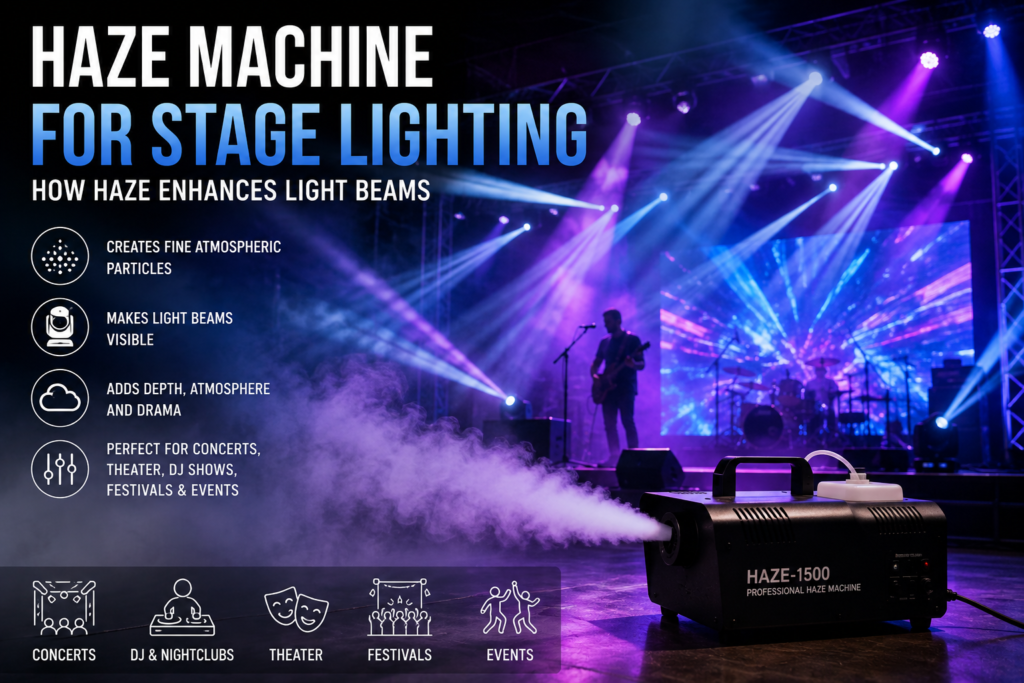
Stage lighting can look dramatically different the moment its beams become visible in the air instead of simply landing as flat pools of color on a stage floor. A haze machine for stage lighting creates a fine atmospheric layer that lets those beams take shape in the air, turning a lighting rig into something audiences can actually see move, cross, and layer. This effect shows up across concerts, theater productions, DJ sets, festivals, live events, corporate productions, and dance performances anywhere a lighting designer wants the beams themselves to become part of the visual story.
It helps to understand one key idea before going further: haze does not create the light beam itself. A fixture produces the light regardless of what’s in the room. What haze provides is a field of fine atmospheric particles that scatter that light along its path, making the beam visible from the audience’s viewing angle instead of invisible until it hits a surface.
Explore our Stage Special Effects Guide to learn about popular effects used in concerts, theater productions, weddings, festivals, and live events. The guide covers options such as fog, haze, bubbles, and other stage effects, helping event planners and production teams choose the right effects for different venues and performances.
What Is a Haze Machine?
A haze machine is a piece of equipment that produces a thin, even layer of atmospheric particles typically from a specialized fluid designed to hang in the air for an extended period without forming a dense, visible cloud. Unlike ordinary fog, which is engineered to be seen as fog, haze is engineered to be felt more than seen. Its job is to interact with light rather than to announce its own presence.
A stage haze machine differs from a fog machine mainly in output style and particle characteristics. Fog machines tend to produce output in bursts that billow and dissipate. Haze machines are generally built for longer, steadier operation, producing a consistent atmosphere that can sit in a venue for extended periods.
It’s worth noting that haze machines are not all built the same way. Different models use different technologies, fluids, and output mechanisms, so the density, coverage, and overall appearance of the haze can vary noticeably from one machine to another. This is one reason venue testing (covered later) matters so much before an event.
How Does Haze Make Light Beams Visible?
This is the core optical idea behind everything else in this article, and it’s simpler than it sounds.
- A stage light produces a beam of light.
- That beam travels through the air toward its target — a performer, a backdrop, or empty space.
- In normal, clear air, there’s very little for that beam to interact with along the way, so it’s mostly invisible until it strikes a surface.
- When fine atmospheric particles from haze are present, some of the light traveling through the air is scattered off those particles.
- That scattered light is what the audience actually sees as a visible beam, from certain viewing angles.
A simple way to picture this: a flashlight beam in a perfectly clean room is nearly invisible in the air. Shine that same flashlight through a room with dust or mist in it, and the beam suddenly becomes a visible shaft of light. Haze does the same thing for stage lighting, just in a controlled, repeatable way.
This is the mechanism behind visible light beams and the broader category of light beam effects that modern lighting design leans on so heavily. Without haze or fog most beam-based effects would simply not register with an audience the way designers intend.
Why Is Haze Important for Stage Lighting?
Haze changes how an audience experiences a lighting rig, not just how bright or colorful it looks. With haze in the air, fixtures like these can read very differently:
- Beam lights — narrow, focused beams become clearly traceable lines in the air
- Moving heads — sweeping and pattern movements become visible as they travel, not just where they land
- Spotlights — the path of the light, not just the lit subject, becomes part of the composition
- Wash lights — broad color washes gain a soft, atmospheric quality
- LED fixtures — colored light gains depth instead of looking flat
- Laser effects — beam paths become visible rather than just the projected pattern
- Backlighting — silhouettes and rim lighting become sharper and more dimensional
In practical terms, haze can add depth, dimension, atmosphere, layering, and a sense of movement to a lighting design. It helps a rig feel three-dimensional instead of two-dimensional, and it can make even a modest lighting setup look more intentional and polished often without the dense, room-filling cloud that people associate with traditional fog.
Haze Machine vs Fog Machine
| Feature | Haze Machine | Fog Machine |
| Main purpose | Enhance atmosphere and lighting visibility | Create more noticeable fog |
| Typical density | Fine/subtle | Generally denser |
| Distribution | Often broad and gradual | Often more visible bursts |
| Light beam visibility | Excellent for atmospheric beam definition | Strong but more dramatic |
| Typical use | Concert lighting, DJs, theater | Special effects, entrances, dramatic moments |
| Continuous use | Often suitable depending on machine | Often used in bursts or controlled output |
Exact results always depend on the specific machine’s design and output, the venue’s size and airflow, and how the operator sets it up on the day. For a deeper breakdown of these two categories, see our guide on fog machine vs haze machine.
Haze Machine for Stage Lighting: Which Lights Benefit Most?
Beam Lights
Narrow, concentrated beams are some of the most dramatic beneficiaries of haze. Without atmospheric particles, a tight beam light mostly disappears into the air. With haze, that same beam becomes a crisp, visible line the kind of effect commonly seen sweeping across concert stages.
Moving Head Lights
Moving heads are built to travel across a space, and haze is what lets an audience actually track that movement through the air, not just see where the beam eventually lands.
Spotlights
A spotlight’s job is usually to isolate a subject, but haze can add a secondary layer a visible column of light connecting the fixture to the performer, reinforcing the sense of focus.
LED Stage Lights
Colored LED washes can look flat on a bare stage. Haze gives that color something to sit in, adding a soft, layered depth that reads well on camera and in person.
Backlights
Backlighting combined with haze is one of the most reliable ways to create strong silhouettes and a sense of atmospheric depth behind performers, separating them visually from the background.
Laser Lighting
Atmospheric particles can make laser beam paths visible in a similar way to conventional beam lights. Because lasers involve concentrated light sources, they should only be operated by trained personnel following manufacturer and venue safety requirements this article does not provide instructions for laser setup or operation.
Haze Machine for Concerts
Concert lighting design leans heavily on visible beams, and a haze machine for concerts is often part of the production from load-in to the final number. Common moments where haze plays a role include:
- Artist entrances, where visible beams can build anticipation
- Coordinated lighting sequences timed to the music
- Big music drops, where beams sweeping through haze emphasize the moment
- Quieter instrumental sections, where subtle atmosphere adds mood without overwhelming the stage
- Transitions between songs or stage setups
- Finale sequences, where multiple fixtures and haze combine for a bigger visual payoff
Haze effects for concerts give lighting designers another dimension to work with not just color and position, but the visible shape of the light itself, which can make even a relatively simple rig look considerably more dynamic.
Haze for DJs and Nightclubs
In DJ performances, nightclubs, dance floors, and electronic music events, haze is often a near-constant presence rather than an occasional effect. A haze machine for DJs typically runs for extended periods to support:
- Moving heads sweeping over the crowd
- Beam lights creating geometric patterns overhead
- Lasers tracing visible lines through the space
- LED fixtures adding color depth to the room
- Strobe effects, where haze adds a layered, textured quality to rapid flashes
Because these environments often run haze continuously across a long set, machine output and distribution characteristics matter more here than in a shorter theatrical cue-based show.
Haze Machine for Theater
Theatrical productions tend to use theatrical haze more selectively than concerts or nightclubs, since performer visibility and audience sightlines are usually a higher priority. Even so, haze still plays a meaningful role by helping to:
- Enhance stage lighting without overwhelming the set
- Add subtle depth to scenes
- Define light beams used for dramatic or symbolic effect
- Support key dramatic moments where atmosphere reinforces the story
Theater productions often favor more controlled atmospheric effects, since maintaining clear visibility of performers’ faces and expressions typically remains a priority throughout the show.
Haze vs Fog vs Smoke
| Effect | Typical Appearance | Main Purpose | Common Applications |
| Haze | Fine and subtle | Lighting atmosphere | Concerts, DJs, theater |
| Fog | More visible/dense | Dramatic atmosphere | Stage effects, entrances |
| Smoke | Depends on source/system | Specific visual or production effect | Specialized applications |
These terms are sometimes used loosely in casual conversation, but professional equipment is generally designed around distinct purposes. For a closer look at how these three effects compare, see fog vs haze vs smoke.
How Much Haze Do You Need for Stage Lighting?
There’s no universal “correct” amount of haze the right level depends on the venue and the goals of the production. Several factors influence this:
- Venue size
- Ceiling height
- Ventilation
- HVAC activity
- General air movement
- Lighting intensity
- How visible the beams need to be
- Distance between the stage and the audience
- The output characteristics of the specific machine
In general terms:
- Too little haze — light beams may remain difficult to see, and the lighting design won’t read the way it was intended.
- Balanced haze — beams become clearly visible while the space still feels relatively clear and comfortable.
- Too much haze — the venue can start to look visually dense, reducing clarity and potentially affecting sightlines or comfort.
There’s no fixed numeric setting that works everywhere; this is one of the main reasons on-site testing matters so much.
What Affects Haze Distribution?
Even a well-chosen machine can perform inconsistently if these factors aren’t accounted for:
- Air conditioning — HVAC systems can actively move haze around a venue, sometimes pulling it away from where it’s needed.
- Ventilation — active ventilation can reduce atmospheric concentration faster than expected.
- Fans — stage or house fans can either help distribute haze evenly or disperse it too quickly.
- Venue size — larger spaces generally require different equipment and planning than small rooms.
- Ceiling height — more air volume means haze has more room to disperse into.
- Machine position — where a machine is placed affects how evenly haze spreads across the space.
- Audience movement — a crowd moving through a venue can locally disturb airflow and shift how haze behaves in real time.
How to Choose a Haze Machine for Stage Lighting
- Venue size — match equipment capability to the physical space you’re working in.
- Haze output — think about the atmospheric density the production actually needs.
- Distribution — decide whether the show calls for localized haze near specific fixtures or broader, room-filling coverage.
- Continuous operation — consider whether haze needs to run steadily throughout a performance or only during specific cues.
- Control options — look at how the machine can be operated, such as manual control, remote control, timers, or integration with professional lighting control systems. Only rely on control protocols that are verified for the specific product you’re considering.
- Fluid compatibility — always use the fluid recommended by the manufacturer for that machine.
- Portability — factor in weight, dimensions, setup time, and how easily the unit transports between venues.
- Maintenance — follow the manufacturer’s maintenance guidance to keep output consistent and equipment reliable over time.
How to Use Haze With Stage Lighting
- Plan the lighting design — identify which beams and fixtures actually need atmospheric visibility before deciding on haze levels.
- Evaluate the venue — assess size, HVAC, ventilation, airflow, and where the audience will be positioned.
- Select the haze equipment — match machine output and distribution capability to the production’s needs.
- Test the haze — evaluate the actual effect under real venue conditions rather than assumptions.
- Adjust lighting — experiment with beam angles, backlighting, side lighting, and moving head positioning to see how they interact with the haze.
- Coordinate effects — synchronize haze output with lighting cues where it supports the show.
- Monitor during the event — environmental conditions like temperature, crowd size, and airflow can shift over the course of a performance, so keep checking in.
Best Stage Lighting Effects With Haze
| Lighting Effect | How Haze Can Enhance It |
| Beam lights | Makes beam paths more visible |
| Moving heads | Adds definition to movement |
| Backlighting | Creates atmospheric depth |
| Spotlights | Helps define the light path |
| LED lighting | Adds depth to colored light |
| Laser effects | Can make paths more visible |
| Strobe effects | Adds atmosphere to rapid flashes |
Actual visual results will vary based on the fixture type, haze density, venue characteristics, and the audience’s viewing angle.
Haze Machine for Different Event Types
| Event | Typical Haze Purpose |
| Concert | Enhance moving lights and beams |
| DJ event | Create atmospheric lighting |
| Theater | Add subtle stage depth |
| Festival | Enhance large-scale lighting |
| Dance show | Highlight movement and beams |
| Corporate event | Add controlled visual atmosphere |
| Nightclub | Enhance lighting environment |
Common Mistakes When Using a Haze Machine
- Using too much haze — can make the atmosphere feel overly dense and reduce overall clarity.
- Ignoring HVAC — can cause uneven distribution and inconsistent results throughout a venue.
- Choosing equipment based only on wattage — output characteristics and intended application matter just as much as raw power.
- Ignoring lighting design — haze works best when it’s planned as part of the overall lighting concept, not added as an afterthought.
- Skipping venue testing — actual airflow and distribution can differ significantly from what’s expected on paper.
- Using incompatible fluid — always follow manufacturer recommendations to protect the equipment and maintain consistent output.
Haze Machine Safety Considerations
- Follow the manufacturer’s operating instructions at all times.
- Use only compatible, manufacturer-recommended haze fluid.
- Follow venue-specific requirements and regulations.
- Maintain appropriate visibility levels, especially near stairs, exits, and walkways.
- Keep emergency exits clear and visible at all times.
- Position equipment securely to avoid tipping or obstruction hazards.
- Protect all electrical connections from moisture and foot traffic.
- Manage cables safely to prevent trip hazards.
- Test equipment before the event to confirm it’s functioning properly.
- Use trained operators for professional productions where appropriate.
Haze Machine Buying Checklist
- ☐ Venue size
- ☐ Desired haze density
- ☐ Lighting system
- ☐ Continuous operation requirements
- ☐ Output characteristics
- ☐ Distribution requirements
- ☐ Control options
- ☐ Fluid compatibility
- ☐ Portability
- ☐ Maintenance
- ☐ HVAC and airflow
- ☐ Venue policies
- ☐ Safety requirements
Frequently Asked Questions
What does a haze machine do on stage?
A haze machine fills the air with a fine atmospheric layer that scatters light from stage fixtures, making beams visible and adding depth and atmosphere to a lighting design.
How does haze make light beams visible?
Light beams are largely invisible in clean air. Haze introduces fine particles that scatter light along the beam’s path, so the audience can see the beam itself rather than just where it lands.
Is haze better than fog for stage lighting?
Neither is universally “better.” Haze is generally suited to subtle, continuous atmospheric enhancement and beam visibility, while fog is better suited to dramatic, more visible moments.
What is the best haze machine for stage lighting?
The right machine depends on venue size, desired output, distribution needs, and control requirements there isn’t a single model that fits every production.
Can haze machines be used at concerts?
Yes. Haze is widely used at concerts to enhance beam lights, moving heads, and overall lighting atmosphere throughout a performance.
Can haze be used with moving head lights?
Yes. Haze is particularly effective with moving heads, since it makes their sweeping and pattern movements visible as they travel through the air.
Does haze damage stage lighting equipment?
When manufacturer-recommended fluid is used and equipment is properly maintained, haze is designed to work alongside stage lighting without causing damage.
How long does stage haze last?
This varies significantly based on the machine, venue size, HVAC activity, and airflow some haze dissipates quickly while other setups maintain atmosphere for extended periods.
What is the difference between haze and fog?
Haze is generally finer, more subtle, and designed for extended atmospheric use, while fog is typically denser and used for more visible, dramatic bursts.
How much haze should be used for stage lighting?
There’s no fixed amount it depends on venue size, ventilation, lighting intensity, and the desired level of beam visibility, which is why on-site testing is recommended.
Haze Machine vs Fog Machine: Which Should You Choose?
Choose haze if:
- Your primary goal is visible light beams
- You want a subtle atmospheric effect
- You need an overall lighting atmosphere
- You are working with moving lights
- You want continuous atmospheric enhancement
Choose fog if:
- You want a dramatic cloud
- You need strong visual bursts
- You want a more noticeable atmospheric effect
- You are creating theatrical special effects
Choose both if: Your production needs a base layer of subtle lighting atmosphere combined with dramatic fog moments at key points in the show. For more detail on making this decision, see fog machine vs haze machine.
Conclusion
Haze and stage lighting work together, not separately. A haze machine doesn’t replace good lighting design it reveals it, giving beams, movement, and color a visible shape in the air that clean air simply can’t provide. Whether it’s supporting a concert’s biggest moment, adding quiet depth to a theatrical scene, keeping a DJ set visually alive for hours, or enhancing lighting at a festival, dance show, nightclub, or corporate event, haze is one of the most reliable tools for turning a lighting rig into a full visual experience.
If you’re planning to add haze to your next production, JJY Stage’s Special Effect Series includes haze equipment designed to work alongside professional stage lighting setups. Explore JJY Stage’s lighting and special effects equipment to find options suited to your venue and production needs.