
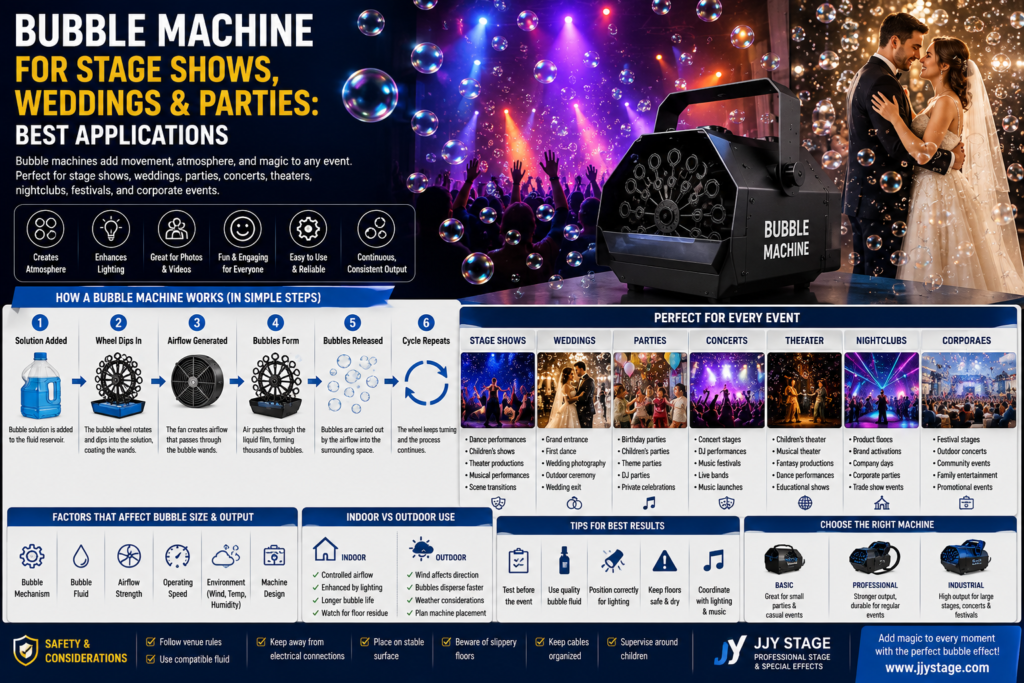
Bubble Machine for Stage Shows, Weddings & Parties: Best Applications
Walk into almost any well-produced event today, a concert, a wedding reception, a theater production, a festival stage and there’s a good chance bubbles have played a role somewhere in the design. They’ve become one of the most versatile effects in modern entertainment, and it’s easy to see why. A bubble machine for stage productions, receptions, and celebrations adds something that’s hard to fake any other way: gentle, natural movement that catches light and holds attention without demanding it.
Bubbles bring a mix of qualities that few other effects combine so easily. They add movement to an otherwise still space, create visual texture against lighting, bring a sense of playfulness to a room, and give guests something worth photographing. A first dance surrounded by drifting bubbles, a children’s theater scene turned into a dreamlike moment, a concert intro with bubbles catching the stage lights each is a different application of the same basic effect.
This guide focuses specifically on where and how bubble machines are used across stage shows, weddings, parties, concerts, theater, nightclubs, festivals, and corporate events. Rather than explaining the mechanics of the equipment or how to shop for it, the goal here is practical: understanding which applications work best, what to consider for each setting, and how to plan bubble effects so they enhance an event instead of distracting from it.
What Are Bubble Effects Used For?
Bubble effects serve a handful of core purposes across different types of events:
- Enhancing a performance. Bubbles can add a layer of visual interest during a song, scene, or moment without requiring additional performers or props.
- Creating a specific mood. Depending on lighting and pacing, bubbles can feel romantic, whimsical, energetic, or magical.
- Highlighting important moments. A grand entrance, a big reveal, or a first dance can feel more memorable with a bubble effect timed to the moment.
- Adding movement to a stage. Static staging can feel flat under lighting alone; bubbles introduce motion that keeps a scene visually active.
- Complementing lighting design. Bubbles interact with light in ways that add texture without needing extra fixtures.
- Creating visual interest for photography and video. Bubbles read well on camera, which is part of why they’re popular at weddings and branded events.
- Supporting a theme. From fairy-tale weddings to festival stages, bubbles can be styled to match the tone of the event.
The most important principle across all of these uses is balance. Bubble effects work best when they complement the event rather than compete with it supporting the performance, the couple, or the moment, rather than becoming a distraction from it.
Bubble Machine for Stage Shows
Stage productions are one of the most common and effective settings for bubble effects, and a stage bubble machine is often chosen specifically for how well it integrates with performance and lighting.
Dance performances. Bubbles can add visual texture to choreography, drifting through a performance space in a way that complements movement without interfering with it. They’re especially effective during slower, more expressive sequences where extra visual motion adds to the mood.
Children’s shows. For younger audiences, bubbles bring an interactive, playful quality that fits naturally into children’s entertainment. They can support storytelling moments or simply add energy to a performance aimed at a young crowd.
Theater productions. In theater, bubble effects are often used to help build:
- Fantasy environments
- Dream sequences
- Magical or otherworldly scenes
- Children’s productions
- Scene transitions
A bubble machine for stage use in theater needs to be timed precisely, since it’s usually supporting a specific narrative beat rather than running continuously in the background.
Musical performances. Bubbles can complement music and lighting during key moments an instrumental break, a big chorus, or a closing number adding a visual accent that matches the energy of the music.
Live entertainment more broadly. Beyond formal theater and concerts, bubble effects show up in general live entertainment settings, from variety shows to promotional stage performances, wherever a producer wants to add a visual layer to a live moment.
How Bubble Machines Enhance Stage Lighting
Bubbles and stage lighting are frequently used together because of how bubbles interact visually with light. As bubbles pass through a beam or wash, light reflects off their surface, creating shifting highlights and color that add detail to the effect.
Bubble machines are commonly paired with:
- Backlighting
- Beam lights
- Moving head lights
- Wash lights
- Color-changing LEDs
- Follow spots
The visual result depends on a combination of factors:
- Lighting angle — light coming from behind or the side tends to reveal bubbles more clearly than direct front lighting.
- Light intensity — brighter, more focused beams tend to create more visible highlights on bubble surfaces.
- Bubble density — a heavier concentration of bubbles creates a more dramatic effect than a light, scattered stream.
- Background — a dark background generally makes bubbles more visually distinct.
- Stage size — larger stages may need bubbles positioned or angled differently to remain visible from the audience.
- Air movement — HVAC systems, open doors, or outdoor wind can shift where bubbles travel relative to the lighting.
Because so many variables affect the final look, lighting and bubble placement are usually planned together rather than treated as separate elements. For a broader look at how bubble effects fit into the full range of live production tools, see our stage special effects guide.
Bubble Machine for Weddings
Weddings are one of the most popular settings for bubble effects, largely because bubbles pair naturally with photography, romantic moments, and celebratory send-offs. A bubble machine for wedding use tends to show up at several distinct points throughout the day.
Wedding entrance. Bubbles can turn a simple walk down the aisle or into a reception into a more visually engaging moment, especially when timed with music.
First dance. During the couple’s first dance, a gentle bubble effect can add atmosphere without overwhelming the moment, particularly when paired with soft lighting.
Wedding photography. Because bubbles catch light and add motion, they’re a popular addition to portrait sessions and candid shots throughout the event.
Outdoor ceremony. Outdoor weddings introduce additional planning factors:
- Wind direction and strength
- Temperature and how it affects bubble longevity
- Venue layout and where guests are seated relative to the machine
Reception. Bubble effects can be worked into reception entertainment, whether as a background atmosphere element or a featured moment during a specific song or activity.
Wedding exit. A bubble-filled send-off has become a popular, guest-friendly alternative to rice or confetti, creating a celebratory visual as the couple leaves.
Across all of these moments, venue policies and floor considerations matter. Some venues restrict bubble machines indoors due to floor safety or cleanup concerns, and bubble residue can make certain flooring slippery if it accumulates both worth confirming with the venue well before the event.
Bubble Machine for Parties
Bubble machines are a natural fit for a wide range of parties and casual celebrations, including:
- Birthday parties
- Children’s parties
- Theme parties
- Family entertainment
- DJ-hosted parties
- School events
- Private celebrations
For parties, a bubble machine for parties is usually chosen for simplicity easy setup, safe operation around kids and guests, and enough coverage to suit the space. Selecting the right machine for a party depends on:
- Venue size — a small backyard gathering needs far less coverage than a rented hall.
- Number of guests — more guests generally means more space to fill with the effect.
- Indoor or outdoor environment — outdoor parties introduce wind and weather considerations that indoor parties don’t have.
- Desired coverage — whether bubbles need to fill a small dance area or spread across a larger open space.
Bubble Effects for Concerts and Music Events
Bubble effects for events like concerts and music festivals are typically used to support the overall production rather than serve as a standalone centerpiece. Common settings include:
- Concert stages
- DJ performances
- Music festivals
- Live bands
- Music launches and release shows
- Entertainment showcases
In these settings, bubble effects are often coordinated with:
- Music transitions, such as building into a chorus or drop
- Lighting cues timed to specific parts of a song
- Performer entrances or key stage moments
- Scene or set changes between songs
- Audience-facing moments meant to boost energy
Bubbles aren’t necessarily suited to every concert or venue; a small acoustic set in an intimate room calls for a very different approach than a large festival stage, and producers should weigh whether the effect fits the tone and scale of the performance before including it.
Bubble Effects for Theaters and Performances
Theatrical use of bubble effects tends to be more narrative-driven than other applications, since the effect usually needs to support a specific story beat or scene. Common uses include:
- Children’s theater
- Musical theater
- Fantasy productions
- Dance performances
- Magical or dreamlike scenes
- Educational performances
Because theater relies heavily on precise blocking and timing, bubble effects in this setting need to be closely coordinated with performers and stage movement. A bubble cue that arrives even a few seconds early or late can disrupt the flow of a scene, so rehearsal and testing matter more here than in many other applications.
Bubble Effects for Nightclubs and DJs
In nightclub settings, bubble effects add another visual layer to an environment that’s already built around lighting, music, and movement. Common applications include:
- Dance floors
- DJ performances
- Theme nights
- Club entrances
- Special one-off events
Bubble machines in this setting typically work alongside:
- Moving lights
- Lasers
- LED lighting
- Music
- Other special effects like fog or confetti
Because nightclubs often run several effects simultaneously, equipment placement and combinations should follow manufacturer guidance rather than improvised setups particularly when multiple effects are running in a compact space with a lot of foot traffic.
Bubble Machines for Festivals and Outdoor Events
Outdoor settings open up bubble effects to a different set of applications, including:
- Festivals
- Community events
- Outdoor concerts
- Family entertainment areas
- Promotional events
Outdoor use comes with environmental factors that indoor events don’t have to consider:
- Wind, which can carry bubbles away from the intended area quickly
- Temperature, which affects how long bubbles hold together after release
- Humidity, which can influence bubble formation and longevity
- Weather more broadly, including the need to protect equipment from rain or extreme conditions
- Bubble dispersion, which tends to happen faster outdoors than indoors
Because of these variables, outdoor bubble effects generally require more planning around placement, timing, and positioning than the same effect would need indoors.
Bubble Effects for Corporate and Promotional Events
Bubble machines also show up in corporate and brand-focused settings, including:
- Product launches
- Brand activations
- Company family days
- Corporate celebrations
- Entertainment zones at trade shows or expos
- Promotional stage moments
In these contexts, bubbles are typically used to create an inviting, memorable atmosphere rather than to carry any specific message. As with other applications, it’s worth keeping expectations realistic bubble effects add visual appeal and a sense of occasion, but they aren’t a marketing strategy on their own.
Best Bubble Effect Applications by Event Type
| Event | Best Bubble Application | Key Consideration |
| Stage show | Timed scene or performance accent | Precise cue timing |
| Wedding | Entrance, first dance, or exit | Venue policy and floor surface |
| Party | General atmosphere or featured moment | Venue size and guest count |
| Concert | Song-specific or transition moment | Coordination with lighting cues |
| Theater | Narrative or scene-supporting effect | Sync with performer blocking |
| Nightclub | Dance floor or entrance accent | Integration with existing lighting rig |
| Festival | Stage or activity area feature | Wind and outdoor conditions |
| Corporate event | Atmosphere for activation or family area | Realistic expectations, not a centerpiece |
Indoor vs Outdoor Bubble Effects
| Factor | Indoor | Outdoor |
| Air movement | Generally minimal, HVAC-influenced | Variable, wind-driven |
| Wind | Rarely a major factor | Can significantly affect bubble direction |
| Bubble visibility | Enhanced by controlled lighting | Depends on natural light and weather |
| Floor considerations | Residue on hard or carpeted floors | Residue on grass, patios, or decking |
| Weather | Not a factor | Rain, heat, or humidity can affect performance |
| Equipment placement | Fixed, near power sources | May need shelter or stable, level ground |
| Cleanup | Usually contained to one area | Spread across a wider outdoor space |
Wind and general air movement are the biggest differentiators here even a mild breeze outdoors can significantly change how far and how fast bubbles travel compared to an indoor setting.
How to Plan Bubble Effects for an Event
A little planning goes a long way toward making sure bubble effects land the way they’re intended to.
- Identify the event type. A wedding, concert, stage show, and party all call for different placement, timing, and scale.
- Define the desired effect. Decide whether bubbles should be a subtle atmospheric touch, a major visual element, or something used only during specific moments.
- Evaluate the venue. Consider available space, ceiling height, floor surface, airflow, and where the audience or guests will be positioned relative to the machine.
- Select suitable equipment. Match the machine to the application and the coverage the event actually needs.
- Test before the event. Running the machine ahead of time helps catch unexpected issues from unclear timing to unexpected fluid use before they become a problem in front of an audience.
- Coordinate with other production elements. Bubble effects generally work best when planned alongside lighting, music, performers, and stage management, rather than added in isolation.
Bubble Effects and Stage Lighting: Creating a Better Visual Experience
Getting the most out of a bubble effect often comes down to how it’s lit. A few practical approaches:
- Backlighting bubbles tends to make them more visible by silhouetting them against a brighter background.
- Colored lights can shift the mood of the effect, from soft and romantic to bold and energetic.
- Beam lighting can highlight bubbles as they pass through a defined shaft of light.
- Moving lights add dynamic movement that plays well against the organic motion of bubbles.
- Timing bubbles with performance cues — a specific lyric, a scene change, a key moment helps the effect feel intentional rather than incidental.
In general, bubbles tend to be more visually noticeable when paired with lighting positioned behind or around them rather than lighting that faces the audience directly. That said, the exact visual result depends on the venue, the specific lighting setup, and how the two elements are coordinated there’s no single formula that guarantees a particular look.
Things to Consider Before Using a Bubble Machine
Before adding bubble effects to an event, it’s worth thinking through a few practical details:
- Venue rules — some venues restrict or prohibit bubble machines
- Floor surfaces — certain flooring can become slippery if bubble fluid accumulates
- Guest movement — avoid placing equipment where it could create a tripping hazard
- Performer movement — on a stage, bubbles and residue shouldn’t interfere with choreography or blocking
- Wind — a factor for any outdoor use
- Air conditioning — indoor airflow can redirect bubbles unexpectedly
- Bubble fluid — using a compatible, appropriate fluid affects both performance and cleanup
- Equipment location — position the machine where it’s both effective and safe
- Cleanup — plan ahead for how residue will be managed after the event
- Electrical safety — keep liquid and electrical components separated at all times
Bubble fluid that accumulates on a floor can create a genuinely slippery surface, so this is one consideration worth taking seriously rather than treating as an afterthought.
Common Mistakes When Using Bubble Machines at Events
Using the wrong machine for the venue. A machine suited to a small party won’t provide enough coverage for a large hall or outdoor stage, and vice versa.
Ignoring airflow. HVAC systems indoors and wind outdoors can redirect bubbles away from where they’re supposed to go if airflow isn’t accounted for during setup.
Using too much fluid. More fluid doesn’t necessarily produce a better effect it can lead to excessive residue and cleanup without improving the visual result.
Skipping testing. Running the machine only for the first time during the actual event increases the risk of timing issues or unexpected performance problems.
Ignoring floor conditions. Failing to account for slippery surfaces can create a real safety hazard for guests, performers, or staff.
Overusing the effect. Bubbles are meant to complement a performance or moment — running them constantly throughout an entire event can dilute their impact and distract from what’s actually happening on stage.
How to Choose a Bubble Machine Based on Application
This section is intentionally brief, since equipment selection is covered in more depth in our dedicated guide, choosing the right bubble machine for events.
| Application | Machine Considerations |
| Wedding | Reliable, moderate coverage, quiet operation |
| Stage show | Precise control and consistent timing |
| Concert | Higher output for larger audience areas |
| Party | Simple operation, coverage matched to venue size |
| Theater | Cue-friendly control for scene coordination |
| Nightclub | Integration with existing lighting and effects |
| Outdoor event | Durable construction suited to wind and weather |
Frequently Asked Questions
Where can a bubble machine be used?
Bubble machines are used across weddings, stage shows, concerts, parties, theater productions, nightclubs, festivals, and corporate events. The right application depends on the venue, desired coverage, and how the effect fits into the overall event design.
What is the best use for a bubble machine on stage?
On stage, bubble machines are most effective when timed to specific moments a scene transition, a song, or a key performance beat rather than running continuously throughout the show.
Can you use a bubble machine at a wedding?
Yes, bubble machines are commonly used at weddings for entrances, first dances, photography, and send-offs. Venue policy, floor surface, and wind (for outdoor ceremonies) should be checked in advance.
Are bubble machines suitable for indoor events?
Yes. Indoor events generally offer more predictable air movement, though floor surfaces and HVAC airflow are still worth considering when planning placement.
Can bubble machines be used outdoors?
Yes, but wind and weather conditions can affect how bubbles travel and disperse. Outdoor use often requires different positioning than an indoor setup.
How do bubble effects work with stage lighting?
Bubbles reflect and interact with light as they pass through it, creating shifting highlights. Backlighting, beam lights, and colored lighting are commonly used to make the effect more visually noticeable.
Are bubble machines good for parties?
Yes, bubble machines are a popular addition to birthday parties, children’s events, and theme parties, adding a playful visual element that’s easy to set up and enjoy.
Can bubble machines be used at concerts? Yes, though they’re typically used to support specific moments — a song, transition, or entrance rather than running throughout an entire set. Suitability depends on the venue and the tone of the performance.
What should I consider before using bubbles at an event?
Key factors include venue rules, floor surfaces, airflow, guest and performer movement, fluid compatibility, equipment placement, and cleanup planning.
How do I choose a bubble machine for a stage show?
For stage use, prioritize precise control and consistent, repeatable output, since the effect usually needs to align closely with specific cues and performance timing.
Conclusion
From wedding entrances and first dances to concert intros, theatrical scenes, and festival stages, bubble machines have found a place across nearly every type of live event. What makes them effective isn’t the effect alone it’s how thoughtfully they’re applied. A subtle atmospheric touch during a first dance calls for a very different approach than a precisely timed cue during a stage production, and success in both cases comes down to matching the equipment, timing, and lighting to the specific application.
Across stage shows, weddings, parties, concerts, theater, nightclubs, festivals, and corporate events, the same principles hold: understand the venue, account for environmental conditions, select suitable equipment, and coordinate the effect with the rest of the production.
For event professionals looking to bring bubble effects into their next production, JJY Stage’s Special Effect Series offers professional bubble-effect equipment suited to a range of applications, a practical option worth exploring for anyone planning to add this effect to an upcoming event.