
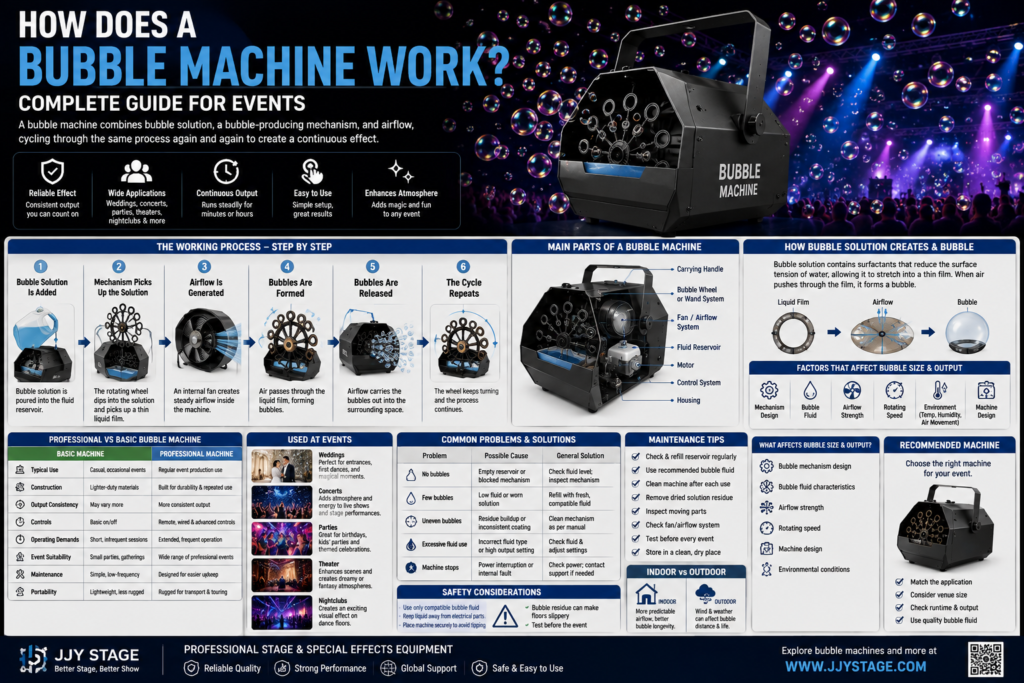
If you’ve ever watched a steady stream of bubbles drift across a stage or a dance floor, you’ve probably wondered how does a bubble machine work to keep producing bubbles for minutes or hours at a time. The short answer: a bubble machine combines bubble solution, a bubble-producing mechanism, and airflow, cycling through the same process again and again to create a continuous effect.
That combination is what separates a machine from a person blowing bubbles by hand. Instead of a single burst that fades quickly, a bubble machine can run steadily through a wedding entrance, a full concert set, a stage scene, or a birthday party, giving event producers a reliable effect they can count on.
This guide breaks down exactly what happens inside a bubble machine, the parts involved, what affects bubble size and output, and how the effect is typically used at events from weddings and concerts to theater and nightclubs.
What Is a Bubble Machine?
A bubble machine is a piece of effects equipment designed to automatically and continuously produce bubbles, rather than requiring someone to blow them manually. It’s used across a wide range of settings, including weddings, concerts, stage productions, parties, theaters, and nightclubs.
The basic purpose of a bubble effect machine is consistency. A person blowing bubbles gets tired, needs to pause, and can’t sustain an even output for long. A machine doesn’t have that limitation as long as it has power, bubble solution, and is operating correctly, it can keep the effect going for as long as the event requires.
That reliability is a big part of why bubble machines are used for events instead of manual alternatives: a wedding entrance or a concert cue needs the effect to appear exactly on time, without gaps or inconsistency.
How Does a Bubble Machine Work?
This is the core question, so let’s walk through the process step by step. While exact mechanisms vary between manufacturers and models, most bubble machines follow a similar general sequence.
Step 1: Bubble Solution Is Added
Every bubble machine starts with a fluid reservoir that holds bubble solution. This liquid is specially formulated to form a stable, stretchable film something plain water can’t do on its own. The reservoir needs to be filled before operation, and its size determines how long the machine can run before it needs a refill.
Step 2: The Bubble Mechanism Picks Up the Solution
Once the reservoir is filled, a bubble-producing mechanism carries the solution up out of the reservoir. This is commonly a rotating wheel with loops or openings, though some machines use a wand-style system or other designs instead. As the mechanism turns, it repeatedly dips into the solution and comes back out coated in a thin liquid film.
Not every bubble machine uses exactly the same mechanism; wheel-based designs are common, but manufacturers vary in the details of how the solution is picked up and presented to the airflow.
Step 3: Airflow Is Generated
At the same time, an internal fan or airflow system inside the machine generates a steady stream of air. This airflow is what eventually pushes through the liquid film to form bubbles, and it’s also what carries finished bubbles away from the machine once they’re formed.
Step 4: Bubbles Are Formed
As the coated mechanism moves into position, air passes through the thin liquid film stretched across its loops or openings. Where the air pushes through the film, it separates the liquid into a rounded pocket of air wrapped in a thin liquid layer. This happens repeatedly and rapidly as the mechanism continues rotating.
Step 5: Bubbles Are Released
Once formed, bubbles are carried by the airflow away from the machine and out into the surrounding space. Depending on the machine’s design, this might mean a focused stream aimed in one direction or a wider spray covering more area.
Step 6: The Cycle Repeats
As long as the machine keeps running, the mechanism continues rotating, picking up more solutions, and airflow continues pushing through it. This repeated cycle is what allows a bubble machine to produce a continuous stream of bubbles instead of a single batch.
The Main Parts of a Bubble Machine
While designs differ between manufacturers, most bubble machines share a similar set of core components.
| Component | Function |
| Fluid reservoir | Holds bubble solution |
| Bubble wheel or wand system | Carries bubble solution through the airflow to form bubbles |
| Fan or airflow system | Helps form bubbles and pushes them out into the space |
| Motor | Drives the rotating or moving mechanism |
| Housing | Protects internal components and directs bubble output |
| Control system | Starts, stops, or adjusts machine operation |
Not every machine contains identical components in identical arrangements some models add extra features like adjustable angles, multiple fans, or additional control options. But this general set of parts covers the core functions found across most bubble machines.
How Bubble Solution Creates a Bubble
The science behind a single bubble is simpler than it might sound. It comes down to a liquid film and surface tension.
Bubble solution typically contains soap or another surfactant. Surfactants reduce the surface tension of water, allowing it to stretch into a thin film instead of just beading up or breaking apart. Think of it like the difference between plain water, which forms tight droplets, and soapy water, which can stretch into a thin, flexible sheet.
When air pushes through that stretched film, the film wraps around the air pocket and seals itself into a rounded shape, a bubble. The surfactant is what allows the film to hold together long enough to form and briefly survive in the air before popping.
This is also why using a suitable, compatible bubble fluid matters. A poorly formulated liquid may not stretch or hold together well, resulting in weak or inconsistent bubbles even if the machine’s mechanism is working properly.
Why Does a Bubble Machine Produce So Many Bubbles?
A person blowing bubbles by hand can only form one film at a time, and needs to pause to take another breath. A bubble machine avoids both limitations.
A few factors combine to make automated bubble production far more continuous:
- Continuous movement. The bubble wheel or mechanism keeps turning without needing rest.
- Multiple bubble-producing surfaces. Many designs have several loops or openings working at once, rather than a single point of bubble formation.
- Steady airflow. The fan runs continuously, rather than in short bursts.
- Repeated cycles. Each rotation repeats the pickup-and-release process, stacking bubble production over time.
- Extended operating time. Because the machine doesn’t tire, it can sustain output for as long as it’s powered and supplied with fluid.
Exact bubble output varies significantly depending on the specific machine, its design, the fluid used, and the settings selected there isn’t a single number that applies across all bubble machines.
What Determines Bubble Size and Output?
Several factors influence how many bubbles a machine produces and how large they appear:
- Bubble mechanism design. The size and number of loops or openings on the wheel or wand affect bubble size and volume.
- Bubble fluid characteristics. Different formulations produce different bubble strength, size, and consistency.
- Airflow. Stronger or more focused airflow can affect both bubble formation and how far bubbles travel.
- Machine design. Overall engineering, including fan placement and housing shape, affects output.
- Operating speed. Faster mechanism rotation generally increases the rate of bubble formation.
- Environmental conditions. Temperature, humidity, and air movement in the room or outdoor space can all affect how bubbles form and how long they last.
Because so many variables are involved, the best way to get consistent results is to follow the manufacturer’s recommendations for compatible fluid and operating settings for that specific machine.
Professional Bubble Machine vs Basic Bubble Machine
| Feature | Basic Machine | Professional Machine |
| Typical use | Casual, occasional events | Regular event production use |
| Construction | Lighter-duty materials | Built for durability and repeated use |
| Operating demands | Short, infrequent sessions | Extended, frequent operation |
| Output consistency | May vary more over time | Generally more consistent |
| Controls | Basic on/off | May include remote, wired, or additional control options |
| Portability | Often lightweight but less rugged | Built for repeated transport |
| Event suitability | Small, casual gatherings | Wide range of professional event types |
| Maintenance | Simple, low-frequency upkeep | Designed for easier upkeep under heavier use |
Professional equipment is generally built for more demanding event environments frequent transport, longer run times, and repeated setup and teardown. That said, professional-grade equipment isn’t automatically the better choice for every situation; a smaller, basic machine can be perfectly suitable for occasional or personal use.
How Bubble Machines Are Used at Events
Understanding the mechanism behind a bubble machine helps explain why it fits so naturally into different event settings.
Weddings. Bubble machines are commonly used for entrances, first dances, and reception moments. They’re also popular for photography, since bubbles catch light well on camera.
Concerts. On a concert stage, bubbles are often used to add atmosphere or accompany specific songs, working alongside the broader lighting design rather than standing alone.
Parties. For birthdays, children’s events, and theme parties, bubble machines add a playful, low-effort visual element that keeps energy up without requiring performers.
Theater. In stage productions, bubbles can enhance a scene, support a children’s production, or help build a fantasy-like atmosphere depending on the story being told.
Nightclubs. On dance floors and during DJ performances, bubble machines are sometimes used alongside other special effects to add visual variety to a set.
Across all of these settings, a bubble machine for events is chosen based on the specific application the mechanism stays largely the same, but the scale, placement, and timing shift depending on the event.
How Bubble Machines Work With Stage Lighting
Bubbles and lighting are frequently paired because bubbles interact visually with light in a way that adds texture to a scene. As bubbles pass through a beam or wash of light, they can pick up color and movement, creating a layered visual effect.
Bubble machines are commonly used alongside:
- Backlighting
- Beam lights
- Moving lights
- Wash lights
- Color-changing lights
The final visual result depends on several factors: the angle of the lighting, its intensity, what’s behind the bubbles, the conditions of the venue, and how dense the bubble effect is at that moment. A lighting designer typically adjusts these elements together rather than treating bubbles as a standalone effect.
For a broader look at how bubble effects fit alongside other equipment types, see our stage special effects guide, which covers the full range of effects used in live event production.
What Type of Bubble Machine Is Best for Different Events?
The right machine depends heavily on the specific application. Here’s a general overview for a deeper breakdown of selection criteria, see our guide on choosing the right bubble machine for events.
| Event | Suitable Machine Type | Main Consideration |
| Small party | Basic or entry-level machine | Simple setup, modest coverage |
| Wedding | Reliable mid-range or professional machine | Timing, venue policy, floor safety |
| Concert | Professional stage-oriented machine | Coordination with lighting and cues |
| Stage show | Professional stage-oriented machine | Consistent timing across performances |
| Theater | Professional or application-specific machine | Integration with scene design |
| Nightclub | Professional machine | Integration with existing lighting rig |
| Festival | Professional, weather-resistant setup | Wind and outdoor conditions |
Machine selection ultimately depends on venue size, the coverage area needed, how long the machine needs to run, and the specific requirements of the event.
Indoor vs Outdoor Bubble Machine Operation
The environment a bubble machine operates in has a direct effect on how bubbles form, travel, and last.
Indoor operation tends to be more predictable. Air conditioning and ventilation systems can create gentle air currents that move bubbles around a room, while room size and ceiling height affect how far bubbles can travel before settling. Floor surfaces also matter indoors, since bubble residue can affect certain flooring types.
Outdoor operation introduces more variables. Wind is the biggest factor even a light breeze can carry bubbles quickly out of the intended area or disperse them faster than expected. Temperature and humidity also play a role in how long bubbles last once released, and weather conditions more broadly can affect both the equipment and the visual result.
In general, outdoor bubbles tend to disperse more quickly than indoor bubbles, simply because there’s more uncontrolled air movement for them to interact with.
How Long Can a Bubble Machine Run?
There’s no single runtime that applies to every bubble machine. Operating time depends on several factors:
- The machine’s design and mechanism
- Fluid reservoir capacity
- The output level or setting being used
- The specific operating mode selected
- The manufacturer’s stated specifications for that model
Because these factors vary so much between machines, the best way to know how long a specific unit can run is to check the manufacturer’s documentation for that model rather than relying on a general assumption.
What Bubble Fluid Does a Bubble Machine Use?
Bubble machines use a bubble solution specifically formulated to create a stable liquid film capable of forming and holding bubbles as air passes through it. Different machines may have different fluid requirements depending on their mechanism and design, which is why manufacturers typically recommend a specific type of compatible fluid.
Using fluid that isn’t designed for the machine including homemade mixtures can lead to weaker bubble formation, inconsistent output, or buildup that affects the equipment’s performance over time. Sticking to the fluid recommended by the manufacturer is the most reliable way to get consistent results.
Common Bubble Machine Problems
| Problem | Possible Cause | General Solution |
| No bubbles | Empty reservoir or blocked mechanism | Check fluid level; inspect mechanism for blockages |
| Few bubbles | Low fluid or worn solution | Refill reservoir with fresh, compatible fluid |
| Uneven bubbles | Residue buildup or inconsistent fluid coating | Clean mechanism per manufacturer instructions |
| Excessive fluid use | Incorrect fluid type or high-output setting | Check fluid compatibility and adjust settings |
| Machine stops | Power interruption or internal fault | Check power connection; contact manufacturer support if unresolved |
For any issue involving internal electrical or mechanical components, it’s best to consult the manufacturer’s documentation or reach out to qualified technical support rather than attempting a repair without guidance.
Bubble Machine Maintenance
Routine maintenance helps keep a bubble machine performing consistently over time:
- Check the fluid reservoir regularly and keep it filled with compatible solution
- Follow the manufacturer’s cleaning instructions closely
- Remove dried residue from components where appropriate
- Inspect moving parts to confirm they turn freely
- Check the fan or airflow system for dust or blockages
- Test the machine before each event rather than assuming it’s ready
- Store the machine properly after use, away from dust and moisture
Consistent upkeep reduces the chance of unexpected issues during a live event, where there’s often no time to troubleshoot on the spot.
Bubble Machine Safety Considerations
Because bubble machines combine liquid and electrical components, a few safety practices are worth following at every event:
- Follow the manufacturer’s setup and operating instructions
- Use only compatible bubble fluid recommended for the machine
- Keep liquid away from electrical connections and power sources
- Place the equipment securely so it can’t be knocked over
- Be mindful that bubble residue can make floors slippery
- Keep cables organized and protected from foot traffic
- Follow any venue-specific requirements or restrictions
- Test the equipment before the event begins
- Position the machine away from areas where guests or performers might accidentally bump into it during operation
Treating a bubble machine with the same care as any other electrical event equipment helps keep the effect safe for everyone involved.
Frequently Asked Questions
How does a bubble machine work?
A bubble machine combines bubble solution, a rotating or moving mechanism, and airflow. The mechanism carries a thin liquid film, and air passing through that film forms bubbles, which are then carried out into the surrounding space by the machine’s airflow.
What liquid does a bubble machine use?
Bubble machines use a bubble solution formulated to create a stable, stretchable liquid film. Different machines may have different fluid requirements, so it’s best to use the fluid recommended by the manufacturer for that specific model.
How does a bubble machine make so many bubbles?
Unlike blowing bubbles by hand, a machine’s mechanism moves continuously, often with multiple bubble-producing surfaces, combined with steady airflow. This allows it to repeat the bubble-forming process rapidly and continuously while it’s operating.
What are the main parts of a bubble machine?
Most bubble machines include a fluid reservoir, a bubble wheel or wand system, a fan or airflow system, a motor, a housing, and a control system. Exact designs vary between manufacturers and models.
Can bubble machines be used indoors?
Yes, bubble machines are commonly used indoors. Indoor environments tend to offer more predictable air movement, though room size, ceiling height, and floor surfaces can all affect the result.
Can bubble machines be used outdoors?
Yes, but outdoor conditions like wind, temperature, and humidity can affect how quickly bubbles disperse. Positioning and placement often need to be adjusted compared to indoor use.
How long can a bubble machine run?
Runtime depends on the specific machine’s design, fluid capacity, and output setting. There’s no universal runtime check the manufacturer’s specifications for the model in question.
Do professional bubble machines work differently?
The basic mechanism is generally similar, but professional machines are typically built with more durable construction and are designed for more consistent output over longer, more frequent use compared to basic machines.
Can a bubble machine work with stage lighting?
Yes, bubble machines are often used alongside beam lights, wash lights, moving lights, and backlighting to add visual texture to a stage. The final effect depends on lighting angle, intensity, and bubble density.
How do you maintain a bubble machine?
Basic maintenance includes checking the fluid reservoir, cleaning components per the manufacturer’s instructions, inspecting moving parts and the airflow system, testing before events, and storing the machine properly when not in use.
Conclusion
At its core, a bubble machine works through a simple combination: bubble solution, a bubble-producing mechanism, and airflow, cycling together to create a continuous bubble effect. The specific design of the mechanism, the quality of the fluid, the strength of the airflow, and the surrounding environment all shape the final result from bubble size to how far the effect travels.
Understanding how the process works can help event professionals make more informed decisions about which equipment fits their application, how to operate it correctly, and what to expect from different machines in different settings.
For event teams looking for reliable, production-ready equipment, JJY Stage’s special effects equipment includes bubble-effect machines designed with professional event use in mind. Exploring the available options is a useful next step for anyone planning to bring bubble effects into an upcoming production, wedding, or show.