
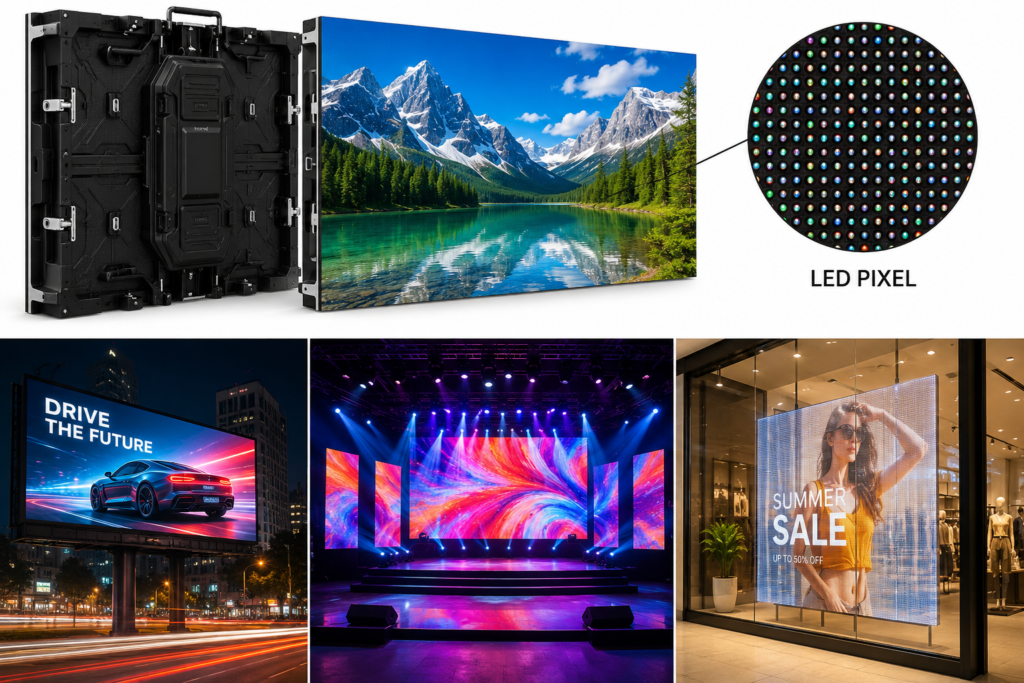
An LED display device is an electronic screen system that uses Light Emitting Diodes (LEDs) to produce bright, high-contrast visuals for video, images, text, and animations. These displays are widely used in advertising, events, control rooms, retail stores, stadiums, and public information systems due to their brightness, durability, and energy efficiency.
What is an LED Display Device?
An LED display device is made up of thousands of tiny LED lights arranged in a grid (pixels). Each LED acts as a light source, and together they form images and videos when controlled by a display system.
Unlike traditional LCD screens, LED displays do not require a backlight, making them brighter and more visible even in direct sunlight.
How LED Display Devices Work
LED display systems operate through a combination of hardware and software:
- LED Modules: Small panels that contain LED pixels
- Receiving Card: Controls signal distribution
- Sending Card / Controller: Sends video input to the screen
- Power Supply Unit: Provides stable electricity
- Software Control System: Manages content display (videos, text, ads)
When a video or image is sent, each LED lights up in different intensities to create full-color visuals.
Types of LED Display Devices
LED display devices come in different types depending on usage:
- Indoor LED Displays: Used in malls, conference rooms, and studios
- Outdoor LED Displays: Used for billboards, stadiums, and roadside advertising
- Transparent LED Displays: Often used in glass windows for modern advertising
- Flexible LED Displays: Can be curved or rolled for creative installations
- Rental LED Displays: Used in events, concerts, and exhibitions
Key Features
- High brightness and visibility in daylight
- Long lifespan (often 50,000–100,000 hours)
- Energy-efficient performance
- Customizable sizes and shapes
- Supports HD, Full HD, and 4K content
- Remote content management capability
Applications of LED Display Devices
LED display systems are used across many industries:
- Advertising billboards and digital signage
- Sports stadium scoreboards and screens
- Concert and stage backdrops
- Transportation hubs (airports, bus stations)
- Retail and shopping mall promotions
- Corporate control rooms and monitoring centers
Advantages
LED display devices offer several benefits:
- Better visibility compared to traditional screens
- Weather-resistant outdoor models
- Easy maintenance with modular design
- High impact for marketing and branding
- Real-time content updates
Conclusion
An LED display device is a powerful visual communication tool that enhances advertising, entertainment, and information delivery. With advanced technology and flexible applications, it has become a standard solution for modern digital display needs.