
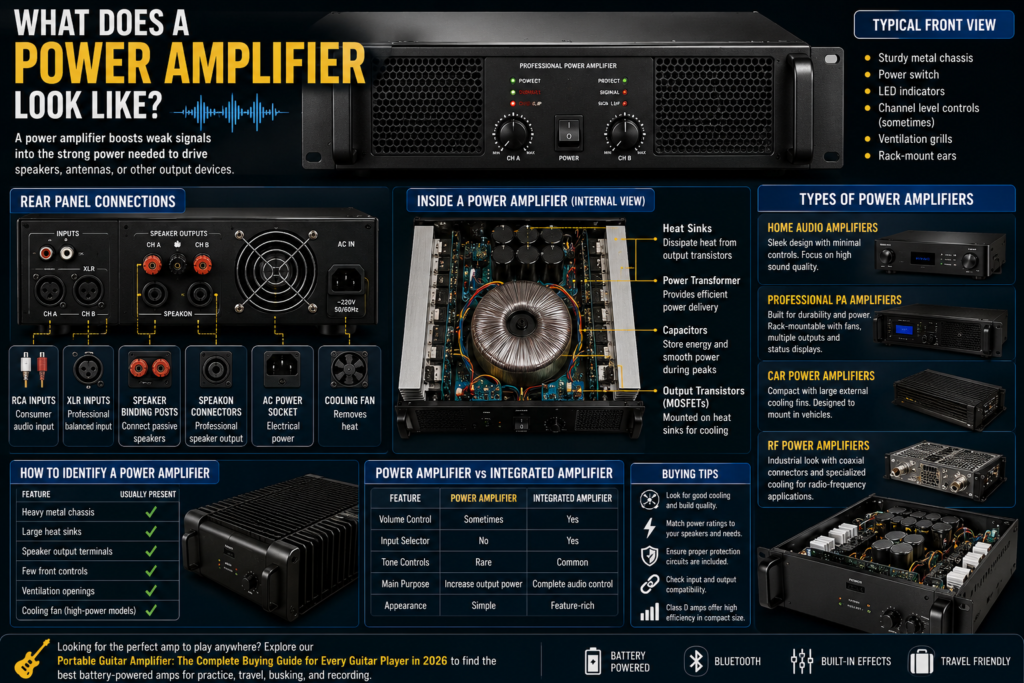
Have you ever seen a black metal box with large cooling fins, heavy speaker terminals, and only a few knobs on the front? Chances are, you were looking at a power amplifier. Many beginners imagine that every amplifier looks the same, but that is far from reality. A power amplifier can be as small as the palm of your hand or as large as professional rack-mounted equipment used at concerts. Its appearance depends on where it will be used, how much power it delivers, and the type of signals it amplifies.
A power amplifier is designed to take a weak audio or radio-frequency signal and increase its power enough to drive speakers, antennas, or other output devices. Unlike integrated amplifiers or receivers, dedicated power amplifiers usually have a simple design with very few controls because their main job is amplification rather than signal processing. Industry references consistently describe power amplifiers as the final stage in an amplification chain, responsible for delivering sufficient power to the connected load.
Understanding a Power Amplifier
What Is a Power Amplifier?
A power amplifier is an electronic device that boosts the strength of an incoming electrical signal so it can drive an output device efficiently. Whether you’re listening to music through home speakers, attending a live concert, or transmitting radio signals, a power amplifier is often doing the heavy lifting behind the scenes.
Unlike a preamplifier, which mainly prepares and conditions the signal, a power amplifier provides the energy required to move speaker cones or transmit RF signals. Engineers classify power amplifiers into several categories, including Class A, Class AB, Class B, Class D, Class G, and Class H, each offering different balances between efficiency, sound quality, and heat generation.
Why Appearance Depends on Its Purpose
Not every power amplifier looks identical because each application demands different hardware. A compact Bluetooth speaker contains a tiny integrated power amplifier hidden on a circuit board, while a stadium sound system uses massive rack-mounted amplifiers with multiple cooling fans.
The higher the output power, the larger the cooling system generally becomes. High-powered amplifiers often include aluminum heat sinks, ventilation slots, cooling fans, and heavy-duty power supplies to safely dissipate heat.
What Does a Typical Power Amplifier Look Like?
External Design and Front Panel
Most standalone audio power amplifiers have a clean, professional appearance. Unlike receivers packed with buttons and menus, dedicated power amplifiers typically feature:
- A sturdy metal chassis
- One or two power switches
- LED power and protection indicators
- Channel level controls (sometimes)
- Ventilation grills
- Rack-mount ears on professional models
Professional studio references note that many dedicated power amplifiers intentionally avoid tone controls, balance controls, and input selectors because those functions belong elsewhere in the audio chain.
Rear Panel Connections
The rear panel usually contains:
| Connection | Purpose |
| RCA Inputs | Consumer audio input |
| XLR Inputs | Professional balanced input |
| Speaker Binding Posts | Connect passive speakers |
| Speakon Connectors | Professional speaker output |
| AC Power Socket | Electrical power |
| Cooling Fan | Removes heat |
These connections help distinguish a true power amplifier from receivers or integrated amplifiers.
Inside a Power Amplifier
Circuit Board
Opening a power amplifier reveals a large printed circuit board (PCB) filled with resistors, capacitors, integrated circuits, and semiconductor devices. Modern amplifiers often use highly integrated designs that maximize efficiency while reducing size.
Heat Sinks
Perhaps the easiest internal feature to recognize is the large aluminum heat sink. Since output transistors generate significant heat, manufacturers install thick metal fins that transfer heat away from sensitive components.
Higher-powered Class A and Class AB amplifiers generally require much larger heat sinks than efficient Class D designs because they waste more energy as heat.
Power Transformer
Traditional amplifiers usually contain a heavy transformer occupying a significant portion of the chassis. Toroidal transformers are common because they provide efficient power delivery while minimizing electrical noise.
Switch-mode power supplies are increasingly popular in lightweight Class D amplifiers because they reduce weight without sacrificing output capability.
Capacitors and Transistors
Large cylindrical capacitors often dominate the amplifier’s interior. These components store electrical energy and smooth power delivery during demanding musical peaks.
Output transistors or MOSFETs are normally mounted directly to the heat sinks, ensuring efficient cooling during operation.
Different Types of Power Amplifiers
Home Audio Amplifiers
Home power amplifiers are designed to blend into entertainment systems. Most have sleek aluminum or black steel cases measuring about 17 inches wide. Controls are intentionally minimal, with emphasis placed on sound quality rather than appearance.
Professional PA Amplifiers
Professional amplifiers prioritize durability over aesthetics. They usually feature:
- Rack-mount construction
- High-speed cooling fans
- Multiple speaker outputs
- Heavy-duty handles
- Digital status displays
These amplifiers are commonly found in concert venues, churches, theaters, and conference halls.
Car Power Amplifiers
Car amplifiers have a completely different appearance. Since space is limited, manufacturers build them with large external aluminum cooling fins that cover nearly the entire housing.
Most are rectangular and designed to mount beneath seats or inside vehicle trunks.
RF Power Amplifiers
RF power amplifiers often resemble industrial electronic equipment rather than consumer audio products. They may include coaxial connectors, shielding enclosures, precision cooling systems, and specialized circuit layouts designed for radio-frequency operation.
How to Identify a Power Amplifier
Features That Make It Easy to Recognize
If you’re trying to identify whether a device is a power amplifier, look for these characteristics:
| Feature | Usually Present |
| Heavy metal chassis | ✅ |
| Large heat sinks | ✅ |
| Speaker output terminals | ✅ |
| Few front controls | ✅ |
| Ventilation openings | ✅ |
| Cooling fan (high-power models) | ✅ |
The absence of multiple source-selection buttons often indicates you’re looking at a dedicated power amplifier instead of an integrated amplifier.
Power Amplifier vs Integrated Amplifier
Key Differences
| Feature | Power Amplifier | Integrated Amplifier |
| Volume Control | Sometimes | Yes |
| Input Selector | No | Yes |
| Tone Controls | Rare | Common |
| Main Purpose | Increase output power | Complete audio control |
| Appearance | Simple | Feature-rich |
An integrated amplifier combines both a preamplifier and a power amplifier into one enclosure, whereas a standalone power amplifier focuses solely on delivering high-output power.
Buying Tips
Before purchasing a power amplifier, consider its intended application rather than appearance alone. A beautiful amplifier with polished aluminum panels may not provide enough power for a large venue, while a rugged professional model may be excessive for a small living room.
Look for quality cooling, adequate power ratings, compatible input and output connections, and reliable protection circuits. Modern Class D amplifiers are particularly popular because they combine compact size with high efficiency, making them ideal for many home and professional installations.
Looking for the perfect amp to play anywhere? Explore our Portable Guitar Amplifier: The Complete Buying Guide for Every Guitar Player in 2026 to discover the best battery-powered amps for practice, travel, busking, and recording. Learn which features actually matter—from wattage and battery life to Bluetooth and built-in effects—before making your next upgrade.
Conclusion
A power amplifier doesn’t have one universal appearance. It can be a compact circuit hidden inside portable electronics, a stylish home stereo component, a finned aluminum car amplifier, or a rugged rack-mounted professional unit. Despite these differences, most power amplifiers share recognizable characteristics such as durable metal construction, substantial cooling systems, speaker output terminals, and a straightforward control layout.
If you’re examining an amplifier and notice a heavy chassis, large heat sinks, minimal front-panel controls, and dedicated speaker outputs, you’re probably looking at a power amplifier. Understanding these visual cues makes it much easier to identify amplifiers whether you’re shopping for audio equipment, repairing electronics, or simply satisfying your curiosity.
FAQs
1. What color are most power amplifiers?
Most power amplifiers are black, silver, or gray with durable metal enclosures.
2. Why do power amplifiers have large heat sinks?
Heat sinks dissipate excess heat generated by the output transistors during operation.
3. Do all power amplifiers have cooling fans?
No. Lower-power models often rely on passive heat sinks, while higher-power amplifiers typically include fans.
4. Can a power amplifier work without a preamplifier?
Some can if the audio source provides enough output level, but many systems use a dedicated preamplifier for proper signal control.
5. Are car power amplifiers different from home amplifiers?
Yes. Car amplifiers are usually smaller, operate on 12-volt DC power, and feature external cooling fins designed for automotive installations.