
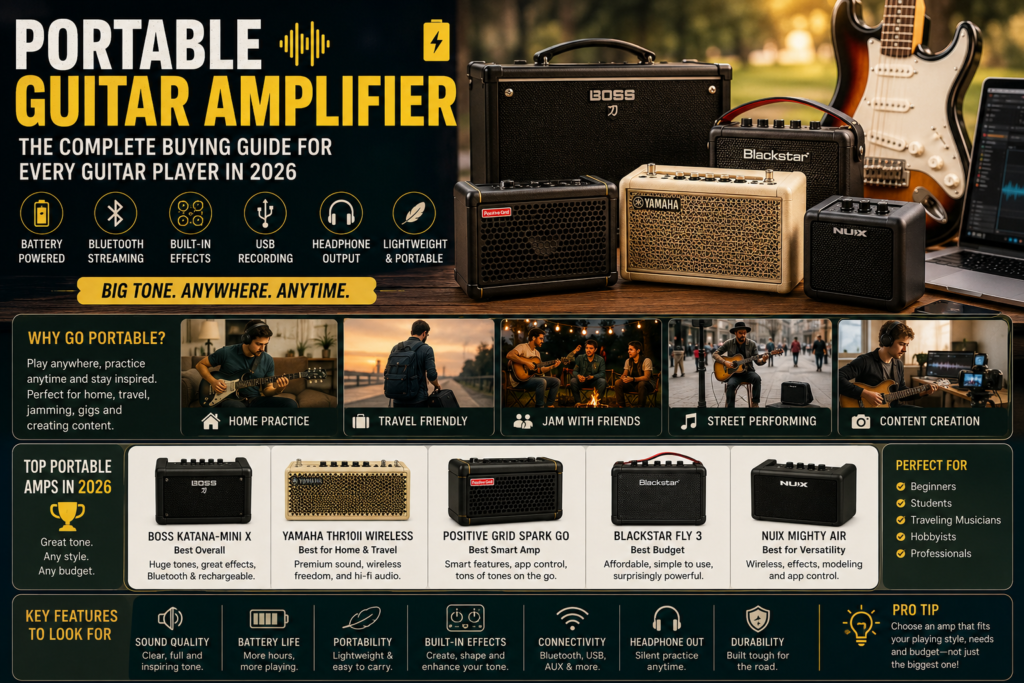
Whether you’re practicing quietly at home, jamming with friends at a local park, traveling between gigs, or entertaining a crowd on a busy street corner, a portable guitar amplifier has become one of the most practical pieces of equipment a guitarist can own. Years ago, portable amps were often considered small practice boxes with limited sound quality and minimal features. Fast forward to 2026, and the landscape has changed dramatically. Today’s portable subwoofer amplifier combine impressive sound, rechargeable batteries, Bluetooth streaming, USB recording, built-in effects, amp modeling, and smartphone integration into compact designs that can easily fit into a backpack or car trunk.
Modern musicians expect flexibility. They no longer want to be tied to wall outlets or carry heavy equipment everywhere they perform. Manufacturers have responded by creating lightweight amplifiers that deliver surprisingly powerful tones without sacrificing convenience. Whether you play blues, jazz, country, rock, pop, metal, or acoustic guitar, there’s now a portable amplifier specifically designed to match your playing style and performance needs.
Choosing the right portable guitar amp can feel overwhelming because there are dozens of excellent models available across every budget. Some prioritize battery life, while others focus on premium speaker quality or advanced digital effects. Understanding the features that actually matter makes the buying process much easier. This guide explains everything you need to know, from the basics of portable amplifiers to the latest technology that makes them an essential investment for beginners and professional musicians alike.
What Is a Portable Guitar Amplifier?
A portable guitar amplifier is a compact amplification system specifically designed to deliver quality guitar sound while remaining lightweight and easy to transport. Unlike traditional amplifiers that often require permanent power sources and occupy significant space, portable models emphasize mobility without compromising the tonal characteristics guitarists expect. Most portable amplifiers feature rechargeable batteries or can operate using standard batteries, making them suitable for locations where electrical outlets are unavailable. Despite their compact dimensions, many current models include surprisingly advanced technology such as digital amp modeling, wireless Bluetooth streaming, headphone outputs for silent practice, USB recording interfaces, auxiliary inputs, and built-in effects like delay, chorus, reverb, tremolo, and overdrive.
The purpose of a portable amplifier extends far beyond simple home practice. Students can easily carry one to lessons, touring musicians can warm up backstage before performances, content creators can record high-quality audio in virtually any location, and street performers can entertain audiences without worrying about nearby power sources. Improvements in speaker design and efficient Class-D subwoofer amplifier technology have enabled manufacturers to produce portable amps capable of delivering impressive volume while consuming minimal battery power. Some premium models even rival the sound quality of much larger practice amplifiers, making them practical for rehearsals and intimate live performances.
The growing popularity of remote work, outdoor entertainment, social media performances, and home recording has also increased demand for portable musical equipment. Today’s guitarists appreciate products that serve multiple purposes, and portable amplifiers perfectly fit that expectation by combining portability, versatility, and professional-grade features into a single compact package.
How Portable Amps Have Evolved
The evolution of portable guitar amplifiers has been remarkable over the past decade. Earlier generations primarily served as low-powered practice tools that emphasized convenience over tone. Many produced thin, boxy sounds with limited headroom and virtually no onboard effects. Battery life was often disappointing, and connectivity options were extremely limited. As a result, many serious musicians viewed portable amplifiers as temporary solutions rather than reliable long-term equipment.
Technological innovation completely transformed this category. Modern digital signal processing has allowed manufacturers to recreate the sound of legendary tube amplifiers inside remarkably compact enclosures. Lightweight neodymium speakers produce richer frequencies while reducing overall weight, and efficient battery technology provides several hours of continuous playing on a single charge. Bluetooth connectivity enables users to stream backing tracks directly from smartphones, while USB-C charging has simplified power management for traveling musicians. Mobile companion apps further expand functionality by allowing users to customize amp models, effects chains, presets, and recording settings directly from their devices.
Artificial intelligence and cloud-based preset sharing are also beginning to influence premium portable amplifiers. Players can download professionally designed tones that emulate famous guitar sounds, making it easier than ever to achieve studio-quality results without investing in multiple pieces of equipment. These advancements have changed the perception of portable amps from beginner accessories into serious musical tools capable of supporting rehearsals, live performances, recording sessions, and professional practice environments. As technology continues advancing, portable guitar amplifiers are expected to become even more powerful while remaining smaller, lighter, and increasingly energy efficient.
Who Should Buy One?
A portable guitar amplifier is an excellent investment for virtually every guitarist, regardless of skill level or musical genre. Beginners especially benefit because these amplifiers are simple to operate, affordable, and often include useful learning features such as backing tracks, metronomes, Bluetooth connectivity, and headphone outputs for silent practice. Instead of purchasing several separate devices, a beginner can enjoy an all-in-one solution that supports daily learning while encouraging consistent practice habits.
Intermediate players appreciate portability for rehearsals, jam sessions, songwriting, and travel. Carrying a lightweight amplifier eliminates the inconvenience of transporting large equipment while still providing enough volume for collaborative playing. Many intermediate musicians also enjoy experimenting with built-in effects and amp simulations that broaden their creative possibilities without requiring expensive pedalboards. Recording enthusiasts gain additional value from USB audio interfaces that allow direct recording into digital audio workstations, making home studio production significantly more accessible.
Professional musicians increasingly include portable amplifiers in their gear collections because convenience matters even at the highest levels. Touring artists often require reliable backstage practice solutions, acoustic performers need compact amplification for smaller venues, and buskers depend on battery-powered equipment capable of operating throughout extended performances. Even experienced session guitarists appreciate having a dependable portable amplifier for teaching lessons, traveling, composing music, or quickly testing instruments before studio sessions. Rather than replacing traditional stage amplifiers, portable models complement professional setups by providing unmatched flexibility in situations where mobility and convenience are essential.
Benefits of Using a Portable Guitar Amplifier
One of the biggest reasons guitarists invest in a portable guitar amplifier is the incredible flexibility it offers. Traditional amplifiers certainly have their place, especially for stage performances and studio recording, but they often require dedicated space, reliable power sources, and considerable effort to transport. Portable amplifiers remove these obstacles, allowing musicians to focus entirely on playing rather than managing heavy equipment. Whether you are practicing in your bedroom, relaxing in your backyard, visiting a friend’s house for a jam session, or performing outdoors, a portable amp makes every situation more convenient.
Another major advantage is affordability. Many portable amplifiers include features that previously required purchasing multiple devices separately. Built-in effects, Bluetooth speakers, USB recording interfaces, headphone outputs, tuner functions, and even drum patterns are now common in many models. This makes portable amplifiers an excellent value for beginners who want an all-in-one solution without spending thousands of dollars on professional equipment. Instead of carrying an amplifier, effects pedals, cables, speakers, and recording interfaces separately, musicians can rely on one compact unit capable of handling nearly every practice situation.
Modern portable amps also encourage more frequent practice. Because they are lightweight and easy to set up, there is virtually no barrier between inspiration and playing. When creativity strikes, musicians can simply switch on the subwoofer amplifier and begin performing within seconds. This convenience often leads to more consistent practice sessions, faster skill development, and greater musical confidence. For players who travel frequently or have limited living space, portability becomes more than a luxury—it becomes an essential part of maintaining their musical routine.
Practice Anywhere
The phrase “practice anywhere” has never been more accurate than it is with today’s generation of portable guitar amplifiers. Rechargeable batteries allow players to enjoy several hours of uninterrupted playing without searching for electrical outlets, making parks, beaches, campsites, hotel rooms, and even road trips practical places to practice. Many compact amplifiers weigh less than five kilograms, making them comfortable to carry in one hand or store inside a backpack alongside other musical accessories.
Silent practice has also become one of the most appreciated features among guitarists. Headphone outputs enable musicians to enjoy full amplifier tone without disturbing family members, roommates, or neighbors. Students living in apartments can continue practicing late into the evening without worrying about excessive noise, while parents appreciate being able to encourage children’s musical education without disrupting household activities. Many portable amplifiers even simulate cabinet responses through headphones, producing an immersive listening experience that closely resembles playing through a full-sized speaker cabinet.
Bluetooth connectivity further expands practice possibilities by allowing guitarists to stream backing tracks, instructional videos, or metronome applications directly through the amplifier’s speaker. This eliminates the need for external speakers and simplifies the overall setup. Instead of juggling multiple devices, players can enjoy a complete practice environment from a single compact amplifier. Whether learning scales, improvising over jazz progressions, or mastering challenging solos, portable amplifiers make practice sessions more engaging, productive, and enjoyable.
Travel and Busking Advantages
Traveling musicians understand the importance of minimizing equipment without sacrificing performance quality. A portable guitar amplifier addresses this challenge exceptionally well by combining portability with impressive audio performance. Whether traveling by car, train, airplane, or public transportation, compact amplifiers occupy very little space while remaining durable enough to withstand regular movement. Many manufacturers design reinforced cabinets, protective corners, and sturdy carrying handles specifically for musicians who frequently perform outside traditional venues.
Busking represents another area where portable amplifiers truly shine. Street performers depend on battery-powered equipment capable of delivering consistent volume for several hours without access to electrical outlets. Modern portable amplifiers provide enough power to entertain audiences in parks, city centers, markets, festivals, and outdoor events while remaining lightweight enough to transport comfortably between locations. Rechargeable lithium-ion batteries significantly reduce operating costs compared to disposable batteries, making them both economical and environmentally friendly for musicians who perform regularly.
Content creators and social media musicians also benefit tremendously from portable amplifiers. Recording guitar performances in scenic outdoor environments has become increasingly popular across platforms like YouTube, Instagram, and TikTok. Compact amplifiers allow creators to produce professional-looking videos without transporting bulky stage equipment into remote locations. Combined with USB recording functionality and smartphone connectivity, today’s portable amps make it easier than ever to create high-quality musical content wherever inspiration appears.
Features to Look For When Buying a Portable Guitar Amplifier
Choosing the best portable guitar amplifier requires understanding the features that genuinely impact performance rather than focusing solely on marketing claims. Every guitarist has unique priorities, so the ideal amplifier depends on how and where it will be used. Some players prioritize long battery life for outdoor performances, while others care more about sound quality, onboard effects, recording capabilities, or Bluetooth functionality. Evaluating these features carefully ensures that your investment remains useful for years rather than becoming outdated after a few months.
Sound quality should always remain the highest priority. Even the most feature-rich amplifier loses value if it fails to produce satisfying guitar tones. Look for models that provide clean headroom, responsive overdrive, balanced frequency response, and speaker designs that accurately reproduce both clean and distorted sounds. Speaker size also influences tonal characteristics. Smaller speakers typically emphasize portability, while larger speakers often deliver fuller bass response and greater overall projection.
Build quality deserves equal attention. A portable amplifier naturally experiences more movement and transportation than a stationary practice amp. Durable cabinets, reinforced corners, quality control knobs, protective speaker grilles, and weather-resistant materials contribute significantly to long-term reliability. Investing slightly more in superior construction often saves money by reducing maintenance costs and extending the amplifier’s lifespan. The following sections explore the individual features that should influence every purchasing decision.
Continuing the article:
Battery Life
Battery performance is one of the defining characteristics of any portable guitar amplifier. After all, portability means very little if the amplifier can only operate for a short period before needing to be recharged. Modern portable amplifiers have made significant progress in this area thanks to advances in lithium-ion battery technology. While older battery-powered amps often lasted only two or three hours, many current models comfortably provide between six and twenty hours of continuous use depending on volume levels, effects usage, and speaker output. This improvement has transformed portable amplifiers from simple practice tools into dependable companions for rehearsals, outdoor performances, travel, and extended recording sessions.
Rechargeable batteries also offer financial and environmental benefits. Instead of constantly replacing disposable batteries, guitarists simply recharge the amplifier using a USB-C charger or dedicated power adapter. Many models even support fast charging, allowing musicians to regain several hours of playing time after only a short charging session. Some premium portable amplifiers include battery indicators through companion smartphone apps, making it easy to monitor remaining power before heading to rehearsals or performances. These thoughtful features reduce the anxiety of unexpected power loss during important musical moments.
When comparing battery specifications, remember that advertised runtime often reflects moderate volume settings. Playing at maximum volume or using processor-intensive digital effects naturally consumes more power. For players who frequently perform outdoors or travel for extended periods, choosing an amplifier with longer battery life provides greater peace of mind. Investing in a model capable of lasting an entire day of casual practice or several live performances ensures consistent reliability and allows musicians to focus entirely on their creativity rather than constantly searching for charging opportunities.
Wattage
Wattage is another specification that often causes confusion among buyers, but understanding its practical impact makes selecting the right portable guitar amplifier much easier. In simple terms, wattage determines how much power an amplifier can deliver to its speaker, directly influencing maximum volume and clean headroom. Portable amplifiers commonly range from around five watts for personal practice up to forty watts or more for rehearsals and small live performances. Higher wattage does not necessarily mean better sound quality; instead, it indicates the amplifier’s ability to remain clear and dynamic at louder listening levels.
For bedroom practice and personal learning, a five to ten-watt amplifier is usually more than sufficient. These compact units provide excellent tone while remaining easy to transport and highly energy efficient. Intermediate players who regularly rehearse with friends may benefit from amplifiers offering fifteen to thirty watts, providing enough volume to compete with acoustic drums in smaller rehearsal spaces. Musicians performing in cafés, street performances, or intimate venues often prefer portable amplifiers in the thirty to forty-watt range because they deliver fuller projection without requiring external speaker systems.
It is also important to remember that speaker efficiency plays a major role alongside wattage. An efficiently designed speaker can often sound louder than a less efficient speaker driven by a higher-powered amplifier. Rather than choosing the highest wattage available, evaluate how the amplifier balances power, battery life, portability, and sound quality. The best portable amplifier delivers enough volume for your intended environment while maintaining excellent tone across both clean and overdriven settings.
Speaker Size
Although digital technology receives much of the attention in today’s portable amplifiers, the speaker remains one of the most influential components affecting overall sound quality. Speaker size directly impacts bass response, clarity, projection, and tonal warmth. Smaller speakers, typically ranging from three to five inches, contribute to lightweight designs that are ideal for travel and personal practice. They reproduce higher frequencies effectively and make compact amplifiers extremely easy to carry, though they may struggle to deliver the fuller low-end response desired for larger performances.
Larger speakers, usually between six and eight inches, provide noticeably richer bass, improved dynamic range, and more natural sound dispersion. These characteristics become particularly valuable for clean guitar tones, jazz performances, acoustic-electric guitars, and styles requiring greater tonal depth. Players who perform outdoors or rehearse with bands often appreciate the additional fullness that larger speakers provide, even if it slightly increases the amplifier’s overall size and weight. Fortunately, advances in lightweight speaker materials have helped manufacturers minimize this trade-off.
Cabinet design also influences speaker performance. Closed-back cabinets generally produce tighter bass response and focused projection, while open-back designs create a wider, more spacious listening experience that many guitarists associate with classic combo amplifiers. Some portable amplifiers even use specially engineered cabinet shapes to maximize acoustic efficiency despite their compact dimensions. When possible, listening to several speaker configurations in person remains one of the best ways to determine which sound best matches your musical preferences.
Built-in Effects
One of the greatest advantages of today’s portable guitar amplifiers is the impressive range of onboard effects available without requiring external pedals. Even entry-level models commonly include reverb, delay, chorus, tremolo, and various overdrive settings, while premium units may offer dozens of customizable digital effects alongside multiple amplifier simulations. These integrated features dramatically expand creative possibilities while keeping the overall setup simple, lightweight, and affordable.
Built-in effects are especially valuable for beginners because they allow experimentation with different musical styles without investing in expensive pedalboards. A player learning blues can easily add warm overdrive, while someone exploring ambient music can combine delay and reverb to create spacious atmospheric sounds. Intermediate musicians often appreciate programmable presets that store favorite combinations of amplifier settings and effects, enabling quick transitions between songs during rehearsals or performances. This convenience saves time while maintaining consistent sound quality across different playing situations.
Digital signal processing has improved significantly over recent years, allowing portable amplifiers to reproduce effects with remarkable realism. Many premium models now emulate classic analog pedals so accurately that casual listeners struggle to distinguish between digital and traditional hardware. Smartphone applications frequently extend these capabilities even further by offering deep editing options, downloadable artist presets, firmware updates, and cloud-based tone sharing communities. As a result, a modern portable guitar amplifier can function not only as a practice tool but also as a complete creative workstation capable of inspiring musicians at every skill level.
Bluetooth and USB Connectivity
Connectivity has become one of the most important selling points of a modern portable guitar amplifier. Gone are the days when an amplifier simply amplified your guitar signal. Today’s portable amps are designed to function as complete entertainment and recording hubs, integrating seamlessly with smartphones, tablets, laptops, and music production software. Bluetooth connectivity is now considered almost essential because it allows musicians to stream backing tracks, online lessons, playlists, and jam tracks directly through the amplifier’s speakers. This feature transforms practice sessions into immersive experiences without requiring additional speakers or complicated wiring.
USB connectivity is equally valuable, especially for guitarists interested in recording or live streaming. Many portable amplifiers now function as USB audio interfaces, enabling direct recording into digital audio workstations such as GarageBand, Logic Pro, Cubase, Reaper, or Ableton Live. Instead of purchasing separate recording hardware, musicians can simply connect the amplifier to a computer and capture professional-quality guitar tracks within minutes. This convenience is particularly attractive to content creators, online music teachers, and home studio enthusiasts who value simple yet effective recording workflows.
Companion smartphone applications further expand what portable amplifiers can accomplish. Through these apps, users can modify amplifier settings, download artist-created presets, update firmware, organize custom tone libraries, and share sounds with online communities. Some advanced amplifiers even offer cloud-based tone sharing, where thousands of user-created presets can be accessed with just a few taps. These digital capabilities ensure that a portable amplifier continues improving over time through software updates rather than becoming outdated after purchase.
Best Portable Guitar Amplifiers in 2026
The portable amplifier market has become incredibly competitive, giving guitarists more choices than ever before. Every major manufacturer now offers compact models aimed at different budgets and musical styles. Some prioritize authentic analog tones, while others focus on advanced digital modeling, Bluetooth integration, or professional recording features. Choosing the right amplifier ultimately depends on your budget, playing environment, and desired features rather than selecting the most expensive model available.
The following comparison highlights several of the most highly regarded portable guitar amplifiers currently available. These models consistently receive positive reviews for their sound quality, durability, battery performance, ease of use, and overall value. Whether you’re purchasing your first amplifier or upgrading an existing practice setup, these options represent excellent starting points for your search.
| Model | Power | Battery Life | Best For | Key Features |
| Positive Grid Spark 2 | 50W | Up to 12 Hours | Advanced Players | AI Tone Engine, Bluetooth, USB Recording |
| BOSS Katana Mini X | 10W | Rechargeable | Beginners & Travel | Classic Katana Tone, Compact Design |
| Fender Champion II 25 | 25W | AC Powered | Home Practice | Multiple Amp Voices, Effects |
| Orange Crush Mini | 3W | Battery Powered | Travel Practice | Analog Tone, Lightweight |
| Blackstar Debut 50R | 50W | AC Powered | Rehearsals | Stereo Reverb, Rich Clean Channel |
Each amplifier offers unique strengths. Some prioritize realistic amp modeling and digital flexibility, while others focus on straightforward analog operation with intuitive controls. Understanding your own playing habits helps narrow the selection considerably.
Budget Picks
Affordable portable guitar amplifiers have improved dramatically over the last several years. Budget no longer means sacrificing quality, as many entry-level models now include features that were once exclusive to premium products. Beginners can enjoy clean sound, headphone outputs, auxiliary inputs, built-in overdrive, and respectable battery life without exceeding a modest budget. This accessibility has encouraged more aspiring guitarists to practice regularly because quality equipment is no longer financially out of reach.
Models like the Orange Crush Mini continue to earn praise for their warm analog sound despite their compact dimensions. Similarly, the BOSS Katana Mini series provides exceptional versatility by incorporating several amplifier voices and onboard delay into an extremely portable package. These amplifiers prove that affordable equipment can still inspire creativity and provide enjoyable playing experiences. Their lightweight construction also makes them excellent choices for students, travelers, and musicians who need a reliable backup amplifier.
Budget amplifiers generally emphasize simplicity, which many players actually appreciate. Straightforward controls encourage users to focus on developing technique rather than endlessly adjusting complicated digital settings. While they may not include smartphone applications or advanced recording interfaces, these compact units deliver dependable performance for daily practice, songwriting, and casual jam sessions. For players entering the world of guitar amplification for the first time, budget-friendly portable amplifiers offer outstanding value without unnecessary complexity.
Mid-Range Options
Mid-range portable guitar amplifiers represent the sweet spot for many musicians because they successfully balance affordability with professional-level features. These models typically offer improved speaker quality, stronger cabinet construction, extended battery life, expanded effects libraries, Bluetooth streaming, USB recording capabilities, and significantly better overall tonal flexibility. Intermediate players often find this category particularly attractive because it supports both home practice and small live performances without requiring substantial financial investment.
Amplifiers in this range commonly feature multiple amplifier simulations that accurately recreate famous vintage and modern guitar sounds. Instead of being limited to a single clean or distorted channel, musicians can quickly switch between classic American cleans, British crunch, modern high-gain metal tones, and acoustic simulations. This versatility encourages experimentation across different musical genres while reducing the need to purchase additional equipment. Many models also include programmable memory presets, making it easy to recall favorite settings instantly during rehearsals or performances.
Another advantage of mid-range amplifiers is their superior connectivity. Bluetooth audio streaming becomes smoother, USB recording quality improves, and mobile applications provide deeper customization options than entry-level products. Build quality also receives noticeable upgrades through reinforced cabinets, premium control knobs, improved speaker components, and longer-lasting rechargeable batteries. These enhancements make mid-range portable guitar amplifiers ideal for serious hobbyists, music students, gigging performers, and content creators seeking dependable equipment capable of adapting to a wide variety of musical situations.
Premium Choices
For guitarists who demand exceptional sound quality, cutting-edge technology, and maximum flexibility, premium portable guitar amplifiers represent the pinnacle of modern amplifier design. These models are engineered to deliver professional-grade performance while maintaining the convenience and mobility that define portable equipment. Although they come with a higher price tag, they often eliminate the need for multiple pieces of gear by combining amplifier modeling, studio-quality effects, recording capabilities, Bluetooth audio, wireless control, rechargeable batteries, and high-quality speakers into a single compact unit.
One of the standout premium models is the Positive Grid Spark 2, which has earned widespread recognition for its intelligent tone technology and remarkable versatility. It features AI-assisted tone generation, hundreds of customizable presets, Bluetooth streaming, USB recording, and seamless integration with companion mobile applications. Guitarists can access an enormous library of community-created sounds that emulate famous guitar rigs, making it possible to achieve tones inspired by legendary artists without purchasing expensive amplifiers or pedalboards. This level of customization makes premium portable amplifiers appealing not only to hobbyists but also to professional musicians who require consistent, high-quality sound in various performance environments.
Premium models also emphasize superior build quality. Manufacturers use stronger cabinet materials, premium speakers, reinforced control panels, and advanced battery management systems that provide dependable performance over many years of regular use. These amplifiers are designed to withstand transportation, rehearsals, outdoor performances, and studio sessions while maintaining excellent reliability. Although the initial investment is higher, the combination of outstanding sound quality, extensive features, and long-term durability often makes premium portable amplifiers a worthwhile purchase for musicians who play frequently and expect professional-level performance from their equipment.
Choosing the Right Portable Guitar Amplifier
Selecting the perfect portable guitar amplifier requires more than simply comparing prices or choosing the model with the most advertised features. Every guitarist has unique goals, playing styles, and performance environments, meaning the ideal amplifier varies from one musician to another. Someone who practices quietly at home has very different requirements than a street performer entertaining outdoor audiences or a touring musician needing a dependable backstage practice amp. Understanding your personal priorities helps narrow the selection and ensures that your investment delivers long-term satisfaction.
Before purchasing an amplifier, consider where you expect to use it most often. Will it primarily remain in your bedroom for daily practice, or do you plan to carry it to rehearsals, parks, beaches, classrooms, and live performances? Battery life becomes especially important for outdoor musicians, while home users may place greater emphasis on recording features or Bluetooth connectivity. Likewise, players interested in experimenting with different genres should prioritize amplifiers offering multiple amp models and onboard effects, whereas traditional guitarists may prefer straightforward analog controls and natural clean tones.
Budget also plays an important role, but it should never be the only deciding factor. Buying the least expensive amplifier may save money initially but could result in limited functionality or reduced durability over time. On the other hand, purchasing a premium model packed with advanced features that you never intend to use may not represent the best value either. Balancing price, sound quality, portability, and practical functionality is the key to finding an amplifier that genuinely enhances your musical journey.
Beginners
For beginners, simplicity is often more valuable than complexity. Learning guitar already involves developing finger strength, rhythm, coordination, music theory, and listening skills, so an amplifier should make the process easier rather than adding unnecessary confusion. A beginner-friendly portable guitar amplifier should feature intuitive controls, reliable sound quality, and practical features that encourage regular practice without overwhelming new players with excessive customization options.
Headphone outputs are especially valuable for beginners because they allow quiet practice at any time of day. Parents appreciate this feature when children are learning at home, while students living in apartments can practice without disturbing neighbors. Bluetooth connectivity also adds tremendous value by allowing learners to stream instructional videos, backing tracks, and online lessons directly through the amplifier. Playing along with favorite songs keeps practice sessions enjoyable and helps develop timing, rhythm, and musical confidence more quickly than practicing in silence.
Affordability remains another important consideration for beginners. Fortunately, today’s entry-level portable amplifiers provide impressive sound quality and useful features at accessible prices. Many include built-in overdrive, delay, reverb, auxiliary inputs, and rechargeable batteries, giving new players everything they need to begin exploring different musical styles. Choosing a dependable beginner amplifier creates a positive learning experience that encourages consistent practice and supports steady musical growth.
Intermediate Players
Intermediate guitarists usually seek greater tonal flexibility as their playing skills continue developing. At this stage, musicians begin exploring different genres, experimenting with effects, joining bands, recording original music, or performing for small audiences. A portable amplifier should therefore provide enough versatility to support these expanding musical interests without becoming overly complicated to operate during rehearsals or performances.
Amplifiers designed for intermediate players often include multiple amplifier models, programmable presets, USB recording, Bluetooth streaming, and expanded digital effects libraries. These features allow musicians to move seamlessly between clean jazz tones, crunchy blues sounds, classic rock distortion, modern high-gain metal, and ambient effects without requiring additional pedals. This versatility encourages creativity while reducing equipment costs and simplifying transportation.
Build quality also becomes increasingly important at the intermediate level because musicians begin carrying their amplifiers more frequently. Strong cabinets, dependable rechargeable batteries, quality speakers, and reliable control knobs contribute significantly to long-term durability. Investing in a well-built portable amplifier at this stage often provides years of dependable service as players continue improving their technique and exploring new musical opportunities.
Professional Musicians
Professional guitarists demand equipment capable of delivering consistent performance under demanding conditions. While large stage amplifiers remain essential for major concerts, portable guitar amplifiers have become valuable additions to professional gear collections because they provide unmatched convenience during travel, rehearsals, backstage warm-ups, songwriting sessions, teaching appointments, and intimate performances. The best professional portable amplifiers combine outstanding sound quality with extensive connectivity, rugged construction, and dependable battery performance.
Recording capability is particularly important for professionals. USB audio interfaces, low-latency monitoring, studio-quality amp modeling, and customizable presets allow musicians to capture ideas immediately without assembling complex recording setups. Whether composing music in a hotel room or recording demonstration tracks between rehearsals, portable amplifiers simplify the creative process while maintaining professional audio quality.
Professionals also value reliability above all else. An amplifier must perform consistently regardless of weather conditions, transportation, or frequent use. Premium construction materials, reinforced cabinets, intelligent battery management, and regular firmware updates contribute to dependable long-term performance. For working musicians, a portable guitar amplifier is far more than a practice tool—it becomes a trusted companion that supports creativity wherever inspiration happens to strike.
Maintenance Tips
A portable guitar amplifier is an investment that can provide many years of dependable performance when properly maintained. Although modern amplifiers are designed with durability in mind, regular care helps preserve sound quality, extend battery life, and reduce the likelihood of unexpected technical issues. Unlike large stationary amplifiers that rarely leave the practice room, portable models experience frequent transportation, changing weather conditions, and regular handling. These factors make routine maintenance even more important. Spending just a few minutes caring for your amplifier after each use can significantly increase its lifespan and ensure it continues performing at its best.
One of the simplest maintenance habits is keeping the amplifier clean. Dust, dirt, and moisture can gradually accumulate around control knobs, input jacks, speaker grilles, and ventilation openings. Using a soft microfiber cloth to wipe the exterior after each session prevents debris from building up and helps maintain the amplifier’s appearance. Avoid using harsh cleaning chemicals because they may damage the cabinet finish or electronic components. If the amplifier becomes exposed to rain or excessive humidity during outdoor performances, allow it to dry completely before storing or charging it.
Battery care is equally important, especially for rechargeable models. Most lithium-ion batteries perform best when they are not repeatedly discharged to zero percent. Charging the amplifier before it becomes completely empty helps maintain long-term battery health. If the amplifier will not be used for several weeks, storing it with approximately fifty percent charge is generally recommended. Extreme temperatures should also be avoided because excessive heat or freezing conditions can reduce battery efficiency over time. Keeping firmware updated through the manufacturer’s companion application ensures access to performance improvements, bug fixes, and new features that may improve overall reliability.
Quick Installation Checklist
Before every practice session or performance, running through a simple setup checklist helps prevent unnecessary interruptions. While portable amplifiers are designed for convenience, taking a few moments to verify everything is working correctly ensures a smoother playing experience.
| Task | Why It Matters |
| Fully charge the battery | Prevents unexpected power loss |
| Check guitar cable connections | Reduces unwanted noise and signal loss |
| Adjust volume before playing | Protects hearing and speakers |
| Test Bluetooth connection | Ensures backing tracks work properly |
| Verify effects presets | Confirms desired sound is ready |
| Inspect speaker grille | Removes dust or debris |
| Update firmware if available | Improves performance and stability |
Following this simple checklist becomes second nature after a few practice sessions. It minimizes technical surprises while allowing you to concentrate on your performance instead of troubleshooting equipment.
Tools & Materials Summary Box
Although portable guitar amplifiers require very little maintenance compared to larger stage equipment, keeping a few basic accessories nearby makes routine care much easier.
| Item | Purpose |
| Microfiber cloth | Cleaning cabinet and controls |
| Soft brush | Removing dust from speaker grille |
| Contact cleaner | Cleaning input and output jacks |
| USB-C or original charger | Safe battery charging |
| Protective carrying case | Prevents transport damage |
| Spare instrument cable | Quick replacement if needed |
| Small screwdriver set | Tightening loose hardware when necessary |
Having these inexpensive accessories readily available helps maintain both appearance and performance throughout the amplifier’s lifetime.
Troubleshooting Checklist
Even high-quality portable guitar amplifiers occasionally experience minor issues. Fortunately, many common problems have simple solutions that do not require professional repairs.
| Problem | Possible Cause | Solution |
| No sound | Loose cable or low volume | Check connections and volume controls |
| Battery drains quickly | Old battery or high volume usage | Recharge fully or replace battery if necessary |
| Bluetooth won’t connect | Device already paired elsewhere | Reset Bluetooth and reconnect |
| Crackling sound | Dirty input jack | Clean using electronic contact cleaner |
| Distorted clean tone | Gain set too high | Reduce gain and increase master volume |
| USB recording not detected | Missing driver or cable issue | Reconnect using recommended USB cable |
Regular maintenance combined with simple troubleshooting knowledge allows most guitarists to solve everyday problems within minutes, avoiding unnecessary downtime and repair costs.
Conclusion
A portable guitar amplifier has evolved into one of the most versatile and valuable tools a guitarist can own. What was once considered a simple practice accessory has transformed into sophisticated musical equipment capable of supporting home practice, outdoor performances, rehearsals, recording sessions, travel, teaching, and content creation. Advances in digital signal processing, rechargeable battery technology, Bluetooth connectivity, USB recording, and compact speaker design have made today’s portable amplifiers remarkably powerful despite their lightweight construction. Whether you’re just beginning your musical journey or performing professionally, there is now a portable amplifier designed specifically for your needs and budget.
Choosing the right amplifier ultimately comes down to understanding how you intend to use it. Beginners may prioritize affordability, ease of use, and headphone outputs, while intermediate players often appreciate expanded effects, programmable presets, and recording features. Professional musicians generally seek premium sound quality, dependable battery life, rugged construction, and advanced connectivity. By carefully considering factors such as battery performance, wattage, speaker size, built-in effects, and wireless capabilities, you can confidently select an amplifier that enhances both your practice sessions and live performances.
The beauty of a portable guitar amplifier lies in its freedom. Inspiration can strike anywhere—at home, during a road trip, in a park, backstage before a concert, or while relaxing with friends. Instead of being limited by bulky equipment or the availability of power outlets, portable amplification allows musicians to bring their creativity wherever life takes them. Investing in a quality portable amplifier is more than purchasing another piece of gear; it is investing in greater flexibility, improved practice habits, and countless opportunities to enjoy making music.
Frequently Asked Questions
1. What is the ideal wattage for a portable guitar amplifier?
For home practice, 5–10 watts is usually sufficient. If you plan to rehearse with a band or perform in small venues, consider a portable amplifier with 20–50 watts for additional volume and clean headroom.
2. Can portable guitar amplifiers be used for live performances?
Yes. Many modern portable amplifiers produce enough volume for busking, coffee shops, small venues, rehearsals, and acoustic performances. Larger concerts typically require dedicated stage amplifiers or PA systems.
3. How long does the battery last on a portable guitar amplifier?
Battery life varies by model, but most rechargeable portable amplifiers operate between 6 and 20 hours on a single charge, depending on volume levels and feature usage.
4. Are Bluetooth features important in a portable amplifier?
Bluetooth is extremely useful because it allows musicians to stream backing tracks, lessons, and music directly through the amplifier, making practice sessions much more enjoyable and productive.
5. Is a portable guitar amplifier suitable for beginners?
Absolutely. Portable amplifiers are among the best choices for beginners because they are affordable, lightweight, easy to use, and often include helpful features such as headphone outputs, built-in effects, Bluetooth connectivity, and rechargeable batteries.