
Introduction
There’s a reason a burst of real fire on stage gets a bigger reaction than almost any other production element. A well-timed flame effect hits an audience on an instinctive level; it’s bright, it’s loud, it radiates heat, and it announces a moment as big. That’s why stage flame machines have become a signature tool for concerts, festivals, DJ performances, theater productions, live shows, product launches, and large-scale entertainment events of every kind.
From the audience’s seat, the effect looks simple: a trigger, a flash, a wall of flame. But behind those few seconds of spectacle is a coordinated system of specialized equipment, a controlled fuel or energy source, a dedicated ignition system, electronic control, layered safety systems, and a professional operator managing all of it in real time. Understanding how that system works and what to look for when specifying equipment for a production is essential for anyone planning to bring real fire into a live show.
This guide breaks down stage special effects guide are, how they function at a high level, where they’re used, how they compare to alternatives like LED flame effects and CO₂ jets, and what safety considerations belong at the center of every flame effect decision.
What Is a Stage Flame Machine?
A stage flame machine is professional effects equipment engineered to produce a controlled flame effect as part of a live production. Rather than an open, unmanaged fire, it’s a purpose-built system designed to generate a repeatable, triggerable flame on cue and to shut that flame down safely when the effect is complete.
While the exact architecture varies by manufacturer and equipment type, a professional flame machine typically brings together several functional systems working in concert:
- Flame-generation components
- A fuel or energy delivery system
- An ignition system
- Electronic controls
- Safety interlocks
- Emergency shutdown systems
- Monitoring systems
No two manufacturers build these systems identically, and the specific configuration of any flame effect machine should always be confirmed against that product’s own documentation. What stays consistent across the category is the underlying goal: turning open fire into a controlled, camera-ready production element.
Are Stage Flame Machines Real Fire?
This is one of the most common questions from event planners, and the honest answer is: it depends on the product.
Some equipment marketed under the “flame effect” umbrella produces genuine, combustion-based fire. Other products create the appearance of flame without any actual combustion, using tools like LEDs, projection, fabric, video, or lighting design.
| Effect | Real Flame? | Main Benefit |
| Professional Flame Machine | Yes | Authentic fire effect |
| LED Flame Effect | No | Simulated flame appearance |
| Projection Flame | No | Flexible visual design |
| Fabric Flame Effect | No | Decorative/theatrical effect |
Knowing this distinction matters well before load-in day. Real flame brings venue restrictions, permitting requirements, and fire-safety obligations that simulated alternatives simply don’t carry. Choosing the wrong category for a venue can mean a rejected production plan at the eleventh hour, so this question should be one of the first things confirmed in the planning process, not an afterthought.
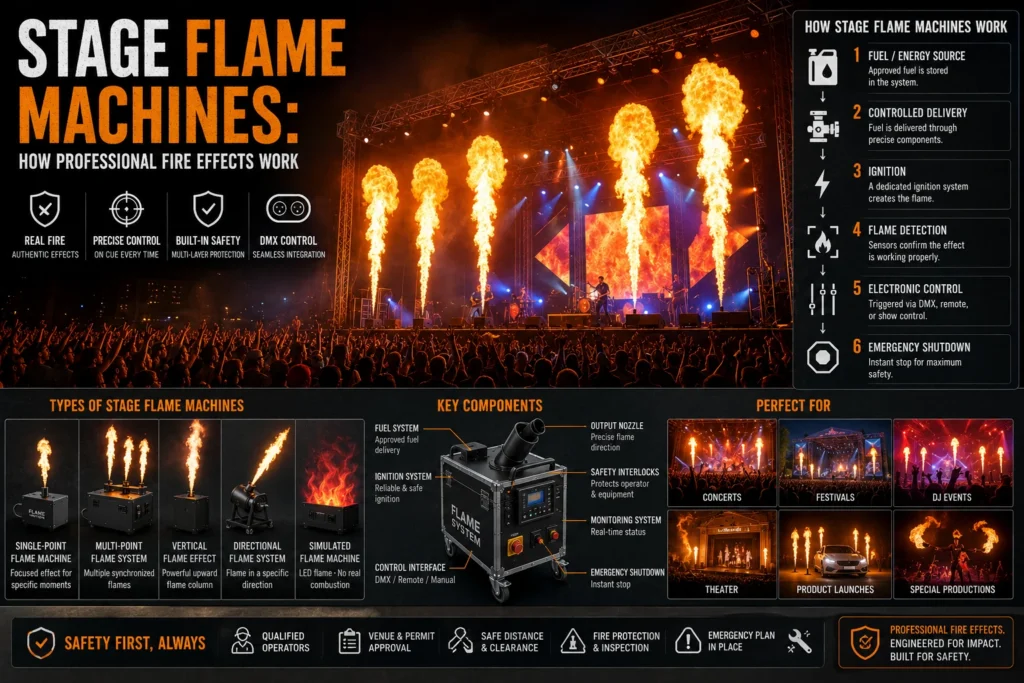
How Do Professional Stage Flame Machines Work?
At a high level, professional flame systems follow a similar operational sequence, even though the specific engineering behind each step is proprietary to the manufacturer.
1. Fuel or Energy Source
Professional flame systems rely on an approved fuel or energy source that matches the specific equipment’s design. The right source, quantity, and handling procedure should always come directly from the manufacturer’s official documentation, never assumed or substituted.
2. Controlled Delivery
The system delivers that fuel or energy through specialized components engineered to manage flow in a controlled, repeatable way, rather than an open or unregulated release.
3. Ignition
When the equipment is triggered, a dedicated ignition system creates the flame. This is a purpose-built component, distinct from any general-purpose or improvised ignition source.
4. Flame Detection and Monitoring
Many professional systems incorporate monitoring mechanisms that help confirm whether the intended effect actually occurred as expected, an important layer for both show reliability and safety oversight.
5. Electronic Control
The operator, or a connected show-control system, triggers the effect according to that specific equipment’s designed control method, whether that’s a manual trigger, a remote, or an integrated cueing system.
6. Emergency Shutdown
Professional systems are built with a way to stop the effect immediately if something goes wrong. This capability should be understood, tested, and ready before any live audience is present.
Important: This overview intentionally stays at a conceptual level. It does not cover operating parameters, valve settings, wiring diagrams, ignition modifications, or construction details that belong exclusively in manufacturer documentation and in the hands of trained technicians.
Main Components of a Professional Flame Machine
Breaking the system down by function helps clarify what each part contributes to the overall effect.
Fuel / Approved Energy System: The source that powers the flame effect. Selection and handling should always follow the manufacturer’s approved specifications.
Flame Generation System: The specialized components responsible for actually producing the visible flame once triggered.
Ignition System: The dedicated mechanism that starts the flame at the moment of activation.
Control System: The interface manual, remote, or show-control integrated that operators use to trigger the effect on cue.
Safety Interlocks: Mechanisms that can prevent or limit operation when specified safety conditions aren’t met, adding a layer of protection beyond the operator’s judgment alone.
Monitoring System: Some professional systems track operational conditions in real time, supporting both reliability and safety oversight.
Emergency Shutdown: A critical, must-have capability for any professional production using real flame is the ability to stop the effect immediately if needed.
Types of Stage Flame Machines
Manufacturers describe their equipment differently, and naming conventions vary widely across the industry. That said, several general categories are commonly discussed in professional production contexts:
| Type | Typical Use | Visual Character |
| Single-Point Flame Machine | Small/medium stage moments | Focused flame |
| Multi-Point Flame System | Large productions | Multiple synchronized flames |
| Vertical Flame Effect | Concerts/festivals | Tall upward effect |
| Directional Flame System | Specialized productions | Focused direction |
| Simulated Flame Machine | Indoor/sensitive venues | Flame-like appearance |
These categories are a useful starting point for conversations with a supplier, but they shouldn’t be treated as a universal standard to always confirm exact terminology and capability against the specific product being considered.
Stage Flame Machines for Concerts
Flame effects have become a staple of modern concert production design. Common cue points include:
- Artist entrances
- Music drops
- Song finales
- Encore performances
- Festival headliner moments
- DJ sets
What separates a memorable concert flame effect from a forgettable one is synchronization. The flame itself is only one layer; the full impact comes from how it’s coordinated with the rest of the production: stage lighting, LED screens, video content, and broader pyrotechnic-style production design. When flame effects for concerts are timed precisely against a music drop or lighting hit, the moment reads as a single, unified spectacle rather than a series of separate effects.
Stage Flame Machines for Festivals
Festival production presents its own set of challenges. Large stages, long viewing distances, and the need for visual impact from far back in a crowd often push productions toward multiple flame-effect positions rather than a single unit, giving designers the ability to build symmetry and scale across a wide stage footprint.
Outdoor festival environments also introduce variables that indoor venues don’t face:
- Wind
- Weather
- Site layout
- Audience positioning
- Emergency access
- Local regulations
Every one of these factors can affect where flame equipment is placed, how it’s rigged, and whether it’s used at all on a given day. Festival production teams typically build contingency plans specifically around weather and wind conditions for this reason.
Stage Flame Machines for DJ Events
In DJ and club-style productions, flame effects are frequently tied to:
- Beat drops
- DJ entrances
- Countdown moments
- Festival-style performance sets
- Club productions
Timing tends to be the defining factor in these environments. A short, precisely triggered burst synchronized to a specific beat or drop often reads as more powerful to an audience than a longer or continuous flame effect; the impact comes from the surprise and precision of the moment, not the duration of the fire itself.
Stage Flame Machines for Theater & Productions
Theatrical productions use flame effects in a more narrative-driven way, supporting:
- Dramatic scenes
- Storytelling moments
- Scene transitions
- Climactic beats
- Historical or fantasy settings
Because theaters often operate under different venue constraints than concert stages closer audience proximity, sensitive architectural elements, stricter fire codes many productions weigh simulated flame effects as an alternative when real flame isn’t practical or permitted for a given space or run.
Stage Flame Machines and Lighting
A flame effect rarely stands alone in a well-designed show it’s most powerful when built into the broader lighting design.
Moving Head Lights Add movement and dynamic contrast around the flame, keeping the moment visually active rather than static.
LED Stage Lighting Lets designers coordinate color palettes around the effect, reinforcing the mood of the moment.
Beam Lights Can visually frame the flame, drawing the eye directly to it.
Backlighting Helps the flame stand out in silhouette against the rest of the stage.
Strobe Effects Can emphasize the short, high-energy nature of a flame burst.
The strongest productions treat the flame machine as one component of a complete stage design, not an isolated special effect dropped into an otherwise unrelated lighting plan.
How Stage Flame Machines Are Controlled
Control methods vary significantly by equipment and manufacturer. Common approaches include:
- Manual control
- Remote control
- DMX
- Dedicated show-control systems
- Manufacturer-specific control platforms
Not every flame machine on the market supports DMX or integrates with third-party show-control software control capability is very product-specific, so this should always be confirmed directly with the manufacturer or supplier before a production plan is finalized.
For shows that rely on tight synchronization, DMX or show-control integration allows flame cues to be coordinated precisely with lighting cues, music, video, and other stage effects turning a standalone flame trigger into part of a fully programmed show.
What Should You Look for in a Stage Flame Machine?
1. Effect Type
Start with the creative goal: a short burst, a repeated effect, multiple synchronized flames, a large-stage-scale effect, or a simulated flame where real fire isn’t an option.
2. Control Compatibility
Confirm the equipment supports whatever control system the production actually requires manual, DMX, or a specific show-control platform.
3. Safety Features
Look for manufacturer-documented features such as:
- Emergency shutdown
- Safety interlocks
- Flame monitoring
- Fault detection
Only rely on features that are explicitly documented for that specific product and don’t assume capability based on category alone.
4. Installation Requirements
Factor in stage layout, mounting needs, required clearance, access for setup and strike, and any venue-specific restrictions.
5. Environmental Conditions
For outdoor events, account for wind, weather, temperature, and general site conditions before finalizing placement.
6. Maintenance & Support
Consider the manufacturer’s support quality, required inspection schedules, availability of replacement parts, access to professional servicing, and completeness of documentation.
Stage Flame Machine vs LED Flame Effect
| Feature | Real Flame Machine | LED Flame Effect |
| Real flame | Yes | No |
| Heat | Yes | No combustion heat |
| Visual realism | Very high | Can be highly convincing |
| Fire risk | Present | Lower fire-related risk |
| Venue restrictions | More significant | Often fewer |
| Indoor applications | Highly venue-dependent | Often easier |
| Maintenance | Specialized | Generally simpler |
| Production impact | Authentic fire | Controlled visual simulation |
LED flame effects can be a strong choice when a venue doesn’t permit real flame, or when a production needs more flexibility around placement and indoor use. That said, LED systems aren’t risk-free; they still involve electrical equipment, rigging, and standard event-production safety considerations, even without combustion in the mix.
Stage Flame Machine vs CO₂ Jet Machine
Flame effects and CO₂ jet machines serve different creative purposes, even though both are popular for high-energy production moments. For a full breakdown, see our guide: CO₂ Jet Machine for Concerts: Complete Guide to CO₂ Stage Effects.
| Feature | Flame Machine | CO₂ Jet |
| Primary visual | Real flame | Dense vapor plume |
| Heat | Yes | No flame |
| Main effect | Fire/energy | Burst/impact |
| Safety considerations | Fire, heat, fuel | CO₂, pressure, clearance |
| Concert applications | Excellent | Excellent |
| Lighting interaction | Strong | Strong |
Many large-scale productions use both effects at different points in a show, choosing whichever best matches the specific cue.
Stage Flame Machine vs Fog Machine
Flame Machine — best suited for:
- Energy
- Fire visuals
- Dramatic bursts
- Climactic moments
Fog Machine — best suited for:
- Atmosphere
- Depth
- Making light beams visible
- Environmental effects
These two tools solve different creative problems, and many productions use both fog to build atmosphere throughout a set, and flame to punctuate specific high-impact moments. For more detail, see: Fog Machine for Stage: Complete Guide to Stage Fog Effects.
Indoor vs Outdoor Stage Flame Machines
| Factor | Indoor | Outdoor |
| Venue approval | Critical | Critical |
| Fire regulations | Critical | Critical |
| Ventilation | Important | Site-dependent |
| Wind | Usually limited | Major consideration |
| Ceiling clearance | Important | Site-dependent |
| Audience separation | Essential | Essential |
| Weather | Controlled | Must be monitored |
Whether real flame is appropriate for a given event ultimately depends on the exact equipment being used, the specific venue, local fire regulations, and a proper professional risk assessment there’s no blanket answer that applies to every space or every show.
Safety Considerations for Stage Flame Machines
Real flame effects should always be treated as professional fire effects not as standard lighting or AV equipment. That distinction should shape every decision made around the equipment.
Qualified Operators Only appropriately trained personnel should operate professional flame equipment. This isn’t a role for general stage crew without specific training on the system in use.
Manufacturer Requirements Always follow the manufacturer’s documentation exactly as written for setup, operation, maintenance, and shutdown procedures alike.
Safety Clearances Maintain the required distance from performers, audience, curtains, set pieces, rigging, lighting fixtures, and any other combustible materials.
Fire Protection Coordinate directly with venue safety teams and the relevant fire authorities before the event.
Emergency Shutdown Have a clear, tested emergency shutdown procedure in place, and make sure everyone involved in the show knows it.
Professional testing and rehearsal should always happen before the audience enters the venue and never treat a live show as the first real test of the equipment.
Weather Outdoor systems must account for changing weather and wind conditions in real time, with a plan for adjusting or pausing effects if conditions change.
Permits Confirm local laws, venue policies, required permits, insurance requirements, and fire authority requirements well ahead of the event date.
Equipment Modification Never bypass, disable, or modify safety systems for any reason these systems exist specifically to protect performers, crew, and audiences.
Stage Flame Machine Safety Checklist
- ☐ Manufacturer-approved equipment
- ☐ Qualified operator
- ☐ Venue approval
- ☐ Fire-safety requirements reviewed
- ☐ Required permits confirmed
- ☐ Insurance requirements checked
- ☐ Safety clearances established
- ☐ Combustible materials evaluated
- ☐ Emergency shutdown procedure prepared
- ☐ Fire protection available as required
- ☐ Equipment professionally inspected
- ☐ Performer positions confirmed
- ☐ Audience position confirmed
- ☐ Weather conditions checked
- ☐ Pre-event test completed
- ☐ Emergency response plan prepared
How Many Stage Flame Machines Do You Need?
There’s no universal number that applies across productions the right count depends on several factors:
- Stage width
- Effect design
- Audience perspective
- Number of cue points
- Desired symmetry
- Equipment output
- Budget
- Production scale
One Unit creates a focused, singular effect often used for a specific dramatic moment.
Two Units allow for a symmetrical visual, framing the stage evenly on both sides.
Multiple Units enable a large-scale, synchronized flame design across a wide stage.
Actual placement and quantity should always be determined by qualified professionals, working from the specific equipment’s documentation and the venue’s requirements not from a generic formula.
How to Synchronize Flame Machines With Stage Shows
Step 1: Identify Key Cues Map out the moments that matter most intro, drop, chorus, finale and decide which of those deserve a flame effect.
Step 2: Coordinate With Lighting Match flame cues with moving heads, beams, strobes, and LED fixtures so the effect feels integrated rather than isolated.
Step 3: Coordinate With Music Pin down the precise musical moments the effect should align with, down to the beat where possible.
Step 4: Coordinate With Performers Make sure performers know exactly where effects will fire and when, so blocking and choreography account for them.
Step 5: Rehearse Run professional testing and rehearsal before the live event synchronization should be confirmed, not assumed.
This process is about creative and production planning. Actual programming or firing of real flame systems should always be handled by trained technicians following manufacturer procedures.
Common Mistakes When Choosing a Stage Flame Machine
Choosing Based Only on Flame Size Bigger isn’t automatically better the right scale depends on the venue, distance, and creative intent.
Ignoring Venue Restrictions Always confirm what a venue actually permits before selecting equipment, not after.
Ignoring Control Requirements Make sure the system is compatible with the production’s actual control workflow before committing to it.
Forgetting Safety Clearance Stage design has to account for the equipment’s required separation distances from day one, not as a late adjustment.
Using Unverified Equipment Professional productions should rely on properly supported, manufacturer-backed equipment.
Ignoring Weather Outdoor conditions can change quickly a plan that doesn’t account for that is incomplete.
Skipping Rehearsal Flame effects need to be fully integrated into the show plan, not bolted on at the last minute.
Modifying Safety Systems Never bypass or alter safety features under any circumstances.
When Should You Choose a Stage Flame Machine?
Real flame may make sense when:
- Authentic fire is central to the creative concept
- The venue permits the effect
- Professional equipment is available
- Qualified operators are involved
- Safety requirements can be fully satisfied
A simulated flame effect may be the better choice when:
- Real flame is prohibited at the venue
- The venue has strict fire-safety restrictions
- The production takes place indoors under limiting conditions
- The desired visual can be achieved without combustion
Frequently Asked Questions
What is a stage flame machine?
A stage flame machine is professional effects equipment designed to produce a controlled flame effect for live productions. It combines a fuel or energy source, ignition, electronic control, and safety systems to create a repeatable, triggerable fire effect.
How do professional flame machines work?
Professional systems deliver an approved fuel or energy source through controlled components, ignite it via a dedicated ignition system, and trigger the effect electronically all supported by monitoring and emergency shutdown systems for safety.
Are stage flame machines real fire?
Some are professional flame machines produce genuine combustion-based fire. Others, like LED or projection flame effects, only simulate the appearance of fire without any actual combustion involved.
What fuel do stage flame machines use?
Fuel requirements vary by equipment and manufacturer. Always refer to the specific product’s official manufacturer documentation for approved fuel types and handling, never assume or substitute.
Can flame machines be used indoors?
It depends on the venue, the specific equipment, local fire regulations, and ventilation. Indoor use of real flame effects requires careful venue approval and professional risk assessment.
Are flame machines suitable for concerts?
Yes flame effects are widely used at concerts for entrances, drops, finales, and headliner moments, especially when synchronized with lighting and music.
Can stage flame machines be controlled with DMX?
Some models support DMX or other show-control integration, but not all. Control compatibility is product-specific and should be confirmed with the manufacturer.
What is the difference between a flame machine and an LED flame effect?
A flame machine produces real, combustion-based fire, while an LED flame effect simulates the look of flame using lighting technology, without heat or combustion.
What safety requirements apply to stage flame machines?
Requirements include qualified operators, manufacturer-documented safety features, proper clearances, fire authority coordination, permits, and a tested emergency shutdown procedure always guided by manufacturer documentation and local regulations.
How do I choose the right flame machine for a stage show?
Consider the desired effect type, control compatibility, documented safety features, installation requirements, environmental conditions, and manufacturer support matched against the specific venue and production needs.
Conclusion
A professional stage flame machine combines specialized flame-generation equipment, controlled activation, layered safety systems, and show control to create dramatic fire effects for live productions. From concert entrances to theatrical climaxes, the visual payoff is only possible because of the engineering and safety discipline working behind the scenes.
Choosing the right system means weighing event type, venue restrictions, desired effect design, control requirements, safety clearances, environmental conditions, local regulations, and above all professional operation. No two productions have identical needs, which is why these decisions should always be made in consultation with qualified professionals and manufacturer documentation.
Explore JJY Stage’s Special Effect Series to discover professional equipment for concerts, festivals, theatrical productions, DJ events, and other live entertainment applications.
Featured Snippet Answers
What is a stage flame machine?
A stage flame machine is professional effects equipment that produces a controlled flame effect for live shows, combining a fuel/energy source, ignition, electronic control, and safety systems into one triggerable unit.
How do professional stage flame machines work?
They deliver an approved fuel or energy source through controlled components, ignite it with a dedicated system, and trigger it electronically, with monitoring and emergency shutdown built in for safety.
Are stage flame machines real fire?
Some are genuine combustion-based fire, while others like LED or projection flame effects only simulate the look of fire without any real combustion.
Can stage flame machines be used indoors?
It depends on the venue’s fire code, ventilation, ceiling clearance, and the specific equipment indoor use always requires venue approval and a professional risk assessment.
Can flame machines be controlled with DMX?
Some models support DMX or show-control integration, but this varies by manufacturer and product, so compatibility should always be confirmed directly.
What is the difference between a flame machine and an LED flame effect?
A flame machine creates real combustion-based fire with heat, while an LED flame effect simulates the visual appearance of flame using lighting technology alone.
What safety requirements apply to stage flame machines?
Qualified operators, manufacturer-documented safety features, proper clearances, fire authority coordination, permits, insurance, and a tested emergency shutdown plan are all essential.