Picking the wrong mixer can cost you a show, a Sunday service, or a studio session. Whether you’re wiring up a small conference room or running front-of-house for a touring band, the mixing console you choose shapes everything downstream: how clean your vocals sound, how fast you can recall settings, and how much extra gear you have to haul around.
Two terms come up constantly in this decision: powered mixing console and digital mixing console. They sound similar, but they solve different problems. A powered mixer bundles an amplifier into the mixing desk so you can drive passive speakers directly. A digital mixing console focuses on processing power DSP effects, scene recall, remote control and typically needs a separate amplifier or active speakers.
Digital audio systems have grown fast over the last decade, showing up in everything from home studios to major concert tours. At the same time, powered mixers haven’t gone anywhere they’re still the backbone of countless churches, schools, and mobile DJ setups because they’re simple, affordable, and reliable.
In this guide, you’ll learn Mixing Console Guide actually is, how they compare feature by feature, which one fits your specific application (church, studio, wedding, corporate event, and more), and how to avoid the buying mistakes that trip up first-time buyers.
What Is a Powered Mixing Console?
A powered mixing console is an audio mixer with a built-in power amplifier, letting it drive passive speakers directly without a separate amp. It combines microphone inputs, gain control, EQ, and amplification in one unit making it a compact, all-in-one solution for small to mid-sized sound systems.
Think of it as a mixer and an amplifier married into a single chassis. You plug in your microphones and instruments through XLR inputs or line inputs, shape the tone with the onboard equalizer, set your levels with gain control, and send amplified signal straight out to your passive speakers.
Typical components of a powered mixing console include:
- Multiple microphone/line channels (commonly available as a 4 channel mixing console, 6 channel mixing console, or 8 channel mixing console)
- Built-in amplifier (power ratings typically range from 300W to 1,000W+ per channel)
- Basic EQ per channel, plus a master EQ
- Phantom power for condenser microphones
- Simple effects such as reverb or delay
- Master and monitor mix outputs
Advantages:
- One box does the job of a mixer and an amplifier, which simplifies setup
- Fewer cables and fewer points of failure
- Generally more affordable than buying a digital mixer and separate amp
- Lightweight and portable enough for mobile DJs and traveling worship teams
Limitations:
- Less DSP horsepower than a dedicated digital mixing console
- Fewer built-in effects and no advanced scene recall on most models
- Amplifier and mixer are tied together, so if one fails, you may lose both
- Not designed for driving active speakers, which already have their own amplification
Powered mixers remain a go-to for small venues, classrooms, and any setup where passive speakers and simple sound reinforcement are all that’s needed.
What Is a Digital Mixing Console?
A digital mixing console is an audio mixer that processes sound digitally using DSP (digital signal processing) instead of analog circuitry. It offers built-in effects, scene recall, remote mixing via Wi-Fi or USB, and detailed routing making it the standard choice for professional live sound, broadcast, and studio work.
Instead of physical circuitry shaping every signal, a digital audio mixer converts incoming audio to digital data, processes it through onboard DSP, and converts it back to analog (or keeps it digital) on the way out. This unlocks features that are difficult or expensive to build into analog gear.
Typical components of a digital mixing console include:
- High channel counts, often expandable well beyond a compact mixer’s limits
- Onboard DSP for compression, gating, EQ, and effects
- Touchscreen display and physical fader banks
- USB recording and multitrack recording capability
- Wi-Fi control or app-based remote mixing from a tablet or phone
- Scene recall to instantly store and reload full mix settings
- Flexible audio routing for monitors, FOH, and recording feeds
Advantages:
- Studio-grade compressors, gates, and effects built in — no outboard gear needed
- Scene recall speeds up soundcheck and repeat events dramatically
- Remote mixing lets an engineer walk the room while adjusting levels
- Multitrack USB recording turns a live show into a studio session
- Scales from a compact mixer for solo acts to a full FOH digital audio mixer for arena tours
Limitations:
- Higher upfront cost than most powered mixers
- Steeper learning curve, especially for engineers used to analog mixing consoles
- Needs a separate amplifier when working with passive speakers
- Firmware updates and menu diving can slow down inexperienced operators
Digital mixing consoles have become the standard in recording studios, touring live sound, and churches with more complex production needs.
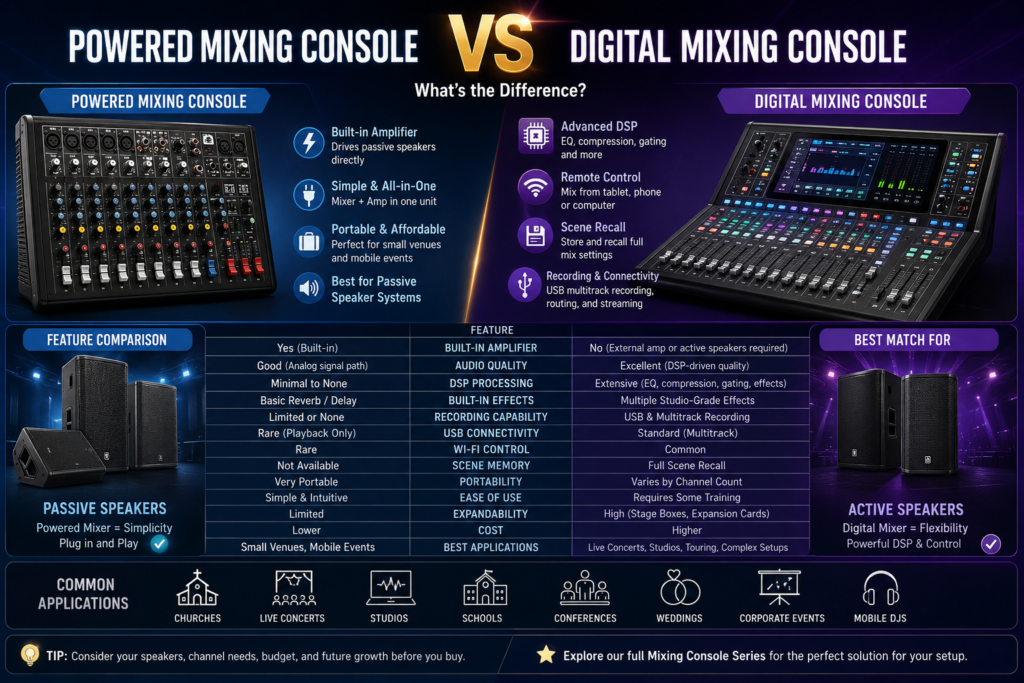
Powered Mixing Console vs Digital Mixing Console: Key Differences
| Feature | Powered Mixing Console | Digital Mixing Console |
| Built-in amplifier | Yes | No (external amp or active speakers required) |
| Audio quality | Good, analog signal path | Excellent, consistent DSP-driven quality |
| DSP processing | Minimal to none | Extensive (EQ, compression, gating) |
| Built-in effects | Basic reverb/delay | Multiple studio-grade effects |
| Recording capability | Limited or none | USB and multitrack recording |
| USB connectivity | Rare, basic playback only | Standard, often multitrack |
| Wi-Fi control | Rare | Common on most models |
| Scene memory | Not available | Full scene recall |
| Portability | Very portable | Varies by channel count |
| Ease of use | Simple, intuitive | Requires some training |
| Expandability | Limited | High, with expansion cards/stage boxes |
| Maintenance | Amp and mixer serviced together | Modular, easier to isolate issues |
| Software updates | Rare | Regular firmware updates |
| Cost | Lower | Higher |
| Best applications | Small venues, mobile events | Live concerts, studios, touring |
This table captures the core trade-off: a powered mixer wins on simplicity and cost, while a digital mixing console wins on flexibility, sound design, and long-term scalability.
Active Speakers vs Passive Speakers
| Speaker Type | Amplification | Best Paired With |
| Passive speakers | Requires external or built-in amp | Powered mixing console |
| Active speakers | Built-in amplifier per speaker | Digital mixing console |
If your venue already uses active speakers, a digital mixer is the more natural fit since you don’t need the mixer to supply amplification. If you’re running passive speakers, a powered mixer keeps your setup simpler.
Advantages of a Powered Mixing Console
A powered mixing console earns its keep in situations where speed of setup and cost matter more than deep processing.
- Simple setup — plug in mics, plug in speakers, and you’re live
- Fewer external devices — no separate amp rack to carry or wire
- Cost-effective — one purchase covers mixing and amplification
- Portable — a compact mixer with amp built in is easy to transport for mobile DJs and traveling teams
- Reliable — fewer connection points mean fewer failure points
- Best for passive speaker systems — no compatibility guesswork
- Well suited to small venues and mobile events where a fast, no-fuss setup wins the day
Pros: affordable, portable, beginner-friendly, fewer cables, quick to learn. Cons: limited DSP, no scene recall, weaker recording options, less flexible for growing production needs.
Advantages of a Digital Mixing Console
A digital mixing console shines when your production demands precision, repeatability, and room to grow.
- Advanced DSP — professional-grade EQ, compression, and gating on every channel
- Built-in effects — reverb, delay, and modulation without outboard processors
- Remote control — mix from anywhere in the room via a tablet or phone
- Touchscreen display — faster access to channel settings and routing
- Scene recall — instantly restore an entire mix for repeat events or services
- Recording capabilities — multitrack USB recording captures every channel for post-production or streaming
- Professional workflow — matches the expectations of touring engineers and studio producers
- Expandability — add stage boxes, expansion cards, or extra channels as your needs grow
Pros: studio-quality processing, faster recall for repeat events, strong recording and streaming setup support, highly expandable. Cons: higher cost, steeper learning curve, needs external amplification for passive speakers.
Which Mixer Is Better for Different Applications?
Churches
Most modern church sound systems benefit from a digital mixing console because of scene recall (useful for repeating the same service format weekly) and built-in effects for vocals and worship bands. Smaller churches on a tighter budget can still get excellent results from a powered mixer paired with passive speakers.
Live Concerts
A digital mixing console is the standard for live concerts. Touring engineers rely on DSP, monitor mixing flexibility, and remote control to manage complex stage plots.
Recording Studios
Recording studios lean heavily on digital audio mixers for multitrack recording, DAW integration, and precise routing. A digital mixer’s USB recording capability is essential here.
Home Studios
For a home studio, a compact digital mixer or an audio interface paired with a small mixing console works well. Podcasters and solo musicians often prefer a small mixing console with USB recording built in.
Schools
Schools with modest AV needs — assemblies, classroom announcements, small stage productions — are well served by a powered mixer. It’s affordable, simple for non-technical staff to operate, and easy to maintain.
Hotels
Hotels hosting conferences, banquets, and weddings benefit from a digital mixing console’s scene recall, since event layouts and audio needs change from one function to the next.
Conference Rooms
Conference room audio typically needs clear speech reinforcement and easy operation — a powered mixer or a compact digital mixer both work, depending on whether video conferencing integration and remote control are required.
Corporate Events
Corporate events often involve presentations, music playback, and multiple microphones. A digital mixing console offers the flexibility to handle these varied inputs and quickly adjust scenes between segments.
Mobile DJs
Mobile DJs prioritize portability and fast setup, making a powered mixer or compact mixer console a practical, budget-friendly choice for weddings, parties, and small venues.
Wedding Productions
Wedding productions benefit from a digital mixing console when live bands, speeches, and playback music all need to be balanced smoothly, though a powered mixer works fine for simpler ceremony-and-reception setups.
How to Choose Between a Powered and Digital Mixing Console
Before buying, walk through these considerations:
- Speaker type — passive speakers point you toward a powered mixer; active speakers work better with a digital mixing console
- Number of channels — count your inputs now, then add room for growth (4, 6, 8, or more channels)
- Future expansion — will you add more mics, monitors, or a streaming setup later?
- Budget — powered mixers cost less upfront; digital consoles cost more but reduce the need for outboard gear
- Portability — mobile events favor lighter, simpler powered mixers
- Recording needs — multitrack recording and podcast recording favor digital mixers
- Live streaming — USB output and routing flexibility matter for streaming setups
- Remote control — Wi-Fi control is a digital mixing console feature, not typically found on powered mixers
- Audio quality — both can sound excellent when properly gain-staged, but DSP gives digital mixers an edge in complex mixes
- Ease of operation — powered mixers are faster to learn; digital consoles reward the time invested in training
- Long-term investment — a digital mixing console tends to have a longer useful life as your production needs grow
Common Buying Mistakes
- Buying the wrong mixer for your speakers — pairing a powered mixer output incorrectly with active speakers, or expecting a digital mixer alone to drive passive speakers without an amp
- Ignoring future growth — buying the exact channel count you need today, with no room to expand
- Overlooking recording features — skipping USB or multitrack recording, then needing it later for streaming or archiving services
- Choosing based only on price — the cheapest mixing console rarely covers every requirement
- Ignoring DSP functionality — underestimating how much time DSP effects and processing save during a live mix
- Forgetting portability — buying a heavy digital console for a mobile DJ setup that needs to move weekly
- Ignoring firmware updates — some digital mixers depend on regular software updates for stability and new features
- Underestimating channel requirements — a 4 channel mixing console won’t cut it for a full worship band or corporate multi-mic setup
- Not considering user experience — a touchscreen-heavy digital mixer can frustrate volunteers or non-technical staff without training
- Skipping compatibility checks — not confirming whether your speakers, stage boxes, or recording software actually work with the mixer
Frequently Asked Questions
What is a powered mixing console?
A powered mixing console is a mixer with a built-in amplifier, letting it drive passive speakers directly without needing a separate amp.
What is a digital mixing console?
A digital mixing console is a mixer that uses DSP to process audio, offering built-in effects, scene recall, and remote mixing capability.
Which mixer has better sound quality?
Both can sound excellent when set up correctly. Digital mixing consoles generally offer more consistent processing and cleaner effects thanks to DSP.
Do I need a built-in amplifier?
Only if you’re using passive speakers. Active speakers already have their own amplification, so a built-in amp isn’t necessary.
Can a digital mixer replace a powered mixer?
Yes, if you pair it with active speakers or a separate amplifier. Without amplification, a digital mixer alone can’t drive passive speakers.
Which is better for churches?
Larger churches with weekly repeat services often benefit from a digital mixing console’s scene recall. Smaller churches on a budget can do well with a powered mixer.
Which is better for live bands?
A digital mixing console is typically preferred for live bands due to monitor mixing flexibility and built-in effects.
Are powered mixers outdated?
No. Powered mixers remain popular for small venues, schools, and mobile events where simplicity and cost matter most.
Can I use active speakers with a powered mixer?
It’s possible using the mixer’s line outputs, but you won’t be using the built-in amplifier, which reduces the mixer’s main advantage.
Which mixer is easier for beginners?
A powered mixer is generally easier for beginners due to its straightforward, all-in-one design.
Which mixer offers better recording features?
A digital mixing console offers stronger recording features, including multitrack USB recording.
Which mixer provides better value for money?
It depends on your needs. A powered mixer offers better value for simple setups, while a digital mixing console offers better long-term value for growing productions.
What is the difference between an analog mixer and a digital mixer?
An analog mixer processes signal through physical circuitry, while a digital mixer converts audio to digital data for DSP-based processing.
Do digital mixing consoles need training to operate?
Yes, most digital consoles have a learning curve due to touchscreen menus and DSP settings, though many models simplify this with presets.
What size mixing console do I need?
This depends on your input count — a 4, 6, or 8 channel mixing console suits small setups, while larger productions need higher channel counts and expandability.
Cost Comparison
| Mixer Type | Typical Price Range | What Drives the Cost |
| Powered mixing console (compact) | Budget-friendly | Amplifier wattage, channel count |
| Powered mixing console (larger) | Mid-range | Higher wattage, more channels, effects |
| Digital mixing console (compact) | Mid-range | DSP power, touchscreen, channel count |
| Digital mixing console (professional) | Premium | Expandability, channel count, build quality, software |
Beginner vs Professional Requirements
| Requirement | Beginner Setup | Professional Setup |
| Channel count | 4–8 channels | 16+ channels, expandable |
| Effects | Basic reverb/delay | Full DSP suite with presets |
| Recording | Optional stereo recording | Multitrack USB recording |
| Control | Manual knobs and faders | Touchscreen plus remote app control |
| Recall | None needed | Scene recall essential |
| Budget priority | Low upfront cost | Long-term flexibility and expansion |
Best Mixer by Application
| Application | Recommended Mixer |
| Churches (small) | Powered mixing console |
| Churches (large, multi-service) | Digital mixing console |
| Live concerts | Digital mixing console |
| Recording studios | Digital mixing console |
| Home studios | Compact digital mixer |
| Schools | Powered mixing console |
| Hotels | Digital mixing console |
| Conference rooms | Powered mixer or compact digital mixer |
| Corporate events | Digital mixing console |
| Mobile DJs | Powered mixing console |
| Wedding productions | Digital mixing console (or powered mixer for simple setups) |
Conclusion
The choice between a powered mixing console and a digital mixing console comes down to what your setup actually needs. A powered mixer gives you a simple, affordable, all-in-one solution for passive speakers, small venues, and mobile events. A digital mixing console delivers advanced DSP, scene recall, remote mixing, and recording capabilities suited to live concerts, recording studios, and growing productions.
Think about your speaker type, channel requirements, budget, and long-term plans before deciding. If you need something you can set up in minutes for a straightforward system, a powered mixer will serve you well. If you’re building toward professional live sound, streaming, or studio work, a digital mixing console is the smarter long-term investment.
Ready to find the right fit for your venue or studio? Explore our full Mixing Console Series for professional-grade powered and digital mixing solutions built for churches, studios, touring engineers, and everything in between.