
Introduction
Anyone comparing a fog machine vs haze machine is usually trying to solve the same underlying question: which one will actually give the atmosphere they’re picturing for their stage, concert, or event? Both machines create atmospheric effects, but they’re designed to produce noticeably different visual results, and the right choice depends on the desired atmosphere, visibility needs, lighting design, event type, venue, how long the effect needs to last, and how much control the operator needs over it.
In general terms, fog tends to produce a more visible, denser cloud, while haze is typically used to create a lighter, more evenly distributed atmosphere that makes lighting beams more visible. That said, this isn’t an absolute rule machine design, fluid type, and operating settings all influence how each effect actually looks in a given space. This guide breaks down the practical differences so you can match the right equipment to your production.
The Stage Special Effects Guide covers bubble machines, fog effects, and other special effects equipment to help event professionals choose the right solution for their production.
Fog Machine vs Haze Machine at a Glance
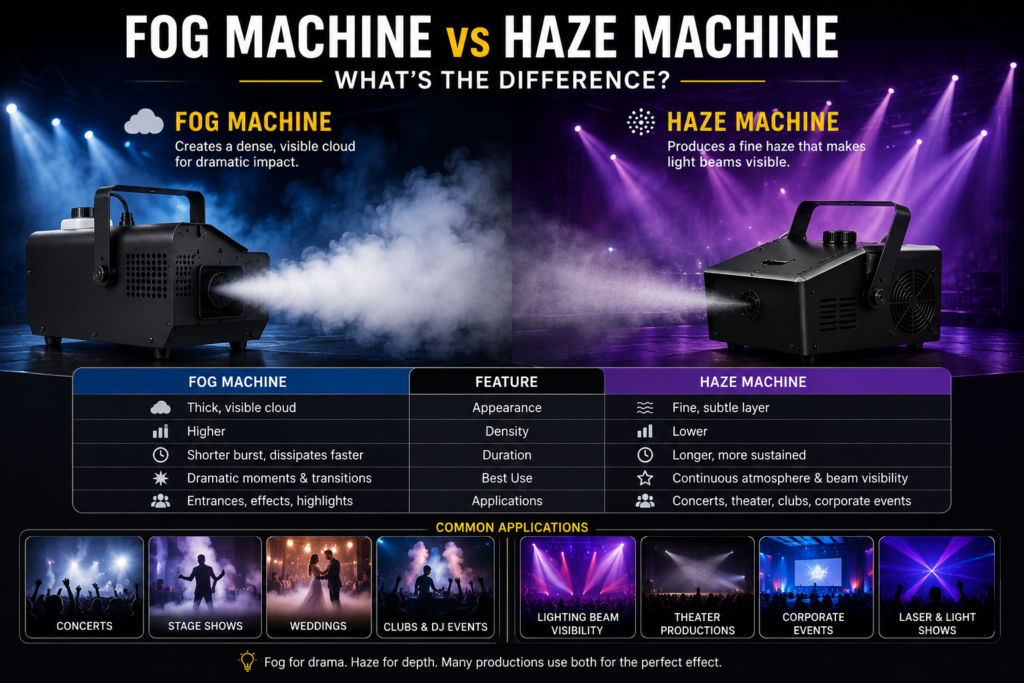
| Feature | Fog Machine | Haze Machine |
| Main purpose | Create a visible, dense atmospheric cloud | Create a subtle, evenly distributed atmosphere |
| Appearance | Thick, cloud-like | Fine, almost invisible layer |
| Typical density | Higher | Lower |
| Distribution | Can concentrate in bursts or drift as a cloud | Spreads evenly through the air |
| Duration in air | Often shorter, more noticeable burst | Often longer, more sustained presence |
| Lighting visibility | Creates strong, visible light beams briefly | Reveals light beams consistently over time |
| Typical applications | Entrances, transitions, dramatic moments | Continuous atmosphere, beam visibility |
| Best for | Bursts of visual drama | Sustained lighting depth |
| Common venues | Theater, concerts, clubs | Concerts, theater, corporate events, clubs |
| Effect style | Bold and dramatic | Subtle and ambient |
This table is a starting reference actual results depend heavily on the specific machine, fluid, and venue conditions, which are covered in more detail below.
What Is a Fog Machine?
A fog machine is a piece of atmospheric effects equipment designed to produce a visible cloud of vapor for stage and event use. Fog is generated by processing a fog fluid inside the machine and releasing the resulting vapor into the air, where it typically appears as a dense, rolling cloud before gradually dispersing.
A stage fog machine is commonly used to create a noticeable atmospheric moment something the audience visibly sees and reacts to, rather than a background layer. Because of this, fog is closely associated with dramatic entrances, scene changes, and other visual highlights in a production. A professional fog machine used for a fog machine for stage application is generally selected because the production wants an atmospheric effect that reads clearly, even from a distance.
What Is a Haze Machine?
A haze machine produces a much finer, more subtle atmospheric effect than a typical fog machine. Rather than creating a visible cloud, haze fills a space with a light, even layer of fine particles that’s often barely noticeable on its own but becomes very apparent once stage lighting passes through it.
A stage haze machine is generally chosen when the goal isn’t to create a visible cloud, but to enhance how lighting looks in a room. This is a key difference from fog: haze is designed to work with light, not to be the visual focal point itself. In theatrical and touring production contexts, this is often referred to as theatrical haze, and it’s commonly run for extended periods rather than in short bursts.
How Does a Fog Machine Work?
At a general level, most fog machines follow a similar process:
- Fog fluid is placed into the machine’s internal tank.
- The machine processes the fluid according to its internal design — this varies between machine types and manufacturers.
- The resulting aerosol vapor is released into the air.
- Airflow in the room, along with the machine’s own output pattern, distributes the fog through the space.
The exact technology used to convert fluid into vapor differs from one fog machine to another, and this guide won’t speculate on specific internal mechanisms for any particular product. For a more detailed breakdown of stage fog equipment and applications, see our fog machine for stage guide.
How Does a Haze Machine Work?
Haze machines follow a broadly similar principle to fog machines but are engineered to produce a much finer output. Haze fluid is used to generate an aerosol made up of very small atmospheric particles, which spread through the venue and interact with stage lighting to make beams, gobos, and moving light effects more visible.
Different haze machines use different technologies to achieve this fine particle output, and manufacturers often design their systems around different output characteristics some prioritize a very fine, long-lasting haze, while others are tuned for faster, denser coverage. Because of this variation, it’s inaccurate to assume every haze machine performs identically; specifications should always be checked for the specific unit being considered.
Fog vs Haze: What Is the Visual Difference?
The clearest way to understand fog vs haze is to compare how each one typically looks and behaves in a venue.
Fog is typically:
- More visible
- Denser
- More dramatic
- Useful for bursts and standout visual moments
- Capable of creating a cloud-like atmosphere that fills part of a stage or room
Haze is typically:
- Finer
- More subtle
- More evenly distributed throughout the space
- Useful for revealing light beams rather than creating a visible cloud
- Often run continuously during a performance rather than in short bursts
The exact appearance of either effect depends on the specific machine, its output setting, the venue’s size and airflow, and how the operator chooses to run it so these characteristics should be treated as general tendencies rather than fixed outcomes.
Fog Machine vs Haze Machine for Stage Lighting
How each effect interacts with lighting is one of the most important factors in choosing between them.
Fog With Stage Lighting
Fog is often used to punctuate specific lighting moments a dramatic beam during an entrance, a burst during a scene change, or a visual accent during a concert’s big moment. Because fog is denser and more visible, it tends to create a bold, noticeable effect rather than a subtle background layer.
Haze With Stage Lighting
Haze is frequently the preferred choice for making moving head lights, lasers, and wash lighting visible as clean beams throughout a performance, rather than only at specific moments. Because it disperses evenly and stays fine rather than dense, haze for stage lighting is often used to add depth and dimension to a lighting design without obscuring the stage or performers.
Neither approach is universally “better” ; the right choice depends on whether the production needs continuous beam visibility (haze) or occasional dramatic atmosphere (fog).
Fog vs Haze for Concerts
Fog for Concerts
Fog is commonly used at concerts for dramatic moments: an artist’s entrance, a drop in the music, a transition between segments of the show, or a specific special-effects cue. These fog effects for concerts are designed to be noticed by the audience as a distinct visual event.
Haze for Concerts
Haze is more often used to maintain a continuous atmosphere throughout a concert supporting the visibility of moving lights and laser effects, and adding overall depth to the stage for the full duration of the performance, rather than at isolated moments.
Many concert productions use a haze machine for stage lighting support throughout the show, while reserving fog for specific high-impact cues.
Fog vs Haze for Theater
Fog
In theater, a theatrical fog machine is often used for:
- Mystery and suspense scenes
- Dramatic character entrances
- Scene transitions
- Fantasy or supernatural sequences
- Isolated special moments within a script
Haze
Theatrical haze is more commonly used to build a subtle, sustained atmosphere across a scene or act supporting the visibility of lighting design and adding background depth without drawing direct attention to itself.
Because theater productions require careful attention to performer and audience visibility, both effects need to be dosed and controlled carefully, with particular attention to sightlines and how the effect interacts with blocking on stage.
Fog vs Haze for DJs and Nightclubs
In nightclub and DJ settings, both effects are used, often for different purposes within the same venue:
- Fog can create dramatic bursts timed to drops, transitions, or specific moments in a DJ set, adding a strong visual punctuation point on the dance floor.
- Haze can maintain an ongoing atmospheric environment that keeps laser and lighting effects visible throughout the night rather than only during specific bursts.
Lighting design plays a significant role in how either effect reads in a club environment, and not every venue is suited to both types of atmospheric effects ventilation, ceiling height, and venue policy all factor into what’s practical.
Fog Machine vs Haze Machine for Weddings & Events
For weddings, corporate events, parties, and product launches, the choice between fog and haze often comes down to how subtle or dramatic the atmosphere should be.
A subtle haze effect may be preferable for events where guests are present throughout the space and a heavy visible cloud would feel intrusive for example, during a formal dinner or presentation where ambient lighting depth is the goal. A more dramatic fog effect may be more appropriate for a specific highlighted moment, such as a first dance or a product reveal, where a visible atmospheric cue supports the moment.
Before choosing either option for these settings, it’s worth confirming:
- Venue policies on atmospheric effects
- Ventilation and HVAC systems in the space
- Audience and guest visibility throughout the room
- Whether the effect could make floors slippery
- Event timing and how the effect fits into the overall schedule
Which Is Better for Stage Lighting?
There isn’t a single universal answer, but there is a useful general guideline: if the main objective is to reveal light beams and add a subtle atmospheric layer across the whole performance, haze is often the more appropriate choice. If the objective is to create a dramatic, visible cloud or a noticeable burst of atmosphere at a specific moment, fog may be more appropriate.
Beyond that general guideline, the right choice ultimately depends on the lighting design itself, the venue, the desired visual effect, the specific machine’s output, and the type of event being produced. Many productions use both, applying each where it fits best.
Fog vs Haze: Which Effect Lasts Longer?
There’s no universal answer to how long either effect lasts in the air it depends on a combination of factors, including:
- Machine output level
- Ventilation and air conditioning in the venue
- General air movement in the space
- Venue size and ceiling height
- The particle characteristics of the specific fluid used
- The operating settings chosen by the operator
As a general tendency, haze is often used for a sustained atmospheric effect that persists over a longer period, while fog is frequently used for shorter, more noticeable bursts that dissipate more quickly. Even so, actual persistence in any specific venue depends on the conditions listed above rather than the machine type alone.
Fog vs Haze: Which Uses More Fluid?
Fluid consumption varies significantly based on the specific machine, its underlying technology, the output level selected, how continuously it’s run, the environment it’s operating in, and how dense an effect the operator wants to achieve. Because of this range of variables, this guide won’t provide generic fluid consumption figures comparing fluid usage purely by machine category (fog vs. haze) can be misleading without looking at the specific unit’s verified specifications.
If fluid consumption is an important factor in your decision, check the manufacturer’s documented figures for the specific machine you’re considering rather than relying on general assumptions about fog or haze as categories.
Can You Use Fog and Haze Together?
Yes where the equipment, venue, production requirements, and safety considerations allow it, fog and haze are often used together as complementary effects rather than competing choices. A common production approach is to run haze continuously for general atmosphere and lighting depth throughout a performance, while reserving fog for specific dramatic cues or transitions.
This kind of layered approach allows lighting operators and stage managers to build a consistent atmospheric base with haze, then punctuate specific moments with a burst of fog when the production calls for extra visual impact. Coordinating both effects typically involves planning cue timing in advance and confirming that the venue’s ventilation and safety systems can accommodate combined use.
How to Choose Between a Fog Machine and Haze Machine
Choose Fog If You Need:
- Dramatic, visible clouds
- Short, noticeable bursts of atmosphere
- Strong atmospheric moments tied to specific cues
- Scene transitions
- Theatrical dramatic effects
- Concert special-effects moments
Choose Haze If You Need:
- Visible light beams throughout a performance
- A subtle, sustained atmosphere
- Continuous atmospheric depth
- Enhanced visual dimension for lighting design
- Support for concert lighting
- Support for DJ and club lighting
Choose Both When:
Your production requires both a continuous atmospheric base and occasional dramatic fog moments layered on top of it.
Fog Machine vs Haze Machine Buying Checklist
- ☐ Desired visual effect
- ☐ Venue size
- ☐ Indoor or outdoor use
- ☐ Lighting design
- ☐ Desired density
- ☐ Continuous or burst operation
- ☐ Fluid compatibility
- ☐ Control options
- ☐ Ventilation
- ☐ Venue rules
- ☐ Maintenance requirements
- ☐ Safety considerations
Common Mistakes When Choosing Fog or Haze
Choosing Based Only on Wattage Power rating alone doesn’t determine effect quality, density, or how well a machine suits a given application. Coverage, fluid type, and output design all matter just as much.
Ignoring Venue Airflow Ventilation and HVAC systems can significantly change how fog or haze behaves in a room, sometimes clearing an effect much faster than expected or pushing it in unintended directions.
Choosing Fog When Beam Visibility Is the Main Goal If the primary objective is making light beams visible throughout a performance, a dense fog cloud can actually obscure the stage rather than enhance it haze is often better suited to this goal.
Choosing Haze When a Dramatic Cloud Is Required If a production genuinely needs a bold, visible atmospheric moment, a subtle haze machine may not deliver enough density a fog machine is likely the better match.
Ignoring Venue Policies Not every venue permits atmospheric effects, or they may have specific restrictions on type, duration, or timing. Always confirm policies before planning an effect into a production.
Fog vs Haze Safety Considerations
- Always follow the manufacturer’s instructions for the specific machine being used.
- Use only fluids compatible with the equipment.
- Maintain appropriate ventilation for the venue and audience size.
- Follow all venue-specific rules regarding atmospheric effects.
- Consider audience and performer visibility at all times.
- Keep emergency exits clear and unobstructed.
- Position equipment securely to prevent it from being knocked over.
- Protect power cables and electrical connections from foot traffic and moisture.
- Test equipment before the event to confirm it’s operating correctly.
- Use trained operators for professional productions where appropriate.
Fog Machine vs Haze Machine: Quick Decision Guide
| If You Want… | Choose |
| Dramatic cloud | Fog |
| Visible light beams | Haze |
| Strong atmospheric burst | Fog |
| Subtle atmosphere | Haze |
| Concert lighting atmosphere | Haze |
| Theatrical dramatic effect | Fog |
| Continuous lighting atmosphere | Haze |
| Scene transition effect | Fog |
| Both subtle atmosphere and dramatic moments | Both |
Actual results still depend on the specific equipment, settings, and venue conditions — use this table as a starting point for narrowing your options, not a final answer.
Frequently Asked Questions
What is the difference between a fog machine and a haze machine?
A fog machine produces a dense, visible cloud, while a haze machine produces a much finer, more subtle atmospheric layer that’s mainly used to enhance the visibility of stage lighting.
Is haze better than fog for stage lighting?
Haze is often preferred when the goal is to make light beams visible over a sustained period, but fog can be more effective for dramatic, short-lived lighting moments neither is universally better.
Does fog last longer than haze?
Not necessarily. Haze is often used for a longer sustained atmosphere, while fog tends to appear in shorter, more noticeable bursts, but actual duration depends on the venue and machine settings.
Which is better for concerts, fog or haze?
Both are used at concerts for different purposes fog for dramatic moments like entrances or drops, and haze for continuous atmosphere that keeps lighting and lasers visible throughout the show.
Can you use fog and haze together?
Yes, many productions run haze continuously for atmosphere and use fog for specific dramatic cues, as long as the venue and safety requirements support combined use.
Is a haze machine the same as a fog machine?
No. While both create atmospheric effects, they’re designed to produce different results haze is finer and more subtle, while fog is denser and more visible.
Which is better for theater, fog or haze?
It depends on the scene. Fog often supports dramatic moments like suspenseful entrances, while haze supports a subtle, sustained atmosphere and lighting depth throughout a scene or act.
Can fog machines be used at weddings?
Yes, fog is sometimes used for specific wedding moments like a first dance, though venue policies, ventilation, and guest visibility should always be checked first.
What is the best machine for making light beams visible?
Haze machines are generally used when the primary goal is making light beams, lasers, and moving lights clearly visible over a sustained period.
Should I buy a fog machine or haze machine?
It depends on your event type and goals choose fog for dramatic, visible atmospheric moments, haze for subtle, sustained lighting atmosphere, or both if your production needs each at different times.
Conclusion
The core distinction in the fog machine vs haze machine comparison comes down to this: fog is generally chosen for stronger, more visible atmospheric effects, while haze is generally chosen for subtle atmosphere and enhanced visibility of lighting beams. The best choice for your production depends on the event type, the desired visual effect, your stage lighting design, the venue, airflow conditions, and how the equipment needs to be operated.
JJY Stage’s stage special effects includes both fog and haze equipment designed for professional event and stage use. If you’re weighing which type of atmospheric effect fits your next production, exploring the available options and matching their specifications to your venue and lighting design is the best next step.