
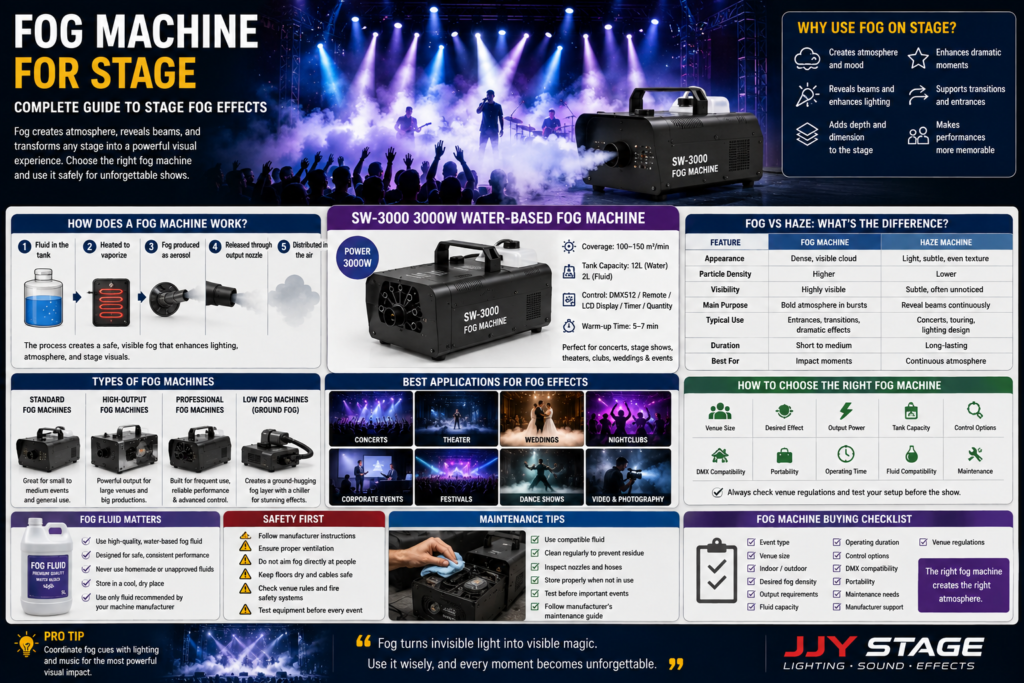
Walk into a dark venue just before a show starts, and you’ll often notice it before the lights even come up: a soft, drifting haze filling the air, waiting for the first beam of light to cut through it. That’s the work of a fog machine for stage use one of the most fundamental tools in live production. Fog can create atmosphere, add depth to a performance, make lighting beams visible, enhance dramatic scenes, support concert visuals, and transform an empty stage into a fully realized environment.
Fog is deceptively simple in concept but genuinely important in execution. The right fog effect can make a lighting rig look three-dimensional instead of flat. The wrong choice too dense, too light, poorly timed, or unsuited to the venue can undercut a performance instead of elevating it. Choosing the right fog machine depends on several factors: venue size, event type, the specific visual effect you’re after, how long the machine needs to run, and whether it needs to integrate with a lighting control system.
This guide covers what event professionals, theater technicians, and production teams need to know about stage fog machines how they work, the different types available, how fog interacts with lighting, and how to choose, use, and maintain equipment safely and effectively.
For a deeper look at the equipment used to create immersive event experiences, explore our Stage Special Effects Guide. It covers fog, haze, bubbles, snow, CO₂ effects, confetti, low fog, and other special effects, along with practical tips for choosing and using the right equipment for concerts, weddings, theaters, clubs, and live productions.
What Is a Fog Machine for Stage?
A fog machine is a piece of equipment that produces a visible, airborne aerosol effect commonly referred to as fog used to add atmosphere and visual depth to a performance space. Stage fog refers specifically to fog used in a controlled, professional context, as opposed to fog used casually for something like a Halloween decoration.
Professional productions use fog because it changes how a space and its lighting are perceived. Fog fills the air with a medium that light interacts with directly, turning invisible beams into visible shapes and giving a stage a sense of scale and depth that flat lighting alone can’t create.
There’s a meaningful difference between a basic consumer fog machine and professional stage equipment. A professional fog machine is generally built for repeated, reliable use across many shows, often supports more consistent output, and in many cases can integrate with a show’s control system. A consumer-grade machine, by contrast, is typically designed for occasional, lower-stakes use and isn’t built with the same durability or control options professional productions require.
How Does a Stage Fog Machine Work?
The basic operating process behind most stage fog machines follows a similar general sequence, though exact technology can vary between equipment designs. Fog fluid is placed in the machine’s reservoir a specially formulated liquid designed to produce a visible fog effect when processed. The machine then processes the fluid according to its design, which in most fog machines involves heating it to convert it into a vapor. The resulting aerosol is released through an output nozzle, forming the visible fog cloud that enters the room, and air movement distributes the effect across the performance area, spreading and thinning the fog as it interacts with the room’s airflow, HVAC system, and any movement on stage.
The exact internal mechanics heating method, output pressure, nozzle design vary between manufacturers and machine categories, so it’s worth reviewing the specific operating details for any machine you’re considering rather than assuming all fog machines function identically.
Why Use Fog Effects on Stage?
Fog effects serve several practical purposes beyond looking dramatic:
- Creating atmosphere — fills an empty stage with a sense of environment and mood.
- Revealing lighting beams — without fog or haze, many lighting effects are only visible where they land, not as they travel through the air.
- Increasing visual depth — helps separate foreground and background, making a stage feel three-dimensional.
- Enhancing dramatic moments — a fog cue timed well adds weight to an entrance, reveal, or climax.
- Supporting transitions — bridges scene changes or shifts in pacing.
- Creating cinematic effects — gives live performances a filmic quality plain lighting can’t achieve alone.
- Improving stage ambience — even without a specific cue, light, consistent fog can make a stage feel more polished.
It’s worth being clear about what fog doesn’t do: it doesn’t replace good lighting design. Fog enhances how lighting is perceived — it works with a well-designed rig, not as a substitute for one.
Fog Machine vs Other Atmospheric Effects
Fog is one of several atmospheric effects used in live production, and it’s easy to conflate fog, haze, smoke, and low fog. Here’s a quick comparison.
| Effect | Appearance | Main Purpose | Common Applications |
| Fog | Dense, visible cloud | Create bold, visible atmosphere in bursts | Concerts, theatrical entrances, transitions |
| Haze | Light, even, subtle texture | Make lighting beams visible without being noticed itself | Concerts, touring lighting design, broadcast |
| Smoke | Similar visual category to fog, often used interchangeably in casual use | Atmospheric fill | Concerts, clubs, general production |
| Low Fog | Ground-hugging fog layer | Create a floor-level cloud effect | Weddings, dramatic stage entrances, theater |
Each effect has its own equipment, use case, and ideal setting, and many productions use more than one. See our dedicated comparison article, Fog Machine vs Haze Machine: What’s the Difference?, for a deeper look at how the two differ in equipment and application.
Types of Fog Machines for Stage Productions
Not all fog machines are designed for the same job. Broadly, stage fog equipment falls into a few categories: standard fog machines, producing general atmospheric fog suitable for smaller to moderate-sized productions; high-output fog machines, built for larger spaces or productions where a greater volume of fog is needed to create a visible effect; professional fog machines, designed for frequent, demanding use across event production, theater, concerts, and rental company inventories, typically built with durability and consistent performance in mind; and low fog machines, a different category entirely usually a standard fog machine paired with a chiller unit that creates a ground-hugging fog layer rather than filling the room’s air space. This is a distinct visual effect suited to specific applications like dramatic entrances or first dances. Our dedicated guide, Low Fog Machine: How to Create a Cloud-Like Stage Effect, covers this effect in more detail.
No single type is universally “better” than another the right choice depends on venue size, desired effect, and how often the equipment will be used.
Fog Effects for Concerts
Fog is a staple of concert production. Fog effects for concerts typically make beams visible so moving head and beam lights read clearly in the air rather than just where they land, support the sweeping paths of moving lights, add general atmosphere, build anticipation before an entrance, mark transitions between songs or set sections, and punctuate musical climaxes.
Fog works alongside several types of concert lighting: moving head lights benefit from fog revealing their beam paths, beam lights become far more defined with fog present, wash lights gain a softer, more atmospheric quality, lasers (where used) become visible as defined lines rather than points of light on surfaces, and color-changing lighting takes on a more saturated look. The exact visual result depends heavily on fog density, lighting design, and venue conditions, so it’s worth testing during rehearsal rather than assuming a specific outcome.
Fog Effects for Theater Productions
In theater, fog is used with more restraint and precision than in concert settings, since it needs to support storytelling rather than provide standalone spectacle. A theatrical fog machine is commonly used for scene transitions signaling a shift in time, place, or mood; atmospheric environments such as a forest or abandoned building; dramatic entrances that build anticipation; mystery scenes adding a sense of the unknown; outdoor or natural settings simulating morning mist; dream sequences that soften a scene’s visual reality; and horror or suspense scenes that build tension through limited visibility.
Theater productions need careful control over fog intensity and timing because the effect is almost always tied to a specific story beat. Too much fog can obscure actors or dialogue delivery; too little can fail to register with the audience. This is why fog cues in theater are typically rehearsed and refined alongside the full cast, not just set once and left unchanged.
Fog Machine for Weddings and Events
Fog isn’t limited to concerts and theater; it’s a popular addition to weddings, corporate events, and other private functions when used thoughtfully. Common applications include wedding entrances and first dances (often paired with lighting for a cinematic look), stage presentations and corporate reveals, parties and themed celebrations, award ceremonies, and indoor entertainment venues.
Venue restrictions are especially important to check for these settings. Many indoor venues, particularly wedding venues, have specific rules about fog; some restrict it entirely, others limit output or require advance notice due to smoke detector sensitivity. Fog isn’t automatically appropriate for every venue, so confirming venue policy and testing equipment in advance is an essential step, not an optional one.
How Fog Enhances Stage Lighting
This is where fog earns its place as one of the most valuable tools in live production: its interaction with lighting design.
- Beam Lights — narrow beam fixtures are often nearly invisible without atmospheric fill; fog reveals the beam’s shape and path clearly.
- Moving Head Lights — as fixtures pan, tilt, and change color, fog makes their movement visible as a continuous shape rather than just a point of light on a surface.
- Wash Lighting — wash fixtures take on a softer, more atmospheric quality when fog is present, helping blend and layer colors across the stage.
- Backlighting — fog positioned behind performers creates a visible layer of depth, separating silhouette from background.
- Color Lighting — colored light interacts visibly with fog, often appearing more saturated and defined than in clear air.
The actual result depends on several variables: fog density, lighting angle, beam intensity, venue conditions, air movement, and stage design. The same fog machine can produce very different results in two different venues, which is why testing during setup or rehearsal matters.
Fog Machine vs Haze Machine
Fog and haze are often confused, but they serve different purposes in a professional lighting design.
| Feature | Fog Machine | Haze Machine |
| Typical appearance | Dense, visible cloud | Light, subtle, even texture |
| Particle density | Higher, more concentrated | Lower, more dispersed |
| Visibility | Highly visible on its own | Subtle, often unnoticed directly |
| Main purpose | Bold atmospheric effect, often in bursts | Long-lasting air texture to reveal lighting beams |
| Typical applications | Entrances, transitions, dramatic moments | Continuous use throughout concerts and touring shows |
| Lighting interaction | Strong, immediate visual impact | Consistent, subtle beam visibility over time |
Fog tends to be used in shorter, more noticeable bursts, while haze is designed to linger in the air at a lower density for extended periods. Many professional productions use both haze as a baseline throughout the show, with fog reserved for specific high-impact moments. For a deeper breakdown of when to choose one over the other, see our dedicated article, Fog Machine vs Haze Machine: What’s the Difference?
How to Choose the Right Fog Machine for Stage
Choosing the right fog machine involves weighing several practical factors together: venue size (larger venues generally need higher-output equipment); desired effect (light atmospheric fog, dense dramatic bursts, short timed effects, or continuous atmosphere); output (evaluate what your venue and application actually need rather than defaulting to the highest-output machine); fluid capacity (a larger tank reduces refill frequency); heating or operating time (warm-up and continuous-use performance vary by machine, so check manufacturer specs); control options (manual, wired/wireless remote, or DMX only assume DMX support if confirmed for the specific machine); portability (size, weight, and ease of transport matter for touring productions); maintenance (how easy the machine is to clean and maintain); and venue requirements (always check venue rules on fog use, since some restrict it due to fire safety systems).
Fog Machine Coverage: How Much Fog Do You Need?
There’s no single “right size” fog machine that works for every venue — coverage needs depend on room size, ceiling height, ventilation, air conditioning, airflow (open doors, fans, or drafts can move fog unpredictably), desired fog density, stage layout, and event duration.
Manufacturer coverage specifications are a useful starting point for planning, but they shouldn’t be treated as a guarantee for every venue. Real-world conditions vary enough that testing equipment in the actual performance space, where possible, is the most reliable way to confirm the right setup.
Indoor vs Outdoor Fog Effects
| Factor | Indoor | Outdoor |
| Air movement | Generally more controlled | Highly variable, wind-dependent |
| Fog dispersion | More predictable | Can disperse quickly or unpredictably |
| Ventilation | Requires attention to HVAC and detection systems | Not a concern in the same way |
| Weather | Not a factor | Wind, temperature, and humidity all affect performance |
| Visibility | Generally strong and consistent | Can vary significantly with conditions |
| Equipment protection | Simpler, controlled environment | Requires protection from weather exposure |
| Venue considerations | Fire safety systems and detector sensitivity | Permits, open-air regulations, sightline visibility |
Outdoor conditions tend to make atmospheric effects harder to control consistently, since wind and open air can disperse fog far more quickly than in an enclosed indoor space. Indoor venues offer more predictable results but come with their own considerations, particularly around ventilation and fire safety systems.
Fog Fluid: What You Should Know
Fog fluid is a specially formulated liquid designed to produce a safe, visible fog effect when processed by a fog machine. It comes in different formulations suited to different machines and effects, and using the correct type matters for both performance and equipment longevity.
Fog machines are generally designed to work with specific fluid formulations using an incompatible or unknown fluid can affect output quality and, in some cases, the equipment itself. Always use the fluid type recommended for your specific machine rather than assuming all fog fluids are interchangeable, and never substitute homemade solutions or unverified fluids, since these behave unpredictably and aren’t formulated to the same safety and performance standards as commercial fog fluid.
A few general considerations also matter: fluid quality affects both output consistency and equipment condition over time; proper storage (cool, sealed, away from direct sunlight) helps maintain fluid quality; compatibility with your specific machine should always be confirmed before use; and residue buildup from fluid use should be addressed through regular cleaning as part of routine maintenance.
Safety Considerations for Stage Fog Machines
Fog machines are widely used and generally safe when operated correctly, but a few responsible practices matter for every event: follow manufacturer instructions for setup, operation, and fluid use; use approved or compatible fluid specific to your machine; keep equipment away from unnecessary liquid exposure; maintain suitable ventilation, especially indoors; consider audience and performer visibility, avoiding density that could obscure sightlines or create hazards; follow venue policies, including any tied to fire alarm systems; keep emergency exits and safety equipment unobstructed; test equipment before the event; keep cables safely positioned; and keep trained personnel responsible for operation on larger productions.
Any electrical or mechanical issue beyond basic operation and cleaning should be addressed by referring to the manufacturer’s documentation or contacting qualified technical support, rather than attempting independent repairs or bypassing built-in safety features.
How to Use a Fog Machine in a Professional Stage Setup
A reliable, general workflow for incorporating fog into a professional production: evaluate the venue (size, ventilation, fire safety); determine the desired visual effect light atmosphere, dramatic bursts, or continuous coverage; choose suitable equipment based on venue size and output needs; select compatible fluid per manufacturer recommendations; position the machine appropriately, considering airflow, sightlines, and safety clearance; connect the control system if the equipment supports DMX or remote integration; test the effect ahead of the live event; coordinate with the lighting operator to align fog cues with the broader design; run the effect according to show cues; and inspect and store the equipment properly afterward.
How to Synchronize Fog With Stage Lighting
Coordinating fog with lighting design is what turns a basic atmospheric effect into a polished production element. Many professional setups trigger fog as part of the same cue system used for lighting changes, allowing consistent, repeatable timing. Where supported by the specific machine, DMX-based control programs fog output directly into a show’s lighting cues rather than relying on manual triggering. For smaller productions, manual cueing lets an operator trigger fog at specific moments by hand. Fog is also commonly used to underscore music transitions between songs or set sections, build anticipation before performer entrances, and support scene changes in theater by helping mask set transitions.
Exact synchronization capabilities depend entirely on the specific equipment and control system in use — not every fog machine supports DMX or advanced cueing, so this should be confirmed before planning a show around it.
Common Fog Machine Problems
| Problem | Possible Cause | General Solution |
| Little or no fog | Low fluid level or fluid line issue | Check fluid level and connections; consult manufacturer guidance |
| Uneven output | Residue buildup or fluid quality issue | Clean components and confirm correct fluid is being used |
| Long warm-up | Normal for some heating systems, or a component issue | Check manufacturer’s expected warm-up guidance for your model |
| Excessive residue | Fluid type mismatch or insufficient cleaning | Use manufacturer-recommended fluid and follow cleaning schedule |
| Unusual operation | Electrical or mechanical fault | Consult manufacturer documentation or qualified technical support |
For any electrical or mechanical problem beyond routine troubleshooting, always refer to the manufacturer’s manual or contact qualified support rather than attempting independent repairs.
Fog Machine Maintenance Tips
- Follow the manufacturer’s cleaning procedure specific to your machine.
- Use compatible fluid at all times to avoid performance or equipment issues.
- Avoid leaving unsuitable fluid in the equipment for extended periods where manufacturer guidance advises against it.
- Inspect hoses, nozzles, and connections periodically for wear or blockages.
- Store equipment correctly, protected from dust, moisture, and temperature extremes.
- Test equipment before important events, rather than assuming it will perform without a check.
- Follow scheduled maintenance recommendations provided by the manufacturer for your specific model.
Best Applications for Professional Fog Machines
| Application | Recommended Fog Use | Key Consideration |
| Concerts | Bursts for entrances and dramatic moments, or continuous light atmosphere | Coordinate closely with lighting cues |
| Theater | Precise, scene-specific cues | Requires rehearsal and careful intensity control |
| Weddings | Light, short bursts for entrances or first dances | Confirm venue policy in advance |
| Nightclubs | Periodic atmosphere bursts | Coordinate with music and lighting timing |
| Corporate events | Sparing use for reveals or presentations | Match tone to the professionalism of the event |
| Festivals | Higher-output equipment for larger outdoor spaces | Account for wind and open-air dispersion |
| Photography/video | Light, controlled fog for visual depth | Test in advance for camera-friendly density |
Fog Machine Buying Checklist
- ☐ Event type
- ☐ Venue size
- ☐ Indoor or outdoor use
- ☐ Desired fog density
- ☐ Output requirements
- ☐ Fluid capacity
- ☐ Operating duration
- ☐ Control options
- ☐ DMX compatibility, if required
- ☐ Portability
- ☐ Maintenance requirements
- ☐ Manufacturer support
- ☐ Venue regulations
Frequently Asked Questions
What is a fog machine for stage?
A fog machine for stage is equipment designed to produce a visible atmospheric fog effect for live performances, used to enhance lighting, create mood, and support dramatic or musical moments.
How does a stage fog machine work?
Fog fluid is processed by the machine, typically through a heating element, and released as a visible aerosol through an output nozzle, then distributed by air movement in the room.
What is the difference between fog and haze?
Fog is denser and more visible, often used in short bursts, while haze is a lighter, more even effect designed to linger in the air and reveal lighting beams without being noticeable on its own.
What type of fog machine is best for concerts?
Concerts often use high-output or professional fog machines capable of producing visible bursts and supporting frequent use throughout a show, though the right choice depends on venue size and desired effect.
Can a fog machine be used indoors?
Yes, fog machines are commonly used indoors, but ventilation, fire detection systems, and venue policies should always be confirmed beforehand.
How much fog does a stage fog machine produce?
Output varies by machine and is influenced by room size, ventilation, and desired density manufacturer specifications offer a starting point, but real-world testing is recommended.
What type of fluid does a fog machine use?
Fog machines use specially formulated fog fluid recommended by the manufacturer; homemade or unknown fluids should never be used.
Can fog machines work with stage lighting?
Yes, fog is widely used alongside stage lighting to make beams visible and add depth, though the exact synchronization capability depends on whether the specific equipment supports DMX or remote control.
Are professional fog machines suitable for theaters?
Yes, professional fog machines are commonly used in theatrical productions, typically with carefully controlled cues to support specific scenes and moments.
How do you maintain a stage fog machine?
Maintenance includes using compatible fluid, following the manufacturer’s cleaning procedures, inspecting hoses and connections, and testing the equipment before important events.
Conclusion
Choosing the right fog machine for stage use comes down to understanding your event type, venue size, the effect you want to create, output requirements, control options, fluid compatibility, and ongoing maintenance needs. Fog works especially well when coordinated thoughtfully with professional stage lighting, turning an otherwise flat lighting design into a visible, dimensional part of the performance.
Safety and venue compliance should always come first confirming venue policies, using compatible fluid, and following manufacturer guidance ensures fog effects enhance a production without unnecessary risk. For event professionals and production teams looking for reliable, professional-grade fog equipment, JJY Stage’s Special Effect Series offers equipment suited to concerts, theater, weddings, and events of every scale.