
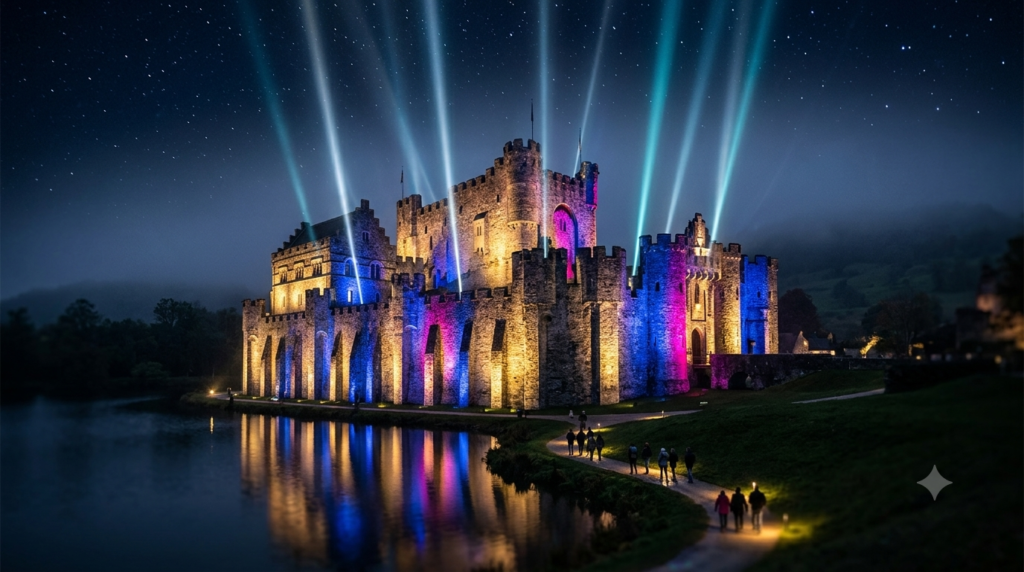
Lighting is far more than a functional requirement in today’s cultural tourism destinations. It shapes how visitors experience history, architecture, performances, landscapes, and public spaces long after sunset. Whether illuminating a heritage district, creating an immersive museum exhibition, enhancing a scenic attraction, or supporting a large-scale outdoor performance, a well-designed lighting system transforms ordinary environments into memorable experiences.
As night tourism continues to grow worldwide, destinations are increasingly investing in cultural tourism lighting to extend operating hours, strengthen local economies, and create compelling visual identities. Intelligent lighting, architectural lighting, projection mapping, and synchronized multimedia shows have become essential tools for attracting visitors and encouraging repeat attendance. When these technologies are planned correctly, they enrich storytelling while improving safety, navigation, and operational flexibility.
Unfortunately, many projects never achieve their full potential because of avoidable design and installation mistakes. Poor fixture selection, inconsistent lighting control, excessive visual effects, inadequate maintenance planning, and insufficient coordination between lighting and other systems often lead to disappointing visitor experiences and higher long-term operating costs.
This guide explores the common lighting mistakes in cultural tourism projects, explains why they occur, and provides practical recommendations to help project owners, architects, lighting designers, tourism developers, and system integrators build engaging, reliable, and future-ready attractions.Beam Moving Head Lights are professional stage lighting fixtures that produce powerful, narrow beams with full pan and tilt movement for dynamic lighting effects. Commonly used in concerts, theaters, clubs, live events, and architectural installations, they create dramatic aerial beams, sharp projections, and synchronized light shows. Learn how beam moving head lights work, their key features, and how to choose the right model for your lighting setup.
Why Lighting Matters in Cultural Tourism Projects
Successful cultural tourism attractions rely on more than architecture or historical significance. Lighting determines how visitors perceive, understand, and emotionally connect with a destination.
Creating Memorable Visitor Experiences
Visitors remember emotions more than individual details. Carefully designed lighting directs attention, reveals textures, highlights architectural features, and creates dramatic transitions that encourage exploration.
For example, subtle landscape lighting along a heritage pathway can gradually reveal historical landmarks, while intelligent stage lighting can turn an outdoor performance into an immersive evening experience.
Enhancing Cultural Storytelling
Every cultural site has a story to tell. Lighting reinforces narratives by emphasizing important structures, guiding visual focus, and creating atmosphere through controlled brightness, color temperature, and timing.
Rather than overwhelming visitors with constant visual stimulation, thoughtful lighting supports the rhythm of the story.
Improving Safety and Navigation
Public spaces must remain comfortable and safe after dark.
Effective lighting helps visitors:
- Identify pathways
- Recognize changes in elevation
- Locate entrances and exits
- Navigate gathering areas
- Feel secure throughout the venue
Good lighting balances visibility with aesthetics instead of sacrificing one for the other.
Supporting Night Tourism
Nighttime attractions generate additional revenue while reducing seasonal limitations. Museums, heritage sites, cultural festivals, historical districts, and outdoor theaters increasingly depend on professional stage lighting and landscape illumination to extend visitor hours without compromising the site’s identity.
Strengthening Destination Branding
Iconic nighttime images often become the most recognizable marketing assets for tourism destinations. Consistent lighting design helps create a distinctive visual identity that supports promotional campaigns and social media engagement.
Mistake #1: Designing Without a Clear Lighting Master Plan
One of the most common lighting mistakes in cultural tourism projects is beginning installation before establishing a comprehensive lighting master plan.
Without a long-term vision, individual lighting decisions become disconnected, resulting in inconsistent aesthetics and expensive revisions.
Common Problems
- Undefined project objectives
- Inconsistent lighting zones
- Conflicting fixture specifications
- Poor budgeting
- Limited expansion capability
- Difficult maintenance planning
Projects often evolve over several years. Without coordinated planning, later additions rarely integrate smoothly with the original design.
Impact
Poor planning typically leads to:
- Uneven visitor experiences
- Higher installation costs
- Redundant equipment purchases
- Inconsistent storytelling
- Reduced operational efficiency
How to Avoid It
Develop a lighting master plan before selecting equipment.
Include:
- Visitor journey mapping
- Functional lighting requirements
- Architectural highlighting
- Performance lighting needs
- Landscape illumination
- Control system architecture
- Future expansion plans
- Maintenance strategy
- Energy consumption targets
Early collaboration between architects, lighting designers, AV consultants, and tourism stakeholders significantly reduces project risk.
Mistake #2: Choosing the Wrong Lighting Fixtures
Even the best lighting design cannot compensate for poorly selected equipment.
Different applications require different fixture types, beam angles, output levels, environmental protection, and control capabilities.
Beam Lights vs. Wash Lights
Beam lights produce concentrated shafts of light suitable for long-distance visual effects and dramatic emphasis.
Wash lights provide broad, even illumination that is ideal for:
- Building facades
- Performance stages
- Landscapes
- Public gathering spaces
Confusing these fixture types often results in uneven illumination and reduced visual impact.
Beam Lights vs. Wash Lights: Complete Buying Guide helps you understand the key differences between narrow, high-intensity beam fixtures and wide-coverage wash lights. Learn which lighting type is best for concerts, stage performances, architectural lighting, and live events so you can choose the right fixture for your specific application and achieve professional lighting results.
Using Indoor Fixtures Outdoors
Outdoor installations expose equipment to rain, dust, humidity, UV radiation, and temperature fluctuations.
Indoor fixtures typically fail prematurely when used outdoors.
Ignoring IP Ratings
Outdoor stage lighting should always be selected according to the environmental conditions.
General guidance:
| Environment | Recommended IP Rating |
| Covered outdoor areas | IP54–IP55 |
| Open-air installations | IP65 |
| Heavy rain or fountains | IP66 or higher |
Higher IP ratings reduce maintenance and extend equipment lifespan.
Incorrect Brightness and Beam Angles
Fixtures that are too dim disappear against ambient lighting, while excessively bright fixtures create glare and visual discomfort.
Similarly, narrow beam angles may leave dark areas, whereas overly wide beams reduce contrast and waste energy.
How to Avoid It
Choose fixtures based on:
- Mounting distance
- Viewing angles
- Required illuminance
- Environmental conditions
- Maintenance accessibility
- Lighting simulations
- Future programming needs
Professional photometric calculations help optimize fixture placement before installation begins.
Mistake #3: Ignoring Historical and Cultural Identity
Lighting should celebrate cultural heritage rather than compete with it.
A common lighting mistake in cultural tourism projects is treating every site as an entertainment venue regardless of its historical significance.
Common Issues
- Over-lighting heritage buildings
- Excessive color-changing effects
- Modern lighting styles conflicting with historical architecture
- Distracting visual clutter
- Loss of authenticity
Visitors expect historical sites to retain their character.
Lighting should reveal architectural craftsmanship instead of overwhelming it.
Color Temperature Matters
Warm white lighting generally complements:
- Stone structures
- Historic streets
- Religious architecture
- Traditional villages
Neutral or cooler color temperatures may be more appropriate for contemporary museums or multimedia installations.
Selecting appropriate color temperature strengthens authenticity while maintaining visual comfort.
How to Avoid It
Before developing the lighting concept:
- Study the site’s history
- Understand cultural symbolism
- Consult heritage conservation specialists
- Minimize permanent visual impact
- Prioritize reversible installations where appropriate
Technology should enhance cultural interpretation rather than dominate it.
Mistake #4: Poor Lighting Control and Programming
Modern attractions require much more than static illumination.
Without intelligent programming, even premium fixtures deliver limited visitor engagement.
Common Problems
- Manual operation
- No DMX lighting control
- Unsynchronized fixtures
- Static scenes
- Poor timing
- Inconsistent brightness transitions
The result is an attraction that feels repetitive rather than immersive.
Why DMX Lighting Control Matters
DMX lighting control enables centralized management of:
- Brightness
- Color
- Movement
- Timing
- Effects
- Show automation
It allows multiple fixtures to operate as one coordinated system.
When integrated with audio, projection mapping, fountains, or special effects, DMX programming creates cohesive storytelling rather than isolated visual moments.
How to Avoid It
Implement:
- Intelligent lighting controllers
- Programmable show sequences
- Scheduled operation
- Seasonal lighting scenes
- Remote monitoring
- System diagnostics
- Backup programming
Automation improves both operational efficiency and visitor consistency.
Mistake #5: Overusing Dynamic Lighting Effects
Dynamic effects attract attention—but too much movement quickly becomes distracting.
One of the most overlooked common lighting mistakes in cultural tourism projects is assuming that more animation automatically creates a better experience.
Signs of Overuse
- Constant movement
- Rapid color changes
- Excessive beam effects
- Flash-heavy programming
- Multiple focal points competing simultaneously
Instead of enhancing storytelling, excessive effects create visual fatigue.
Visitors may struggle to identify the site’s most important architectural or cultural features.
Better Design Principles
Use dynamic lighting intentionally.
Reserve movement for:
- Key story moments
- Performance highlights
- Festival celebrations
- Seasonal events
- Special ceremonies
Allow quieter lighting scenes to create contrast. Moments of visual calm make dramatic sequences more impactful.
How to Avoid It
A balanced programming strategy should include:
- Static architectural scenes
- Slow transitions
- Controlled color palettes
- Purposeful movement
- Clearly defined focal points
- Visitor viewing considerations
The goal is not to showcase every lighting capability but to strengthen the overall narrative.
Mistake → Impact → Solution Summary
| Mistake | Impact | Solution |
| No lighting master plan | Budget overruns, inconsistent results | Develop a comprehensive lighting master plan before procurement |
| Wrong lighting fixtures | Uneven illumination and equipment failure | Match fixture type, beam angle, brightness, and IP rating to the application |
| Ignoring cultural identity | Loss of authenticity and visitor engagement | Align lighting with heritage values, architecture, and storytelling |
| Poor lighting control | Static experiences and inefficient operation | Implement DMX lighting control with programmable scenes |
| Overusing dynamic effects | Visual fatigue and reduced storytelling impact | Use movement and color selectively to emphasize key moments |
Mistake #6: Ignoring Visitor Comfort and Safety
One of the most costly common lighting mistakes in cultural tourism projects is focusing exclusively on visual impact while overlooking visitor comfort and safety. A spectacular nighttime attraction loses its appeal if guests struggle to navigate pathways, experience glare, or feel unsafe.
Professional cultural tourism lighting should balance aesthetics with usability. Every lighting decision should support a pleasant, inclusive, and secure visitor journey.
Common Problems
- Excessive glare from poorly aimed fixtures
- Dark pathways and staircases
- Uneven illumination between activity zones
- Insufficient emergency lighting
- Poor accessibility for elderly visitors and people with disabilities
Even a beautifully illuminated landmark can become hazardous if surrounding circulation areas are poorly lit.
Impact
Ignoring visitor comfort can lead to:
- Reduced visitor satisfaction
- Safety incidents and liability risks
- Lower accessibility
- Shorter visitor dwell times
- Negative online reviews
How to Avoid It
Design lighting with people—not just architecture—in mind.
Best practices include:
- Use glare-control accessories such as louvers or shields.
- Provide consistent illumination along walkways and gathering areas.
- Highlight changes in elevation with step lighting.
- Integrate emergency and backup lighting systems.
- Ensure compliance with local accessibility and safety regulations.
- Test the lighting experience from the visitor’s perspective before project handover.
The most successful attractions are comfortable to explore at every stage of the visitor journey.
Mistake #7: Neglecting Maintenance and Long-Term Operation
Many projects invest heavily in installation but underestimate ongoing maintenance. As a result, lighting performance gradually declines, increasing operating costs and reducing the attraction’s overall quality.
Maintenance planning should begin during the design phase—not after installation.
Common Maintenance Issues
- Dirty lenses reducing light output
- Aging LED modules with inconsistent color
- Corroded outdoor connectors
- Water ingress caused by damaged seals
- Cable failures
- Missing spare parts
- Poor documentation
Outdoor environments are particularly demanding due to dust, humidity, temperature changes, and UV exposure.
Impact
Without preventive maintenance:
- Brightness decreases over time.
- Color consistency deteriorates.
- Fixture failures become more frequent.
- Repair costs increase.
- Visitor experience becomes inconsistent.
How to Avoid It
Create a preventive maintenance program that includes:
- Routine cleaning schedules
- Annual fixture inspections
- Waterproof seal inspections
- Firmware updates for intelligent lighting
- Electrical testing
- Spare parts inventory
- Maintenance logs
Choosing professional LED stage lighting with modular components also simplifies future servicing and reduces downtime.
Mistake #8: Ignoring Energy Efficiency and Sustainability
Energy efficiency is no longer simply a cost-saving measure—it is a key component of responsible tourism development.
Outdated lighting technologies consume more electricity, require more maintenance, and generate unnecessary environmental impacts.
Common Problems
- Older discharge lamps
- Inefficient power supplies
- Excessive fixture quantities
- Poor lighting control strategies
- Fixtures operating at full output throughout the night
These practices increase operational expenses without improving visitor experiences.
Impact
Poor energy performance leads to:
- Higher electricity bills
- Increased maintenance requirements
- Larger carbon footprints
- Reduced sustainability credentials
- Greater lifecycle costs
How to Avoid It
Adopt sustainable tourism lighting solutions by incorporating:
- High-efficiency LED fixtures
- Smart lighting control systems
- Occupancy and scheduling controls
- Adaptive brightness based on ambient conditions
- Precision optics that minimize wasted light
- Energy monitoring software
Sustainability should be evaluated across the entire lifecycle of the lighting system, including installation, operation, maintenance, and future upgrades.
Mistake #9: Poor Integration Between Lighting, Audio, and Multimedia
Modern cultural attractions rarely rely on lighting alone. Audio systems, projection mapping, fountains, video displays, interactive technologies, and special effects often work together to create immersive storytelling.
When these systems are not properly integrated, the overall experience feels disconnected.
Common Problems
- Unsynchronized lighting and music
- Delayed visual effects
- Confeting control systems
- Inconsistent show timing
- Separate programming teams working independently
Instead of telling one cohesive story, visitors experience unrelated technical elements competing for attention.
Impact
Poor integration reduces:
- Emotional engagement
- Story clarity
- Operational efficiency
- Show reliability
Technical conflicts can also make troubleshooting more difficult during live performances.
How to Avoid It
Develop a unified control strategy early in the project.
Coordinate:
- Lighting designers
- AV integrators
- Multimedia programmers
- Show producers
- Architects
- Control system engineers
Using compatible control protocols and synchronized programming ensures that lighting, audio, projection mapping, and multimedia reinforce one another rather than operating independently.
Mistake #10: Choosing Price Over Quality
Budget constraints are a reality for nearly every project, but selecting equipment solely on purchase price often results in significantly higher long-term costs.
Low-cost fixtures may appear attractive during procurement but frequently introduce reliability issues that affect both operations and visitor satisfaction.
Common Issues
- Low brightness
- Poor optical performance
- Inconsistent color rendering
- Short product lifespan
- Limited warranty support
- Lack of replacement parts
- Weak environmental protection
These shortcomings become especially problematic in demanding outdoor environments.
Long-Term Impact
Cheap fixtures often require:
- More frequent replacement
- Increased maintenance
- Higher labor costs
- Greater downtime
- Earlier system upgrades
The initial savings are often offset within a few years.
How to Avoid It
When evaluating professional stage lighting, consider:
- Optical quality
- LED lifespan
- Waterproof performance
- Intelligent control compatibility
- Manufacturer support
- Product certifications
- Availability of spare parts
- Total cost of ownership
A reliable lighting system delivers better performance over many years while reducing operational risk.
Best Practices for Successful Cultural Tourism Lighting Projects
Avoiding the common lighting mistakes in cultural tourism projects requires more than purchasing quality fixtures. Successful projects combine thoughtful planning, technical expertise, and long-term operational strategies.
1. Develop a Comprehensive Lighting Master Plan
A master plan should define:
- Visitor circulation
- Storytelling objectives
- Architectural priorities
- Landscape integration
- Lighting zones
- Maintenance strategies
- Future expansion opportunities
2. Use Lighting Simulations
Photometric simulations help verify:
- Fixture placement
- Beam coverage
- Glare control
- Illuminance levels
- Energy performance
This reduces costly design revisions during installation.
3. Choose Reliable Equipment
Invest in professional-grade products designed for demanding environments, including:
- Intelligent lighting
- Waterproof stage lights
- Moving head lights
- Beam lights
- Wash lights
- Architectural lighting fixtures
4. Design for Scalability
Tourism destinations evolve over time.
Lighting systems should accommodate:
- Additional attractions
- Seasonal events
- New multimedia technologies
- Expanded performance areas
Scalable infrastructure minimizes future renovation costs.
5. Prioritize Preventive Maintenance
Routine inspections and scheduled servicing extend equipment life while maintaining consistent lighting quality.
6. Optimize Energy Consumption
Smart controls, efficient optics, and LED technology help reduce operating costs without sacrificing visual quality.
7. Collaborate Across Disciplines
The best projects involve close collaboration among:
- Architects
- Lighting designers
- Heritage specialists
- Landscape architects
- Electrical engineers
- AV system integrators
- Operations teams
Integrated planning consistently produces stronger visitor experiences.
Real-World Examples of Effective Cultural Tourism Lighting
Many successful destinations demonstrate how thoughtful lighting enhances cultural interpretation while respecting the character of each site.
Heritage Sites
Historic buildings often use warm architectural lighting that highlights stone textures, arches, and decorative details without overwhelming the original architecture.
Lesson: Less is often more. Subtle lighting preserves authenticity.
Theme Parks
Theme parks combine intelligent lighting, synchronized music, projection mapping, and multimedia effects to create immersive nighttime experiences.
Lesson: Integrated control systems deliver stronger storytelling than isolated technologies.
Museums
Many museums use carefully controlled lighting to protect sensitive collections while directing visitor attention toward key exhibits.
Lesson: Lighting should enhance interpretation while supporting conservation requirements.
Outdoor Performances
Professional outdoor stage lighting allows festivals, concerts, and cultural performances to adapt quickly to different productions through programmable lighting scenes and intelligent fixtures.
Lesson: Flexible lighting systems improve operational efficiency and creative possibilities.
Historic Districts
Urban heritage areas often combine architectural lighting, landscape lighting, and public space illumination to improve safety while encouraging evening tourism.
Lesson: Lighting should support both everyday functionality and destination branding.
Scenic Attractions
Natural viewpoints frequently use carefully positioned lighting that enhances visitor safety while minimizing light pollution and preserving the surrounding landscape.
Lesson: Respecting the environment is just as important as creating visual impact.
Conclusion
The common lighting mistakes in cultural tourism projects are rarely caused by a single poor decision. More often, they result from inadequate planning, inappropriate equipment selection, weak system integration, or insufficient attention to long-term operation.
By investing in a comprehensive lighting master plan, selecting high-quality professional stage lighting, implementing intelligent DMX lighting control, prioritizing visitor comfort, and designing with sustainability in mind, project owners can create attractions that remain visually compelling and operationally reliable for years to come.
Successful cultural tourism lighting is not about using the brightest fixtures or the most dramatic effects. It is about creating meaningful experiences that strengthen cultural storytelling, enhance safety, support the nighttime economy, and reinforce a destination’s unique identity.
Whether developing a heritage site, theme park, museum, public square, or outdoor performance venue, partnering with experienced lighting professionals from the earliest planning stages helps avoid costly mistakes and delivers a future-ready solution that balances creativity, durability, and long-term value.
Frequently Asked Questions (FAQ)
What is cultural tourism lighting?
Cultural tourism lighting uses professional lighting systems to enhance heritage sites, museums, public spaces, and cultural attractions by improving storytelling, visitor safety, and nighttime experiences.
Why is a lighting master plan important?
A lighting master plan aligns project goals, fixture selection, control systems, maintenance, and future expansion, reducing costs and ensuring consistent lighting performance.
Why is DMX lighting control used in tourism attractions?
DMX lighting control synchronizes lighting effects, colors, movement, and timing, enabling immersive shows that integrate with audio, video, and projection mapping.
What IP rating is best for outdoor stage lighting?
IP65 is generally recommended for most outdoor stage lighting installations, while IP66 or higher is preferred for locations exposed to heavy rain or water features.
How can energy-efficient lighting benefit cultural tourism projects?
Energy-efficient LED lighting lowers electricity consumption, reduces maintenance costs, extends fixture lifespan, and supports sustainability goals without compromising visual quality.