
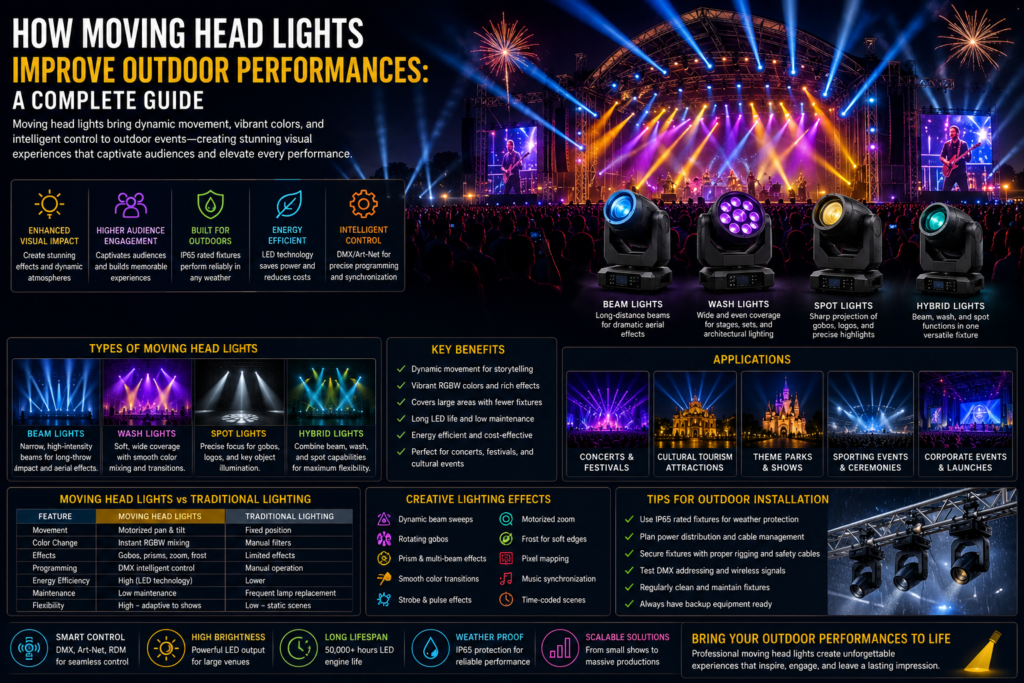
Introduction to Outdoor Performance Lighting
Outdoor performances have evolved into highly immersive experiences where lighting is just as important as music, acting, or stage design. Whether it’s a large-scale music festival, an open-air concert, a cultural tourism attraction, or a spectacular theme park show, audiences expect visually stunning productions that keep them engaged from beginning to end. A well-designed lighting system transforms an ordinary venue into an unforgettable destination, helping organizers create memorable experiences that attract larger audiences and encourage repeat attendance.
Among today’s most advanced professional stage lighting solutions, moving head lights for outdoor performances have become the preferred choice for event professionals. Unlike traditional static fixtures, these intelligent lighting systems can pan, tilt, zoom, change colors, project gobos, and synchronize perfectly with music or programmed shows. Their flexibility allows lighting designers to build dynamic scenes without constantly repositioning equipment.
Modern LED moving head lights also provide impressive brightness while consuming less power than older lighting technologies. Combined with advanced DMX lighting control, Art-Net compatibility, and weather-resistant IP65-rated designs, these fixtures deliver exceptional performance even in demanding outdoor environments. From intimate cultural performances to stadium concerts, moving head lights create dramatic visual effects that elevate every production.
What Are Moving Head Lights?
How Moving Head Lights Work
Moving head lights are intelligent lighting fixtures designed to produce highly controlled beams of light while physically moving during a performance. Unlike conventional spotlights that remain fixed in one direction, moving head fixtures rotate horizontally (pan) and vertically (tilt), allowing operators to direct light precisely wherever it is needed. This flexibility dramatically reduces the number of fixtures required while expanding creative possibilities.
At the heart of every fixture is a sophisticated control system that communicates with lighting consoles using DMX lighting control protocols. Lighting programmers create scenes, transitions, and synchronized effects that automatically control movement, colors, brightness, gobos, prisms, zoom functions, and strobe effects. The result is a seamless visual performance that appears effortless to the audience.
Today’s intelligent stage lighting systems are powered primarily by efficient LED light engines. LEDs offer longer operational life, reduced maintenance requirements, and significantly lower energy consumption compared with older discharge lamps. They also produce vibrant RGBW color mixing, allowing designers to generate millions of color combinations instantly.
Because of their versatility, moving head lights have become essential components in concert lighting, festival lighting, theatrical productions, sporting events, product launches, television broadcasts, and permanent outdoor entertainment venues.
Types of Moving Head Fixtures
Professional manufacturers generally offer four primary categories of moving head fixtures, each designed for different applications.
Moving Head Beam Lights
Beam fixtures produce extremely narrow, concentrated shafts of light that travel long distances. These lights excel at creating dramatic aerial effects visible even in large outdoor venues. Their sharp beams cut through haze and atmospheric effects, making them ideal for concerts and festivals.
Moving Head Wash Lights
Wash fixtures provide broad, even illumination across stages, performers, scenery, or architectural elements. They are commonly used for color washes, background lighting, and smooth transitions throughout live performances.
Moving Head Spot Lights
Spot fixtures combine precise focus with powerful optics. They can project gobos, logos, textures, and detailed patterns while maintaining excellent brightness across long throw distances.
Hybrid Moving Head Lights
Hybrid fixtures integrate beam, wash, and spot capabilities into a single unit. They offer exceptional flexibility for production companies that require multiple lighting functions while minimizing equipment inventory.
Why Moving Head Lights Are Essential for Outdoor Performances
Enhancing Visual Impact
Outdoor venues present unique lighting challenges. Unlike indoor theaters where lighting conditions remain controlled, outdoor environments compete with ambient light, expansive spaces, unpredictable weather, and varying audience viewing angles. Moving head lights for outdoor performances address these challenges by delivering exceptional brightness, long throw distances, and highly adaptable beam positioning.
One of the greatest advantages of moving head fixtures is their ability to completely transform the atmosphere within seconds. During a live concert, for example, soft blue washes can instantly transition into energetic sweeping beams synchronized with a drum solo. During cultural performances, gentle warm lighting can evolve into vibrant color sequences that emphasize storytelling and emotional moments.
The addition of gobos, rotating prisms, frost filters, and advanced zoom functions enables designers to create countless visual combinations without changing fixtures. Instead of relying on large numbers of conventional lights, a carefully programmed moving head system provides enormous creative flexibility while simplifying stage design.
Because these fixtures can continuously reposition throughout an event, they maximize lighting coverage and reduce dark areas on stage. This capability is particularly valuable for outdoor festivals where performers frequently move across large stages.
Improving Audience Engagement
Great performances tell stories, and lighting is one of the most powerful storytelling tools available. Dynamic lighting naturally guides audience attention toward performers, highlights dramatic moments, and reinforces the emotional energy of live entertainment.
During high-energy concerts, synchronized beam movements create excitement that extends beyond the stage into the audience itself. Sweeping lights, rapid color changes, and rhythmic effects encourage audience participation while amplifying the overall atmosphere. In theatrical productions or cultural tourism attractions, carefully programmed lighting transitions help establish mood, direct focus, and enhance narrative progression.
Interactive lighting has become increasingly important as audiences expect immersive experiences rather than passive entertainment. Modern outdoor event lighting systems integrate with audio, video, pyrotechnics, fountains, drones, and multimedia content to create synchronized productions that leave lasting impressions.
For theme parks and heritage attractions, intelligent lighting extends operating hours by transforming nighttime environments into vibrant entertainment destinations. Visitors experience familiar locations in entirely new ways through carefully choreographed lighting effects that celebrate architecture, landscapes, and cultural heritage.
From a business perspective, professionally designed lighting also delivers measurable value. Memorable visual experiences encourage social media sharing, improve audience satisfaction, strengthen event branding, and increase the likelihood of repeat attendance. Event organizers, production companies, and tourism developers increasingly recognize that investing in high-quality stage lighting equipment contributes directly to visitor engagement and long-term commercial success.
Key Benefits of Moving Head Lights for Outdoor Performances
Choosing the right moving head lights for outdoor performances is about more than adding brightness to a stage. These intelligent fixtures bring flexibility, creativity, and efficiency together in one solution, making them a valuable investment for event organizers, rental companies, and venue owners. Whether the event is a large-scale music festival or a cultural tourism attraction, moving head lights allow lighting designers to adapt quickly to changing performance requirements while maintaining consistent visual quality.
One of the biggest advantages is their ability to cover large areas with fewer fixtures. Traditional lighting systems often require multiple fixed lights to illuminate different parts of a stage. Moving head fixtures can pan, tilt, zoom, and change colors automatically, reducing the overall number of lights needed. This not only simplifies installation but also lowers transportation, rigging, and maintenance costs. Rental companies particularly benefit because fewer fixtures can deliver more lighting effects, increasing return on investment.
High-output LED moving head lights are designed for long throw distances, making them suitable for outdoor stages where performers and audience members may be separated by hundreds of feet. Advanced optics ensure that beams remain sharp and bright even over long distances, while RGBW color mixing delivers vibrant colors without requiring separate color filters. The addition of rotating gobos, prisms, frost filters, and motorized zoom functions allows designers to create everything from narrow aerial beams to wide stage washes using the same fixture.
Energy efficiency is another important benefit. Compared with older discharge lamp fixtures, LED technology consumes significantly less electricity while generating less heat. Longer operating lifespans reduce replacement costs and maintenance downtime, making modern moving head fixtures an environmentally friendly and cost-effective choice for professional productions.
Performance and Efficiency
Professional lighting designers appreciate moving head fixtures because they streamline both production planning and live operation. Once programmed through DMX lighting control, multiple fixtures can execute synchronized movements with incredible precision. This allows complex lighting sequences to run automatically, freeing operators to focus on overall show quality.
Key performance advantages include:
| Feature | Benefit |
| Fast Pan & Tilt | Covers multiple stage areas instantly |
| RGBW LED Mixing | Millions of vibrant color combinations |
| Motorized Zoom | Narrow beams or wide washes from one fixture |
| Rotating Gobos | Dynamic patterns and logo projections |
| Prism Effects | Multi-beam aerial visuals |
| Long LED Lifespan | Lower maintenance costs |
| Low Power Consumption | Reduced operating expenses |
| Intelligent Programming | Automated synchronized shows |
These capabilities help production teams create visually impressive performances without dramatically increasing equipment inventories or staffing requirements.
Creative Lighting Effects
Creativity is where intelligent stage lighting truly stands out. Modern moving head fixtures offer an extensive range of programmable effects that enhance storytelling and audience engagement.
Some of the most popular effects include:
- Dynamic beam sweeps across the audience
- Smooth color fades between scenes
- Rotating gobo projections
- Prism-generated multi-beam effects
- Adjustable frost for soft edge lighting
- High-speed strobe effects
- Pixel-mapped lighting sequences
- Music-synchronized movements
- Layered lighting scenes
- Time-coded visual productions
These effects allow designers to create unique visual identities for concerts, festivals, theatrical productions, and permanent attractions while keeping audiences fully immersed throughout the performance.
Types of Moving Head Lights
Selecting the right fixture begins with understanding how each category performs in different environments. While all moving head lights share intelligent movement capabilities, each type is optimized for specific lighting tasks.
Moving Head Beam Lights
Moving head beam lights are engineered to produce extremely narrow, high-intensity beams that travel long distances. Their concentrated output creates striking aerial effects, especially when combined with haze or atmospheric fog.
These fixtures are particularly effective for:
- Stadium concerts
- Outdoor music festivals
- Opening ceremonies
- Fireworks displays
- Large public celebrations
- Nighttime entertainment venues
Because beam lights prioritize intensity over coverage, they are typically used alongside wash or spot fixtures to create balanced lighting designs.
Moving Head Wash Lights
Wash fixtures are designed to spread light evenly across performers, stages, scenery, or architectural elements. Their wide beam angles make them ideal for creating colorful backgrounds and ensuring performers remain properly illuminated throughout a production.
Applications include:
- Theatre productions
- Cultural tourism performances
- Outdoor fashion shows
- Television broadcasts
- Corporate presentations
- Theme park entertainment
Modern wash fixtures feature motorized zoom systems that allow designers to switch between narrow and wide coverage without changing equipment.
Moving Head Spot Lights
Spot fixtures combine brightness with precision. Their adjustable focus allows operators to project detailed gobos, company logos, textured patterns, and sharp spotlight effects while maintaining excellent image clarity.
They perform exceptionally well in:
- Product launches
- Corporate events
- Award ceremonies
- Architectural lighting
- Heritage site performances
- Live broadcasts
Spot fixtures are often the preferred choice when branding, storytelling, or detailed projection effects are important.
Hybrid Moving Head Lights
Hybrid fixtures integrate beam, wash, and spot functionality into a single intelligent lighting unit. These versatile fixtures have become increasingly popular because they reduce equipment requirements while expanding creative possibilities.
Advantages include:
- Greater flexibility
- Lower transportation costs
- Faster installation
- Simplified inventory management
- Reduced rigging complexity
- Excellent value for rental companies
For production companies managing different event types throughout the year, hybrid fixtures offer exceptional versatility and long-term cost savings.
Not sure whether to choose beam lights or wash lights for your next project? Our detailed comparison explains the key differences, ideal applications, and advantages of each fixture for cultural tourism, heritage sites, festivals, and stage productions. Learn how the right lighting combination can create stunning visual effects while enhancing visitor experiences.
Applications of Moving Head Lights in Outdoor Events
The versatility of moving head lights for outdoor performances makes them suitable for almost every type of live event. Their ability to adapt to different venues, production styles, and audience sizes has made them a standard component of professional lighting systems worldwide.
Concerts and Music Festivals
Concerts are perhaps the most recognizable application for moving head lighting. Large touring productions rely on hundreds of intelligent fixtures working together to create synchronized visual experiences that complement live music.
During performances, lighting designers use beam effects to energize audiences, wash lighting to illuminate performers, and spot fixtures to highlight solo artists. Time-coded programming ensures every lighting cue matches the music perfectly, creating seamless productions that enhance emotional impact.
Music festivals benefit even more because multiple performers often share the same stage. Moving head fixtures can be reprogrammed quickly between performances, allowing each artist to have a unique visual identity without extensive equipment changes.
Cultural Tourism Attractions
Governments and tourism developers increasingly use intelligent lighting to transform historical sites into immersive nighttime attractions. Carefully designed lighting enhances architectural beauty while supporting storytelling through synchronized visual effects.
Applications include:
- Ancient city performances
- Heritage building illumination
- Cultural festivals
- Historical reenactments
- Tourist attractions
- Landmark celebrations
By combining lighting with projection mapping, music, and narration, destinations create memorable experiences that encourage longer visitor stays and increased tourism revenue.
Discover how Cultural Tourism Lighting transforms heritage sites, museums, theme parks, and public attractions into immersive nighttime experiences. Learn how LED lighting, projection mapping, intelligent controls, and architectural lighting work together to enhance storytelling, attract more visitors, and create unforgettable cultural destinations after dark.
Theme Parks
Theme parks depend heavily on entertainment lighting to create magical experiences after sunset. Moving head fixtures provide dynamic effects for parades, stunt shows, theatrical performances, fountains, and seasonal events.
Their programmable nature allows parks to refresh shows regularly without replacing lighting equipment, helping attractions remain exciting for returning visitors.
Sporting Events
Sporting venues use intelligent lighting for:
- Player introductions
- Opening ceremonies
- Half-time entertainment
- Victory celebrations
- Fan engagement
- Television broadcasts
Moving head lights add excitement before, during, and after competitions while improving the viewing experience for both live audiences and television viewers.
Corporate Events and Product Launches
Corporate productions increasingly resemble concert-quality performances. Product launches, conferences, exhibitions, and award ceremonies all benefit from professional lighting that reinforces branding and creates memorable presentations.
Moving head spot lights can project company logos, while wash fixtures establish brand colors throughout the venue. Dynamic beam effects help build anticipation during keynote speeches and product reveals, ensuring important moments leave a lasting impression.
How Moving Head Lights Create Immersive Audience Experiences
Modern audiences expect more than a live performance—they expect an experience that stimulates the senses and creates lasting memories. This is where moving head lights for outdoor performances truly shine. By combining movement, color, intensity, and synchronization, these intelligent fixtures transform ordinary stages into immersive environments that captivate audiences from the first moment to the final encore.
One of the greatest strengths of moving head lights is their ability to direct attention exactly where it is needed. During a concert, spot fixtures can follow the lead performer while wash lights provide balanced stage illumination. Beam lights sweep across the crowd during high-energy moments, encouraging audience participation and amplifying excitement. This constant movement keeps the visual experience fresh and engaging throughout the event.
Advanced DMX lighting control enables lighting designers to synchronize every movement, color transition, and lighting effect with music, video content, or theatrical cues. Time-coded programming ensures every lighting change happens with perfect precision, creating seamless productions that feel natural rather than mechanical. This synchronization strengthens emotional storytelling and reinforces the overall production value.
Layered lighting design is another essential technique. By combining moving head beam lights, moving head wash lights, and moving head spot lights, designers create depth and dimension across the stage. Background washes establish mood, spotlights highlight performers, and beam effects add dramatic movement above the audience. The result is a visually rich environment that enhances every aspect of the performance.
Moving Head Lights vs Traditional Stage Lighting
Although traditional stage lighting still has its place, intelligent moving head fixtures offer significant advantages for outdoor productions.
| Feature | Moving Head Lights | Traditional Stage Lighting |
| Movement | Motorized pan and tilt | Fixed position |
| Coverage | Wide coverage with fewer fixtures | Multiple fixtures required |
| Color Changes | Instant RGBW color mixing | Manual color filters |
| Effects | Gobos, prisms, zoom, frost, strobe | Limited effects |
| Programming | Fully programmable via DMX | Mostly manual adjustments |
| Energy Efficiency | High with LED technology | Higher power consumption |
| Maintenance | Lower due to long-life LEDs | Frequent lamp replacement |
| Installation | Flexible and scalable | More fixtures and cabling |
| Cost Effectiveness | Higher long-term value | Lower initial cost but higher operating expenses |
| Best Applications | Concerts, festivals, theme parks, cultural attractions | Small venues and static lighting setups |
While conventional fixtures remain suitable for simple lighting tasks, intelligent moving head systems provide the flexibility and creative freedom required for today’s large-scale outdoor events.
How to Choose the Right Moving Head Lights for Outdoor Performances
Selecting the ideal lighting fixtures involves balancing technical requirements, environmental conditions, and budget. The right equipment should meet current production needs while providing flexibility for future projects.
Consider the following factors:
Venue Size and Throw Distance
Large outdoor stages require fixtures with high-output LEDs and long throw capabilities. Smaller venues may achieve excellent results with lower-powered models, reducing energy consumption without sacrificing performance.
Beam Angle
Narrow beam angles create dramatic aerial effects, while wider beam angles provide even stage illumination. Hybrid fixtures with motorized zoom offer the flexibility to perform both functions.
Weather Protection
Outdoor installations should use fixtures with at least an IP65 rating. These enclosures protect against dust, rain, and moisture, ensuring reliable operation in changing weather conditions.
Control Protocols
Professional systems should support:
- DMX512
- Art-Net
- RDM
- sACN (where applicable)
These protocols simplify integration with modern lighting consoles and networked control systems.
Power Consumption
Energy-efficient LED moving head lights reduce operating costs while minimizing heat generation. Lower power requirements also simplify electrical planning for large productions.
Mounting Options
Consider whether fixtures will be installed on:
- Truss systems
- Ground supports
- Towers
- Roof structures
- Permanent architectural installations
Proper mounting ensures safety and optimal lighting coverage.
Budget and Future Scalability
Rather than focusing solely on purchase price, evaluate total cost of ownership. Durable fixtures with longer lifespans, lower maintenance needs, and software upgrade capabilities often provide better long-term value.
Best Practices for Installing Moving Head Lights Outdoors
Successful outdoor lighting begins long before the audience arrives. Careful planning and professional installation help maximize performance while ensuring safety.
Key installation recommendations include:
- Position fixtures to eliminate unwanted shadows.
- Maintain balanced beam overlap for consistent stage coverage.
- Use certified rigging hardware and safety cables.
- Protect power distribution systems from moisture.
- Label all DMX addresses clearly.
- Test wireless DMX systems before live operation.
- Perform complete programming rehearsals.
- Inspect fixtures for damage before every event.
- Clean lenses and cooling systems regularly.
- Keep backup fixtures, cables, and controllers available.
Weather monitoring is equally important. Even IP-rated fixtures should be inspected after heavy rain or dust exposure to maintain long-term reliability.
Common Mistakes to Avoid
Even experienced production teams occasionally encounter preventable issues. Avoiding these common mistakes improves reliability and show quality.
Using Indoor Fixtures Outdoors
Indoor-rated fixtures lack adequate weather protection and may fail when exposed to rain, humidity, or dust.
Poor Fixture Spacing
Incorrect spacing creates uneven lighting and visible dark spots across the performance area.
Ignoring Beam Overlap
Proper overlap ensures smooth transitions and balanced illumination without distracting gaps.
Incorrect DMX Addressing
Programming errors caused by duplicate addresses or incorrect fixture profiles can disrupt an entire lighting system.
Underestimating Power Requirements
Large productions require detailed electrical planning to prevent overloads and unexpected shutdowns.
Neglecting Maintenance
Dirty optics, clogged cooling fans, and loose connections reduce brightness and shorten equipment lifespan.
Poor Programming
Overusing fast movements or excessive effects can distract audiences instead of enhancing the performance.
No Backup Equipment
Professional productions always prepare spare fixtures, controllers, cables, and power supplies to minimize downtime.
Future Trends in Outdoor Moving Head Lighting
The future of professional stage lighting is becoming smarter, more connected, and increasingly sustainable. Manufacturers continue to develop technologies that improve efficiency while expanding creative possibilities.
Several emerging trends are shaping the industry:
- AI-assisted lighting programming that automatically generates synchronized effects.
- Cloud-based lighting management for remote monitoring and updates.
- Wireless DMX systems that reduce cable installation time.
- IoT-enabled fixtures capable of reporting maintenance status.
- Advanced RGBAL and RGBW LED engines with improved color accuracy.
- Higher-efficiency optical systems producing greater brightness with lower energy consumption.
- Environmentally friendly materials and recyclable fixture components.
- Enhanced integration with video walls, projection mapping, drones, fountains, and augmented reality experiences.
As outdoor entertainment continues to grow, intelligent lighting will play an even greater role in creating immersive experiences that combine technology, creativity, and storytelling.
Conclusion
Moving head lights for outdoor performances have become an essential component of modern entertainment because they deliver exceptional flexibility, creativity, and reliability. Their ability to combine precise movement, vibrant color mixing, dynamic beam effects, and intelligent programming allows event organizers to create visually stunning productions that captivate audiences across concerts, festivals, cultural tourism attractions, theme parks, sporting events, and corporate gatherings.
Compared with traditional lighting systems, modern LED moving head lights offer greater energy efficiency, lower maintenance requirements, and far more creative possibilities. Whether using beam, wash, spot, or hybrid fixtures, lighting designers can adapt quickly to different venues and production styles while maintaining professional-quality results.
For organizations planning outdoor events, investing in high-quality stage lighting equipment is more than a technical decision—it is an investment in audience engagement, brand reputation, and long-term success. By choosing reliable intelligent lighting solutions and partnering with experienced manufacturers, event professionals can deliver unforgettable visual experiences that leave lasting impressions on every audience.
Call to Action
Looking for reliable and high-performance moving head lights for outdoor performances? Contact our professional stage lighting team today for expert guidance, customized lighting solutions, and intelligent fixtures designed to elevate concerts, festivals, cultural tourism attractions, theme parks, and live events with outstanding visual impact.
Frequently Asked Questions
1. What are moving head lights?
Moving head lights are intelligent lighting fixtures that can pan, tilt, change colors, project gobos, and create dynamic lighting effects through programmable control systems.
2. Are moving head lights suitable for outdoor events?
Yes. Outdoor events should use weather-resistant fixtures with an IP65 or higher rating to ensure reliable performance in rain, dust, and other environmental conditions.
3. What is the difference between beam, wash, and spot moving head lights?
Beam lights produce narrow, long-distance beams, wash lights provide wide and even illumination, while spot lights create focused projections, gobos, and precise highlighting.
4. What IP rating is recommended for outdoor lighting?
An IP65 rating or higher is generally recommended for outdoor stage lighting applications.
5. How do moving head lights work with DMX controllers?
DMX controllers send digital commands that control movement, brightness, color, gobos, zoom, prisms, and other fixture functions.