
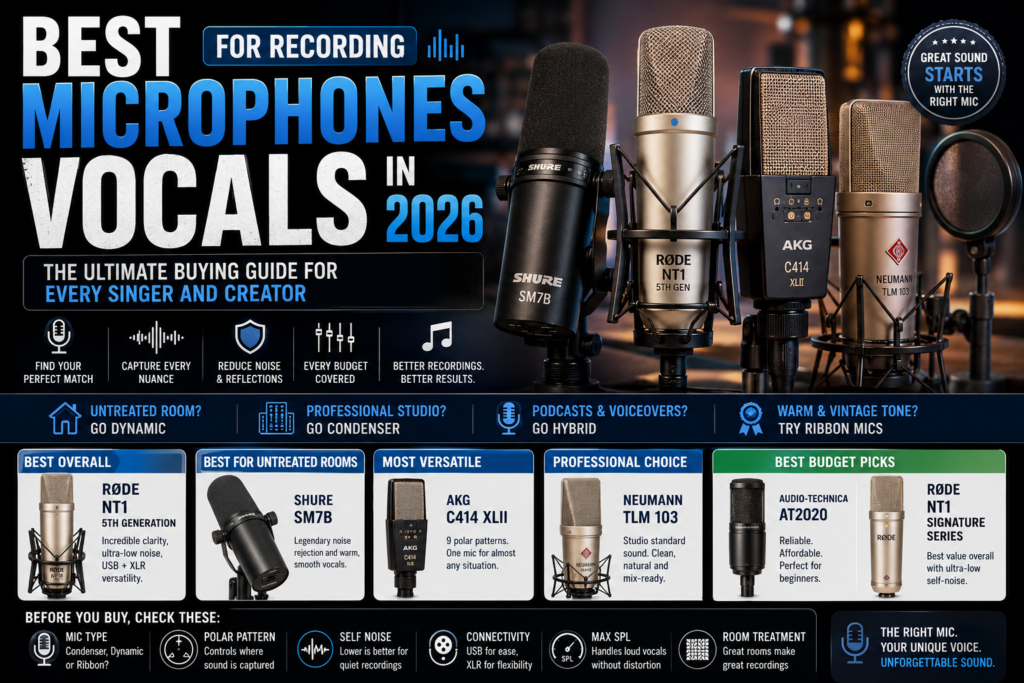
Why Choosing the Right Vocal Microphone Matters
Buying a microphone for vocals feels a little like buying shoes for a marathon. You can technically run in almost anything, but the right pair changes everything. The same principle applies to microphones. The right microphone doesn’t simply capture your voice; it shapes how listeners experience it. Warm, intimate vocals that seem to sit right beside the listener often come from a microphone that complements the singer’s natural tone rather than fights against it.
One of the biggest misconceptions among beginners is that studio-quality recordings come purely from expensive gear. Reality works differently. Recording engineers have spent decades matching voices with microphones because every voice carries unique characteristics. A microphone that makes one singer sound like a superstar might make another sound harsh, muddy, or lifeless. Professional studios often keep dozens of microphones available for exactly this reason.
The room itself matters almost as much as the microphone. A $3,000 microphone placed inside an untreated bedroom can sound worse than a $150 microphone recorded in a properly treated room. Testing performed across dozens of microphones in 2026 found that nearly 30% of expensive microphone purchases fail to meet expectations because buyers ignore room acoustics entirely.
Understanding your environment, vocal style, and budget before spending money often produces dramatically better results than simply buying whatever appears in a celebrity studio tour on YouTube.
The Relationship Between Your Voice and Your Microphone
Imagine microphones as camera lenses. Some lenses make landscapes breathtaking while others are designed for portraits. Microphones work the same way with human voices.
Bright voices often pair beautifully with darker microphones such as the legendary Shure SM7B because they smooth out sharp frequencies and create a warm broadcast sound. Singers with naturally deep or dark voices frequently achieve better clarity from condenser microphones that add sparkle and air to the top end.
Professional engineers regularly conduct “mic shootouts,” where singers test several microphones before recording begins. The reason is simple: there is no universal winner. Even microphones regarded as studio legends have strengths and weaknesses depending on the vocalist. Industry experts repeatedly emphasize that no microphone is objectively perfect for every singer.
Distance from the microphone also dramatically changes tone. Move closer and bass frequencies increase due to something called the proximity effect. Pull back slightly and vocals become more open and natural. Many beginners blame their microphone for muddy recordings when the issue is actually microphone placement.
Learning how your voice interacts with microphone characteristics is often more valuable than upgrading to a more expensive model.
Why Expensive Doesn’t Always Mean Better
The audio world loves luxury products. Vintage microphones sell for thousands of dollars and collectors chase legendary studio gear almost like rare sports cars. That doesn’t mean expensive microphones automatically create better recordings.
Recent testing involving 47 microphones across multiple price categories found that some affordable models delivered results surprisingly close to microphones costing ten times as much. The standout example was the RØDE NT1 Signature Series, which consistently outperformed expectations despite costing only around $159.
Budget microphones have improved enormously over the last decade. Manufacturing precision, capsule quality, and onboard electronics have advanced to the point where entry-level microphones are producing recordings that would have impressed major studios twenty years ago.
What often separates premium microphones today is versatility rather than raw sound quality. High-end models may include multiple polar patterns, lower self-noise, higher maximum sound pressure handling, and superior build quality. Those are valuable improvements, but many home studio owners simply don’t need them.
The smartest purchase is usually the microphone that solves your specific recording challenges rather than the microphone with the biggest price tag.
Understanding Condenser Microphones
Condenser microphones dominate modern vocal recording for one simple reason: detail. They capture tiny nuances that dynamic microphones sometimes miss, including breathiness, vocal texture, and subtle emotional performances.
This sensitivity makes condensers favorites for pop, acoustic music, jazz, and voiceover work. Models such as the RØDE NT1 5th Generation and Neumann TLM 103 have become studio standards because they deliver clarity without sounding artificial.
The downside is sensitivity to room reflections. A condenser microphone hears almost everything. Computer fans, traffic noise, air conditioning systems, and untreated walls all become part of the recording. That’s wonderful in professional studios and frustrating in bedrooms with tile floors and bare walls.
Condenser microphones also require phantom power, usually supplied by an audio interface or mixing console. This isn’t a problem for most musicians today, but it remains something beginners occasionally overlook.
When used in the right environment, condensers create recordings with an openness and realism that many singers instantly fall in love with.
Understanding Dynamic Microphones
Dynamic microphones are the pickup trucks of the audio world. They are rugged, dependable, and surprisingly versatile.
Unlike condensers, dynamic microphones are less sensitive and naturally reject room reflections better. This makes them ideal for untreated bedrooms, apartments, and noisy environments. The legendary Shure SM7B has become almost synonymous with podcasts, radio stations, and modern hip-hop recording for exactly this reason.
Many new artists mistakenly believe dynamic microphones produce inferior recordings. In reality, some of the most recognizable vocal performances in music history were recorded using dynamic microphones. Their tighter pickup patterns and reduced sensitivity often create cleaner recordings in real-world environments than sensitive condensers.
The trade-off comes in the form of detail. Dynamic microphones generally capture less high-frequency information than condensers, which some listeners interpret as warmth while others perceive as reduced clarity. Reddit audio communities frequently describe the SM7B as sounding darker than many condenser alternatives.
For creators recording in bedrooms or untreated rooms, dynamic microphones frequently represent the smartest investment available.
Understanding Ribbon Microphones
Ribbon microphones occupy a fascinating middle ground between condenser detail and dynamic warmth. Their sound often feels smooth, vintage, and almost cinematic.
These microphones became famous during the golden age of recording in the 1950s and continue appearing in high-end studios today. Modern ribbon microphones are far more durable than their fragile ancestors and can comfortably handle modern recording situations.
Ribbon microphones tend to soften harsh vocals beautifully. Singers with aggressive upper frequencies often sound richer and more polished through ribbons. Engineers recording rock vocals, brass instruments, and guitar amplifiers frequently reach for ribbon microphones to reduce harshness naturally before equalization even begins.
The downside is cost and specialization. Ribbon microphones rarely serve as first microphones for beginners because they excel in very specific situations rather than covering every recording need.
For experienced engineers chasing vintage character and warmth, ribbon microphones remain one of audio’s hidden treasures.
Best Overall Microphones for Recording Vocals
RØDE NT1 5th Generation
The biggest success story of 2026 may be the RØDE NT1 5th Generation. It combines traditional XLR recording with modern USB connectivity and even supports 32-bit float recording through USB-C. This allows creators to record vocals with incredible flexibility while avoiding clipping disasters that ruin takes.
Its incredibly low self-noise allows whisper-quiet recordings without introducing hiss or background artifacts. Singers recording intimate performances, audiobooks, or cinematic vocals benefit enormously from this capability.
Shure SM7B
The Shure SM7B continues dominating podcasts, radio, streaming, and rap vocals in 2026. Its ability to reject room noise makes it almost magical in untreated environments. Hip-hop producers especially continue recommending it for home recording setups.
AKG C414 XLII
Few microphones offer the versatility of the AKG C414 XLII. Nine polar patterns allow engineers to record solo vocals, duets, room ambience, and instruments with a single microphone. Many studios consider it one of the best long-term investments available.
Neumann TLM 103
The Neumann TLM 103 remains one of the most respected professional vocal microphones available. It delivers a polished sound that slips effortlessly into modern mixes and has become a favorite in commercial studios worldwide.
Best Budget Vocal Microphones
Audio-Technica AT2020
Few microphones have introduced more people to recording than the Audio-Technica AT2020. Affordable pricing, reliable performance, and excellent versatility make it a beginner favorite year after year. Community recommendations continue placing it among the safest entry-level purchases available.
RØDE NT1 Signature Series
The RØDE NT1 Signature Series may be the best value microphone currently available. Independent testing across 47 microphones identified it as the strongest overall performer for most home studios in 2026. Its incredibly low 4dBA self-noise figure remains among the quietest in the industry.
Best Microphones for Different Recording Situations
Best for Untreated Rooms
If your room has hard walls, echo, or outside noise, dynamic microphones win almost every time. The SM7B continues dominating recommendations because its design naturally minimizes unwanted room reflections. Community discussions consistently support this recommendation for rappers and home studio users.
Best for Professional Studios
Professional environments unlock the full potential of premium condenser microphones. Models like the AKG C414 XLII and Neumann TLM 103 thrive inside acoustically controlled rooms where their detail can truly shine.
Best for Podcasting and Voiceovers
Podcast creators increasingly favor hybrid microphones capable of both USB and XLR recording. The new generation of hybrid microphones such as the RØDE NT1 5th Gen and recent broadcast-focused releases offer remarkable flexibility for creators who work across multiple platforms.
Features You Should Check Before Buying
Before buying any microphone, evaluate these factors carefully:
| Feature | Why It Matters |
| Microphone Type | Determines sensitivity and noise rejection |
| Polar Pattern | Controls where the microphone captures sound |
| Self Noise | Critical for quiet recordings |
| Connectivity | USB offers convenience while XLR offers flexibility |
| Maximum SPL | Important for loud vocal performances |
| Room Treatment | Often more important than microphone price |
Ignoring these specifications often leads to disappointment, even with expensive microphones.
Comparison Table of Top Vocal Microphones
| Microphone | Type | Best For | Approx Price |
| RØDE NT1 5th Gen | Condenser | Home studios and creators | Mid-range |
| Shure SM7B | Dynamic | Untreated rooms and podcasts | Mid-range |
| AKG C414 XLII | Condenser | Professional studios | Premium |
| Neumann TLM 103 | Condenser | Commercial vocal production | Premium |
| Audio-Technica AT2020 | Condenser | Beginners | Budget |
| RØDE NT1 Signature | Condenser | Best value overall | Budget |
Conclusion
The search for the best microphone for recording vocals ends with an uncomfortable truth: there is no universal champion. The best microphone is the one that complements your voice, suits your room, and fits your workflow.
For most home studio owners, the RØDE NT1 5th Generation offers one of the strongest combinations of sound quality, flexibility, and future-proof features currently available. Artists recording in untreated spaces will probably achieve better results with the Shure SM7B. Professional studios looking for ultimate versatility continue trusting microphones such as the AKG C414 XLII and Neumann TLM 103.
Microphones are translators. Their job isn’t simply to record sound but to translate emotion into something listeners can feel. Choosing the right translator can turn a good performance into a memorable one.
FAQs
1. Are condenser microphones better than dynamic microphones for vocals?
Not necessarily. Condensers capture more detail, while dynamic microphones perform better in noisy or untreated environments.
2. Is the Shure SM7B good for singing?
Yes. It is widely used for singing, rap vocals, podcasts, and broadcasting, particularly in untreated rooms.
3. Do I need an audio interface for recording vocals?
You need an interface for XLR microphones. USB microphones can connect directly to a computer.
4. Which microphone is best for beginners?
The Audio-Technica AT2020 and RØDE NT1 Signature Series remain two of the best beginner options available.
5. Does room treatment matter more than the microphone?
In many situations, yes. Improving room acoustics often creates a larger improvement than upgrading microphones.