
Why Color Quality Defines Modern Stage Experiences
Professional lighting has evolved far beyond simply illuminating performers so audiences can see the stage. Today’s concerts, theatres, immersive attractions, theme parks, cultural tourism destinations, and architectural installations rely heavily on lighting as a storytelling tool. A carefully designed lighting scene can create excitement before the first note of a concert, build emotional tension during a theatrical performance, or transform a historical monument into a living visual experience. Color quality sits at the center of that transformation. If the lighting system cannot reproduce accurate whites, natural skin tones, or subtle color gradients, even the most expensive production design can appear flat and artificial.
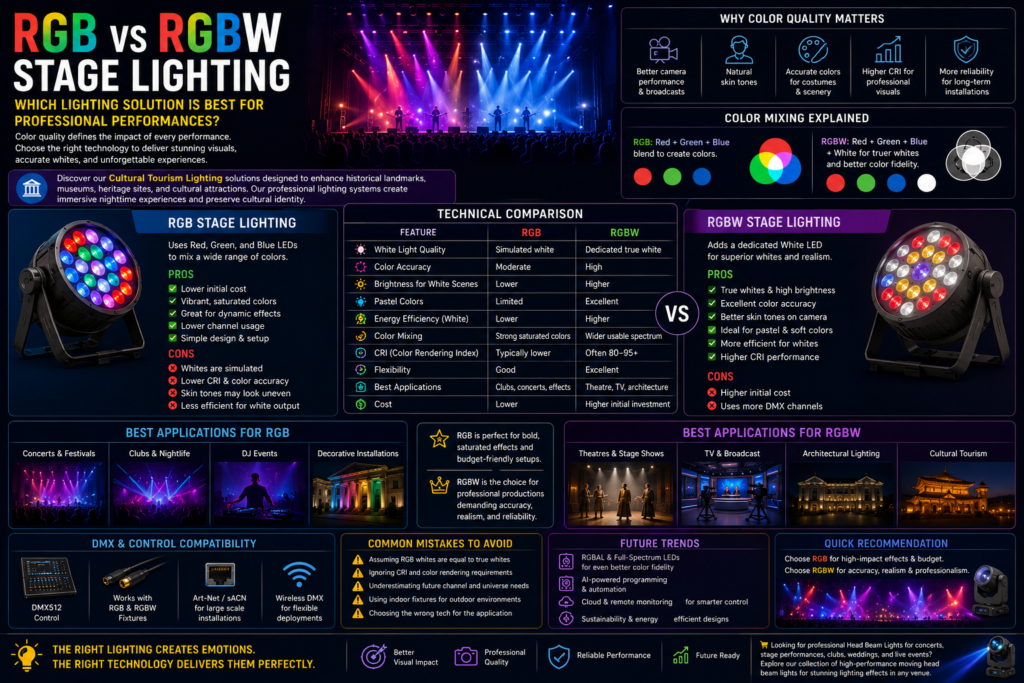
This is exactly where the discussion around RGB vs RGBW stage lighting becomes important. Both technologies use LED color mixing, but they approach the challenge differently. Traditional RGB fixtures combine red, green, and blue LEDs to create colors, while RGBW systems add a dedicated white emitter to improve color accuracy and white-light performance. That additional white channel may sound like a minor upgrade, but in practical applications it changes everything from brightness levels to camera compatibility.
Discover our Cultural Tourism Lighting solutions designed to enhance historical landmarks, museums, heritage sites, and cultural attractions. Our professional lighting systems create immersive nighttime experiences, highlight architectural beauty, and help destinations attract more visitors while preserving their cultural identity.
Recent technical evaluations show RGB-generated white often struggles with color rendering and natural skin tones, while RGBW fixtures regularly achieve significantly better CRI and broadcast performance due to the dedicated white source. Productions targeting television, livestreaming, and high-resolution video increasingly specify RGBW fixtures as standard equipment.
Understanding RGB Stage Lighting
How RGB Color Mixing Works
RGB stage lighting uses additive color mixing. Red, green, and blue LEDs operate at different intensities, and the human eye blends these wavelengths into a wide spectrum of colors. Increase red and blue while reducing green and you create magenta. Increase all three equally and the fixture attempts to generate white. The principle is elegant and efficient, which explains why RGB technology became the foundation of modern LED entertainment lighting.
RGB fixtures excel at producing highly saturated colors that feel energetic and dramatic. Concert designers love deep blues, aggressive reds, and vibrant purples because these colors create atmosphere and excitement. Nightclubs, music festivals, DJ events, and touring productions frequently rely on RGB wash lights and beam fixtures because they deliver precisely the kind of visual impact these environments demand.
The challenge appears when productions require realistic white illumination. Since RGB fixtures create white by blending colored emitters rather than using a dedicated white source, the resulting spectrum often contains gaps that reduce color fidelity. Human skin can appear slightly unnatural, costumes may lose texture detail, and cameras may struggle with white balance consistency. Recent measurements show RGB-generated white frequently produces lower CRI performance compared with dedicated white LEDs.
Advantages and Limitations of RGB Fixtures
RGB fixtures continue to dominate many sectors because they remain highly cost-effective. Rental companies can deploy large quantities of RGB pars and wash lights for festivals and corporate events without significantly increasing budgets. Their simpler architecture also means lower acquisition costs and reduced maintenance complexity.
The limitations become noticeable in environments where visual realism matters. Theatre productions, museums, television studios, and cultural attractions depend heavily on accurate skin tones and subtle pastel colors. RGB systems can approximate these colors but often struggle to reproduce them consistently across different brightness levels and camera systems. This limitation explains why many touring productions combine RGB effects lighting with dedicated white front lighting systems.
Understanding RGBW Stage Lighting
The Role of the Dedicated White LED
The defining feature of RGBW stage lighting is the additional white LED integrated into the fixture. Instead of forcing red, green, and blue emitters to imitate white, the fixture activates a dedicated white source specifically engineered for broad-spectrum illumination. This dramatically improves white-light quality while allowing the RGB channels to focus entirely on color generation.
The white channel also increases fixture efficiency. Producing white with RGB LEDs requires driving three emitters simultaneously, which consumes more energy and reduces available output for color effects. RGBW systems can generate bright whites using the dedicated white channel alone, preserving both power and thermal headroom for additional effects programming.
The improvement is immediately visible in theatres and live broadcasts. Performers appear more natural, costume colors become richer, and camera sensors capture scenes more accurately. Modern RGBW fixtures often include tunable white functionality, allowing designers to select precise color temperatures ranging from warm tungsten-style 3200K scenes to daylight-balanced 5600K environments.
Why RGBW Delivers Better Color Accuracy
The additional white emitter also expands the fixture’s color gamut in practical ways. Pastel shades become cleaner and softer because they no longer require heavy desaturation of RGB channels. Architectural lighting projects particularly benefit from this capability because facades often require elegant whites and subtle color transitions rather than aggressive concert-style effects.
Research published during 2026 consistently shows RGBW fixtures delivering superior CRI performance compared with RGB-only alternatives. Many professional fixtures achieve CRI values above 90, making them suitable for broadcast, television production, museums, and premium event venues. Higher CRI ratings improve the appearance of skin tones, fabrics, artwork, and branded corporate colors.
RGB vs RGBW Stage Lighting: Technical Comparison
| Feature | RGB | RGBW |
| White Light Quality | Simulated white | Dedicated true white |
| Color Accuracy | Moderate | High |
| Brightness for White Scenes | Lower | Higher |
| Pastel Colors | Limited | Excellent |
| Energy Efficiency for White Output | Lower | Higher |
| Color Mixing | Strong saturated colors | Wider usable spectrum |
| CRI | Typically lower | Often 80–95+ |
| Flexibility | Good | Excellent |
| Outdoor Performance | Good | Superior |
| Best Applications | Clubs, concerts, effects | Theatre, TV, architecture |
| Cost | Lower | Higher initial investment |
The table only tells part of the story. The real distinction emerges during programming sessions. Lighting designers working with theatrical productions frequently spend less time correcting color temperature shifts on RGBW systems because the white channel naturally stabilizes the palette. Corporate productions appreciate RGBW fixtures because logos and branding colors appear more accurate on stage and camera.
Advantages of RGB Stage Lighting
The strongest advantage of RGB systems remains affordability. Large touring productions requiring hundreds of fixtures can reduce capital expenditure significantly by selecting RGB washes and effects lights for non-critical positions. Clubs and entertainment venues often prioritize atmosphere over accurate skin tones, making RGB fixtures an excellent financial decision.
RGB fixtures also produce exceptionally vibrant colors. Saturated reds, greens, and blues can appear more intense because the fixture’s entire optical system is optimized around these three channels. Music festivals often rely heavily on these dramatic color palettes to generate excitement and audience engagement.
Installation simplicity represents another benefit. Three-channel color engines require fewer DMX resources and can simplify programming in smaller productions. Entry-level venues frequently appreciate the reduced complexity because technicians can achieve impressive effects without extensive training.
Advantages of RGBW Stage Lighting
The addition of white fundamentally changes the capabilities of professional fixtures. The first benefit is obvious: pure white output. Front lighting for theatre actors, keynote speakers, presenters, and performers becomes cleaner and more flattering.
Camera systems also benefit enormously. Modern 4K and 8K sensors reveal color inconsistencies that previous generations often masked. RGBW fixtures reduce white-balance issues and improve consistency across multiple cameras. Industry guidance increasingly recommends RGBW or even full-spectrum LED systems for television and streaming productions.
Museums, heritage sites, and cultural tourism attractions represent another major market. These environments often require both dramatic storytelling effects and faithful color reproduction for artifacts or architecture. RGBW allows designers to move seamlessly between immersive scenes and accurate illumination without changing fixture types.
Best Applications for RGB Lighting
RGB systems continue to thrive in environments where excitement matters more than realism. Concerts, DJ performances, dance festivals, and nightclubs all benefit from vivid saturated colors. Beam fixtures cutting through haze with electric blue and deep red effects remain an iconic part of live entertainment.
Decorative installations also represent an ideal application. Shopping malls, bars, restaurants, exhibition booths, and seasonal events frequently prioritize visual impact over precise color rendering. RGB technology offers excellent performance while maintaining manageable budgets.
Small theatres and community venues can also benefit from RGB fixtures, especially when paired with separate front lighting systems. This hybrid strategy delivers the best balance between cost and performance.
Best Applications for RGBW Lighting
Professional concerts increasingly specify RGBW fixtures for front wash and key lighting positions. Television productions rely on them for predictable color temperature and superior skin tones. Fashion shows depend on them because clothing textures and colors must remain accurate under stage illumination.
Cultural tourism developments have become one of the fastest-growing markets for RGBW systems. Historical sites, museums, castles, and themed attractions frequently combine immersive storytelling with educational experiences. RGBW technology supports both objectives simultaneously.
Architectural lighting also strongly favors RGBW solutions. Buildings spend much of their operational life illuminated in white rather than dynamic colors. Dedicated white LEDs dramatically improve both efficiency and visual quality in these scenarios.
RGB vs RGBW for Outdoor Stage Lighting
Outdoor environments amplify every lighting weakness. Long throw distances demand higher brightness, and audience members located hundreds of meters away depend on clean illumination to maintain visual connection with performers.
RGB systems can produce spectacular aerial effects outdoors, particularly when used in beam lights and moving heads. However, the absence of dedicated white becomes increasingly noticeable during speeches, acoustic performances, and television coverage.
RGBW fixtures solve many of these challenges. Dedicated white emitters provide stronger punch, improved visibility, and more accurate color rendering at distance. Modern IP65-rated RGBW fixtures designed for festivals and outdoor stages often include tunable color temperatures between 3200K and 8000K for maximum flexibility.
How DMX Controllers Improve Lighting Performance
The rise of intelligent lighting would not have been possible without DMX512 control systems. DMX allows hundreds of fixtures to operate in perfect synchronization from a single console, enabling complex scenes that would otherwise require dozens of technicians.
RGB fixtures typically consume fewer channels because they control only three color sources. RGBW fixtures add an additional white channel and often include advanced color temperature controls. While this increases programming complexity slightly, it dramatically expands creative possibilities.
Modern consoles now integrate automation, music synchronization, pixel mapping, and real-time effects generation. Wireless DMX solutions are also becoming increasingly common in temporary event environments, reducing cable runs and installation time.
Choosing Between RGB and RGBW Systems
The decision ultimately depends on project goals rather than technology trends. Budget remains the first consideration. If the production requires large numbers of fixtures and primarily uses saturated effects, RGB may offer the best return on investment.
Venue type comes next. Theatres, broadcast studios, museums, and cultural attractions benefit enormously from RGBW capabilities. Clubs and festivals may prioritize RGB effects lighting while supplementing critical positions with dedicated white fixtures.
Future scalability should also influence purchasing decisions. Many venues eventually expand into livestreaming, hybrid events, and broadcast production. Investing in RGBW from the beginning often prevents expensive upgrades later.
Common Purchasing Mistakes
One of the most common mistakes involves assuming RGB-generated white is equivalent to dedicated white LEDs. The difference becomes painfully obvious during camera rehearsals or close-up theatrical scenes.
Ignoring CRI represents another major issue. Buyers often focus exclusively on brightness and wattage while overlooking color quality metrics. Productions involving people, costumes, or artwork should prioritize CRI values above 90 whenever possible.
Another frequent error involves selecting indoor fixtures for outdoor applications. Environmental protection ratings such as IP65 become essential for festivals, theme parks, and architectural projects.
Future Trends in Professional LED Stage Lighting
RGBAL and Full-Spectrum LEDs
The industry is already moving beyond RGBW. RGBAL, RGBL, and full-spectrum LED engines add amber, lime, and additional emitters to improve color reproduction even further. These systems provide exceptional skin-tone accuracy and smoother color transitions.
Manufacturers increasingly target CRI values above 95 alongside improved TM-30 and TLCI measurements. Broadcast and film production will likely drive adoption as image resolutions continue increasing.
AI and Wireless DMX
Artificial intelligence is beginning to influence programming workflows. Automated scene generation, predictive maintenance, and intelligent color matching are gradually entering commercial lighting consoles.
Wireless DMX deployment continues accelerating across touring productions and temporary events because it reduces installation time while increasing flexibility. Sustainability initiatives are also encouraging manufacturers to improve efficiency and thermal management.
Conclusion
The debate around RGB vs RGBW stage lighting is not about identifying a universal winner. It is about matching technology to creative objectives. RGB fixtures remain exceptional tools for concerts, clubs, festivals, and decorative environments where saturated colors dominate the visual language.
RGBW fixtures, however, have become the preferred solution for professional productions demanding superior white light, accurate skin tones, broadcast compatibility, and architectural flexibility. The dedicated white channel delivers measurable improvements in CRI, brightness, pastel rendering, and camera performance that modern productions increasingly require.
Organizations planning theatres, cultural attractions, outdoor events, television productions, or premium entertainment venues should strongly consider RGBW systems as a long-term investment. Consulting an experienced stage lighting manufacturer during project planning can ensure fixture selections align with technical requirements, creative goals, and future expansion plans.
Looking for professional Head Beam Lights for concerts, stage performances, clubs, weddings, and live events? Explore our collection of high-performance moving head beam lights featuring powerful beams, fast pan and tilt movement, vibrant colors, and reliable performance for creating stunning lighting effects in any venue.
Frequently Asked Questions
1. What is the difference between RGB and RGBW stage lighting?
RGB uses red, green, and blue LEDs for color mixing, while RGBW adds a dedicated white LED to improve white-light quality and color accuracy.
2. Is RGBW better than RGB?
For theatre, television, architecture, and cultural attractions, RGBW generally performs better due to superior whites and higher CRI values.
3. Why does RGBW include a white LED?
The white LED produces cleaner whites, improved skin tones, better pastel colors, and greater energy efficiency for neutral scenes.
4. Which system is better for concerts?
Concerts focused on energetic effects often succeed with RGB fixtures, while premium productions frequently combine RGB effects with RGBW front lighting.
5. Can RGB fixtures create white light?
Yes, but the white is generated through color mixing and usually lacks the quality and consistency of dedicated white LEDs.
6. Which lighting solution works better outdoors?
RGBW generally delivers stronger white output and better long-distance visibility for outdoor productions.
7. Are RGBW fixtures more expensive?
Yes, initial costs are higher, but improved versatility often lowers long-term ownership costs.
8. Can both fixture types use DMX control?
Absolutely. RGB and RGBW fixtures both integrate easily with DMX512 lighting control systems.
9. Are RGBW fixtures suitable for cultural tourism projects?
Yes. They are widely used in museums, heritage sites, theme parks, and immersive attractions.
10. Which technology should I choose?
Choose RGB for budget-friendly saturated effects and RGBW for professional productions requiring accurate white illumination and premium visual quality.