
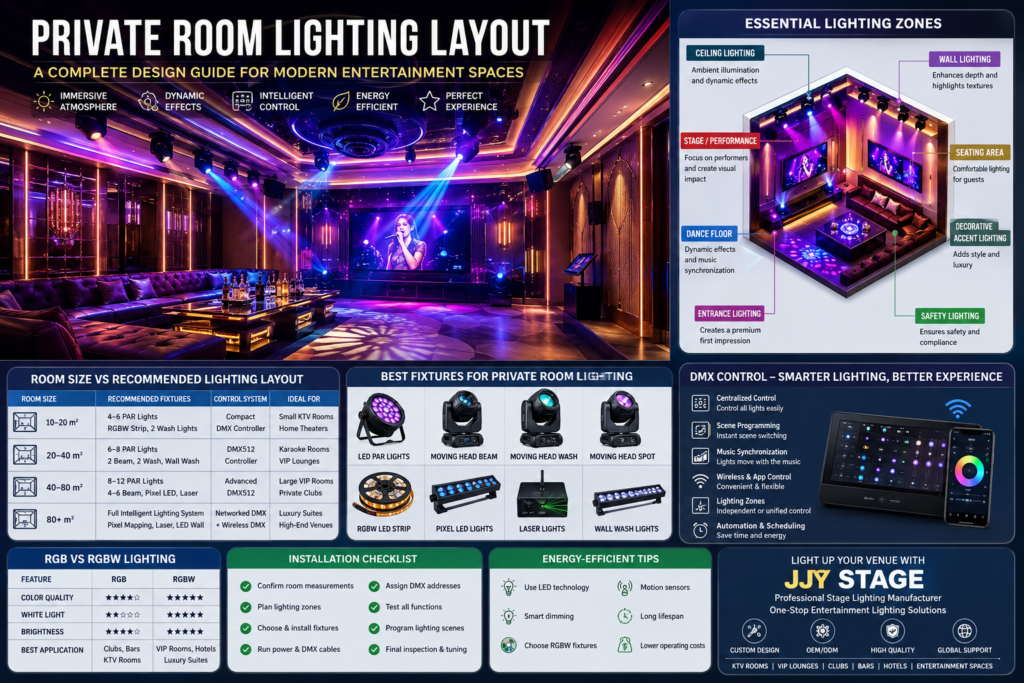
Modern entertainment venues compete on more than sound quality and interior design. The lighting experience has become one of the biggest factors influencing how guests perceive a private room, whether it’s a luxury KTV suite, VIP lounge, karaoke room, hotel entertainment space, private club, gaming room, or home theater. A well-planned private room lighting layout transforms an ordinary room into an immersive environment where lighting reacts to music, enhances décor, and creates memorable experiences.
professional led stage lighting design goes beyond installing a few LED fixtures. It involves planning lighting zones, selecting the right beam angles, positioning fixtures correctly, integrating intelligent DMX512 control systems, and ensuring every lighting element works together seamlessly. From ambient lighting around seating areas to moving head lights over performance stages, each fixture plays a specific role in creating balanced illumination and dynamic visual effects.
Whether you’re building a new entertainment venue or upgrading an existing one, understanding how to design an effective private room lighting layout will help improve customer satisfaction, reduce energy consumption, and increase the flexibility of your venue.
As a professional manufacturer of intelligent entertainment lighting solutions, JJY Stage provides customized lighting systems, DMX-controlled fixtures, OEM/ODM manufacturing, and turnkey solutions for private entertainment projects worldwide.
What Is a Private Room Lighting Layout?
A private room lighting layout is the strategic arrangement of lighting fixtures within an entertainment space to achieve optimal functionality, aesthetics, and atmosphere. Rather than randomly placing lights throughout a room, designers carefully determine where each fixture should be installed, what purpose it serves, and how it interacts with other lighting elements.
An effective lighting layout considers multiple factors, including room dimensions, ceiling height, interior finishes, seating arrangements, performance areas, and customer movement. The goal is to create a layered lighting system that provides flexibility for different activities—from relaxed conversations to energetic karaoke performances.
Unlike traditional residential lighting, entertainment room lighting is designed to be dynamic. Intelligent lighting systems allow venue operators to switch between multiple scenes, synchronize lights with music, and adjust colors and brightness instantly to suit different moods.
The Purpose of Lighting Layout Planning
Planning a lighting layout before installation offers several important advantages:
- Creates balanced illumination throughout the room
- Eliminates dark corners and harsh glare
- Highlights architectural and decorative features
- Supports different entertainment activities
- Improves customer comfort and safety
- Simplifies maintenance and future upgrades
- Maximizes the performance of intelligent lighting systems
Without proper planning, even high-quality lighting fixtures may fail to deliver the desired visual effect.
How Lighting Layout Influences Customer Experience
Lighting directly affects how guests perceive a venue. Warm ambient lighting encourages relaxation, while dynamic RGB effects energize karaoke sessions and dance performances. Properly placed moving head lights can create a professional stage atmosphere, making guests feel like performers instead of spectators.
A thoughtfully designed private room lighting layout also enhances social interaction, improves visibility for service staff, and creates visually appealing environments that guests are more likely to photograph and share on social media.
Why Lighting Layout Matters
Lighting is one of the most powerful design elements in any entertainment venue. A professionally planned layout ensures that every area of the room serves its intended purpose while maintaining visual harmony.
Balanced Illumination
Balanced lighting distributes brightness evenly across the room, preventing areas that are excessively bright or uncomfortably dark. Layered lighting techniques combine ambient, task, and accent lighting to create depth and visual comfort.
Enhanced Visual Appeal
Modern VIP room lighting relies on multiple lighting layers to emphasize architectural details, textured walls, decorative ceilings, and premium furniture. Proper fixture placement helps transform ordinary interiors into luxurious entertainment spaces.
Better Entertainment Experience
Dynamic lighting significantly enhances karaoke performances, DJ sets, gaming experiences, and private parties. Intelligent lighting systems can automatically change colors, beam movements, and brightness levels based on music or pre-programmed scenes.
Benefits include:
- Greater audience engagement
- More immersive performances
- Professional stage atmosphere
- Improved customer satisfaction
- Stronger brand identity
Improved Safety
Entertainment venues often operate in low-light environments, making safety lighting essential. A carefully planned layout ensures that entrances, exits, stairs, and walkways remain visible without disrupting the room’s atmosphere.
Emergency lighting should comply with local building regulations while blending naturally into the overall design.
Energy Efficiency
Modern LED entertainment lighting consumes significantly less electricity than traditional lighting technologies. Combining LED fixtures with intelligent control systems allows operators to reduce energy usage by:
- Dimming unused lighting zones
- Scheduling operating hours
- Activating occupancy-based scenes
- Using programmable lighting presets
Lower energy consumption translates into reduced operating costs over the life of the venue.
Flexible Lighting Scenes
One of the greatest advantages of intelligent lighting systems is flexibility. A single room can support multiple lighting scenes, such as:
| Activity | Recommended Lighting Style |
| Guest Arrival | Warm ambient lighting |
| Karaoke Performance | Dynamic RGB beam effects |
| Birthday Party | Color-changing moving lights |
| Business Meeting | Neutral white lighting |
| Dancing | High-energy moving beams and laser effects |
| Relaxation | Soft indirect ambient lighting |
Scene-based programming allows venue staff to change the room atmosphere instantly without manually adjusting individual fixtures.
Key Factors to Consider Before Designing a Lighting Layout
Every entertainment venue is unique. Before selecting fixtures or creating a lighting layout design, evaluate the following factors to ensure the system meets both functional and aesthetic requirements.
1. Room Dimensions
Room size determines the number, type, and placement of lighting fixtures.
Smaller rooms require fewer fixtures with wider beam angles, while larger entertainment spaces often benefit from multiple lighting zones and a combination of moving head lights, wash lights, and accent lighting.
Accurate room measurements help prevent over-lighting and ensure even illumination.
2. Ceiling Height
Ceiling height has a direct impact on fixture selection and installation.
Low ceilings may limit the use of larger moving head fixtures, making compact LED PAR lights or recessed lighting a better choice. Higher ceilings provide more flexibility for suspended trusses, beam lights, and programmable lighting effects.
General recommendations include:
- 2.5–3 m: Compact LED fixtures and strip lighting
- 3–4 m: Small moving heads and wash lights
- 4 m+: Professional beam lights, spot lights, and suspended lighting systems
3. Interior Design Style
Lighting should complement the overall design rather than compete with it.
For example:
- Luxury VIP lounges benefit from warm indirect lighting and elegant accent fixtures.
- Modern karaoke rooms often feature RGBW LED strips, pixel lighting, and dynamic ceiling effects.
- Industrial-themed clubs may emphasize exposed fixtures and dramatic beam lighting.
Selecting fixtures that match the room’s materials, colors, and architectural details creates a cohesive visual experience.
4. Seating Arrangement
Furniture placement influences how light is distributed throughout the room.
Avoid positioning fixtures directly above seating areas where they may cause glare or discomfort. Instead, use indirect lighting, wall washers, or adjustable wash lights to create a comfortable environment while maintaining sufficient brightness.
5. Stage or Performance Area
If the room includes a performance space, it should be treated as a dedicated lighting zone.
The stage typically requires:
- Focused spot lighting
- Moving head beam fixtures
- Color-changing wash lights
- Dynamic lighting effects synchronized with music
Proper positioning ensures performers remain visible without casting distracting shadows.
6. Audience Capacity
The number of guests influences lighting intensity and fixture quantity.
Larger groups generally require:
- More ambient lighting
- Additional accent lighting
- Wider beam coverage
- Stronger moving light effects
Designing for expected occupancy helps maintain a comfortable and engaging environment.
7. Power Availability
Before selecting fixtures, verify the venue’s electrical capacity.
Consider:
- Total fixture wattage
- Circuit distribution
- Power redundancy
- Future expansion needs
Proper electrical planning prevents overloads and simplifies future upgrades.
8. Budget Planning
A realistic budget helps prioritize investments in high-impact lighting components.
Rather than focusing solely on fixture quantity, allocate funds toward:
- High-quality LED fixtures
- Reliable DMX controllers
- Durable mounting hardware
- Professional installation
- Scalable infrastructure
A well-designed system can often deliver better results with fewer high-performance fixtures than with many low-cost alternatives.
9. Future Expansion
Entertainment venues frequently evolve to meet changing customer expectations.
When designing your private room lighting layout, leave room for:
- Additional DMX universes
- Extra power capacity
- Wireless DMX upgrades
- Pixel lighting installations
- New intelligent fixtures
- Smart automation systems
Planning for expansion minimizes future renovation costs and keeps the venue adaptable to emerging lighting technologies.
Expert Tip: Design your lighting infrastructure with scalability in mind. Installing additional DMX lines, spare power circuits, and flexible mounting points during the initial build is far more cost-effective than retrofitting the system later.
Essential Lighting Zones in a Private Room
A professional private room lighting layout is built around clearly defined lighting zones. Each zone has a specific purpose, and together they create a layered lighting environment that is functional, visually appealing, and adaptable to different entertainment scenarios. Instead of relying on a single bright ceiling light, modern private room lighting combines ambient, accent, task, and dynamic effect lighting to deliver an immersive guest experience.
Below are the essential lighting zones every modern entertainment room should include.
Ceiling Lighting
Ceiling lighting provides the foundation of the entire lighting system. It delivers general illumination while supporting decorative and dynamic lighting effects.
Recommended Fixtures
- LED PAR Lights
- Recessed LED Downlights
- RGB/RGBW Ceiling Lights
- Pixel LED Ceiling Panels
- LED Strip Lights around ceiling coves
Design Tips
- Maintain even spacing between fixtures.
- Avoid creating overly bright hotspots.
- Install RGBW fixtures for both colorful effects and clean white illumination.
- Add indirect LED strip lighting around ceiling edges to create depth.
Best For:
- General room lighting
- Mood creation
- Dynamic scene transitions
- Ambient illumination
Wall Lighting
Wall lighting enhances architectural features while adding depth to the room.
Rather than illuminating the walls evenly, designers often use wall washing techniques to produce soft gradients of color that make the room feel larger and more luxurious.
Recommended Fixtures
- Wall Wash Lights
- LED Wall Grazers
- RGB LED Strip Lights
- Decorative Wall Sconces
Design Tips
- Highlight textured finishes.
- Emphasize decorative wall panels.
- Avoid direct glare toward guests.
- Use programmable color changes for different scenes.
Ideal applications include:
- VIP lounges
- Karaoke rooms
- Hotel entertainment suites
- Luxury clubs
Stage or Performance Area
The performance area is usually the visual centerpiece of a karaoke or KTV room.
This zone requires brighter, more focused lighting that draws attention to performers while creating a professional concert-like atmosphere.
Recommended Fixtures
- Moving Head Beam Lights
- Moving Head Spot Lights
- LED PAR Lights
- Wash Lights
Placement Guide
Install fixtures:
- Above the stage
- On ceiling trusses
- Behind performers
- At front corners for face lighting
Avoid placing bright beam fixtures directly behind singers unless haze effects are used intentionally.
Seating Area
Guests spend most of their time in seating zones, making comfort the highest priority.
Lighting should feel warm and relaxing without becoming too dark.
Recommended Fixtures
- Warm White LED Strip Lights
- Indirect Ceiling Lighting
- Small Wash Lights
- Accent Wall Lights
Good seating lighting should:
- Eliminate harsh shadows
- Prevent glare
- Allow guests to read menus comfortably
- Create a welcoming atmosphere
Dance Floor
If the room includes a dance area, this zone should feature the most dynamic lighting effects.
Unlike seating areas, dance floors benefit from constantly changing movement and color.
Recommended Fixtures
- Moving Head Beam Lights
- Laser Lights
- Pixel LED Lighting
- Strobe Lights
Typical effects include:
- Rotating beams
- Color chases
- Music synchronization
- Dynamic gobos
- Pixel animations
Entrance Lighting
The guest experience begins before entering the room.
An illuminated entrance creates anticipation while reinforcing the venue’s branding.
Recommended Fixtures
- LED Strip Lighting
- Wall Wash Lights
- Logo Projectors
- RGB Entrance Lighting
Good entrance lighting should:
- Clearly identify room numbers
- Highlight architectural features
- Create a premium first impression
Decorative Accent Lighting
Accent lighting adds personality and luxury.
Instead of increasing brightness, accent lighting emphasizes specific design elements.
Examples include:
- Floating shelves
- Decorative ceilings
- Artwork
- Mirrors
- Bar counters
- Display cabinets
Recommended Fixtures
- RGB LED Strip Lights
- Pixel LED Lights
- Mini Spotlights
Emergency and Safety Lighting
Even luxury entertainment venues must prioritize safety.
Emergency lighting should remain functional during power failures while remaining discreet during normal operation.
Include lighting for:
- Emergency exits
- Stairways
- Walkways
- Electrical rooms
Safety lighting should comply with local building regulations and fire safety requirements.
Lighting Zone Diagram (Text Description)
—————————————————-
| Ceiling RGBW |
| PAR Beam Beam PAR |
| |
| Wall Wash Wall Wash |
| |
| Accent LED Seating Area Accent LED |
| |
| |
| Performance / Karaoke Stage |
| Spot Light Singer Spot Light |
| |
| Dance Floor Pixel LED Laser Lights |
| |
| Entrance Lighting Exit Sign |
—————————————————-
This layered arrangement provides balanced illumination while keeping each functional area visually distinct.
Best Lighting Fixtures for Private Room Layouts
Selecting the right fixtures is just as important as determining their placement. A balanced private room lighting layout combines several fixture types to create layered lighting that can adapt to different entertainment scenarios.
LED PAR Lights
LED PAR lights are among the most versatile fixtures in entertainment lighting.
Best Installation Locations
- Ceiling corners
- Stage lighting
- Wall washing
- Ambient lighting
Advantages
- Wide beam coverage
- Low power consumption
- Excellent color mixing
- Long service life
- Minimal maintenance
Best suited for:
- Karaoke rooms
- VIP lounges
- Hotels
- Private clubs
Moving Head Beam Lights
Beam lights create dramatic, narrow light shafts that energize performances.
Best Placement
- Ceiling trusses
- Stage perimeter
- Dance floor corners
Advantages include:
- Sharp beam effects
- Fast movement
- Long projection distance
- Dynamic programming
These fixtures are ideal for creating concert-quality visual effects in KTV room lighting and luxury entertainment spaces.
Moving Head Wash Lights
Wash lights provide soft, even illumination across large areas.
Recommended Uses
- Seating areas
- Stage backlighting
- Wall washing
- Ambient scenes
Unlike beam lights, wash fixtures emphasize smooth color transitions rather than concentrated light.
Moving Head Spot Lights
Spot fixtures project focused beams and gobos, making them perfect for highlighting performers or decorative features.
Common applications include:
- Singer spotlighting
- Logo projection
- Decorative gobos
- Feature lighting
RGB/RGBW LED Strip Lights
LED strips are one of the most cost-effective ways to enhance interior design.
Install Around
- Ceiling coves
- Furniture edges
- Stairs
- Wall panels
- Bar counters
RGBW strips provide superior white light while maintaining vibrant color effects.
Pixel LED Lights
Pixel lighting gives designers complete control over individual LED segments.
Popular effects include:
- Running animations
- Wave patterns
- Color chases
- Interactive lighting
Pixel LEDs are increasingly used in premium entertainment room lighting projects because they deliver highly customized visual experiences.
Laser Lights
Laser fixtures produce striking aerial effects when combined with haze or fog.
Best installed above:
- Dance floors
- Performance stages
Avoid directing laser beams toward seating areas or eye level.
Wall Wash Lights
Wall wash fixtures spread light evenly across vertical surfaces.
Applications include:
- Decorative walls
- Stone finishes
- Acoustic panels
- Textured surfaces
These fixtures create a premium atmosphere while visually enlarging the room.
Strobe Lights
Strobes deliver high-energy flashes during concerts, DJ performances, and dance scenes.
Use them selectively to avoid guest discomfort.
Ideal for:
- Dance breaks
- Live performances
- Music climaxes
Fixture Placement Guide
| Fixture Type | Best Location | Primary Function |
| LED PAR Lights | Ceiling, stage | Ambient & wash lighting |
| Moving Head Beam | Ceiling corners, truss | Dynamic beam effects |
| Moving Head Wash | Ceiling perimeter | Smooth color coverage |
| Moving Head Spot | Stage | Performer highlighting |
| RGBW LED Strip | Ceiling coves, furniture | Decorative ambient lighting |
| Pixel LED | Walls, ceiling | Animated lighting effects |
| Laser Lights | Dance floor | Aerial visual effects |
| Wall Wash Lights | Side walls | Accent lighting |
| Strobe Lights | Stage & dance area | High-energy effects |
How to Design a Lighting Layout Based on Room Size
Every entertainment room requires a different lighting strategy. The number of fixtures, beam angles, lighting zones, and DMX programming should be scaled according to the room’s dimensions.
Small Private Rooms (10–20 m²)
Recommended Layout
- 4–6 LED PAR Lights
- RGBW LED Strip Lighting
- 1–2 Small Moving Head Wash Lights
- Compact DMX Controller
Focus on ambient lighting while avoiding excessive brightness.
Medium Entertainment Rooms (20–40 m²)
Recommended fixtures include:
- 6–8 LED PAR Lights
- 2 Beam Lights
- 2 Wash Lights
- RGBW Ceiling Strips
- Wall Wash Lighting
- Basic Pixel Lighting
These rooms benefit from multiple lighting zones and scene presets for karaoke, dining, and parties.
Large VIP Rooms (40–80 m²)
Typical layout:
- 8–12 LED PAR Lights
- 4–6 Moving Head Beam Lights
- 4 Wash Lights
- Pixel LED Ceiling Effects
- Laser Lighting
- Advanced DMX512 Controller
The larger space allows for more dramatic beam movements and layered visual effects.
Luxury Entertainment Suites (80 m²+)
High-end entertainment suites often include:
- Professional Moving Head Fixtures
- RGBW Architectural Lighting
- Full Pixel Mapping
- Laser Systems
- Interactive LED Floors
- Wireless DMX
- Intelligent Scene Automation
- Mobile App Control
These installations are designed to deliver a fully immersive entertainment experience with maximum flexibility.
Room Size vs Recommended Lighting Layout
| Room Size | Recommended Fixtures | Control System |
| 10–20 m² | 4–6 PAR Lights, RGBW Strips, 2 Wash Lights | Compact DMX Controller |
| 20–40 m² | 6–8 PAR Lights, 2 Beam, 2 Wash, Wall Wash | DMX512 Controller |
| 40–80 m² | 8–12 PAR, 4–6 Beam, Pixel LED, Laser | Advanced DMX512 |
| 80+ m² | Full Intelligent Lighting System | Networked DMX + Wireless DMX |
RGB vs RGBW Lighting in Room Layout Design
Selecting between RGB and RGBW lighting affects color accuracy, atmosphere, and flexibility within your private room lighting layout.
| Feature | RGB Lighting | RGBW Lighting |
| Color Mixing | Excellent | Excellent |
| Pure White Light | Limited | Outstanding |
| Brightness | High | Higher with white channel |
| Energy Efficiency | Very Good | Excellent |
| Mood Lighting | Excellent | Excellent |
| Decorative Effects | Excellent | Excellent |
| Hospitality Applications | Good | Excellent |
| Luxury VIP Rooms | Good | Highly Recommended |
| Best Use | Clubs, karaoke rooms | VIP lounges, hotels, luxury entertainment suites |
Expert Tip: RGBW fixtures are often the preferred choice for premium entertainment venues because the dedicated white LED produces cleaner, more natural illumination for conversations, dining, and maintenance while still delivering vibrant color effects for performances.
Why DMX Controllers Improve Lighting Layouts
A professionally designed private room lighting layout becomes far more powerful when paired with an intelligent DMX512 control system. Instead of operating each fixture individually, DMX allows venue operators to control every compatible light from a single interface, creating synchronized lighting scenes, automated effects, and seamless transitions.
For KTV venues, VIP lounges, karaoke rooms, and private clubs, DMX control is no longer a luxury—it is the industry standard for delivering dynamic and immersive entertainment experiences.
What Is DMX512?
DMX512 (Digital Multiplex) is the most widely used communication protocol for professional entertainment lighting. It enables a controller to send commands to multiple lighting fixtures over a single data cable, ensuring precise control of color, brightness, movement, strobe speed, gobos, and other effects.
Key Benefits of DMX512
- Centralized control of all lighting fixtures
- Smooth color transitions and dimming
- Synchronized moving head effects
- Programmable lighting scenes
- Easy expansion for future fixtures
- Reliable communication across multiple devices
Scene Programming
Pre-programmed lighting scenes allow operators to switch the room’s atmosphere instantly.
Common scenes include:
| Scene | Lighting Effect |
| Guest Welcome | Warm white ambient lighting |
| Karaoke Mode | Color-changing wash lights with moving beams |
| Birthday Celebration | Dynamic RGB animations and strobes |
| Dance Party | Beam lights, lasers, and music synchronization |
| Relax Mode | Soft indirect lighting with reduced brightness |
| Cleaning Mode | Bright white lighting for maintenance |
Programming scenes saves time, ensures consistency, and enhances the guest experience.
Music Synchronization
Modern intelligent lighting systems can synchronize effects with music using built-in microphones, audio processors, or software integration.
Popular synchronized effects include:
- Color chasing
- Beam movement
- Pulse dimming
- Pixel animations
- Strobe bursts during musical climaxes
Music-synchronized lighting creates a more engaging and immersive entertainment environment.
Wireless DMX
Wireless DMX technology eliminates the need for long data cables between fixtures and controllers, making installations cleaner and more flexible.
Advantages include:
- Faster installation
- Easier venue renovations
- Reduced cable clutter
- Simplified maintenance
- Greater flexibility for temporary setups
Mobile App Control
Many modern DMX systems support smartphone or tablet control, allowing venue staff to:
- Change lighting scenes remotely
- Adjust brightness and colors
- Trigger special effects
- Monitor fixture status
- Schedule automatic lighting programs
Lighting Zones
One of DMX’s greatest strengths is its ability to divide a room into independent lighting zones.
For example:
- Ceiling lighting
- Stage lighting
- Seating area
- Dance floor
- Wall lighting
- Entrance lighting
Each zone can operate independently or as part of a synchronized show, giving operators maximum creative flexibility.
Smart Entertainment Systems
Today’s intelligent lighting systems integrate with:
- Audio systems
- Video displays
- Automation platforms
- Touch panels
- Mobile applications
- Cloud-based management systems
This integration enables fully automated entertainment environments that require minimal manual operation.
Expert Tip: Choose a DMX controller with extra channel capacity to accommodate future lighting upgrades without replacing the control system.
Common Private Room Lighting Layout Mistakes
Even high-quality lighting fixtures can underperform if the layout is poorly planned. Avoiding these common mistakes will improve performance, aesthetics, and long-term reliability.
1. Uneven Lighting
Problem
Some areas are overly bright while others remain too dark.
Solution
Use layered lighting and distribute fixtures evenly across the room.
2. Poor Fixture Spacing
Problem
Fixtures installed too close together create hotspots, while excessive spacing leaves visible dark areas.
Solution
Follow manufacturer-recommended spacing based on beam angle and mounting height.
3. Incorrect Beam Angles
Problem
Narrow beams may not provide adequate coverage, while overly wide beams reduce visual impact.
Solution
Select beam angles according to the function of each lighting zone:
- Narrow beams for stages
- Wide washes for seating
- Medium beams for general effects
4. Over-Lighting
Problem
Too many fixtures can overwhelm guests, increase power consumption, and reduce the impact of dynamic effects.
Solution
Focus on quality fixture placement instead of quantity.
5. Under-Lighting
Problem
Insufficient lighting creates an uncomfortable environment and limits fixture performance.
Solution
Ensure every functional zone has appropriate ambient and accent lighting.
6. Ignoring Lighting Layers
Problem
Using only ceiling lighting results in a flat and uninspiring atmosphere.
Solution
Combine:
- Ambient lighting
- Accent lighting
- Task lighting
- Dynamic entertainment lighting
This layered approach creates depth and visual interest.
7. Weak Cable Management
Problem
Visible or disorganized cables detract from the room’s appearance and complicate maintenance.
Solution
- Route cables through conduits or cable trays
- Label all DMX and power cables
- Separate data and power lines where possible
- Leave service loops for future maintenance
8. Choosing the Wrong Controller
Problem
A controller with insufficient channels or limited programming capabilities restricts future expansion.
Solution
Select a scalable DMX controller that supports additional fixtures and advanced scene programming.
Installation Best Practices
A carefully planned installation ensures reliable operation, easier maintenance, and consistent lighting performance.
Fixture Positioning
- Aim fixtures to avoid direct glare.
- Balance beam coverage across all zones.
- Test sightlines from different seating positions.
- Leave adequate clearance for fixture movement.
Mounting Methods
Use professional mounting hardware suitable for the fixture’s weight and installation location.
Common mounting options include:
- Ceiling brackets
- Trusses
- Wall brackets
- Recessed mounts
- Suspension systems
Cable Management
Organized cabling improves safety and simplifies troubleshooting.
Best practices:
- Label every cable
- Bundle cables neatly
- Protect cables from physical damage
- Avoid sharp bends
Ventilation
Entertainment lighting fixtures generate heat.
Provide adequate airflow around fixtures to:
- Prevent overheating
- Extend LED lifespan
- Maintain consistent performance
DMX Wiring
Reliable DMX communication depends on proper wiring.
Recommendations:
- Use high-quality DMX cables
- Avoid excessive cable lengths
- Install DMX terminators where required
- Test communication before opening the venue
Electrical Safety
Ensure:
- Correct circuit protection
- Proper grounding
- Compliance with local electrical codes
- Qualified installation personnel
Testing
Before opening the venue:
- Test every lighting scene
- Verify DMX addresses
- Check moving head calibration
- Inspect color consistency
- Confirm emergency lighting functionality
Maintenance
Routine maintenance helps preserve lighting performance.
Recommended tasks:
- Clean fixture lenses
- Check mounting hardware
- Update controller software
- Inspect electrical connections
- Replace damaged cables promptly
Installation Checklist
✅ Confirm room measurements
✅ Verify power capacity
✅ Install mounting hardware securely
✅ Label all power and DMX cables
✅ Assign DMX addresses
✅ Test fixture movement
✅ Program lighting scenes
✅ Check emergency lighting
✅ Verify ventilation
✅ Perform final system inspection
Energy-Efficient Lighting Design Tips
Energy efficiency reduces operating costs while supporting sustainable venue management.
Use LED Technology
Modern LED fixtures consume significantly less power than traditional lighting while providing excellent brightness and color quality.
Smart Dimming
Reduce power consumption by dimming fixtures when full output is unnecessary.
Choose RGBW Fixtures
RGBW fixtures often deliver better efficiency for applications requiring both colored and white lighting.
Motion Sensors
Install sensors in low-traffic areas such as corridors or storage rooms to automatically switch lights on and off.
Long-Life Components
High-quality LED fixtures typically offer operational lifespans of 30,000–50,000 hours, reducing maintenance and replacement costs.
Sustainable Lighting Design
Consider:
- Low-power fixtures
- Recyclable materials
- Intelligent scheduling
- Automated shutdown during idle periods
These practices lower operating expenses and support environmentally responsible venue operation.
Future Trends in Private Room Lighting Layout
Entertainment lighting continues to evolve rapidly, offering new opportunities for immersive guest experiences.
AI-Powered Lighting
Artificial intelligence can analyze music, occupancy, and user preferences to automatically adjust lighting scenes in real time.
Wireless DMX
Wireless systems are becoming more reliable, enabling faster installation and easier venue upgrades.
Interactive Lighting
Motion sensors, touch controls, and gesture recognition allow guests to interact with lighting effects, creating personalized experiences.
Pixel Mapping
Advanced pixel mapping gives designers precise control over individual LEDs, enabling intricate animations and synchronized visual displays.
Projection Integration
Combining projection mapping with programmable lighting creates immersive environments ideal for luxury entertainment venues.
IoT-Enabled Lighting
Internet of Things (IoT) technology enables remote monitoring, diagnostics, and maintenance of lighting systems through connected devices.
Cloud-Based Lighting Control
Cloud platforms allow venue operators to:
- Manage multiple locations
- Update lighting scenes remotely
- Monitor system performance
- Schedule automated programs
As these technologies mature, private entertainment spaces will become more intelligent, efficient, and engaging.
Frequently Asked Questions (FAQ)
1. What is a private room lighting layout?
A private room lighting layout is a planned arrangement of lighting fixtures, lighting zones, and control systems designed to provide balanced illumination, visual appeal, and flexible lighting scenes for entertainment spaces.
2. How do I design a VIP room lighting layout?
Start by measuring the room, defining functional zones, selecting suitable LED fixtures, planning fixture placement, and integrating a DMX512 control system for programmable lighting.
3. How many lights does a private room need?
The number depends on room size, ceiling height, and intended use. Small rooms may require 6–10 fixtures, while luxury entertainment suites often include 20 or more intelligent lighting fixtures.
4. Where should moving head lights be installed?
Moving head lights are typically mounted on ceilings, trusses, or stage perimeters where they have sufficient clearance for movement and optimal beam coverage.
5. Should I choose RGB or RGBW lighting?
RGB lighting is excellent for vibrant color effects, while RGBW lighting includes a dedicated white LED that produces cleaner white light, making it the preferred choice for premium entertainment venues.
6. Why is DMX important?
DMX enables centralized control, scene programming, music synchronization, automation, and synchronized operation of multiple lighting fixtures.
7. What is the ideal ceiling height for entertainment lighting?
Ceilings between 3 and 4 meters offer good flexibility for intelligent lighting. Higher ceilings can accommodate larger moving head fixtures and more dramatic beam effects.
8. How much does a private room lighting system cost?
Costs vary depending on room size, fixture quality, control systems, and installation complexity. A professional design helps maximize value and avoid unnecessary expenses.
9. Are LED lights energy-efficient?
Yes. LED entertainment lighting consumes less electricity, generates less heat, and typically lasts much longer than conventional lighting technologies.
10. How do I choose the right lighting fixtures?
Consider room dimensions, ceiling height, intended activities, desired atmosphere, control requirements, and future expansion plans. A combination of LED PAR lights, moving heads, wash lights, RGBW strips, and intelligent DMX control often provides the best results.
Conclusion
A thoughtfully planned private room lighting layout is the foundation of a memorable entertainment experience. By dividing the room into functional lighting zones, selecting the right combination of LED PAR lights, moving head beam and wash fixtures, RGBW strip lighting, pixel LEDs, and intelligent DMX512 control systems, venue owners can create spaces that are visually stunning, flexible, and energy-efficient.
Whether you are designing a compact karaoke room, a premium VIP lounge, a private club, or a luxury entertainment suite, investing in professional lighting design enhances guest satisfaction, supports efficient operations, and future-proofs your venue for emerging smart lighting technologies.
Transform Your Entertainment Space with JJY Stage
Looking for a customized private room lighting layout tailored to your venue?
JJY Stage specializes in intelligent entertainment lighting solutions for KTV rooms, karaoke venues, VIP lounges, hotels, bars, private clubs, and commercial entertainment projects worldwide. Our team provides customized lighting layouts, advanced DMX control systems, OEM/ODM manufacturing, and complete turnkey lighting solutions designed to match your project’s unique requirements.
Contact JJY Stage today to discuss your next entertainment lighting project and discover how our professional expertise can help you create an immersive, high-performance lighting environment that leaves a lasting impression.