
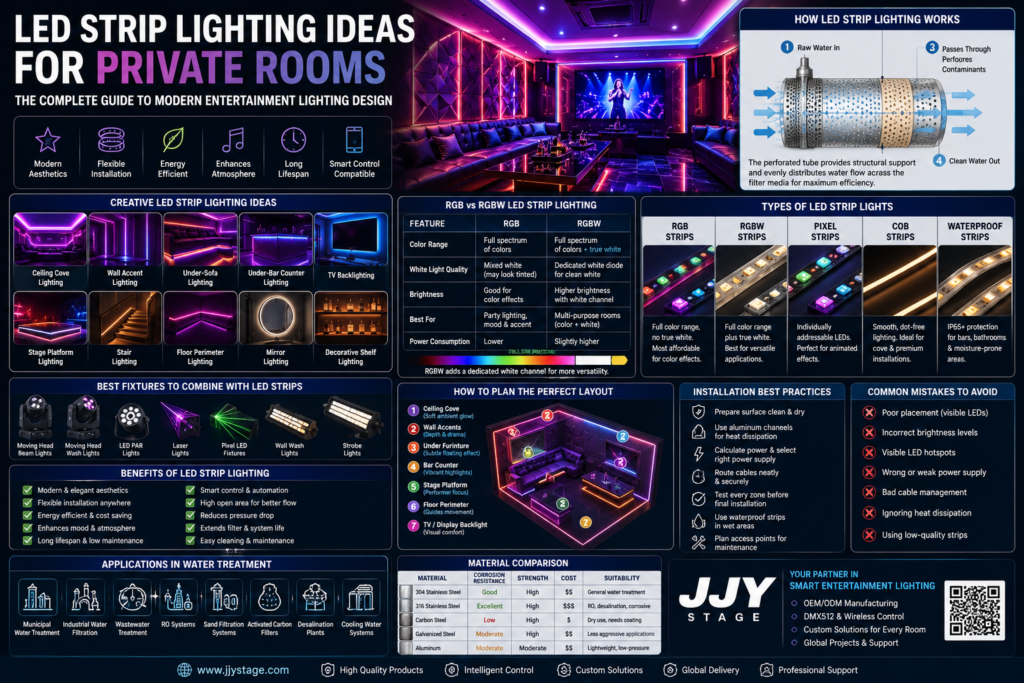
A private room lives or dies on its atmosphere, and lighting is the single biggest factor in creating it. Whether you’re designing a KTV suite, a VIP lounge, a home theater, or a luxury gaming room, the right LED strip lighting ideas for private rooms can turn a flat, generic space into an immersive entertainment experience.
At JJY Stage, we design and manufacture LED strip lighting and intelligent entertainment lighting systems for venues around the world, from boutique karaoke rooms to full-scale nightclubs. This guide walks through practical LED strip lighting ideas for private rooms, covering layout planning, RGB vs RGBW technology, DMX integration, installation best practices, and the fixtures that pair best with strip lighting to build a complete, professional lighting design.
A successful entertainment venue starts with professional private room lighting that balances ambiance, functionality, and visual impact. From KTV rooms and VIP lounges to karaoke spaces and private clubs, the right lighting design enhances guest experiences, improves energy efficiency, and creates dynamic atmospheres. Learn more in our comprehensive guide: Professional Private Room Lighting the Complete Guide to Entertainment Lighting Solutions.
Why LED Strip Lighting Is Perfect for Private Rooms
Modern aesthetics. Thin, flexible, and nearly invisible when installed correctly, LED strips create clean architectural lines and glowing accents that instantly elevate a room’s design language.
Flexible installation. Strips can be cut, bent, and mounted along almost any surface — ceilings, walls, furniture edges, stairs — making them adaptable to rooms of any shape or size.
Energy efficiency. LED technology consumes significantly less power than traditional lighting while producing comparable or greater brightness, reducing long-term operating costs for venues running lighting for hours every night.
Mood enhancement. Color-changing and dimmable strips let operators shift a room’s atmosphere instantly, from energetic party lighting to relaxed, intimate ambiance.
Long lifespan. Quality LED strips are rated for tens of thousands of hours of operation, far outlasting incandescent or fluorescent alternatives.
Low maintenance. With no filaments to burn out and minimal heat output when properly installed, LED strips require far less ongoing maintenance than legacy lighting systems.
Smart lighting compatibility. Modern LED strips integrate directly with DMX controllers, mobile apps, and voice assistants, giving venue operators precise control over scenes, colors, and timing.
Choosing the Right LED Strip Lights
Not all LED strips are built the same, and choosing the wrong type is one of the most common design mistakes in private room lighting.
RGB LED strips produce a full range of colors by combining red, green, and blue diodes, making them ideal for dynamic, colorful entertainment lighting.
RGBW LED strips add a dedicated white diode, allowing the strip to produce true white light alongside color — useful for rooms that need both functional white lighting and colorful accents.
Pixel LED strips feature individually addressable LEDs, enabling chasing effects, gradients, and animations often used in stage-style or high-end VIP room designs.
COB (Chip-on-Board) LED strips pack diodes tightly together for a smooth, dot-free glow, well suited to cove and accent lighting where a seamless line of light is the goal.
Waterproof vs non-waterproof strips matter for placement — bar counters, bathrooms, and outdoor-adjacent areas need IP65-rated or higher strips, while dry indoor cove or ceiling lighting can typically use non-waterproof strips.
Brightness levels, measured in lumens per meter, should be matched to the strip’s purpose — higher brightness for functional task areas, lower brightness for ambient accent lighting.
Color temperature, measured in Kelvin, determines whether white light output feels warm and cozy (2700–3000K) or cool and energetic (4000K+).
CRI (Color Rendering Index) measures how accurately a light source renders colors compared to natural light — a higher CRI (90+) is important in areas where guests apply makeup, read menus, or want true-to-life color rendering.
LED strip type comparison:
| Strip Type | Color Output | Best For | Notes |
| RGB | Full color range, no true white | Colorful accent and mood lighting | Most affordable dynamic option |
| RGBW | Full color range + true white | Multi-purpose rooms needing both function and mood | Slightly higher cost than RGB |
| Pixel | Individually addressable color | Animated effects, gradients, stage-style displays | Requires a pixel-compatible controller |
| COB | Smooth, seamless glow | Cove lighting, high-end accent lines | Higher LED density, higher cost |
Creative LED Strip Lighting Ideas for Private Rooms
Ceiling Cove Lighting
Recessed into a ceiling perimeter channel, cove lighting creates a soft glow that washes upward or downward without visible fixtures, giving KTV rooms and VIP lounges a floating, luxurious ceiling effect.
Wall Accent Lighting
Vertical or horizontal strips mounted behind wall panels or along architectural features add depth and drama, especially effective behind feature walls in private club rooms.
Under-Sofa Lighting
A hidden strip beneath sofa or booth seating creates a low, ambient glow that makes furniture appear to float — a favorite technique in modern KTV and lounge design.
Under-Bar Counter Lighting
Waterproof RGB or RGBW strips beneath a bar counter’s edge add a vibrant, color-changing glow that makes the bar a visual focal point in VIP and private club rooms.
TV and Display Backlighting
Strips mounted behind a television or display screen reduce eye strain and add a cinematic glow, popular in home theaters and karaoke rooms with large display screens.
Stage Platform Lighting
Strips embedded along the edge of a karaoke or performance stage highlight the platform and draw attention to performers, a signature feature in KTV room design.
Stair Lighting
LED strips installed along stair treads or under handrails improve safety while adding a sleek, modern accent — particularly effective in multi-level lounges and clubs.
Floor Perimeter Lighting
A low strip running along the base of walls creates a soft glow across the floor, useful for guiding movement in dim, entertainment-focused private rooms.
Mirror Lighting
Strips framing mirrors in VIP restrooms or private room vanity areas provide flattering, even illumination while reinforcing the venue’s premium aesthetic.
Decorative Shelf Lighting
Strips tucked beneath display shelves highlight bottles, decor, or awards, adding a retail-quality showcase effect to bars and lounge shelving.
RGB vs RGBW LED Strip Lighting
Choosing between RGB and RGBW is one of the most common decisions in private room LED lighting design, and the right answer depends on how the room will be used.
| Feature | RGB | RGBW |
| Color Range | Full spectrum of colors | Full spectrum of colors plus true white |
| White Light Quality | Produced by mixing RGB channels (can appear tinted) | Dedicated white diode produces clean, accurate white |
| Brightness | Strong for color effects | Higher overall brightness when white channel is used |
| Energy Efficiency | Efficient for color-only use | Slightly higher power draw due to added white diode |
| Best Applications | Party lighting, accent walls, mood-focused spaces | Multi-purpose rooms needing both white task lighting and color effects |
For rooms used purely for colorful ambiance — dance floors, accent walls, party zones — RGB is often sufficient and more cost-effective. For rooms that also need functional white lighting, such as KTV rooms used for dining as well as entertainment, RGBW is generally the better long-term investment.
How to Plan an LED Strip Lighting Layout
Room size determines how many lighting zones are needed and how much total strip length a design requires larger rooms benefit from multiple independently controlled zones rather than one continuous run.
Ceiling height affects how cove lighting reads visually; higher ceilings can support deeper cove channels and more dramatic uplighting.
Furniture placement should be finalized before installation, since under-sofa, under-bar, and shelf lighting all depend on exact furniture positioning.
Lighting zones such as entrance, seating, stage, and bar areas — should each be independently controllable to allow different moods within the same room.
Accent lighting highlights architectural features and focal points, while ambient lighting provides the room’s base illumination level.
Entertainment areas, like a KTV stage or dance floor, typically need brighter, more dynamic lighting than seating or lounge zones.
Hidden lighting techniques recessed channels, routed grooves, and behind-panel mounting keep the light source invisible so only the glow is visible, which is the hallmark of professional-grade design.
Room size vs. recommended layout:
| Room Size | Suggested Zones | Recommended Strip Approach |
| Small (under 200 sq ft) | 2–3 zones (ceiling, accent, furniture) | Single controller, RGB or RGBW strip throughout |
| Medium (200–500 sq ft) | 4–5 zones (ceiling, wall, bar, stage, floor) | Multi-zone DMX control, mix of RGB/RGBW and pixel strips |
| Large (500+ sq ft) | 6+ zones with layered fixtures | Full DMX512 system with pixel mapping and moving fixtures |
Layout planning checklist:
- [ ] Measure room dimensions and ceiling height
- [ ] Finalize furniture and stage placement
- [ ] Identify distinct lighting zones
- [ ] Choose strip type per zone (RGB, RGBW, pixel, COB)
- [ ] Plan hidden channel or recess locations
- [ ] Confirm power supply capacity per zone
- [ ] Select a compatible controller for the full layout
Integrating LED Strip Lights with DMX Controllers
DMX512 is the industry-standard protocol for controlling professional lighting, allowing multiple fixtures including LED strips to be addressed and controlled from a single console or controller.
Smart controllers let operators create, save, and recall custom lighting scenes, an essential feature for venues that switch between different moods throughout a night.
Wireless DMX removes the need for extensive control cabling, simplifying installation in renovated or existing rooms where running new wiring is difficult.
Music synchronization allows LED strips to pulse, chase, or change color in time with audio input, a signature feature in KTV rooms and dance-focused private spaces.
Scene programming lets designers pre-set combinations of color, brightness, and effect for different times of day or types of events.
Mobile app control gives venue staff the ability to adjust lighting from a tablet or smartphone without needing to access a physical console.
Voice control integration allows simple commands to adjust lighting in smaller private rooms or home entertainment spaces.
Automation — such as scheduled scene changes or motion-triggered lighting — reduces the need for manual adjustment during operating hours.
Practical example: A KTV room might run a warm, dim ambient scene during quiet dining hours, then switch either manually or via a scheduled DMX cue to a high-energy, music-synchronized RGB scene once guests begin singing and dancing.
Best Fixtures to Combine with LED Strip Lights
LED strips excel at ambient and accent lighting, but layering them with dedicated fixtures creates a more dynamic, professional-grade entertainment space.
Moving Head Beam Lights add sharp, focused beams that sweep across a room, ideal for high-energy moments in KTV and club-style private rooms.
Moving Head Wash Lights flood a space with broad, even color coverage, useful for filling a room with vibrant background color that complements strip lighting.
LED PAR Lights provide strong, directional color washes and are commonly used to uplight walls or highlight stage areas alongside strip lighting.
Laser Lights add sharp, graphic patterns for high-energy entertainment moments, often used sparingly in VIP rooms and clubs for special effect moments.
Pixel LED Fixtures extend the pixel-mapped animation effects of pixel strips into three-dimensional fixtures, creating cohesive animated lighting displays.
Wall Wash Lights provide even, broad illumination across large wall surfaces, often used to complement or extend wall accent strip lighting.
Strobe Lights deliver high-impact flash effects for peak entertainment moments, typically used briefly rather than continuously.
Layering these fixtures with LED strips rather than relying on strips alone is what separates a professionally designed entertainment room from a basic DIY installation.
Common LED Strip Lighting Mistakes
Poor placement mounting strips where the light source itself is visible rather than hidden undermines the clean, professional look strip lighting is meant to achieve. Solution: always plan for a recessed channel, groove, or behind-panel mount.
Incorrect brightness either too dim to have visual impact or too bright to be comfortable is a common oversight. Solution: match lumens per meter to the zone’s purpose and pair with a dimmable controller.
Visible LED hotspots occur when individual diodes are visible as distinct points of light rather than a smooth line. Solution: use a diffuser cover or a higher-density COB strip for areas viewed up close.
Wrong power supply undersized or incompatible with the strip’s voltage and current draw leads to dim output or premature failure. Solution: calculate total wattage needs before selecting a power supply (see calculation example below).
Weak cable management creates both a safety hazard and a visual distraction in an otherwise polished room. Solution: route and secure cabling within channels or behind finished surfaces during installation.
Ignoring heat dissipation shortens LED lifespan significantly, especially in enclosed channels. Solution: use aluminum channels, which double as heat sinks, particularly for high-density or COB strips.
Choosing low-quality strips often results in color inconsistency, early failure, and flickering. Solution: source strips from a reputable manufacturer with documented specifications and quality control.
Installation Best Practices
Surface preparation clean, dry, and smooth surfaces ensures adhesive backing bonds properly and strips stay securely mounted over time.
Aluminum channels protect the strip, improve heat dissipation, and give installations a clean, finished edge, especially in cove and accent applications.
Cable routing should be planned before installation begins, with clear paths from each strip to its power supply and controller.
Power calculations must account for total strip length, LEDs per meter, and wattage per meter to avoid overloading a power supply or circuit.
Controller placement should allow easy access for programming and maintenance while keeping wiring runs as short as practical.
Waterproofing is essential for any strip placed near bars, sinks, or areas exposed to moisture or cleaning liquids.
Testing every zone before final assembly (before walls or furniture are permanently closed up) prevents costly rework if a strip or connection fails.
Maintenance access points should be built into the design so strips can be inspected or replaced without major reconstruction.
Power calculation example: A 5-meter run of RGB strip rated at 14.4W per meter requires approximately 72W of power (5m × 14.4W). Adding a 20% safety margin for driver efficiency and longevity, a 90W-rated power supply would be an appropriate choice for that zone.
Installation checklist:
- [ ] Confirm surface is clean and dry
- [ ] Install aluminum channels where applicable
- [ ] Calculate total wattage and select correct power supply
- [ ] Route and secure all cabling
- [ ] Mount controller in an accessible location
- [ ] Apply waterproof strips in moisture-prone zones
- [ ] Test every zone before finishing surfaces
- [ ] Document layout and wiring for future maintenance
Energy-Efficient LED Strip Lighting
LED efficiency means significantly lower energy consumption per lumen compared to incandescent or halogen lighting, an important factor for venues running lighting systems for extended hours nightly.
Smart dimming further reduces energy use during lower-traffic periods without sacrificing the room’s atmosphere.
Long lifespan reduces the frequency and cost of replacement, lowering both material waste and labor costs over time.
Lower maintenance requirements translate directly into reduced operating expenses for venue owners.
Sustainable lighting design, using efficient LEDs and smart controls, aligns with growing guest and regulatory expectations around energy responsibility.
Reduced electricity costs compound over the lifespan of a well-designed LED lighting system, often paying back the initial investment within a few years of operation.
Future Trends in LED Strip Lighting
Smart LED strips with built-in Wi-Fi or Bluetooth connectivity are increasingly standard, simplifying setup and control.
AI-powered lighting systems are beginning to adjust color, brightness, and scene selection automatically based on time of day, occupancy, or even music tempo.
Pixel mapping is expanding beyond stage design into private room lighting, enabling increasingly sophisticated animated effects.
Wireless control continues to reduce installation complexity, particularly valuable for renovation projects in existing venues.
IoT integration connects lighting systems with broader venue management platforms, from HVAC to audio systems.
Interactive lighting responding to guest movement or touch is emerging in high-end VIP and experiential venue design.
Dynamic lighting scenes that shift gradually throughout an evening are replacing static, single-setting installations.
Human-centric lighting, which adjusts color temperature to support circadian rhythms, is beginning to influence hospitality and entertainment lighting design.
Frequently Asked Questions (FAQ)
What are the best LED strip lighting ideas for private rooms?
Ceiling cove lighting, wall accent lighting, under-furniture lighting, and stage or bar highlighting are among the most effective LED strip lighting ideas for private rooms, each contributing to a layered, immersive atmosphere.
Should I choose RGB or RGBW LED strips?
Choose RGB for spaces focused purely on colorful mood lighting, and RGBW for multi-purpose rooms that also need clean, functional white light.
Can LED strip lights sync with music?
Yes. When paired with a compatible DMX or smart controller, LED strips can pulse, chase, and change color in sync with audio input.
Are LED strip lights energy-efficient?
Yes. LED strips use significantly less energy than traditional lighting while offering long lifespans and compatibility with smart dimming controls.
How do I install LED strip lights?
Installation typically involves preparing the mounting surface, installing aluminum channels, routing cabling, connecting an appropriately sized power supply, and testing each zone before finishing the space.
Do I need a DMX controller?
A DMX controller isn’t strictly required for simple installations, but it’s recommended for any private room with multiple lighting zones, music synchronization, or scene programming needs.
What is the best brightness for entertainment rooms?
Brightness should vary by zone — ambient and accent areas typically use lower brightness, while stage and functional task areas need higher output, all ideally on dimmable controls.
Can LED strips be hidden?
Yes. Recessed channels, routed grooves, and behind-panel mounting are standard techniques for hiding the light source so only the glow is visible.
How long do LED strip lights last?
Quality LED strips are typically rated for 30,000 to 50,000+ hours of operation, though actual lifespan depends on strip quality, heat management, and usage patterns.
What power supply do LED strip lights require?
Power requirements depend on strip length and wattage per meter; total wattage should be calculated per zone, with a safety margin added when selecting the power supply.
Are waterproof LED strips necessary?
Waterproof strips are necessary in any area exposed to moisture, spills, or cleaning liquids, such as bar counters or bathroom mirror lighting, but aren’t required for dry indoor cove or ceiling applications.
How do I maintain LED strip lighting?
Routine maintenance includes periodic inspection for loose connections or discoloration, gentle cleaning of dust buildup, and prompt replacement of any failing sections to prevent uneven lighting.
Conclusion
LED strip lighting remains one of the most versatile and effective tools available for designing private entertainment rooms, offering the flexibility to create everything from soft, intimate ambiance to high-energy, music-synchronized party lighting. But great results depend on thoughtful layout planning, the right combination of RGB, RGBW, pixel, or COB strips, intelligent DMX control, and quality installation.
Whether you’re designing a single KTV room or outfitting an entire entertainment venue, getting these details right from LED lighting for private rooms through to fixture layering and system integration is what separates an average space from a truly immersive one.
JJY Stage designs and manufactures professional LED strip lighting, DMX control solutions, and complete entertainment lighting systems for KTV rooms, VIP lounges, hotels, clubs, and luxury private spaces worldwide. As an OEM/ODM manufacturer, we work directly with venue owners, architects, interior designers, and AV integrators to deliver customized, turnkey lighting solutions built to spec. Contact JJY Stage today to discuss your private room lighting project and discover how our LED strip lighting and intelligent entertainment lighting systems can bring your design vision to life.