
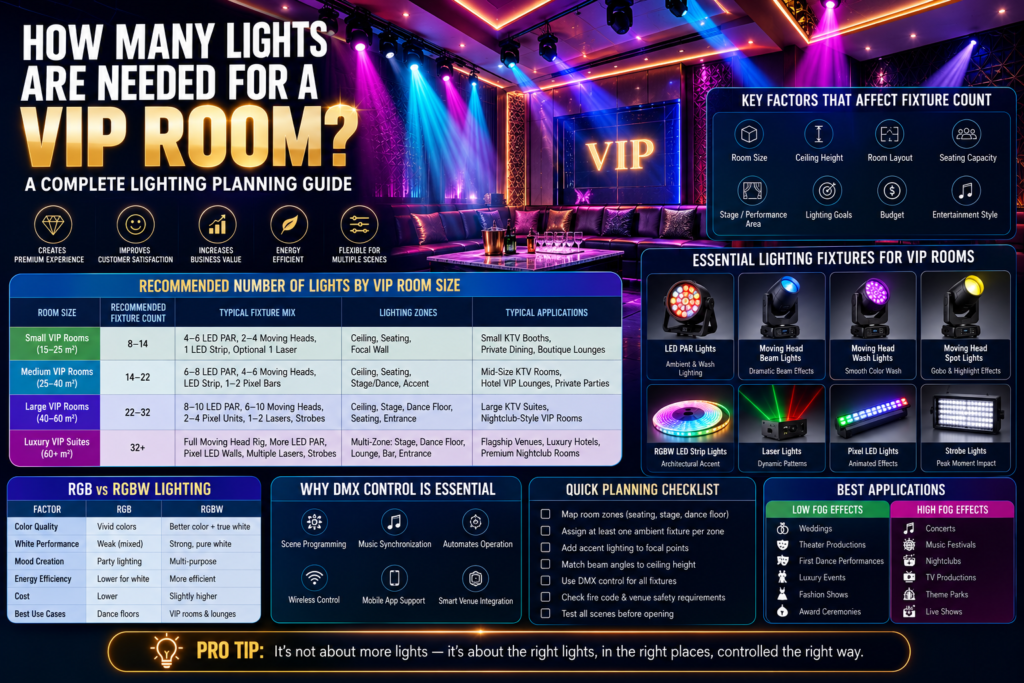
Lighting is the single element that decides whether a VIP room feels like a genuinely premium experience or just an ordinary space with expensive furniture. Ask any venue owner who has hosted a launch night, a birthday celebration, or a high-spending client group, and they will tell you the same thing: guests remember how a room made them feel, not how much the sofas cost. That feeling is almost entirely shaped by light.
So how many lights are needed for a VIP room? There is no single number that fits every space, because the right answer depends on room size, ceiling height, seating layout, and the type of entertainment experience you want to deliver. A 20 m² private karaoke booth and a 70 m² luxury VIP suite with a small stage will never need the same fixture count. What they do need is a planning method a way to calculate lighting requirements based on measurable factors rather than guesswork.
This guide walks through that method step by step. You’ll find practical fixture-count tables for different VIP room sizes, guidance on choosing between LED PAR lights, moving heads, wash lights, and LED strips, and an explanation of why DMX control systems are no longer optional in professional entertainment lighting design. Whether you’re a KTV operator, a hotel lounge owner, an interior designer, or an AV integrator, this article gives you a repeatable framework for getting VIP room lighting design right the first time.
Want to create a premium entertainment experience? Explore our Professional Private Room Lighting guide to learn how to design immersive lighting for VIP rooms, KTV suites, karaoke lounges, private theaters, and luxury hospitality spaces using LED stage lights, DMX control systems, and intelligent lighting solutions that enhance ambiance, guest satisfaction, and venue value.
Why Lighting Planning Matters for VIP Rooms
A VIP room lighting design is not decoration it’s an operational decision that affects revenue, comfort, and guest retention.
Creating immersive experiences. Layered light a mix of ambient glow, colored wash, and moving accents turns a plain box of a room into an environment that feels curated and exclusive. This is what separates a “VIP” room from a room that simply has a VIP sign on the door.
Customer satisfaction. Guests notice glare, flicker, dead zones, and harsh white light almost instantly, even if they can’t name what’s wrong. Poor lighting quietly shortens visit times and reduces repeat bookings.
Luxury atmosphere. Warm dimmable layers combined with intelligent color-changing fixtures signal quality in the same way that fine finishes and upholstery do. Lighting is one of the cheapest ways to raise perceived value per square meter.
Business value. A well-lit VIP room photographs better for social media, supports higher price points, and differentiates a venue from competitors offering similar food, drink, or karaoke catalogs.
Energy efficiency. Modern LED VIP room lighting draws a fraction of the power of older halogen or incandescent rigs while producing more saturated color and longer fixture life a genuine operating-cost advantage over years of nightly use.
Long-term flexibility. A DMX-controlled system with programmable scenes can be reconfigured for different events quiet dinner service, birthday party, live performance without buying new hardware, which protects your investment as the venue’s use case evolves.
Factors That Determine the Number of Lights Needed
Before you can answer “how many lights are needed for a VIP room,” you need to assess eight variables that interact with each other.
- Room size: larger floor areas need more fixtures to avoid dark corners, but the relationship isn’t perfectly linear; ceiling height and fixture beam angle matter just as much.
- Ceiling height: low ceilings (under 2.5 m) require wider beam angles and more evenly spaced fixtures to avoid harsh pooling; higher ceilings allow moving heads to throw light further with fewer units.
- Room layout: an open rectangular room lights differently than an L-shaped suite with a separate lounge and stage area.
- Seating capacity: more seats generally means more guests to flatter with even, glare-free ambient light, which increases the ambient fixture count even if the performance lighting stays modest.
- Stage or performance area: a room with a small stage or dance floor needs dedicated moving heads, beams, and wash lights layered on top of the ambient plan.
- Lighting goals: a quiet lounge-style VIP room needs mostly mood and accent lighting; a KTV or party-style room needs dynamic, music-reactive fixtures in addition to ambient light.
- Budget: fixture count should match realistic budget tiers; it’s better to buy fewer high-quality, DMX-addressable fixtures than to overcrowd a room with low-grade units.
- Entertainment style: karaoke rooms, private dining VIP rooms, and nightclub-style VIP suites all have different expectations for beam effects, strobes, and lasers.
Recommended Number of Lights by VIP Room Size
The table below gives a starting-point fixture count for common VIP room sizes. These numbers assume a mixed lighting goal (ambient + accent + moderate entertainment effects) and should be adjusted up for high-energy KTV rooms or down for quiet, dinner-focused VIP lounges.
| Room Size | Recommended Fixture Count | Typical Fixture Mix | Lighting Zones | Typical Applications |
| Small VIP Rooms (15–25 m²) | 8–14 fixtures | 4–6 LED PAR lights, 2–4 moving head wash/beam lights, 1 LED strip run, optional 1 small laser | Ceiling ambient, seating accent, one focal wall | Small karaoke booths, private dining rooms, boutique lounge booths |
| Medium VIP Rooms (25–40 m²) | 14–22 fixtures | 6–8 LED PAR lights, 4–6 moving heads (wash + beam), LED strip perimeter, 1–2 pixel LED bars | Ceiling grid, seating zone, small stage/dance area, accent trim | Mid-size KTV rooms, hotel VIP lounges, private party rooms |
| Large VIP Rooms (40–60 m²) | 22–32 fixtures | 8–10 LED PAR lights, 6–10 moving heads (wash, beam, spot mix), 2–4 pixel LED units, 1–2 laser units, strobes for peak moments | Ceiling grid, stage lighting, dance floor, seating perimeter, entrance accent | Large KTV suites, nightclub-style VIP rooms, event venues |
| Luxury VIP Suites (60+ m²) | 32+ fixtures (scaled to layout) | Full moving head rig (wash, beam, spot), extensive LED PAR ceiling grid, pixel-mapped LED walls, multiple laser and strobe units, hidden LED strip architecture | Multi-zone: stage, dance floor, lounge seating, bar, entrance, accent walls | Flagship entertainment venues, luxury hotel VIP suites, premium nightclub rooms |
These ranges assume professional-grade fixtures on a DMX512 control system. Lower-output or budget fixtures may require higher counts to achieve the same visual coverage.
Essential Lighting Fixtures for VIP Rooms
Each fixture type serves a distinct role in a well-balanced VIP room lighting design. Mixing fixture types rather than relying on just one is what creates depth.
LED PAR Lights
LED PAR lights are the workhorse of ambient and wash lighting. They’re typically mounted on ceiling trusses or wall brackets to provide broad, even, color-changing base illumination across the room. Most small-to-medium VIP rooms use 4–10 units as the foundation layer before adding moving fixtures on top.
Moving Head Beam Lights
Beam lights produce tight, high-intensity shafts of light that create dramatic aerial effects, ideal for music-driven moments in KTV and party-style VIP rooms. Two to six units are usually enough for small-to-medium rooms; larger stages may use more for symmetrical coverage.
Moving Head Wash Lights
Wash lights flood a wider area with smooth, blended color and are essential for lighting walls, stages, and performer areas without harsh hot spots. They pair naturally with beam lights, with wash units typically outnumbering beams in performance-focused rooms.
Moving Head Spot Lights
Spot fixtures add gobo patterns, sharp-edged effects, and can highlight specific guests or performance areas. They’re used more selectively than wash or PAR fixtures, often just 2–6 units even in larger suites.
RGBW LED Strip Lights
LED strip lights outline architectural features — ceiling coves, bar fronts, stage edges — and add a continuous glow that ties the room’s other fixtures together. Strips are typically measured in linear meters rather than unit counts, and are essential for the “hidden glow” effect associated with high-end VIP room lighting.
Laser Lights
Laser fixtures add dynamic beam and pattern effects for high-energy moments. One to two units are usually sufficient even for large rooms, since lasers are visually intense and easily overused.
Pixel LED Lights
Pixel-controllable LED bars or panels allow chase effects and color animations across a surface, often used on stage fronts, bar fronts, or feature walls. They add a modern, high-tech visual layer distinct from standard PAR washes.
Strobe Lights
Strobes are used sparingly for peak musical moments and emphasis effects. One to two units placed near the stage or dance floor are typically enough; overuse causes guest discomfort and should be avoided.
How to Design a Balanced VIP Room Lighting Layout
A strong VIP room lighting layout is built in layers, not as a single flat wash of light.
- Ceiling lighting: the primary ambient layer, usually LED PAR or wash fixtures spaced evenly across the ceiling grid.
- Wall lighting: accent fixtures or LED strips that add depth and prevent the room from feeling flat or shadowless.
- Stage lighting: a dedicated combination of beam, wash, and spot fixtures focused on the performance area.
- Dance area: dynamic fixtures (beams, pixel units, occasional strobe) synced to music for energy during peak hours.
- Seating area: softer, dimmable, glare-free light that flatters guests and supports conversation and dining.
- Accent lighting: small focal fixtures on artwork, bar displays, or architectural features.
- Hidden LED strips: concealed strip lighting in coves, risers, or behind furniture for a soft glow without visible fixtures.
- Layered lighting techniques: combining all of the above so no single light source dominates, and every zone can be dimmed or scened independently.
Quick Layout Planning Checklist
- [ ] Map the room into functional zones (seating, stage, dance floor, entrance)
- [ ] Assign at least one ambient fixture type per zone
- [ ] Add accent or architectural lighting to at least two focal points
- [ ] Confirm beam angles match ceiling height
- [ ] Reserve entertainment fixtures (beams, lasers, strobes) for the stage/dance zone only
- [ ] Test all zones on a DMX controller before finalizing fixture count
Choosing Between RGB and RGBW Lighting
One of the most common questions in VIP room lighting design is whether to specify RGB or RGBW fixtures.
| Factor | RGB Lighting | RGBW Lighting |
| Color Quality | Vivid saturated colors, but mixed white can look tinted | Cleaner, purer color mixing with a dedicated white channel |
| White Light Performance | Weak — white is created by mixing red, green, and blue | Strong — true white LED produces a crisp, usable white |
| Mood Creation | Best for bold, saturated party lighting | Best for both mood lighting and functional white-light needs |
| Energy Efficiency | Slightly lower efficiency when producing white light | More efficient for white output due to dedicated white diode |
| Cost | Generally lower upfront cost | Slightly higher cost per fixture |
| Best Use Cases | Dance floors, beam effects, high-energy color moments | Multi-purpose rooms needing both ambient white and colored mood lighting |
For most VIP rooms that double as dining or lounge spaces, RGBW lighting is the safer long-term choice because it delivers usable white light for practical moments alongside full-color capability for entertainment scenes.
Why DMX Lighting Control Is Essential
Once a VIP room has more than a handful of fixtures, manual control becomes impractical. This is where DMX512 the industry-standard lighting control protocol becomes essential rather than optional.
Scene programming lets operators save preset looks (dinner service, party mode, performance mode) and recall them instantly instead of manually adjusting dozens of fixtures. Music synchronization allows beams, strobes, and pixel effects to react to the beat in real time, which is central to the KTV and nightclub-style VIP room experience. Automation reduces staffing needs, since a single controller can run an entire room’s lighting program without a dedicated operator.
Wireless DMX removes the need for extensive control cabling, which is especially useful when retrofitting existing VIP rooms. Mobile app control lets venue managers adjust scenes from a tablet or phone, and modern smart lighting systems increasingly integrate DMX control with venue-wide automation platforms, allowing lighting to be managed alongside audio and HVAC systems from one interface.
In short, DMX is what allows a room with 20–30 individual fixtures to behave as one coordinated lighting system rather than 20–30 separate switches.
Common Lighting Design Mistakes
Even well-funded VIP room projects run into avoidable lighting problems.
- Too many fixtures: overcrowding a small room creates visual clutter and unnecessary heat load; solution: follow zone-based fixture counts rather than maximizing quantity.
- Too few fixtures: leaves dark corners and flat, uninviting seating areas; solution: map every functional zone before finalizing a fixture list.
- Uneven lighting: inconsistent spacing creates hot spots and shadows; solution: use symmetrical ceiling grids and consistent beam angles.
- Wrong beam angles: narrow beams in low-ceiling rooms create harsh pooling; solution: match beam angle to ceiling height and fixture distance.
- Excessive brightness: overly bright ambient light kills the “VIP” feel; solution: use dimmable fixtures and scene presets for different times of day.
- Ignoring ceiling height: fixture throw distance and beam spread change dramatically with height; solution: recalculate spacing whenever ceiling height differs from a standard plan.
- Poor cable management: visible or unsafe wiring undermines a premium look; solution: use concealed conduit, truss-mounted cabling, or wireless DMX where possible.
- Choosing low-quality fixtures: cheap fixtures fail faster and produce inconsistent color; solution: specify professional-grade fixtures from a manufacturer with warranty support.
Installation Best Practices
Getting the fixture count right is only half the job installation quality determines whether the design performs as intended.
- Fixture spacing: follow manufacturer beam-angle guidance to avoid overlapping hot spots or dark gaps.
- Mounting methods: use truss systems, ceiling brackets, or recessed housings appropriate to the room’s structure and weight limits.
- DMX wiring: run dedicated DMX lines (or use reliable wireless DMX transmitters) separate from power cabling to avoid signal interference.
- Cable management: conceal cabling in conduit, trunking, or ceiling voids to maintain a clean visual finish.
- Ventilation: ensure fixtures with higher heat output have adequate airflow, especially in enclosed ceiling spaces.
- Electrical safety: confirm circuits are rated for total fixture load and comply with local electrical codes.
- Testing: run a full DMX scene test before opening the room to guests, checking every fixture at every programmed scene.
- Maintenance: schedule periodic fixture cleaning and firmware updates to keep color output and DMX responsiveness consistent.
Installation Checklist
- [ ] Confirm mounting points can bear fixture weight safely
- [ ] Route DMX and power cabling separately
- [ ] Label every fixture’s DMX address
- [ ] Test all scenes before guest access
- [ ] Schedule quarterly maintenance checks
Energy-Efficient VIP Room Lighting Solutions
Modern VIP room lighting design doesn’t have to trade luxury for efficiency.
LED technology underpins nearly all professional entertainment lighting today, using a fraction of the power of legacy halogen fixtures. Smart dimming allows fixtures to run at partial output during low-traffic hours, extending lamp life and cutting energy costs. RGBW fixtures improve efficiency further by using a dedicated white diode rather than mixing colors to approximate white. Motion sensors can automatically adjust ambient lighting in unoccupied VIP rooms, reducing waste between bookings.
LED fixtures also offer low power consumption relative to output, a long lifespan that reduces replacement frequency, and support broader sustainable lighting goals that increasingly matter to hotel groups and entertainment brands managing energy costs across multiple venues.
Future Trends in VIP Room Lighting
Entertainment lighting technology continues to evolve quickly, and forward-looking venues are already adopting several trends.
- AI-powered lighting that automatically adjusts scenes based on music tempo, crowd activity, or time of day.
- Wireless DMX systems that simplify installation and reduce retrofit costs in existing rooms.
- Interactive lighting that responds to guest movement or app-based controls.
- Pixel mapping across LED walls and strips for animated, high-resolution visual effects.
- Voice control integration for hands-free scene changes.
- IoT integration linking lighting with other smart building systems.
- Cloud lighting management allowing multi-venue operators to monitor and program rooms remotely.
- Smart entertainment spaces that combine lighting, audio, and visual displays into a single managed ecosystem.
Frequently Asked Questions (FAQ)
How many lights are needed for a VIP room?
Most small VIP rooms (15–25 m²) need 8–14 fixtures, medium rooms (25–40 m²) need 14–22, large rooms (40–60 m²) need 22–32, and luxury suites over 60 m² typically need 32 or more, depending on layout and entertainment goals.
What lights are best for VIP rooms?
A mix of LED PAR lights for ambient wash, moving head beam and wash fixtures for dynamic effects, and RGBW LED strips for architectural accents generally produces the most balanced result.
Are moving head lights necessary?
They aren’t strictly required for very small or dining-focused VIP rooms, but they are essential for KTV, party, and stage-oriented VIP rooms that need dynamic, music-synchronized effects.
How many LED PAR lights should a VIP room have?
As a starting point, small rooms typically use 4–6 units, medium rooms 6–8, and large rooms 8–10, scaled up further for luxury suites with larger ceiling grids.
What is the best lighting layout?
A layered layout combining ceiling ambient light, stage-focused fixtures, seating-area accent lighting, and hidden LED strips generally performs best, since it avoids relying on a single flat light source.
Should I choose RGB or RGBW lighting?
RGBW is generally the better choice for VIP rooms that need both true white light and vivid color effects, while RGB alone can suit rooms focused purely on colorful party lighting.
Is a DMX controller required?
For any VIP room with more than a handful of fixtures, a DMX512 controller is essential for coordinated scene control, music synchronization, and efficient operation.
How much does a professional VIP room lighting system cost?
Costs vary widely based on fixture count, brand, and control system complexity, so it’s best to request a tailored quote based on your room’s size and entertainment goals.
Are LED lights energy-efficient?
Yes, LED fixtures use significantly less power than older halogen or incandescent lighting while offering longer lifespans and lower maintenance costs.
How do I choose the right lighting fixtures?
Start by mapping your room’s zones and entertainment goals, then select fixture types and quantities using a size-based planning table before finalizing your layout with a DMX control system.
Conclusion
Getting VIP room lighting design right isn’t about buying as many fixtures as the budget allows it’s about matching fixture type, quantity, and placement to the room’s actual size, layout, and entertainment purpose. A well-planned lighting system built around LED PAR lights, moving heads, RGBW strips, and a reliable DMX control system elevates the guest experience, supports higher price points, and gives venues the flexibility to adapt as their entertainment offering evolves.
If you’re planning a new VIP room or upgrading an existing space, JJY Stage offers customized VIP room lighting systems, OEM/ODM manufacturing, intelligent lighting controls, and complete turnkey entertainment lighting solutions. Contact JJY Stage today to get a tailored fixture plan built around your room’s exact dimensions and entertainment goals.