
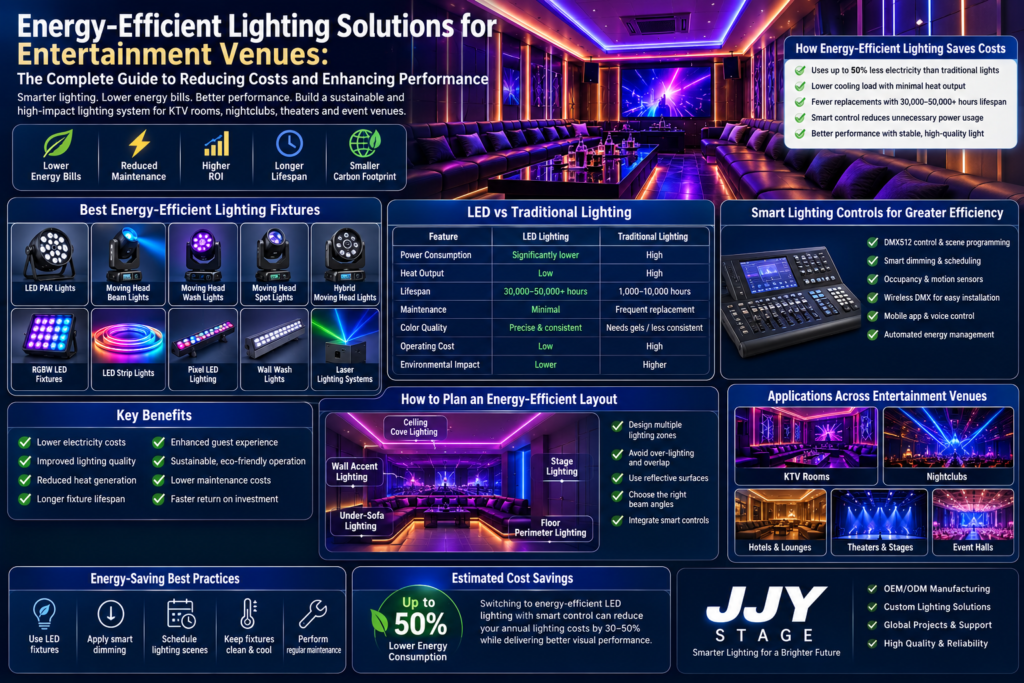
Lighting is one of the largest, most controllable operating costs in any entertainment venue and one of the easiest to get wrong. Nightclubs, KTV rooms, theaters, and event halls often run lighting systems for eight, ten, or more hours a night, which means even small inefficiencies compound into significant electricity bills over a year.
Energy-efficient lighting solutions for entertainment venues address this directly, combining modern LED fixtures, intelligent DMX controls, and smart automation to cut power consumption without sacrificing visual impact. This guide covers the fixtures, control systems, layout strategies, and maintenance practices that reduce energy costs while improving lighting quality for KTV venues, nightclubs, hotels, theaters, and live event spaces with JJY Stage’s engineering experience behind every recommendation.
A successful entertainment venue starts with professional private room lighting that balances ambiance, functionality, and visual impact. From KTV rooms and VIP lounges to karaoke spaces and private clubs, the right lighting design enhances guest experiences, improves energy efficiency, and creates dynamic atmospheres. Learn more in our comprehensive guide: Professional Private Room Lighting the complete guide to entertainment lighting solutions.
Why Energy Efficiency Matters in Entertainment Venues
Rising electricity costs make lighting efficiency a direct line item on a venue’s bottom line, not just an environmental consideration.
Long operating hours often nightly, multi-hour sessions mean entertainment venues accumulate energy costs far faster than typical commercial spaces with standard business hours.
Environmental sustainability is increasingly expected by guests, investors, and local regulators, making efficient lighting part of a venue’s broader sustainability profile.
Lower maintenance expenses naturally follow from efficient LED systems, which generate less heat and fail less frequently than older lighting technology.
Better return on investment (ROI) comes from the combination of reduced energy bills, lower maintenance costs, and extended fixture lifespan.
Compliance with green building standards is becoming more relevant for hotels, casinos, and large event venues pursuing certifications or meeting local energy codes.
What Makes a Lighting System Energy-Efficient?
LED technology is the foundation of any energy-efficient entertainment lighting solution, converting a much higher percentage of electricity into usable light compared to traditional sources.
High luminous efficacy the amount of light produced per watt of power is the core metric that separates efficient fixtures from outdated ones; modern LED fixtures significantly outperform halogen and incandescent equivalents on this measure.
Smart drivers regulate power delivery precisely, reducing wasted energy and protecting LED components from voltage fluctuations that shorten lifespan.
Low heat generation means less energy is lost as waste heat, and it also reduces the load on a venue’s HVAC system an often-overlooked secondary energy saving.
Longer lifespan reduces the energy and material cost associated with manufacturing and replacing fixtures over time.
Intelligent lighting controls dimming, scheduling, sensors, and DMX-based scene programming ensure fixtures only draw the power actually needed for a given moment, rather than running at full output continuously.
Best Energy-Efficient Lighting Fixtures for Entertainment Venues
LED PAR Lights
Power consumption: Typically low to moderate, often in the range of 20–100W depending on output level, far below traditional PAR can fixtures using halogen lamps. Energy-saving benefits: High luminous efficacy and long lifespan reduce both energy and replacement costs. Best applications: Stage washes, uplighting, and color wall effects. Recommended venues: KTV stages, event halls, small live performance venues.
LED Moving Head Beam Lights
Power consumption: Moderate, generally more efficient than traditional discharge-lamp moving heads while producing comparable beam intensity. Energy-saving benefits: LED sources eliminate lamp replacement costs and maintain consistent output over a longer service life. Best applications: Sharp, focused beam effects for high-energy entertainment moments. Recommended venues: Nightclubs, large KTV rooms, event venues.
LED Moving Head Wash Lights
Power consumption: Moderate, scaling with the size of the LED array used for broad coverage. Energy-saving benefits: Even color coverage achieved with fewer total fixtures than older wash technology. Best applications: Filling stages or rooms with broad, even color. Recommended venues: Theaters, live performance venues, large private rooms.
LED Moving Head Spot Lights
Power consumption: Moderate, with efficient gobo and pattern projection compared to traditional lamp-based spot fixtures. Energy-saving benefits: Sharp pattern and image projection with significantly reduced lamp-replacement overhead. Best applications: Gobo projection, pattern effects, and focused spotlighting. Recommended venues: Theaters, event halls, performance stages.
Hybrid Moving Head Lights
Power consumption: Moderate to higher, reflecting their combined beam, spot, and wash functionality in a single fixture. Energy-saving benefits: Replacing three fixture types with one hybrid unit reduces total fixture count and overall power draw for a given effect range. Best applications: Venues needing beam, spot, and wash effects without installing separate fixture types. Recommended venues: Nightclubs, multi-purpose event spaces.
RGB & RGBW LED Fixtures
Power consumption: Low to moderate, varying with fixture size and LED density. Energy-saving benefits: Full-color output from a single efficient LED source, eliminating the need for colored gels or filters that reduce light output. Best applications: Mood lighting, accent walls, and color-changing ambiance. Recommended venues: KTV rooms, VIP lounges, bars.
LED Strip Lights
Power consumption: Very low per meter, typically 5–15W per meter depending on density. Energy-saving benefits: Ideal for continuous ambient and accent lighting with minimal power draw relative to coverage area. Best applications: Cove lighting, furniture accents, architectural highlights. Recommended venues: Private rooms, hotel lounges, KTV suites.
Pixel LED Lighting
Power consumption: Low to moderate, scaling with the number of individually controlled pixels. Energy-saving benefits: Creates complex animated effects without the higher power draw of traditional moving fixtures. Best applications: Dynamic, animated lighting displays and gradients. Recommended venues: Nightclubs, stage backdrops, high-end VIP rooms.
Wall Wash Lights
Power consumption: Low to moderate depending on coverage area. Energy-saving benefits: Even wall coverage from fewer fixtures compared to older flood-lighting approaches. Best applications: Large wall surfaces, architectural highlighting. Recommended venues: Hotels, event halls, lounges.
Laser Lighting Systems
Power consumption: Varies significantly by output power, generally efficient relative to the visual impact produced. Energy-saving benefits: High visual impact per watt for short, high-energy effect moments rather than continuous use. Best applications: Peak entertainment moments and graphic effects. Recommended venues: Nightclubs, large event venues.
LED vs Traditional Stage Lighting
| Feature | LED Lighting | Traditional Lighting |
| Power Consumption | Significantly lower for comparable output | High, especially with halogen or discharge lamps |
| Heat Output | Low | High, increasing HVAC load |
| Lifespan | 30,000–50,000+ hours | 1,000–10,000 hours depending on lamp type |
| Maintenance | Minimal, infrequent replacement | Frequent lamp and filter replacement |
| Brightness | High, stable output over lifespan | Output degrades as lamps age |
| Color Quality | Precise, consistent color mixing (RGB/RGBW) | Requires gels/filters, less consistent |
| Operating Cost | Low | High due to energy and replacement costs |
| Environmental Impact | Lower energy use, less waste | Higher energy use, more frequent disposal of lamps |
LED technology has become the preferred choice for entertainment venues because it delivers equal or better visual performance while substantially reducing the ongoing costs tied to power consumption, cooling, and fixture replacement.
Smart Lighting Controls That Save Energy
DMX512 control allows precise, centralized management of every fixture in a venue, ensuring lights operate only as needed rather than running at fixed, potentially wasteful settings.
Smart dimming reduces output during lower-traffic periods, cutting energy use without noticeably affecting guest experience.
Occupancy sensors automatically reduce or shut off lighting in unused rooms or areas, a particularly useful feature for private KTV rooms that aren’t in continuous use.
Motion sensors support similar savings in hallways, restrooms, and transitional spaces within a venue.
Scheduling ensures lighting scenes automatically shift with a venue’s operating hours, avoiding energy waste from lights left at full brightness during setup or slow periods.
Wireless DMX reduces installation complexity and cost, particularly valuable when retrofitting energy-efficient controls into existing venues.
Mobile app control allows staff to make real-time adjustments without needing access to a central console, supporting faster response to changing venue conditions.
Automated scene programming pre-set combinations of brightness, color, and effect ensures consistent, optimized lighting without relying on manual adjustment throughout the night.
Practical example: A nightclub might use scheduling to run lower-intensity ambient lighting during early opening hours, then automatically transition to full-output, DMX-programmed party scenes once peak hours begin avoiding unnecessary high-power operation during quieter periods.
How Lighting Automation Reduces Operating Costs
Automatic brightness adjustment based on time of day or occupancy prevents fixtures from running at unnecessarily high output.
Scheduled lighting scenes eliminate the energy waste that comes from staff forgetting to dim or switch off unused zones.
Standby power reduction through smart power management cuts the small but continuous draw of fixtures left in standby mode.
Intelligent power management balances load across a venue’s lighting system, avoiding spikes that can increase peak demand charges.
Multi-zone lighting control ensures energy is directed only to active areas of a venue rather than illuminating unused rooms at full capacity.
Energy monitoring tools give venue operators visibility into actual consumption patterns, making it possible to identify and correct inefficiencies over time.
Estimated cost-saving example: A mid-sized KTV venue running 20 LED PAR fixtures at an average of 60W each for 8 hours nightly consumes roughly 9.6 kWh per night per zone. Adding smart dimming and occupancy-based control that reduces average runtime intensity by even 25% can save well over 2 kWh per zone nightly a meaningful reduction when scaled across a full venue and multiplied over a year of operation.
Designing an Energy-Efficient Lighting Layout
Layered lighting combining ambient, accent, and functional layers allows each layer to run at the lowest effective brightness rather than relying on one over-bright source to do everything.
Fixture spacing should be planned to avoid overlapping coverage, which wastes energy by illuminating the same area with multiple fixtures at full output.
Ceiling height affects beam spread and fixture selection; higher ceilings may require fewer, more efficient fixtures with wider beam angles rather than many lower-output units.
Lighting zones allow different areas of a venue to be controlled and powered independently based on actual use.
Beam angle optimization ensures light is directed precisely where needed, reducing the total fixture count and wattage required to achieve the desired coverage.
Reflective surfaces light-colored walls, ceilings, or finishes can reduce the total lighting output needed to achieve a given brightness level.
Room size considerations determine not just fixture count but also the balance between strip lighting, wash fixtures, and moving heads needed for efficient, even coverage.
Layout planning checklist:
- [ ] Map lighting zones based on actual room usage patterns
- [ ] Select fixtures with beam angles matched to zone size
- [ ] Avoid unnecessary coverage overlap between fixtures
- [ ] Incorporate reflective or light-colored surfaces where possible
- [ ] Assign independent control to each zone
- [ ] Confirm total system wattage against available power capacity
Maintenance Practices That Improve Energy Efficiency
Cleaning lenses regularly prevents dust and grime buildup, which forces fixtures to run at higher output to achieve the same visible brightness.
Firmware updates on smart fixtures and controllers often include efficiency improvements and bug fixes that affect power management.
DMX testing ensures control signals are reaching fixtures correctly, preventing fixtures from defaulting to inefficient full-brightness states due to communication errors.
Driver inspection catches early signs of driver degradation, which can cause fixtures to draw more power than necessary or fail prematurely.
Cooling system maintenance checking fixture fans and vents keeps LED components operating at optimal temperature, supporting both efficiency and lifespan.
Cable inspections prevent voltage drops caused by damaged or degraded wiring, which can force fixtures to compensate with higher power draw.
Preventive maintenance schedules, rather than reactive repairs, catch efficiency-reducing issues before they escalate into fixture failures.
Maintenance checklist:
- [ ] Clean fixture lenses and housings monthly
- [ ] Check and update controller/fixture firmware quarterly
- [ ] Test DMX signal integrity across all zones
- [ ] Inspect drivers and power supplies for wear
- [ ] Verify cooling fans and vents are unobstructed
- [ ] Inspect cabling and connectors for damage
- [ ] Log and review energy consumption trends regularly
Common Energy-Wasting Lighting Mistakes
Using outdated fixtures legacy halogen or discharge-lamp equipment consumes far more power than modern LED equivalents for the same output. Solution: prioritize LED retrofits for the highest-usage areas first.
Over-lighting spaces wastes energy without improving guest experience. Solution: design lighting levels around actual functional and atmospheric needs, not maximum output.
Poor fixture placement forces venues to compensate with additional fixtures or higher brightness to cover gaps. Solution: plan fixture layout around beam angle and coverage area before installation.
Ignoring dimming controls means fixtures often run at full brightness even when lower output would suffice. Solution: integrate smart dimming into every zone’s control scheme.
Lack of maintenance allows dust, driver wear, and cabling issues to quietly increase power draw over time. Solution: follow a consistent preventive maintenance schedule.
Running lights unnecessarily in unused rooms or during closed hours is one of the simplest and most avoidable sources of waste. Solution: use scheduling and occupancy sensors to automate shutoffs.
Choosing the wrong beam angle leads to either wasted spill light or insufficient coverage requiring extra fixtures. Solution: match beam angle specifications to the actual room dimensions and mounting height.
Sustainable Lighting Trends for Entertainment Venues
AI-powered lighting optimization is beginning to automatically adjust brightness, color, and scene timing based on occupancy and usage patterns, further reducing unnecessary energy use.
IoT-enabled lighting systems connect fixtures to broader venue management platforms, allowing energy data to be tracked alongside HVAC and other building systems.
Smart energy monitoring gives operators granular visibility into which fixtures or zones consume the most power, supporting targeted efficiency improvements.
Solar-powered support systems are increasingly used to offset lighting energy needs in venues with suitable infrastructure.
High-efficiency LED technology continues to improve luminous efficacy year over year, meaning newer fixtures often outperform even recent LED generations.
Green venue certifications are becoming a meaningful differentiator for hotels, event venues, and entertainment businesses seeking to attract sustainability-conscious guests and partners.
Carbon footprint reduction, driven largely by lighting and HVAC efficiency, is increasingly part of entertainment venues’ broader sustainability reporting and marketing.
How to Choose the Right Energy-Efficient Lighting System
Venue size determines total fixture count, power infrastructure requirements, and the complexity of zoning needed for efficient control.
Budget should account not just for upfront fixture cost but for long-term energy and maintenance savings that offset a higher initial investment.
Operating hours directly affect the potential savings from efficient fixtures and smart controls venues with longer nightly operation see the fastest payback.
Lighting goals whether focused on ambiance, performance lighting, or a combination shape which fixture types deliver the best efficiency-to-impact ratio.
Fixture compatibility with existing DMX or control infrastructure affects both installation cost and long-term flexibility.
Control systems should support the level of automation a venue needs, from basic dimming to full scene programming and sensor integration.
Scalability matters for venues planning future expansion or renovation, since a modular lighting system is easier and cheaper to extend.
Future upgrades such as wireless DMX or AI-based controls should be considered during initial design to avoid costly rework later.
Buying checklist:
- [ ] Define venue size, layout, and zoning needs
- [ ] Set a budget that accounts for long-term energy savings
- [ ] Confirm daily/nightly operating hours
- [ ] Clarify lighting goals (ambiance, performance, or both)
- [ ] Verify fixture compatibility with DMX/control systems
- [ ] Choose a control system with the needed automation features
- [ ] Confirm the system’s scalability for future expansion
- [ ] Discuss upgrade paths with your lighting manufacturer
Frequently Asked Questions (FAQ)
What are energy-efficient lighting solutions?
Energy-efficient lighting solutions combine high-efficacy LED fixtures with intelligent controls such as DMX systems, dimming, and sensors to reduce electricity consumption while maintaining or improving lighting performance.
Why are LED lights more energy-efficient?
LED fixtures convert a much higher percentage of electricity into visible light compared to traditional lamps, produce significantly less waste heat, and last far longer, reducing both energy and replacement costs.
How much electricity can LED stage lights save?
Savings vary by fixture and usage, but LED lighting commonly reduces energy consumption by 50% or more compared to equivalent traditional lighting, with additional savings available through smart dimming and scheduling.
Are moving head LED lights energy-efficient?
Yes. LED-based moving head fixtures consume significantly less power than older discharge-lamp moving heads while delivering comparable or superior brightness and color performance.
How does DMX control reduce energy consumption?
DMX control allows precise management of brightness, timing, and scenes across every fixture, ensuring lights operate only at the intensity and duration actually needed rather than running continuously at full output.
What is smart dimming?
Smart dimming automatically or manually reduces fixture output based on need such as time of day, occupancy, or programmed scenes cutting energy use without switching lights off entirely.
How long do LED entertainment lights last?
Quality LED entertainment fixtures typically last 30,000 to 50,000+ hours, far exceeding the lifespan of halogen or discharge-lamp equivalents.
Which lighting fixtures consume the least power?
LED strip lights and small LED PAR fixtures generally consume the least power per unit, making them ideal for ambient and accent lighting in energy-conscious designs.
How often should lighting systems be maintained?
A preventive maintenance schedule including lens cleaning, driver inspection, and DMX testing is generally recommended on a monthly to quarterly basis, depending on venue usage intensity.
How can entertainment venues reduce lighting costs?
Venues can reduce lighting costs by upgrading to LED fixtures, implementing smart dimming and scheduling, using occupancy sensors, and following consistent maintenance practices.
Are energy-efficient lighting systems worth the investment?
Yes, for most venues. The combination of lower energy bills, reduced maintenance costs, and longer fixture lifespan typically delivers a strong return on investment over the system’s operating life.
What is the ROI of upgrading to LED lighting?
ROI varies by venue size and usage, but many entertainment venues recover the cost of an LED upgrade within a few years through reduced energy and maintenance expenses, with continued savings for the remainder of the system’s lifespan.
Conclusion
Energy-efficient lighting solutions for entertainment venues aren’t just a sustainability checkbox they’re a direct, measurable way to reduce operating costs while improving the guest experience. LED technology, paired with intelligent DMX controls, smart dimming, sensors, and consistent maintenance, gives venue owners precise control over both energy consumption and visual performance.
Whether you’re retrofitting an existing nightclub, designing a new hotel entertainment space, or building out a full-scale event venue, the fixtures and control strategies covered in this guide provide a practical roadmap for reducing costs without compromising on lighting quality.
JJY Stage engineers and manufactures energy-efficient LED stage lighting, DMX control systems, and complete intelligent lighting solutions for KTV venues, nightclubs, hotels, theaters, and live event spaces worldwide. As an OEM/ODM manufacturer, we partner directly with venue owners, architects, designers, and AV integrators to deliver customized, turnkey lighting systems built around real energy and performance goals. Contact JJY Stage today to discuss your energy-efficient lighting project and see how our intelligent DMX control solutions and custom fixture manufacturing can lower your operating costs while elevating your venue’s visual experience.