
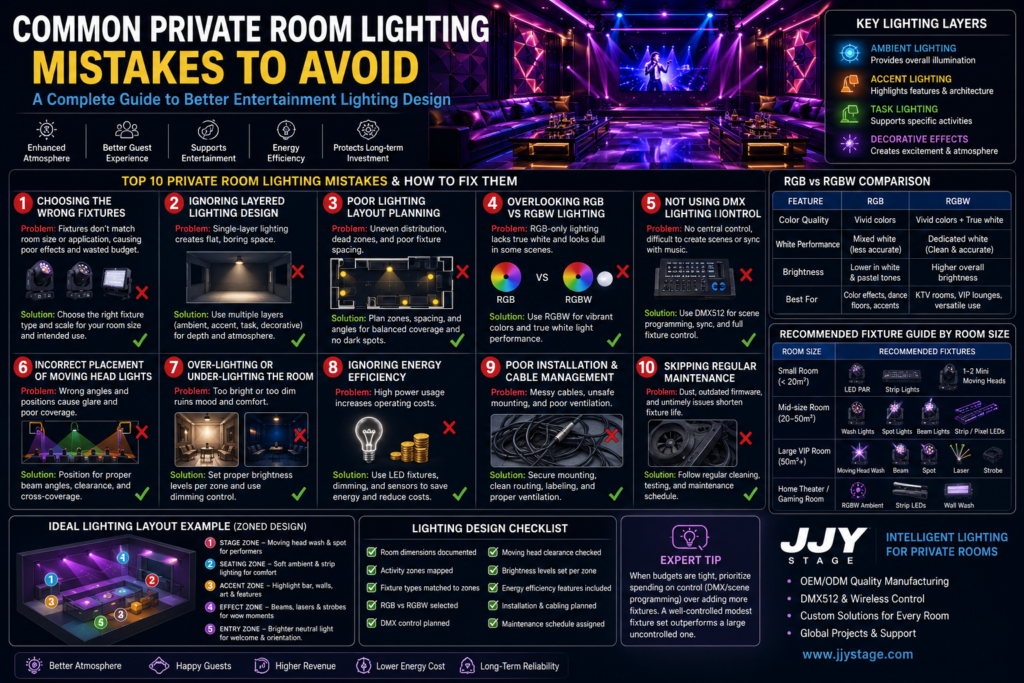
Private entertainment rooms live or die on atmosphere, and atmosphere lives or dies on lighting. Yet across KTV venues, VIP lounges, karaoke rooms, and private clubs, the same lighting design mistakes keep showing up — flat brightness, poor fixture choices, tangled cabling, and controls that never quite deliver the mood a room is paying for.
This guide walks through the most common private room lighting mistakes to avoid, why they happen, and exactly how to fix them. Whether you’re an owner planning a new KTV build-out, an interior designer specifying fixtures, or an AV integrator programming a DMX system, you’ll find practical, field-tested guidance here — not theory.
As a manufacturer that designs and builds intelligent entertainment lighting systems for venues worldwide, JJY Stage sees these mistakes repeat across markets and room types. The fixes are consistent, and they’re covered below.
Why Proper Private Room Lighting Matters
Lighting is not decoration in a private room — it’s infrastructure. It shapes how guests feel the moment they walk in, and it directly affects how long they stay and how much they spend.
Creating the right atmosphere. Color temperature, brightness, and movement set the emotional tone of a room. A karaoke room lit like an office feels sterile; one lit with layered RGB and moving beams feels alive.
Enhancing guest experience. Good lighting makes performers look good on camera and on stage, makes menus and surfaces easy to read, and makes the space feel intentional rather than accidental.
Improving functionality. Different activities — singing, dining, lounging, dancing — need different light levels and angles. A single flat wash can’t serve all of them well.
Supporting entertainment activities. Music-synchronized lighting, color changes, and beam effects are part of the entertainment product itself in KTV and karaoke rooms, not an afterthought.
Increasing energy efficiency. Modern LED entertainment lighting with smart dimming and zoning cuts electricity costs significantly compared to legacy fixtures left running at full output.
Protecting long-term investment. Well-specified, well-installed systems last longer, need less maintenance, and avoid the cost of ripping out and replacing a poorly planned installation two years in.
Get these fundamentals wrong and every private room lighting mistake below becomes more expensive to fix later. Get them right, and the room sells itself.
Mistake #1: Choosing the Wrong Lighting Fixtures
The single most common private room lighting mistake is selecting fixtures based on price or appearance alone, without matching them to the room’s actual use.
Incorrect fixture types. A small KTV room doesn’t need club-scale moving heads throwing a 25-meter beam; a large VIP hall doesn’t need underpowered LED PAR lights that can’t fill the space. Mismatched fixture scale creates either overwhelming glare or a dim, flat room.
Poor-quality lighting. Budget fixtures with weak LED chips, inconsistent color mixing, or noisy fans fail early and produce inconsistent RGB output — visible as banding or flicker on camera, which matters enormously in karaoke and KTV settings where guests are filming themselves.
Mismatched applications. Using wash lights where beam lights are needed (or vice versa) wastes budget and underdelivers the intended effect. Wash lights flood a surface evenly; beam lights cut a sharp, focused line — they solve different problems.
How to select the right fixtures for different room types:
- Small karaoke rooms (under 20 m²): compact LED PAR lights, RGBW strip lighting, one or two small moving heads
- Mid-size KTV rooms: moving head wash and spot combos, pixel LED strips for accenting, beam lights for effect moments
- Large VIP lounges and clubs: full moving head rigs (wash, beam, spot), laser lights, strobe lights, and layered ambient lighting
- Home theaters and gaming rooms: primarily RGBW ambient and accent lighting with minimal beam/strobe use
JJY Stage engineers fixture packages around room dimensions, ceiling height, and intended use rather than selling a one-size-fits-all catalog, which is the fastest way to avoid this first mistake entirely.
Mistake #2: Ignoring Layered Lighting Design
Many private rooms rely on a single lighting layer — usually a ceiling wash — and wonder why the space feels flat. Professional entertainment lighting design always layers multiple light types together.
Ambient lighting provides the room’s base illumination — soft, even, and non-distracting. This is the foundation every other layer sits on top of.
Accent lighting highlights specific features: a bar counter, a stage edge, artwork, or architectural detailing. It adds depth and visual interest without raising overall brightness.
Task lighting supports specific activities like reading a menu, mixing drinks, or operating equipment. It’s often overlooked in entertainment spaces but matters for usability.
Decorative lighting — LED strip lighting, pixel LED effects, laser lights — delivers the “wow” factor guests associate with premium KTV and VIP rooms.
Combining these four layers, rather than relying on one, is what separates a lighting layout that feels professionally designed from one that feels like a single ceiling fixture was switched on. Each layer should also be independently controllable, which ties directly into the DMX control mistake covered later.
Mistake #3: Poor Lighting Layout Planning
Even excellent fixtures fail if the lighting layout is planned poorly. This is one of the most frequent lighting layout mistakes JJY Stage encounters during venue consultations.
Uneven lighting distribution. Clustering fixtures in one area while leaving another dim creates visual imbalance and makes the room feel smaller or oddly shaped.
Incorrect fixture spacing. Spacing fixtures too far apart creates dark gaps; spacing them too close wastes budget and can cause color-mixing artifacts on walls and ceilings.
Dead zones. Corners, seating areas, and stage edges are commonly under-lit because layout planning focuses only on the room’s center.
Ceiling height considerations. Low ceilings need wider beam angles and lower-glare fixtures; high ceilings can support tighter beams and more dramatic moving head effects without discomfort to guests below.
Layout planning tips:
- Map the room’s activity zones first (stage, seating, bar, walkways), then assign lighting layers to each
- Use a mix of ceiling-mounted and wall-mounted fixtures to avoid single-source flatness
- Keep moving head clearance in mind — beams need unobstructed throw paths
- Plan for at least one lighting zone that can run independently for mood changes during a session
- Always walk the room in 3D (or model it) before finalizing fixture positions, not just on a 2D floor plan
Mistake #4: Overlooking RGB vs RGBW Lighting
Many venue owners assume all color LED lighting is the same. In practice, the choice between RGB and RGBW lighting has a real impact on color quality, white light performance, and overall guest experience.
| Feature | RGB Lighting | RGBW Lighting |
| Color quality | Vivid saturated colors, but mixed white can appear slightly tinted | True, clean white light thanks to a dedicated white LED chip |
| White light performance | Weaker — white is created by mixing red, green, and blue | Strong — dedicated white channel produces accurate white |
| Brightness | Slightly lower perceived brightness in white/pastel tones | Higher overall brightness, especially in lighter colors |
| Best applications | Bold color effects, dance floors, accent and mood lighting | Rooms needing both vivid color and clean white, such as KTV and VIP lounges |
| Typical fixtures | LED PAR lights, beam lights, laser lights | LED strip lights, wash lights, pixel LED lighting |
For most private rooms — KTV, karaoke, VIP lounges — RGBW lighting is the safer default because it covers both dramatic color scenes and clean, comfortable white light for dining or conversation without switching fixture types. RGB-only setups still have a place for pure effect lighting, such as dance floor accents or laser-driven moments, where saturated color matters more than white light accuracy.
Mistake #5: Not Using DMX Lighting Control
A private room with excellent fixtures but no centralized control is still working with one hand tied behind its back. Skipping DMX lighting control is one of the costliest long-term private room lighting mistakes.
DMX512 is the industry-standard protocol for controlling entertainment lighting fixtures — it lets a single controller address dozens or hundreds of fixtures individually, synchronizing color, movement, and intensity.
Scene programming allows a venue to save preset looks (romantic dinner, high-energy karaoke, relaxed lounge) and recall them instantly instead of manually adjusting fixtures every time.
Music synchronization lets lighting react to beat and rhythm automatically, which is a core expectation in KTV and karaoke room lighting today.
Automation enables scheduled changes — dimming ambient lighting during quiet hours, for example — without staff intervention.
Wireless DMX removes the need for extensive control cabling, which is especially valuable in retrofit projects where running new cable through finished walls and ceilings is costly or impractical.
Mobile app control puts scene selection and adjustment in the hands of venue staff (or even guests, in some VIP setups) through a simple smartphone interface rather than a technical lighting desk.
Expert Tip: Even a modest KTV room benefits from a basic DMX controller with 4–8 saved scenes. The upgrade from manual switches to programmed scenes is often the single highest-impact, lowest-cost change a venue can make.
JJY Stage builds both wired and wireless DMX-ready intelligent lighting systems, so venues aren’t locked into manual control as they scale from a single room to a multi-room property.
Mistake #6: Incorrect Placement of Moving Head Lights
Moving head lights are the workhorses of KTV, karaoke, and VIP room lighting, but poor placement undermines their entire value.
Beam angles. Fixtures mounted with the wrong beam angle either flood too wide (washing out effects) or stay too narrow (leaving gaps between fixtures). Angle should match room width and ceiling height, not a default factory setting.
Ceiling mounting. Mounting height affects both beam coverage and glare. Fixtures mounted too low can shine directly into guests’ eyes when panning; too high, and beam intensity weakens by the time it reaches usable height.
Wall clearance. Moving heads need clearance to pan and tilt without hitting walls, drop ceilings, or HVAC fixtures — a common oversight in smaller, retrofitted rooms.
Coverage. Two or more moving heads should be positioned to cross-cover the room’s key zones (stage, seating, dance area) rather than all pointing at the same central spot.
Performance optimization. Positioning fixtures to avoid shadowing performers, avoid direct eye-level glare toward seated guests, and maximize visible beam paths through any haze or fog effects in use.
Mistake #7: Over-Lighting or Under-Lighting the Room
Brightness balance is one of the more subtle private room lighting mistakes because both extremes feel wrong for different reasons.
Brightness balance. Over-lit rooms feel clinical and kill the entertainment mood; under-lit rooms feel unsafe, make performers hard to see, and frustrate staff trying to serve food or drinks.
Glare reduction. Direct, unshielded light sources at eye level cause discomfort even in a room with correct overall brightness — diffusers, angled mounting, and dimming solve this.
Mood creation. Brightness should shift with activity: brighter for entry and service, dimmer and more colorful once a session is underway.
Energy waste. Rooms lit brighter than necessary simply burn more electricity without improving guest experience — smart dimming solves both the mood and the cost problem simultaneously.
Recommended lighting levels by room size (approximate, adjustable by activity):
| Room Size | Ambient Base Level | Notes |
| Small karaoke room (under 20 m²) | 150–250 lux ambient, dimmable | Layer with color/accent for effect |
| Mid-size KTV room (20–50 m²) | 100–200 lux ambient, dimmable | Add moving head and beam layers |
| Large VIP lounge (50 m²+) | 75–150 lux ambient, zoned | Multiple independently controlled zones |
These figures are a starting baseline — the right level always depends on final fixture selection, wall colors, and intended atmosphere, which is why on-site or virtual lighting consultation matters more than a generic number.
Mistake #8: Ignoring Energy Efficiency
Energy efficiency is often treated as a secondary concern in entertainment lighting design, but it directly affects operating cost across a venue’s entire fixture lifespan.
LED technology. Modern LED entertainment lighting uses a fraction of the power of older halogen or incandescent stage lighting while producing equal or greater output and color range.
Smart dimming. Dimming fixtures during low-occupancy periods or specific scenes cuts consumption without any visible loss of atmosphere when programmed well.
Occupancy sensors. Corridors, restrooms, and transitional spaces around private rooms benefit from occupancy-based control, reducing waste in areas that don’t need constant full brightness.
Long lifespan. Quality LED fixtures rated for tens of thousands of hours reduce replacement frequency dramatically compared to legacy lamp-based fixtures.
Reduced maintenance costs. Fewer lamp replacements, fewer service callouts, and lower cooling load (LEDs generate less heat) all compound into meaningful savings over a multi-year period.
Mistake #9: Poor Installation and Cable Management
Even the best-specified system underperforms — or becomes a safety hazard — if installation is rushed or cable management is an afterthought.
Fixture mounting. Fixtures must be mounted to rated points capable of supporting their weight and movement, not improvised brackets or drop-ceiling grids never designed for dynamic loads.
Cable routing. DMX and power cabling should be routed separately where possible, labeled, and secured — tangled or unlabeled cabling turns simple troubleshooting into a multi-hour job.
Ventilation. Moving heads and high-output fixtures generate heat; enclosed ceiling spaces without airflow shorten fixture lifespan and can trigger thermal shutdowns mid-session.
Electrical safety. Circuits must be properly rated for total fixture load, with correct grounding and surge protection — critical in rooms where fixtures run for hours nightly.
Future maintenance. Installations should leave access points for servicing fixtures without demolishing ceiling panels or wall finishes.
Installation best practices:
- Confirm structural mounting points before fixture delivery, not during install
- Separate low-voltage control cable runs from high-voltage power runs
- Label every DMX line and power circuit at both ends
- Leave slack in cable runs for future fixture repositioning
- Test full DMX addressing and scene programming before final ceiling closure
Mistake #10: Skipping Regular Maintenance
Lighting systems are treated as “install and forget,” but entertainment fixtures run long hours in environments with fog, haze, smoke, and heavy use — all of which accelerate wear.
Cleaning fixtures. Dust and haze residue build up on lenses and internal optics, reducing brightness and color accuracy over time.
Software updates. DMX controllers and intelligent fixtures often receive firmware updates that fix bugs, add features, or improve compatibility — skipping these leaves performance on the table.
DMX testing. Periodic testing catches address conflicts, failing channels, or cable degradation before they cause a visible failure during a live session.
Lens cleaning. Beam and moving head lenses need direct attention, since even light haze buildup measurably dims output and softens beam sharpness.
Performance checks. Scheduled checks of color mixing, pan/tilt accuracy, and dimming curves catch drift before guests notice it.
Maintenance checklist:
- [ ] Wipe down fixture lenses and housings monthly
- [ ] Check and tighten mounting hardware quarterly
- [ ] Test full DMX addressing and scene recall quarterly
- [ ] Update controller and fixture firmware as released
- [ ] Inspect cabling and connectors for wear twice yearly
- [ ] Log fixture run-hours to plan proactive replacement before failure
Common Private Room Lighting Mistakes vs. Solutions
| Mistake | Solution |
| Wrong fixture types for room size | Match fixtures to room dimensions and activity type |
| Single-layer lighting only | Combine ambient, accent, task, and decorative layers |
| Poor layout with dead zones | Map activity zones first, then plan fixture spacing |
| RGB-only lighting with weak white | Use RGBW for rooms needing both color and clean white |
| No centralized lighting control | Install DMX512 with scene programming |
| Moving heads mounted without planning | Position for beam angle, clearance, and cross-coverage |
| Over-lit or under-lit rooms | Set brightness baselines and use smart dimming |
| No energy efficiency planning | Use LED fixtures with dimming and sensors |
| Rushed installation, messy cabling | Follow labeled, load-rated, ventilated installation practices |
| No maintenance schedule | Follow a routine cleaning and testing checklist |
Private Room Lighting Layout: A Visual Guide (Text Description)
Picture the room divided into concentric functional zones rather than a single flat grid of ceiling lights:
- Center/stage zone: Moving head wash and spot fixtures angled inward from two or more ceiling points for cross-coverage, avoiding direct downward glare on performers
- Perimeter/seating zone: Softer RGBW ambient lighting and LED strip accents along walls or booth edges, dimmable independently from the stage zone
- Accent points: Pixel LED lighting or strip lighting tracing bar edges, ceiling coves, or architectural features
- Effect layer: Beam lights and laser lights positioned for dramatic moments, angled to avoid direct eye-level contact with seated guests
- Entry/transition zone: Neutral, brighter lighting near the door for orientation, dimming as guests move toward the seating area
Each zone should sit on its own DMX channel group so it can be dimmed, colored, or scened independently of the others — this is what allows one room to shift convincingly from “welcome and order drinks” to “full karaoke energy” without a fixture swap.
Private Room Lighting Design Checklist
- [ ] Room dimensions and ceiling height documented before fixture selection
- [ ] Activity zones mapped (stage, seating, bar, walkways)
- [ ] Fixture types matched to zone function (wash, beam, spot, strip)
- [ ] RGB vs RGBW decision made based on white light needs
- [ ] DMX control and scene programming planned from the start
- [ ] Moving head clearance and beam angles confirmed
- [ ] Brightness levels set per zone, not room-wide
- [ ] Energy efficiency features specified (dimming, sensors, LED)
- [ ] Installation plan includes cable labeling and access points
- [ ] Maintenance schedule assigned to a responsible team member
Expert Tips for Designing the Perfect Private Room Lighting System
Choosing fixtures: Specify fixtures based on room size and activity mix first, brand and price second. A smaller number of well-placed, well-matched fixtures consistently outperforms a larger number of mismatched ones.
Planning lighting zones: Treat every private room as multiple lighting zones, not one. Independent zone control is what makes a room feel dynamic across an entire session rather than static.
Using intelligent controls: DMX and app-based control aren’t premium add-ons anymore — they’re the baseline expectation for KTV and VIP room lighting in 2026. Budget for control infrastructure alongside fixtures, not after.
Future-proofing the system: Choose DMX-ready fixtures and scalable controllers even for a single-room installation, so a future multi-room expansion doesn’t require replacing everything already installed.
Expert Tip: When budgets are tight, prioritize spending on control (DMX/scene programming) over adding more fixtures. A well-controlled modest fixture set consistently outperforms a large uncontrolled one.
Frequently Asked Questions (FAQ)
What are the most common private room lighting mistakes? The most common private room lighting mistakes include choosing the wrong fixtures for the room size, skipping layered lighting design, poor layout planning that creates dead zones, ignoring DMX control, and over- or under-lighting the space.
How do I design a better lighting layout? Start by mapping the room’s activity zones — stage, seating, bar, walkways — before choosing fixture positions. Combine ambient, accent, task, and decorative lighting layers, and give each zone independent control.
Should I choose RGB or RGBW lighting? RGBW lighting is generally the better choice for private rooms because it delivers both vivid color effects and true white light from a dedicated white LED chip. RGB-only fixtures still suit pure color-effect applications like dance floor accents.
Why is DMX important? DMX512 lets a single controller manage multiple fixtures together, enabling scene programming, music synchronization, and automation — without it, every fixture must be adjusted manually.
How many lighting fixtures does a private room need? It depends on room size and zone count, but most mid-size KTV rooms need a mix of 2–4 moving heads, several LED PAR or strip fixtures for ambient/accent layers, and at least one effect fixture such as a beam or laser light.
How do moving head lights improve entertainment spaces? Moving head lights add dynamic movement, color change, and beam effects that static fixtures can’t replicate, making them central to the “live” feel of KTV and VIP room lighting.
Are LED lights energy-efficient? Yes. LED entertainment lighting uses significantly less power than older halogen or incandescent stage lighting while offering equal or better brightness, color range, and lifespan.
How often should lighting systems be maintained? Lenses and housings should be cleaned monthly, DMX addressing and scene recall tested quarterly, and full cabling/connector inspections carried out at least twice a year.
What is the ideal lighting layout for a VIP room? An ideal VIP room layout uses zoned lighting — a stage/performance zone with cross-covered moving heads, a softer ambient perimeter zone, accent lighting on architectural features, and an effect layer for beams or lasers, each independently controllable.
How can I reduce energy consumption? Switch to LED fixtures, use smart dimming and occupancy sensors in transitional spaces, and program scenes that avoid running every fixture at full output simultaneously.
What causes glare in private room lighting, and how is it fixed? Glare usually comes from unshielded, eye-level fixtures or moving heads panning directly toward seated guests. Angled mounting, diffusers, and careful beam-path planning during layout resolve it.
Can existing private rooms be retrofitted with DMX and RGBW lighting? Yes. Wireless DMX in particular makes retrofits practical by removing the need to run new control cabling through finished walls and ceilings.
Conclusion
Avoiding these common private room lighting mistakes comes down to treating lighting as a designed system, not an afterthought. Fixture selection matched to room type, layered lighting design, careful layout planning, RGBW color performance, DMX control, correct moving head placement, balanced brightness, energy efficiency, clean installation, and consistent maintenance — together, these decisions determine whether a private room lighting system feels professional or improvised.
Getting them right the first time protects both guest experience and long-term investment, while avoiding the cost of retrofitting a poorly planned system later.