
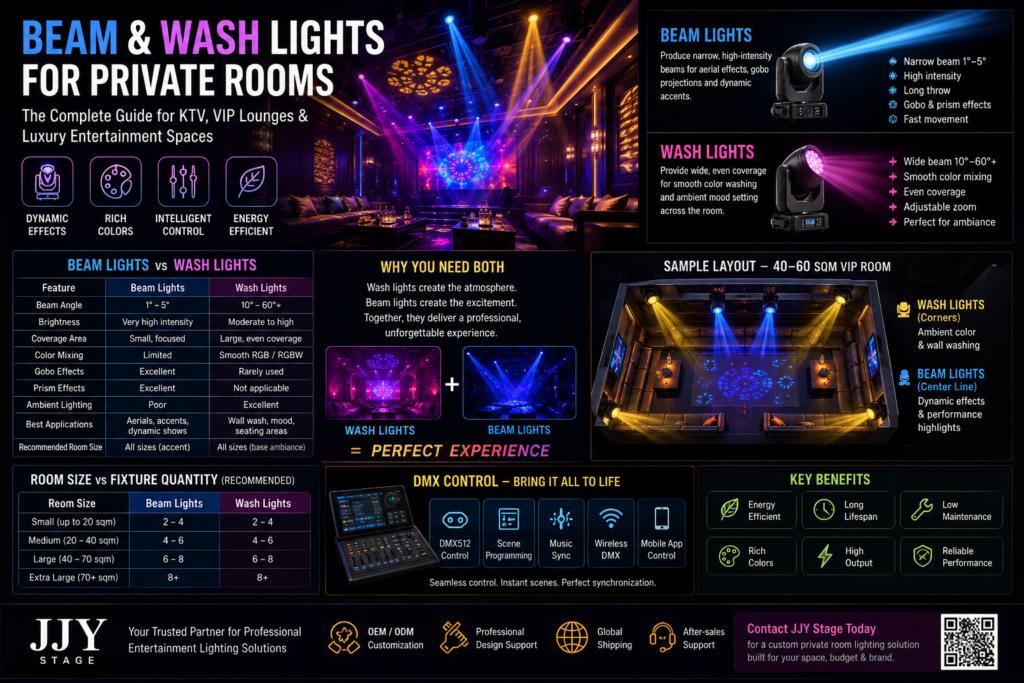
Private rooms are the heartbeat of modern KTV venues, VIP lounges, and luxury entertainment spaces and lighting is what turns an empty room into an unforgettable experience. Yet many venue owners struggle with one deceptively simple question: which fixtures actually belong on the ceiling?
Choosing the right beam and wash lights for private rooms is one of the most important and most overlooked decisions in entertainment venue design. Get it wrong, and you end up with a room that feels either sterile or overwhelming. Get it right, and every performance, celebration, or quiet evening feels intentional.
This guide breaks down everything KTV owners, karaoke operators, VIP lounge managers, architects, and AV integrators need to know: what beam and wash lights actually do, how they differ, how to combine them, and how to avoid the mistakes that quietly ruin an otherwise great room.
What Are Beam Lights?
Beam lights are moving head fixtures engineered to produce a tight, high-intensity shaft of light that travels long distances without losing focus. Instead of covering a wide area, a beam light concentrates its output into a narrow cone often between 1° and 5° creating sharp, defined lines of light that cut through haze or fog.
How beam lights work: A compact, high-output LED or discharge source sits behind a focused lens system. Because the beam angle is so narrow, the light stays concentrated even across long throws, which is why beam fixtures are the go-to choice for aerial effects, gobo projections, and rapid movement sequences.
Key characteristics of beam lights include:
- Narrow beam angles for sharp, laser-like projection
- High-intensity output that remains visible even in brightly lit rooms
- Long-distance projection with minimal light falloff
- Fast pan-and-tilt movement, ideal for dynamic effects
- Gobo and prism compatibility for pattern and multiplication effects
Typical applications: In private rooms, beam lights are used for ceiling patterns, aerial sweeps during music drops, gobo textures on walls, and high-energy visual moments during karaoke performances or celebrations.
What Are Wash Lights?
Wash lights are moving head or static fixtures designed to flood a space with smooth, even, wide-coverage illumination. Where beam lights are about precision, wash lights are about atmosphere.
How wash lights work: Wash fixtures use multiple LED sources often arranged in RGB or RGBW clusters combined with a diffusion lens or zoom system that spreads light evenly across a wide area, typically 10° to 60° or more depending on zoom settings.
Key characteristics of wash lights include:
- Wide beam coverage for full-room illumination
- Smooth color blending with minimal visible hot spots
- Ambient illumination that sets overall room mood
- Gradual color transitions for slow, atmospheric changes
- Adjustable zoom to shift between tight and broad coverage
Typical applications: In private rooms, wash lights handle wall washing, ceiling color, seating area ambiance, and the soft background tone that makes a room feel warm, romantic, energetic, or luxurious depending on the moment.
Beam Lights vs Wash Lights: What’s the Difference?
Understanding the difference between beam and wash lights is the foundation of any private room lighting design. The table below compares both fixture types side by side.
| Feature | Beam Lights | Wash Lights |
| Beam Angle | Narrow (1°–5°) | Wide (10°–60°+, adjustable) |
| Brightness | Very high intensity, concentrated | Moderate to high, evenly distributed |
| Coverage Area | Small, focused point | Large, full-room coverage |
| Color Mixing | Limited, mainly for accent effects | Smooth RGB/RGBW blending |
| Gobo Effects | Excellent, sharp pattern projection | Rarely used |
| Prism Effects | Excellent, beam multiplication | Not applicable |
| Ambient Lighting | Poor, not designed for this | Excellent, primary purpose |
| Best Applications | Aerial effects, dance floor accents, dynamic shows | Wall washing, mood lighting, seating areas |
| Recommended Room Size | Small to large rooms (accent use) | Small to large rooms (base ambiance) |
| Typical Cost Range | Mid to high, depending on output and features | Low to mid, depending on LED count and zoom range |
When beam lights perform best: During high-energy moments music drops, celebrations, dance sequences where sharp, moving light draws the eye and creates excitement.
When wash lights perform best: As the foundation layer that runs continuously, setting the room’s color temperature and mood between and around beam effects.
Why Private Rooms Need Both Beam and Wash Lights
A private room Lights with only beam lights feels harsh and clinical once the excitement fades there’s no ambient warmth to fall back on. A room lit with only wash lights feels flat during performances, lacking the dynamic energy guests expect from a premium KTV or VIP experience.
Layered lighting design solves this by combining both fixture types into a single system:
- Wash lights provide the base layer soft, even color that defines the room’s mood
- Beam lights provide the accent layer sharp, moving effects that highlight key moments
- Together, they create depth, contrast, and the sense of a professionally designed space
Practical example: In a 40 sqm VIP karaoke room, wash lights might hold a warm amber tone during quiet conversation, then shift to deep blue as the music starts. Beam lights stay dim in the background until the chorus hits, then burst into fast-moving gobo patterns across the ceiling creating a moment that feels choreographed rather than accidental.
This layered approach is also what separates a genuinely luxurious entertainment space from a room that simply has lights installed in it.
Choosing the Right Beam Lights
Selecting beam fixtures for a private room comes down to matching technical specifications to the room’s size, ceiling height, and intended use.
Key factors to evaluate:
- Wattage: Higher wattage delivers more punch through haze, but small rooms rarely need extreme output
- Beam angle: Tighter angles (1°–3°) suit dramatic aerial effects; slightly wider angles (4°–5°) work better in smaller rooms
- Brightness (lumens): Match brightness to room size overpowering a small VIP room causes glare and discomfort
- Gobo wheels: More gobo slots mean more pattern variety without needing additional fixtures
- Prism effects: Rotating prisms multiply beams for dramatic ceiling and wall effects
- Rotation speed: Faster pan/tilt motors suit high-energy venues; smoother, slower motors suit upscale lounges
- Pan and tilt range: Wider movement range increases coverage flexibility from a single mounting point
- DMX compatibility: Essential for programming, scene control, and syncing with wash fixtures
Beam light buying checklist:
- [ ] Confirm beam angle suits room dimensions and ceiling height
- [ ] Check lumen output against ambient room lighting
- [ ] Verify DMX channel count and protocol support
- [ ] Confirm gobo and prism options match desired effects
- [ ] Check pan/tilt speed and noise level (important for quiet VIP rooms)
- [ ] Request fixture lifespan and warranty documentation
- [ ] Confirm compatibility with existing or planned DMX controllers
Choosing the Right Wash Lights
Wash lights carry the ambient mood of the entire room, so getting the specification right matters just as much as beam selection.
Key factors to evaluate:
- RGB vs RGBW: RGBW adds a dedicated white LED, producing cleaner pastels and more accurate whites than RGB alone
- Zoom range: A wide zoom range (5°–60°) lets a single fixture handle both tight accent washing and broad ambient coverage
- Color mixing quality: Look for smooth blending without visible color banding or hot spots
- Dimming quality: Flicker-free, smooth dimming curves are essential for camera-friendly private rooms
- Coverage angle: Match to ceiling height and room width to avoid dark corners
- Fixture size: Compact housings matter in rooms with lower ceilings or tighter architectural finishes
- Power consumption: LED wash fixtures should offer strong output-to-wattage efficiency
Selection recommendations: For most private rooms, RGBW wash lights with a 15°–45° zoom range strike the best balance between flexibility and cost. Rooms with lower ceilings benefit from compact, wide-angle fixtures, while larger VIP halls may need higher-output units with narrower minimum zoom settings.
Designing the Ideal Beam and Wash Lighting Layout
A well-designed lighting layout distributes beam and wash fixtures across distinct functional zones rather than clustering everything in the center of the ceiling.
Core layout principles:
- Ceiling placement: Beam fixtures typically mount at ceiling corners or along a central truss line for maximum movement range
- Stage/performance area lighting: If the room includes a small stage or singing area, beam fixtures should cross-angle toward this zone for dynamic front coverage
- Dance floor coverage: Beam lights aimed downward and across the floor create movement-reactive effects
- Seating area illumination: Wash lights positioned above and around seating provide soft, non-glaring ambient color
- Wall washing: Wash fixtures angled toward walls create depth and eliminate dark, flat surfaces
- Lighting zones: Divide the room into performance zone, seating zone, and transition zone, each with its own DMX-programmed look
- Layered lighting technique: Wash lights run as a continuous base layer; beam lights trigger on cue points for accents
Sample room layout (40–60 sqm VIP room):
Picture the ceiling divided into a rectangle. Four wash lights sit at each corner, angled inward and slightly downward to flood the seating perimeter with even color. Two to four beam lights mount along the center ceiling line, angled toward the performance/singing area and dance space. A short LED strip or accent wash lines the back wall for depth. This arrangement gives the room a soft, colorful perimeter with a dynamic, high-energy core the layered effect described earlier.
DMX Controllers and Intelligent Lighting Control
Beam and wash fixtures only reach their full potential when tied together through a proper control system.
- DMX512 remains the industry-standard protocol for controlling fixture parameters color, movement, intensity, gobo selection, and more from a single console
- Wireless DMX eliminates cable runs across ceilings, simplifying installation in finished private rooms
- Scene programming allows operators to save preset looks (romantic, party, karaoke performance) and recall them instantly
- Music synchronization lets beam and wash fixtures react automatically to audio input, syncing movement and color changes to the beat
- Mobile app control gives venue staff simple, tablet- or phone-based control without needing a lighting technician on-site
- Smart lighting automation can trigger scene changes based on time of day, room occupancy, or song selection
How beam and wash fixtures work together under DMX: A single scene can program wash lights to hold a static ambient color while beam lights execute a synchronized gobo sweep all triggered from one button press or one music cue, ensuring the two fixture types always feel like one coordinated system rather than two separate installations.
Common Mistakes When Choosing Beam and Wash Lights
Even experienced venue owners fall into predictable traps when planning private room lighting.
- Choosing only beam fixtures: Creates a harsh, uncomfortable room with no ambient warmth solution: always pair with wash fixtures for a base layer
- Ignoring ambient lighting: Leaves guests in visually inconsistent spaces during quiet moments solution: program a dedicated “ambient mode” scene
- Incorrect beam angles: Too narrow in a small room causes glare; too wide wastes intensity solution: match beam angle to room dimensions before purchasing
- Wrong fixture placement: Poor mounting points create dead zones or excessive overlap solution: map out zones before installation, not after
- Poor DMX programming: Fixtures that aren’t properly addressed cause flickering or unresponsive scenes solution: work with an experienced integrator or supplier support team
- Over-lighting: Too many fixtures at full output overwhelms small rooms solution: prioritize dimming control and scene layering over raw fixture count
- Under-lighting: Too few fixtures leave dark corners and inconsistent coverage solution: use the room size vs fixture quantity table below as a baseline
- Buying incompatible fixtures: Mixing protocols or control systems that don’t integrate smoothly solution: confirm DMX compatibility across the entire fixture set before purchase
Room Size vs Recommended Fixture Quantity
| Room Size | Recommended Beam Lights | Recommended Wash Lights |
| Small (up to 20 sqm) | 2–4 | 2–4 |
| Medium (20–40 sqm) | 4–6 | 4–6 |
| Large (40–70 sqm) | 6–8 | 6–8 |
| Extra Large (70+ sqm) | 8+ | 8+ |
These figures are starting points — ceiling height, room shape, and desired effect intensity all influence the final fixture count.
Energy-Efficient Beam and Wash Lighting
Modern LED-based beam and wash fixtures dramatically reduce operating costs compared to older discharge-lamp systems.
- LED technology delivers high output with a fraction of the power draw of traditional lamps
- Smart dimming reduces energy use during low-activity periods without sacrificing visual quality
- RGBW efficiency produces cleaner color mixing with fewer LEDs needed per fixture
- Reduced maintenance since LED sources don’t require lamp replacement
- Lower operating costs across long operating hours typical of KTV and lounge environments
- Long fixture lifespan, often rated for tens of thousands of hours of use
Future Trends in Entertainment Lighting
The private room lighting category continues to evolve alongside broader entertainment lighting technology:
- Hybrid beam-wash fixtures that combine both functions in a single moving head, reducing fixture count and installation complexity
- AI-powered lighting that adjusts scenes based on music genre, tempo, or crowd activity
- Wireless DMX becoming standard rather than optional, simplifying retrofits
- Pixel mapping for more granular, individually addressable LED control across fixture arrays
- Interactive lighting that responds to guest movement or app-based input
- Cloud-based programming allowing venue groups to manage lighting scenes across multiple locations remotely
- IoT-enabled lighting systems integrated with broader smart building and AV control platforms
Frequently Asked Questions (FAQ)
What is the difference between beam and wash lights?
Beam lights produce narrow, high-intensity shafts of light for accents and dynamic effects, while wash lights produce wide, even coverage used for ambient mood and color across a room.
Which is better for private rooms?
Neither is “better” on its own private rooms perform best with both fixture types working together, wash lights for ambiance and beam lights for dynamic accents.
Do I need both beam and wash lights?
Yes, for most private entertainment rooms. Beam-only setups feel harsh, and wash-only setups lack energy during performances.
What beam angle is best for a VIP room?
A narrow 2°–4° beam angle typically works well for VIP rooms, offering sharp effects without excessive glare in a confined space.
Should I choose RGB or RGBW wash lights?
RGBW is generally recommended for private rooms, since the added white LED produces cleaner pastel tones and more accurate color mixing than RGB alone.
Are beam lights suitable for small rooms?
Yes, as long as wattage and beam angle are matched appropriately — smaller rooms typically need fewer, lower-output beam fixtures to avoid overwhelming brightness.
How many beam and wash lights are needed?
This depends on room size; refer to the room size vs fixture quantity table above as a general planning baseline.
Can they sync with music?
Yes, most modern DMX-controlled beam and wash fixtures support music synchronization through built-in sound-active modes or DMX controller audio input.
Do I need a DMX controller?
A DMX controller is strongly recommended for any multi-fixture private room setup, since it enables scene programming, synchronization, and centralized control.
Are LED beam and wash lights energy-efficient?
Yes, LED-based fixtures use significantly less power than older discharge-lamp systems while offering longer lifespans and lower maintenance needs.
What maintenance do they require?
LED beam and wash lights need periodic lens cleaning, firmware updates where applicable, and occasional motor/mechanical inspection, but require far less upkeep than lamp-based fixtures.
How do I choose the right fixtures?
Match beam angle, brightness, and coverage to room size, confirm DMX compatibility across the full system, and work with an experienced manufacturer who can advise on layout and specification.
Conclusion
Choosing the right beam and wash lights for private rooms isn’t about picking the flashiest fixture on a spec sheet it’s about understanding how narrow, high-intensity beams and smooth, wide-coverage washes work together to create layered, emotionally resonant spaces. Proper fixture selection, thoughtful layout, and intelligent DMX control are what separate a forgettable room from one guests want to return to.
Whether you’re outfitting a single VIP karaoke suite or planning a full-scale luxury entertainment venue, getting this balance right pays off in guest experience and long-term reliability.
JJY Stage designs and manufactures customized beam and wash lighting systems, intelligent DMX control solutions, and complete OEM/ODM entertainment lighting packages for KTV venues, VIP lounges, private clubs, and hotels worldwide. Contact JJY Stage today to discuss a turnkey private room lighting solution built around your exact space, budget, and brand experience.