
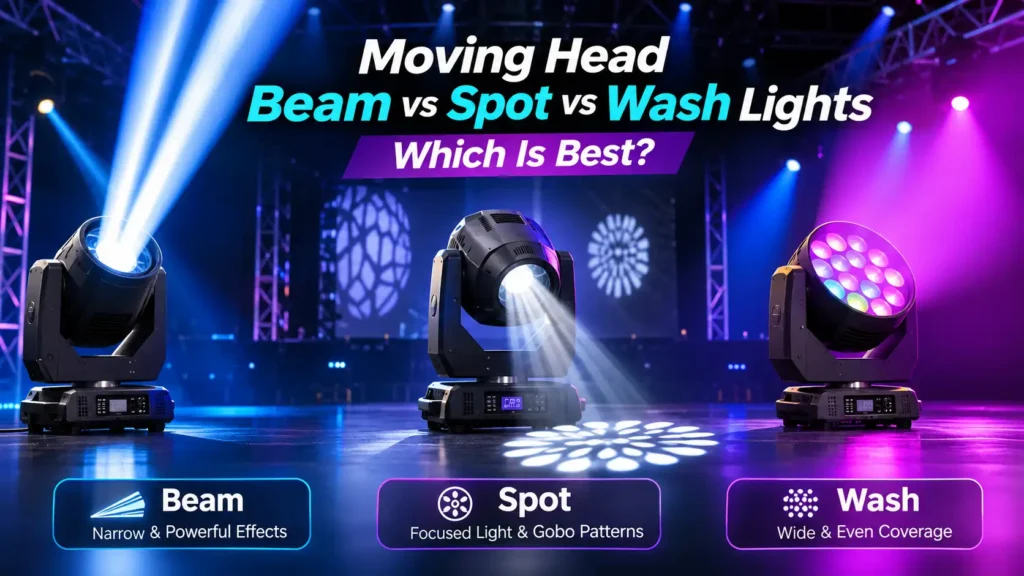
Choosing the right moving head lights can make a significant difference in the appearance and performance of any stage, concert, nightclub, or live event. Professional lighting systems help create atmosphere, highlight performers, produce dynamic visual effects, and transform ordinary venues into engaging entertainment environments.
Among the most popular professional stage lighting fixtures are moving head beam lights, moving head spot lights, and moving head wash lights. Although they may look similar, each fixture serves a different purpose in stage lighting design.
Understanding the differences between moving head beam vs spot vs wash lights can help event organizers, DJs, lighting designers, and production companies select the right equipment for their requirements.
In this guide, we explain how these three lighting fixtures work, their main features, applications, and which option is best for different event environments.
What Are Moving Head Lights?
Moving head lights are automated lighting fixtures that can move horizontally (pan) and vertically (tilt) to direct light across a stage or venue.
Unlike traditional fixed lighting fixtures, moving heads can change their direction, colors, patterns, intensity, and other lighting effects through a lighting control system.
Most professional moving head fixtures support DMX512 control, allowing lighting operators to program movements, synchronize effects, and create coordinated lighting sequences.
Moving head lights are commonly used in:
- Concerts and live music performances
- Nightclubs and DJ shows
- Theatres and stage productions
- Corporate events and exhibitions
- Wedding and entertainment venues
- Touring productions and event rental setups
The three main categories discussed in this guide are beam, spot, and wash fixtures.
What Are Moving Head Beam Lights?
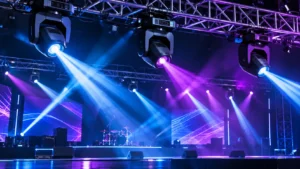
Moving head beam lights are designed to produce narrow, concentrated beams of light that create sharp visual effects in the air.
They are particularly effective in environments where lighting needs to be visible from a distance or create dramatic patterns above an audience.
Beam fixtures typically use a narrow beam angle to produce intense, defined shafts of light. When combined with atmospheric haze or fog, these beams become more visible and create striking effects.
Key Features of Beam Lights
- Narrow and concentrated beam output
- Sharp aerial lighting effects
- Fast pan and tilt movements
- Dynamic color changes
- Prism effects on supported models
- Suitable for synchronized lighting shows
Best Applications of Beam Lights
Nightclubs and DJ Shows: Beam fixtures create energetic lighting effects that move with the music and enhance the atmosphere of dance floors.
Concerts and Live Performances: They produce dramatic aerial effects and synchronized light movements during musical performances.
Large Event Productions: Beam lights can create striking visual patterns across large stages and entertainment venues.
Stage Lighting Shows: They work particularly well for fast-paced lighting sequences and dramatic transitions.
Beam lights are an excellent option when the main objective is to create powerful, narrow light effects rather than illuminate large surfaces evenly.
What Are Moving Head Spot Lights?
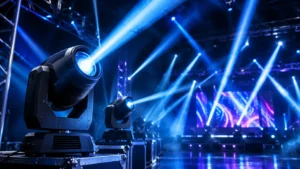
Moving head spot lights are versatile fixtures designed to project focused light with greater control over patterns and visual details.
Unlike beam fixtures, spot lights generally provide a wider optical beam and can project gobos, shapes, textures, and other visual effects.
Many professional moving head spot fixtures include adjustable focus, framing or shutter functions, color wheels, and rotating gobos, depending on the model.
These features make spot lights useful for both creative stage effects and highlighting specific areas or performers.
Key Features of Spot Lights
- Focused light projection
- Gobo patterns and image effects
- Adjustable focus on supported models
- Color selection and color effects
- Rotating gobos on selected fixtures
- Flexible positioning and movement
Best Applications of Spot Lights
Concerts and Live Performances: Spot fixtures can highlight singers, musicians, and important stage areas.
Theatre Productions: They help create focused lighting effects and emphasize specific performers or scenes.
Corporate Events: Spot lights can illuminate speakers, presentation areas, and event features.
Nightclubs: Gobo patterns and moving effects add visual variety to entertainment environments.
Moving head spot lights are a strong choice when lighting designers need a combination of focused illumination and creative projection effects.
What Are Moving Head Wash Lights?
Moving head wash lights are designed to spread light across larger areas with smooth and relatively even illumination.
Rather than producing a narrow beam or sharply defined projected patterns, wash fixtures create broad areas of colored light.
They are commonly used to illuminate performers, backgrounds, stage structures, and large event spaces.
Many LED moving head wash lights offer RGBW or other multi-color LED configurations, variable zoom, smooth dimming, and adjustable color effects, depending on the model.
Key Features of Wash Lights
- Wide light coverage
- Smooth and even illumination
- Multiple color options
- Adjustable zoom on supported models
- Smooth dimming capabilities
- Suitable for background and stage lighting
Best Applications of Wash Lights
Concert Stages: Wash lights provide broad illumination for performers and stage backgrounds.
Theatre Productions: They help establish the overall lighting atmosphere for different scenes.
Corporate Events: Wash fixtures illuminate stage backdrops, presentation areas, and event spaces.
Nightclubs and DJ Shows: They create colorful lighting effects across dance floors and venue interiors.
Wash lights are particularly useful when the goal is to illuminate a larger area rather than produce narrow beams or detailed projected patterns.
Moving Head Beam vs Spot vs Wash Lights: Key Differences
Although all three fixtures are used in professional stage lighting, their optical designs and intended applications are different.
| Feature | Beam Light | Spot Light | Wash Light |
|---|---|---|---|
| Main purpose | Narrow aerial effects | Focused projection | Broad illumination |
| Beam angle | Very narrow | Medium or adjustable | Wide or adjustable |
| Light appearance | Sharp beam | Defined light projection | Soft and spread-out light |
| Gobo effects | Model dependent | Common | Less common |
| Color effects | Yes | Yes | Yes |
| Typical use | DJ shows and concerts | Stage highlighting | Stage and background lighting |
| Best for | Aerial effects | Patterns and focus | Area coverage |
The exact beam angles, brightness, optical features, and capabilities depend on the fixture’s design and specifications.
Beam vs Spot vs Wash: Which Is Best for Different Events?
The best moving head fixture depends on the type of event, venue size, lighting design, and desired visual effects.
1. For Nightclubs and DJ Shows
Beam lights are particularly popular for nightclubs because they create sharp aerial effects and dynamic lighting movements.
However, combining beam and wash fixtures can create a more balanced lighting environment.
Beam lights provide dramatic visual effects, while wash lights add color and general illumination to the venue.
2. For Concerts and Live Music Performances
Concert lighting often requires a combination of all three fixture types.
- Beam lights create dramatic aerial effects.
- Spot lights highlight performers and produce gobo projections.
- Wash lights provide broad stage illumination.
Using different fixture types together gives lighting designers greater flexibility throughout a performance.
3. For Theatre and Stage Productions
Spot lights are particularly useful for highlighting actors, performers, and important stage elements.
Wash lights provide general illumination and help establish the atmosphere for different scenes.
Beam fixtures can also be used for specific creative effects when required by the production.
4. For Corporate Events and Exhibitions
Wash lights are useful for illuminating stage backdrops, exhibition spaces, and presentation areas.
Spot lights can highlight speakers, products, and important display elements.
Beam fixtures may be added for entrances, presentations, and special event effects.
Can You Combine Beam, Spot, and Wash Lights?
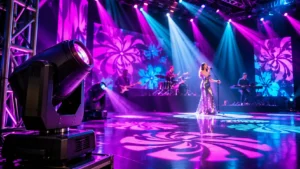
Yes. Combining all three types of moving head fixtures is often an effective approach for professional stage lighting.
Each fixture performs a different role, and using them together can produce a more complete lighting design.
For example, a concert stage might use:
- Beam lights positioned around the stage for aerial effects.
- Spot lights directed toward performers and important stage areas.
- Wash lights positioned to illuminate the stage background and create color transitions.
The number and positioning of fixtures should be determined by the stage dimensions, viewing angles, lighting requirements, and production budget.
A properly designed lighting system can deliver more flexibility than relying on a single fixture category.
What to Consider When Choosing Moving Head Lights
Before purchasing moving head beam, spot, or wash fixtures, consider the following factors.
1. Venue Size
Larger venues may require fixtures with suitable output, beam angles, and coverage capabilities.
2. Lighting Purpose
Decide whether you need aerial effects, focused projections, broad illumination, or a combination of these features.
3. Light Source and Output
Compare LED or other light-source technologies, rated output, optical performance, and fixture specifications.
4. Beam Angle and Zoom
Beam angle determines how concentrated or spread out the light appears. Wash and zoom-capable spot fixtures offer different coverage options depending on their optical design.
5. DMX Compatibility
Check DMX512 compatibility, channel modes, control options, and integration with your existing lighting console.
6. Build Quality and Cooling
Professional lighting fixtures should have suitable construction, thermal management, and components for their intended operating environment.
7. Maintenance and Technical Support
Consider spare parts availability, warranty conditions, service support, and the manufacturer’s experience.
Why Choose Professional Moving Head Lights from JJY Stage?
Selecting a reliable stage lighting supplier is important for event production companies, rental businesses, distributors, and entertainment venues.
JJY Stage offers professional stage lighting and entertainment equipment for different event and production requirements.
When evaluating moving head beam, spot, and wash fixtures, buyers should compare optical specifications, light output, control compatibility, construction quality, and available technical support.
For businesses purchasing equipment in larger quantities, it is also worth discussing product configurations, OEM customization, and project-specific requirements with the supplier.
Whether you are upgrading a nightclub lighting system, preparing a concert production, or sourcing equipment for an event rental business, choosing the right combination of lighting fixtures can improve the flexibility and performance of your setup.
Frequently Asked Questions
1. What is the main difference between beam, spot, and wash lights?
Beam lights produce narrow and concentrated aerial effects. Spot lights provide focused illumination and projection patterns, while wash lights spread light across larger areas.
2. Are moving head beam lights better than spot lights?
Neither is universally better. Beam lights are better suited to dramatic aerial effects, while spot lights offer more flexibility for focused illumination and gobo projections.
3. Which moving head lights are best for DJ shows?
Beam lights are popular for energetic DJ lighting effects. Combining them with wash lights can provide both aerial effects and broad color coverage.
4. Can moving head wash lights be used for concerts?
Yes. Wash lights are widely used in concerts to illuminate performers, stage backgrounds, and larger stage areas.
5. Do moving head lights support DMX512?
Many professional moving head fixtures support DMX512. However, buyers should confirm the supported control modes and channel configurations for each model.
6. Should I buy beam, spot, and wash lights together?
If your lighting setup requires aerial effects, performer highlighting, and broad stage illumination, combining all three can be a useful solution. Your final selection should depend on the venue, production requirements, and budget.
Final Thoughts
Moving head beam, spot, and wash lights each serve a different purpose in professional stage lighting.
Beam fixtures are ideal for sharp aerial effects, spot fixtures provide focused projections and performer highlighting, and wash fixtures create broad and colorful illumination.
For many concerts, nightclubs, and professional event productions, combining these three fixture types offers greater creative flexibility.
Before selecting equipment, consider your venue, lighting requirements, fixture specifications, and long-term operating needs.
Explore JJY Stage’s professional lighting solutions to find suitable equipment for your next concert, nightclub, or live event production.