
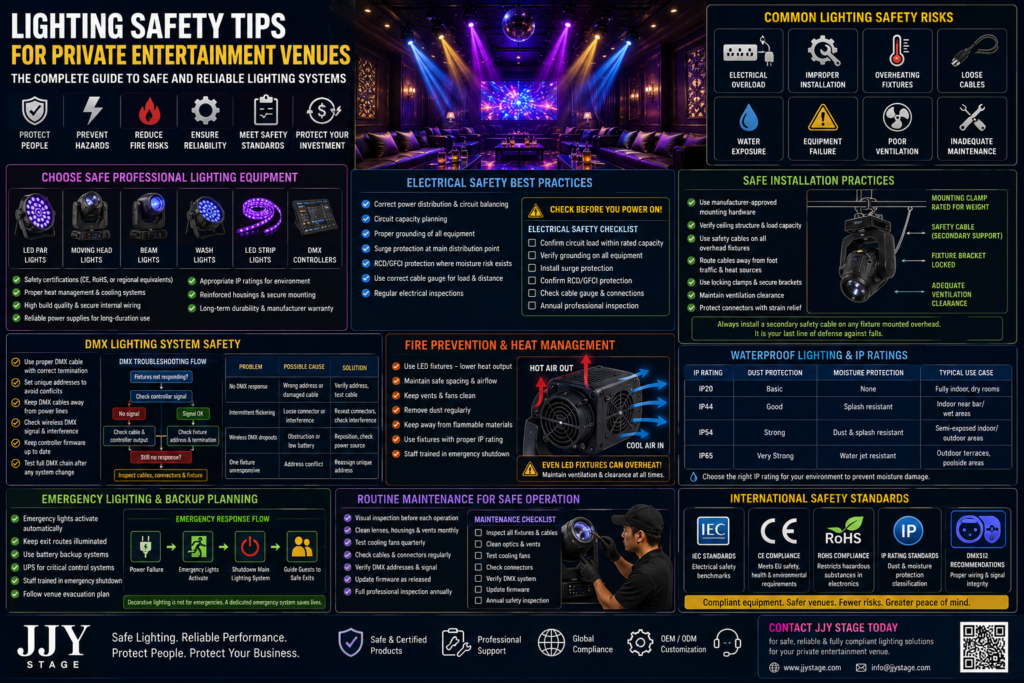
Private entertainment venues run complex lighting systems for hours every night — moving heads, beam and wash fixtures, LED strips, and DMX controllers, often installed in enclosed rooms with fog, low ventilation, and heavy guest traffic. That combination makes safety a non-negotiable part of any lighting design, not an afterthought.
These lighting safety tips for private entertainment venues cover the electrical practices, installation standards, fire prevention measures, and international compliance requirements that protect guests, staff, and equipment alike. Whether you’re a KTV owner, hotel entertainment manager, or AV integrator specifying a new system, this guide gives you a practical safety framework grounded in recognized industry standards.
Getting lighting safety right isn’t just about avoiding incidents it’s also what keeps a venue operating without costly downtime, insurance issues, or regulatory problems.
Why Lighting Safety Matters in Private Entertainment Venues
Lighting systems in private rooms combine high-power electronics, moving mechanical parts, and close proximity to guests, a combination that demands careful risk management.
- Protecting guests and staff from electrical shock, falling fixtures, or fire hazards
- Preventing electrical hazards caused by overloaded circuits or damaged wiring
- Reducing fire risks associated with overheating fixtures or poor ventilation
- Ensuring business continuity by avoiding shutdowns from safety incidents or equipment failure
- Protecting expensive lighting equipment from damage caused by unsafe electrical conditions
- Meeting local safety regulations, which is often required for licensing, insurance, and occupancy approval
A single overlooked safety issue an overloaded circuit, a damaged cable, a blocked vent can escalate into guest injury, fire damage, or an extended venue closure.
Understanding Common Lighting Safety Risks
Most lighting incidents in private entertainment venues trace back to a small set of recurring risk factors.
- Electrical overload: Too many fixtures on one circuit can trip breakers or, worse, overheat wiring
- Improper installation: Fixtures mounted without proper load calculation or secure hardware risk falling
- Overheating fixtures: Poor airflow around moving heads or LED arrays accelerates component failure
- Loose cables: Create tripping hazards and increase risk of accidental disconnection or short circuits
- Water exposure: Condensation, spills, or humidity can damage fixtures not rated for the environment
- Equipment failure: Aging or poorly maintained fixtures fail more frequently and less predictably
- Poor ventilation: Enclosed ceiling spaces trap heat, increasing fire risk and shortening fixture lifespan
- Inadequate maintenance: Skipped inspections let small issues develop into serious hazards
Real-world example: A VIP room with beam fixtures mounted directly above a low, unventilated ceiling void experienced repeated fixture shutdowns during peak summer months, a heat management issue that proper spacing and ventilation planning could have prevented from the start.
Choosing Safe Professional Lighting Equipment
Fixture selection is the first safety decision every venue makes, long before installation begins.
LED PAR Lights
Look for solid heat-sink design, certified power supplies, and stable housings that don’t rely on fragile mounting points.
Moving Head Lights
Prioritize fixtures with reinforced motor housings, safety-rated mounting brackets, and manufacturer-tested thermal management systems.
Beam Lights
High-output beam sources generate significant heat, so cooling design and certified components matter more here than in most other fixture types.
Wash Lights
Look for stable LED drivers and even heat distribution across the fixture body to avoid localized hot spots.
LED Strip Lights
Confirm proper current ratings for strip length and check for certified connectors rather than exposed wire splices.
DMX Controllers
Choose controllers with certified power supplies and stable firmware, since controller failure can affect an entire room’s lighting system at once.
Across all fixture types, prioritize:
- Safety certifications (CE, RoHS, or regional equivalents)
- Heat management through proper heat sinks and cooling fans
- Build quality with reinforced housings and secure internal wiring
- Reliable power supplies rated for consistent, long-duration use
- Proper IP ratings matched to the installation environment
- Long-term durability backed by manufacturer testing and warranty support
Electrical Safety Best Practices
Electrical safety is the foundation of every reliable lighting installation.
- Correct power distribution: Balance fixture loads across circuits rather than concentrating them on one
- Circuit capacity planning: Calculate total fixture wattage against circuit rating before installation
- Grounding requirements: Ensure all fixtures and distribution panels are properly grounded
- Surge protection: Install surge protection to shield sensitive electronics from voltage spikes
- Residual current protection (RCD/GFCI where applicable): Use RCD/GFCI protection in areas with any moisture risk
- Power cable sizing: Match cable gauge to fixture load and run length to prevent overheating
- Electrical inspections: Schedule periodic professional inspections, particularly after any system expansion
Electrical safety checklist:
- [ ] Confirm total circuit load stays within rated capacity
- [ ] Verify grounding on all fixtures and distribution equipment
- [ ] Install surge protection at the main distribution point
- [ ] Confirm RCD/GFCI protection where moisture exposure is possible
- [ ] Check cable gauge against fixture load and run length
- [ ] Schedule a professional electrical inspection at least annually
Safe Installation Practices
Installation quality determines whether a lighting system remains safe for years or becomes a recurring hazard.
- Fixture mounting: Use manufacturer-approved mounting hardware rated for the fixture’s weight
- Load calculations: Confirm ceiling structure and mounting points can support total fixture weight plus safety margin
- Secure brackets: Use locking brackets and clamps rather than improvised mounting solutions
- Ceiling and wall support: Verify structural capacity before mounting, especially in renovated spaces
- Safety cables: Fit secondary safety cables on all overhead fixtures as a fall-prevention backup
- Cable routing: Route cables away from foot traffic, sharp edges, and heat sources
- Connector protection: Use weatherproof or strain-relief connectors where cables experience movement or flexing
- Ventilation requirements: Maintain manufacturer-recommended clearance around fixtures for airflow
Installation recommendation: Always install a secondary safety cable on any fixture mounted overhead, rated independently of the primary bracket this is standard practice across professional stage and venue lighting installations.
DMX Lighting System Safety
DMX systems are generally low-voltage and low-risk, but poor wiring practices still create reliability and safety issues.
- Safe DMX wiring: Use proper DMX cable (not standard audio cable) with correct termination
- Address configuration: Set unique addresses to avoid conflicts that can cause erratic fixture behavior
- Cable separation from power lines: Route DMX cables away from high-voltage power lines to reduce interference
- Wireless DMX considerations: Verify signal range and interference levels in enclosed private rooms
- Controller maintenance: Keep controller firmware updated for stability and compatibility
- Signal reliability: Test full DMX chains after any fixture addition or cable change
Troubleshooting tips: If fixtures behave unpredictably, check for address conflicts first, then inspect cable runs for damage or improper termination before assuming a fixture-level fault.
Fire Prevention and Heat Management
Heat management is one of the most important and most underestimated safety considerations in private room lighting.
- LED vs traditional lighting heat output: LED fixtures generate significantly less heat than older discharge or incandescent sources, reducing fire risk
- Safe fixture spacing: Maintain manufacturer-recommended clearance between fixtures and surrounding materials
- Ventilation: Ensure ceiling voids and fixture housings have adequate airflow
- Cooling fans: Keep fans clean and functional to prevent internal overheating
- Dust removal: Regular dust removal prevents heat buildup inside fixture housings
- Avoiding flammable materials: Keep fixtures clear of curtains, fabric, or decorative materials that could ignite from heat exposure
- Emergency shutdown procedures: Ensure staff can quickly cut power to the lighting system in an emergency
Expert Tip: Even LED fixtures generate concentrated heat at the LED array itself — never assume “LED” automatically means “no fire risk” without proper spacing and ventilation.
Waterproof Lighting and IP Ratings
IP (Ingress Protection) ratings indicate how well a fixture resists dust and moisture critical information for any venue with fog machines, bar areas, or outdoor-adjacent installations.
What IP ratings mean: The two digits following “IP” indicate solid particle protection and liquid protection respectively for example, IP65 indicates strong dust protection and resistance to water jets.
Indoor vs outdoor fixtures: Standard indoor private room fixtures typically don’t need high IP ratings, but any fixture near bar areas, pool decks, or outdoor terraces should be rated accordingly.
Moisture protection: Fog machines and condensation can affect fixtures over time even in fully indoor rooms, so moderate moisture resistance is a reasonable baseline.
Cleaning precautions: Never use fixtures rated below the moisture exposure they’ll realistically encounter, and always power down before any cleaning near moisture-prone areas.
IP Rating Comparison Table:
| IP Rating | Dust Protection | Moisture Protection | Typical Use Case |
| IP20 | Basic | None | Fully indoor, dry rooms |
| IP44 | Good | Splash resistant | Indoor rooms near bar/wet areas |
| IP54 | Strong | Dust and splash resistant | Semi-exposed indoor/outdoor transition areas |
| IP65 | Very strong | Water jet resistant | Outdoor terraces, poolside entertainment areas |
Choosing waterproof lighting when required: Any fixture installed outdoors, near water features, or in high-humidity areas should meet at minimum an IP65 rating.
Emergency Lighting and Backup Planning
Entertainment lighting systems should never be the only source of illumination guests depend on in an emergency.
- Emergency lighting systems: Independent emergency lights should activate automatically if main power fails
- Exit route illumination: Exit paths must remain visible regardless of the state of the decorative lighting system
- Backup power: Battery backup for emergency lighting ensures continued illumination during outages
- UPS systems: Uninterruptible power supplies can protect critical control systems from sudden power loss
- Emergency shutdown: Staff should be trained on a clear, fast process for cutting power to the full lighting system
- Evacuation planning: Emergency lighting layout should align with the venue’s overall evacuation plan
Why these systems are essential: Decorative and effect lighting is not designed for emergency use a dedicated, independently powered emergency lighting system is what actually keeps exit routes visible and safe during a power failure.
Emergency response flow (text description): If main power fails, emergency lighting should activate automatically within seconds, illuminating exit routes independent of the entertainment lighting system. Staff should then execute the emergency shutdown procedure for the main lighting circuit, confirm all guests can see exit paths, and follow the venue’s evacuation plan toward marked exits.
Routine Maintenance for Safe Operation
Ongoing maintenance keeps a safely installed system safe over time.
- Fixture cleaning: Regular dust and debris removal reduces both fire risk and performance degradation
- Lens inspection: Check for cracks or damage that could allow moisture or debris intrusion
- Cable inspection: Look for fraying, exposed wire, or connector damage
- Connector testing: Verify secure, corrosion-free connections at all power and DMX points
- Firmware updates: Keep controllers and networked fixtures current for stability
- Fan maintenance: Clean and test cooling fans to confirm proper airflow
- Preventive maintenance schedule: Follow a consistent, documented maintenance calendar
Maintenance checklist:
- [ ] Inspect all fixtures and cables visually before each operating period
- [ ] Clean lenses, housings, and vents on a monthly basis
- [ ] Test cooling fans quarterly
- [ ] Verify DMX addressing and signal integrity after any system change
- [ ] Apply firmware updates as they’re released
- [ ] Schedule a full professional safety inspection annually
Common Lighting Safety Mistakes to Avoid
| Common Risk | Example Impact | Recommended Solution |
| Overloading electrical circuits | Tripped breakers, wiring overheating | Calculate load before adding fixtures |
| Blocking ventilation | Overheating, reduced fixture lifespan | Maintain manufacturer clearance around fixtures |
| Using damaged cables | Shock or fire risk | Inspect and replace damaged cables promptly |
| Ignoring safety cables | Risk of fixture falling | Fit safety cables on all overhead fixtures |
| Incorrect fixture mounting | Structural failure risk | Use rated brackets and verify ceiling load capacity |
| Poor cable management | Tripping hazards, cable damage | Route and secure cables away from foot traffic |
| Skipping inspections | Small issues become major failures | Follow a documented inspection schedule |
| Using unsuitable fixtures | Moisture or heat damage | Match fixture IP rating and thermal design to the environment |
International Lighting Safety Standards
Compliance with recognized standards gives venue owners confidence that equipment has been tested against consistent safety benchmarks.
- IEC electrical safety standards provide internationally recognized benchmarks for electrical equipment safety
- DMX512 recommendations guide proper wiring, termination, and signal integrity practices
- CE compliance indicates conformity with relevant European health, safety, and environmental protection standards
- RoHS compliance restricts hazardous substances in electronic components
- IP rating standards provide a standardized system for describing dust and moisture protection
- Best practices from professional entertainment lighting organizations such as PLASA, ESTA, and USITT help inform safe design and installation practices
Why compliance matters: Standards-compliant equipment has typically undergone more rigorous testing, giving venue owners greater confidence in long-term reliability and reducing liability exposure.
Frequently Asked Questions (FAQ)
Why is lighting safety important?
Lighting safety protects guests and staff from electrical and fire hazards, prevents costly equipment damage, and helps venues meet regulatory and insurance requirements.
How often should lighting systems be inspected?
A full professional safety inspection is recommended at least annually, with regular visual and functional checks performed more frequently as part of routine maintenance.
What causes entertainment lighting failures?
Common causes include electrical overload, poor ventilation, damaged cables, inadequate maintenance, and using fixtures unsuited to their installation environment.
What is the safest lighting technology?
LED fixtures are generally considered the safest modern option due to lower heat output and reduced fire risk compared to older lighting technologies.
Are LED lights safer than traditional fixtures?
Yes, LED fixtures produce significantly less heat than incandescent or discharge lighting, reducing both fire risk and burn hazard during handling or maintenance.
What IP rating should indoor entertainment lighting have?
Most fully indoor private room fixtures perform well at IP20–IP44, while fixtures near bar areas or moisture exposure should meet IP54 or higher.
How do I prevent electrical overload?
Calculate total fixture wattage against circuit capacity before installation, and distribute fixtures evenly across multiple circuits rather than concentrating load.
Do moving head lights require special maintenance?
Yes, their motors, gears, and cooling fans need more frequent inspection than static fixtures to maintain both performance and safety.
What safety checks should be performed before events?
A pre-event check should confirm secure fixture mounting, functional safety cables, clear ventilation, and proper cable management with no visible damage.
Can DMX cables run alongside power cables?
DMX cables should be routed separately from high-voltage power lines where possible to reduce interference and maintain signal reliability.
How can I reduce fire risks?
Use LED fixtures with proper heat management, maintain adequate ventilation and spacing, keep flammable materials clear of fixtures, and follow a regular cleaning schedule.
What international safety standards should I look for?
Look for IEC electrical safety compliance, CE and RoHS certification, appropriate IP ratings, and adherence to DMX512 wiring recommendations.
Conclusion
Following consistent lighting safety tips for private entertainment venues protects guests, staff, and equipment while keeping a venue running without costly interruptions. Quality equipment, professional installation, routine maintenance, and compliance with recognized international standards form the foundation of any safe, reliable entertainment lighting system.
Safety isn’t a one-time checklist it’s an ongoing commitment that pays off in guest confidence, regulatory compliance, and long-term equipment reliability.
JJY Stage designs and manufactures safe, certified, and customized entertainment lighting systems, intelligent DMX control solutions, and complete OEM/ODM lighting packages for KTV venues, VIP lounges, hotels, and private clubs worldwide. Contact JJY Stage today to discuss a safe, reliable, and fully compliant turnkey lighting solution for your venue.