
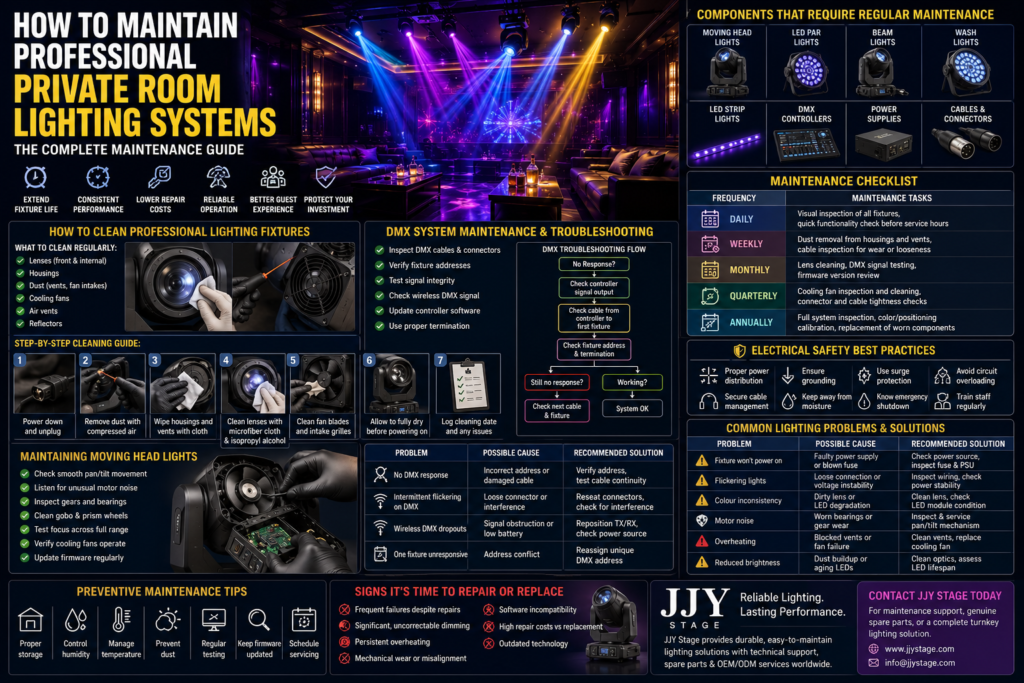
A beam and wash lighting system can transform a private room into a show-stopping experience but only if it keeps working the way it did on day one. Too many venue owners invest heavily in fixtures, then let maintenance slide until something fails mid-performance.
Knowing how to maintain professional private room lighting systems is what separates venues with reliable, consistent lighting from those constantly fighting flickering fixtures, dead motors, and DMX dropouts. This guide walks through the maintenance schedules, cleaning procedures, troubleshooting steps, and safety practices that keep KTV, VIP, and entertainment lighting systems performing at their best for years.
Whether you manage a single karaoke suite or a multi-room entertainment venue, this guide gives facility managers, lighting technicians, and AV integrators a practical framework for protecting their lighting investment.
Why Regular Lighting Maintenance Matters
Private room lighting systems run long hours, often in warm, enclosed spaces with fog, haze, and heavy usage cycles. Without a maintenance routine, that environment accelerates wear on motors, lenses, and electronics.
Regular maintenance delivers several concrete benefits:
- Extending fixture lifespan by reducing strain on motors, LEDs, and cooling systems
- Maintaining consistent lighting performance so color and brightness stay uniform across fixtures
- Reducing repair costs by catching small issues before they become expensive failures
- Improving guest experiences through reliable, glitch-free lighting during every event
- Preventing unexpected downtime that can disrupt bookings and performances
- Protecting your investment in what is often one of the most expensive parts of a private room build-out
Venues that treat maintenance as routine not reactive consistently report fewer fixture replacements and lower long-term operating costs.
Components That Require Regular Maintenance
Every element of a private room lighting system has its own maintenance needs. Understanding each component helps technicians prioritize inspection time.
Moving Head Lights
Moving Head Lights combine motors, gears, optics, and electronics in a single housing, making them the most maintenance-intensive fixture type. Pan/tilt mechanisms, gobo wheels, and cooling fans all need periodic attention.
LED PAR Lights
LED PAR fixtures are relatively low-maintenance but still require lens cleaning and heat-sink dust removal to maintain consistent color and brightness output.
Beam Lights
Beam fixtures rely on precise optics and high-output sources, so lens clarity and cooling performance directly affect beam sharpness and intensity over time.
Wash Lights
Wash fixtures need consistent color calibration and clean diffusion lenses to maintain the smooth, even blending that private rooms depend on for ambiance.
LED Strip Lights
Strip lighting should be checked for connector corrosion, adhesive/mounting integrity, and consistent color output across the full run.
DMX Controllers
Controllers require software updates, backup of saved scenes, and periodic verification that all connected fixtures still respond correctly to programmed cues.
Power Supplies
Power supplies should be inspected for overheating, voltage stability, and secure connections, since a failing power supply can affect multiple fixtures at once.
Cables and Connectors
DMX and power cables endure regular flexing and handling; connectors should be checked for corrosion, looseness, or wear that could cause signal or power interruptions.
Daily, Weekly, Monthly, and Annual Maintenance Checklist
A structured maintenance schedule keeps tasks manageable and ensures nothing gets overlooked.
| Frequency | Maintenance Tasks |
| Daily | Visual inspection of all fixtures, quick functionality check before service hours |
| Weekly | Dust removal from housings and vents, cable inspection for wear or looseness |
| Monthly | Lens cleaning, DMX signal testing, firmware version review |
| Quarterly | Cooling fan inspection and cleaning, connector and cable tightness checks |
| Annually | Full system inspection, color/positioning calibration, replacement of worn components |
Expert Tip: Keep a simple maintenance log for each room. Recording dates and findings makes it far easier to spot recurring issues before they turn into fixture failures.
How to Clean Professional Lighting Fixtures
Proper cleaning protects optical clarity and cooling efficiency two of the biggest factors in consistent lighting output.
What to clean regularly:
- Lenses: Front and internal lenses affect beam sharpness and brightness directly
- Housings: Dust buildup on housings can trap heat and affect internal components
- Dust removal: Focus on vents, fan intakes, and internal optics where dust accumulates fastest
- Cooling fans: Blocked or dusty fans reduce cooling efficiency and shorten LED lifespan
- Air vents: Keep intake and exhaust vents clear to maintain proper airflow
- Reflectors: Clean reflectors preserve maximum light output and even color rendering
Safe cleaning materials: Use lint-free microfiber cloths, compressed air for dust removal, and isopropyl alcohol (in moderation) for lens surfaces. Avoid abrasive materials or household glass cleaners, which can damage optical coatings.
Step-by-step cleaning guide:
- Power down and unplug the fixture completely before cleaning
- Remove surface dust with compressed air, working from top to bottom
- Wipe housings and vents with a dry or lightly dampened microfiber cloth
- Clean front and internal lenses gently with a microfiber cloth and small amount of isopropyl alcohol
- Inspect and clean cooling fan blades and intake grilles
- Allow the fixture to fully dry before powering back on
- Log the cleaning date and any issues noticed during the process
Cleaning precautions: Always disconnect power before cleaning, avoid spraying liquids directly onto fixtures, and allow adequate drying time before reconnecting power.
Maintaining Moving Head Lights
Moving heads require more attention than static fixtures due to their mechanical complexity.
- Pan and tilt mechanisms: Check for smooth, consistent movement without grinding or hesitation
- Motors: Listen for unusual noise, which often signals early motor wear
- Bearings: Inspect for excess play or resistance during movement
- Gobo wheels: Clean gently and check for proper alignment and rotation
- Prism wheels: Verify smooth rotation and clean optical surfaces
- Focus system: Test focus consistency across the full zoom range
- Cooling fans: Confirm fans engage properly under load and aren’t obstructed
- Firmware updates: Apply manufacturer firmware updates to maintain compatibility and fix known bugs
Inspection recommendation: Run a full pan/tilt/gobo/prism cycle test monthly, listening and watching for irregularities that wouldn’t be obvious during normal operation.
DMX System Maintenance and Troubleshooting
DMX issues are among the most common and most preventable lighting system problems in private rooms.
- DMX512 cable inspection: Check connectors for bent pins, corrosion, or loose connections
- Address verification: Confirm fixture DMX addresses match the controller’s programming, especially after any fixture swap
- Signal testing: Test signal integrity at the end of long cable runs, where degradation is most likely
- Wireless DMX checks: Verify transmitter/receiver pairing and signal strength in wireless setups
- Controller software updates: Keep console or software firmware current to avoid compatibility issues
- Common DMX problems: Address conflicts, damaged cables, incorrect termination, and interference are frequent culprits
- Preventive troubleshooting: Test the full DMX chain after any system change, not just the fixture that was modified
DMX troubleshooting flow (text description): Start by confirming the controller is sending signal checks for activity indicators. If signal is present, verify cable continuity from controller to first fixture, then fixture to fixture down the chain. If a specific fixture fails to respond, check its DMX address and termination resistor placement. If the entire chain fails, suspect the controller output or the first cable segment rather than individual fixtures.
| Problem | Possible Cause | Recommended Solution |
| No DMX response | Incorrect address or damaged cable | Verify address, test cable continuity |
| Intermittent flickering on DMX | Loose connector or interference | Reseat connectors, check for signal interference |
| Wireless DMX dropouts | Signal obstruction or low battery | Reposition transmitter/receiver, check power source |
| One fixture unresponsive | Address conflict | Reassign unique DMX address |
Electrical Safety Best Practices
Electrical safety protects both equipment and personnel in any private room lighting installation.
- Power distribution: Ensure circuits are properly rated for total connected fixture load
- Grounding: Confirm all fixtures and distribution equipment are properly grounded
- Surge protection: Use surge protection to shield sensitive electronics from voltage spikes
- Circuit loading: Avoid overloading circuits, especially when adding fixtures to existing installations
- Cable management: Route and secure cables to prevent tripping hazards and physical damage
- Moisture protection: Keep electrical connections away from condensation, spills, or humidity sources
- Emergency shutdown procedures: Ensure staff know how to safely cut power in an emergency
Common Lighting Problems and Solutions
| Problem | Possible Cause | Recommended Solution |
| Fixture won’t power on | Faulty power supply or blown fuse | Check power source, inspect fuse and power supply |
| Flickering lights | Loose connection or voltage instability | Inspect wiring, check power stability |
| DMX signal loss | Damaged cable or address conflict | Test cable continuity, verify addressing |
| Colour inconsistency | Dirty lens or LED degradation | Clean lens, check LED module condition |
| Motor noise | Worn bearings or gear wear | Inspect and service pan/tilt mechanism |
| Overheating | Blocked vents or fan failure | Clean vents, inspect and replace cooling fan |
| Reduced brightness | Dust buildup or aging LEDs | Clean optics, assess LED module lifespan |
Preventive Maintenance Tips to Extend Fixture Lifespan
- Proper storage: Store spare fixtures in dry, dust-free, temperature-controlled conditions
- Environmental control: Manage room humidity and temperature to reduce component stress
- Temperature management: Ensure adequate airflow around fixtures, especially in enclosed ceiling spaces
- Dust prevention: Use fixture covers where appropriate and maintain clean HVAC filters nearby
- Regular testing: Run functional tests even during periods of lower venue usage
- Firmware updates: Apply updates promptly to fix bugs and maintain compatibility
- Scheduled servicing: Book periodic professional servicing rather than waiting for visible failures
Expert Tip: Fixtures mounted near fog or haze machines require more frequent lens cleaning residue builds up faster than in dry-air environments.
Signs It’s Time to Repair or Replace Lighting Fixtures
- Frequent failures: Recurring issues despite repairs often signal end-of-life components
- Reduced brightness: Significant, uncorrectable dimming after cleaning suggests LED degradation
- Overheating: Persistent overheating despite proper cleaning may indicate failing internal components
- Mechanical wear: Grinding, hesitation, or misalignment in moving parts that cleaning can’t resolve
- Software incompatibility: Older fixtures that can’t support current DMX features or firmware
- Increased maintenance costs: When repair costs approach replacement cost, replacement is usually the better investment
- Outdated technology: Older fixtures may lack the efficiency, color accuracy, or control features of current models
Repair vs. replace guidance: As a general rule, if a fixture is under half its rated lifespan and the fault is isolated (a single component), repair is usually cost-effective. Beyond that point, or with recurring multi-component issues, replacement typically offers better long-term value.
Future Trends in Lighting Maintenance
- AI-powered diagnostics that flag abnormal fixture behavior before visible failure occurs
- Remote monitoring allowing technicians to check fixture status without an on-site visit
- Predictive maintenance using usage data to schedule servicing before problems arise
- IoT-enabled fixtures that report operating hours, temperature, and error codes automatically
- Cloud-based management for tracking maintenance history across multiple venues or rooms
- Smart maintenance alerts that notify staff automatically when a fixture needs attention
Frequently Asked Questions (FAQ)
How often should private room lighting systems be maintained?
Most systems benefit from daily visual checks, weekly dust removal, monthly deeper cleaning and DMX testing, and a full annual inspection.
How do I clean LED lighting fixtures safely?
Power down the fixture, remove dust with compressed air, and clean lenses and housings with a microfiber cloth and small amounts of isopropyl alcohol, avoiding abrasive materials.
How long do professional LED lights last?
Quality LED fixtures are often rated for tens of thousands of hours, though actual lifespan depends on usage patterns, heat management, and maintenance quality.
What causes DMX communication issues?
Common causes include damaged cables, incorrect fixture addressing, loose connectors, and signal interference in wireless setups.
How can I prevent lighting system failures?
Following a structured maintenance schedule, keeping fixtures clean, managing heat and dust, and applying firmware updates promptly all reduce failure risk significantly.
How often should firmware be updated?
Firmware should be reviewed monthly and updated whenever the manufacturer releases a stability, compatibility, or feature update.
Are moving head lights difficult to maintain?
They require more attention than static fixtures due to motors and mechanical parts, but regular inspection and cleaning keep them reliable long-term.
When should lighting fixtures be replaced?
Replacement is generally recommended when repair costs approach replacement cost, or when a fixture shows persistent multi-component failures.
How can I reduce maintenance costs?
Preventive maintenance, proper environmental control, and choosing durable, well-supported fixtures from the start all reduce long-term maintenance expenses.
What tools are needed for lighting maintenance?
Basic tools include microfiber cloths, compressed air, isopropyl alcohol, a DMX tester, and standard hand tools for housing access and connector checks.
Can regular maintenance improve energy efficiency?
Yes, clean lenses, well-maintained cooling systems, and updated firmware all help fixtures operate at their intended efficiency rather than compensating for buildup or wear.
What is the best maintenance schedule for entertainment venues?
A tiered schedule of daily checks, weekly cleaning, monthly deeper maintenance, quarterly mechanical inspection, and annual full servicing covers most private room lighting needs effectively.
Conclusion
Learning how to maintain professional private room lighting systems isn’t a one-time task it’s an ongoing discipline that protects both guest experience and equipment investment. Preventive care, structured inspection schedules, and intelligent system management are what keep beam, wash, and moving head fixtures performing reliably year after year.
Venues that build maintenance into their regular operations consistently see fewer breakdowns, lower repair costs, and more consistent lighting quality across every event.
JJY Stage supplies durable, easy-to-maintain professional lighting fixtures along with technical support, spare parts, and complete OEM/ODM manufacturing for KTV venues, VIP lounges, hotels, and entertainment businesses worldwide. Contact JJY Stage today for maintenance support, genuine spare parts, or a complete turnkey private entertainment lighting solution built to last.