
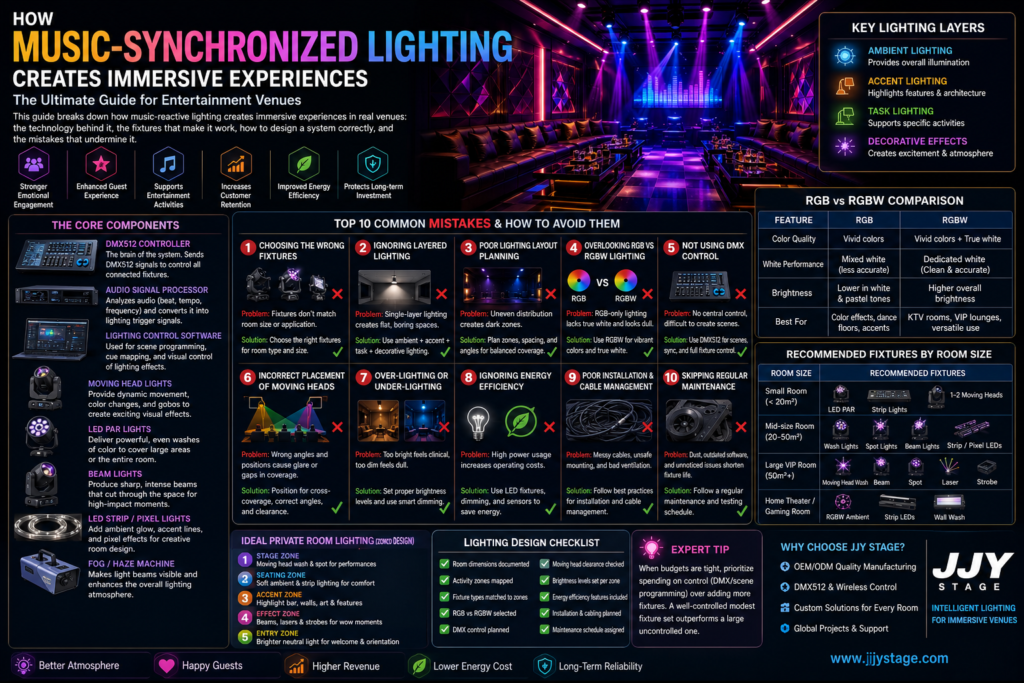
Walk into a KTV room, nightclub, or VIP lounge where the lighting shifts, pulses, and changes color exactly on the beat, and the room feels alive in a way flat, static lighting never achieves. That effect isn’t luck — it’s music-synchronized lighting, engineered with the right fixtures, control systems, and design planning.
This guide breaks down how music-reactive lighting creates immersive experiences in real venues: the technology behind it, the fixtures that make it work, how to design a system correctly, and the mistakes that undermine it. Whether you’re a KTV owner planning a new room, a nightclub operator upgrading your rig, or an AV integrator specifying equipment, this is a practical field guide rather than marketing theory.
JJY Stage designs and manufactures the intelligent lighting systems behind many of these installations, and the principles below reflect what consistently works across venue types and room sizes.
What Is Music-Synchronized Lighting?
Definition. Music-synchronized lighting is a lighting system that changes color, intensity, movement, or pattern in real time based on the music playing in a venue, creating a coordinated audiovisual experience rather than lighting and sound operating independently.
How music-reactive lighting works. An audio signal — either a live microphone feed, a direct line-in from a mixer, or a pre-programmed cue track — is analyzed for beat, tempo, and frequency. That analysis triggers lighting changes through a controller, so a bass hit might trigger a strobe flash while a rising melody shifts color gradually.
Difference between sound-activated and programmed lighting. Sound-activated lighting reacts automatically to whatever audio it detects, useful for live or unpredictable music but less precise. Programmed lighting, built on DMX lighting control and scene programming, is pre-mapped to specific songs or cue points, giving exact, repeatable results — most professional KTV and karaoke lighting systems use a combination of both.
Why synchronization matters in entertainment venues. Lighting that lags or mismatches the music breaks immersion instantly; guests notice a beat drop with no visual response far more than they notice good synchronization. Getting the timing right is what separates entertainment lighting from ordinary room lighting.
Why Synchronized Lighting Enhances Immersive Experiences
Emotional engagement. Coordinated light and sound trigger a stronger emotional response than either alone — this is the same principle concerts and theme parks have used for decades, now standard in KTV and nightclub design.
Dynamic visual effects. Beat-synced color changes, moving beams, and pixel effects keep a room visually interesting over a multi-hour session, where static lighting would start to feel monotonous.
Improved guest experience. Guests actively performing — singing karaoke, dancing — feel more confident and engaged when the room’s lighting responds to what they’re doing, reinforcing the sense of a live show.
Enhanced performances. For karaoke and KTV specifically, synchronized lighting elevates an amateur performance into something that feels produced, which is a major part of what guests are paying for.
Increased customer retention. Venues with a genuinely immersive atmosphere see guests stay longer and return more often — lighting quality is a measurable factor in repeat bookings for KTV and VIP rooms.
Social media appeal. Dynamic, synchronized lighting photographs and films dramatically better than flat lighting, and guest-generated content from a visually striking room is free marketing.
Luxury venue atmosphere. In VIP lounges and premium clubs, synchronized lighting is part of what justifies premium pricing — it signals a produced, high-end experience rather than a basic rental space.
Core Components of a Music-Synchronized Lighting System
A functioning music synchronized lighting system depends on several components working together — remove or under-spec any one of them and the whole system underperforms.
DMX512 Controller
The controller is the system’s brain, sending DMX512 signals to every connected fixture to control color, movement, intensity, and timing. It’s what turns individual fixtures into one coordinated system.
Audio Signal Processor
This component analyzes incoming audio — beat, tempo, frequency bands — and converts that analysis into trigger signals the controller can act on, forming the link between sound and light.
Lighting Control Software
Software layers on top of the controller for scene programming, cue mapping, and — in modern systems — visual programming interfaces that let designers build complex sequences without manual DMX coding.
Moving Head Lights
Moving head lights physically pan, tilt, and change color/gobo in real time, delivering the dynamic movement most associated with music-reactive lighting effects.
LED PAR Lights
LED PAR lights provide broad, even color washes across a room or stage area, forming the base color layer that other fixtures work on top of.
Beam Lights
Beam lights produce tight, high-intensity beams ideal for sharp, fast beat-synced effects — the visual “hits” that land exactly on strong beats.
Wash Lights
Wash lights flood a wider area with soft, even color, used for smoother musical transitions and ambient color changes rather than sharp beat hits.
Pixel LED Fixtures
Pixel LED fixtures (strips, panels, or matrices) allow individually addressable points of light, enabling pixel mapping effects that ripple, chase, or animate in sync with music in ways single-color fixtures can’t.
Laser Lights
Laser lights add high-impact beam patterns and aerial effects, typically reserved for peak musical moments given their intensity and the safety considerations involved.
Each component depends on the others: a powerful controller with weak fixtures underdelivers, and excellent fixtures with no audio processor or control software just run static or manual cues instead of true audio-reactive lighting.
Best Lighting Effects for Music Synchronization
Different effects suit different moments in a song or session — using the right effect at the right time is what makes synchronized lighting feel intentional rather than random.
Beat-synced color changes. Sharp color shifts timed to strong beats, ideal for high-energy choruses and drops.
Moving beam effects. Fast pan/tilt beam movement adds kinetic energy during build-ups and high-tempo sections.
Wash lighting transitions. Slow, smooth color fades suit verses, ballads, and quieter musical passages where sharp effects would feel jarring.
Gobo projections. Patterned light projections add texture and visual interest without requiring additional color or movement complexity.
Prism effects. Prism attachments split beams into multiple points, multiplying visual impact from a single fixture during peak moments.
Pixel mapping. Individually controlled LED points create chasing, rippling, or wave-like effects synchronized to rhythm — a signature look in modern KTV and club lighting.
Laser patterns. Geometric laser patterns work well for instrumental breaks or climactic moments, used sparingly for maximum impact.
Strobe effects. Short, sharp strobe bursts emphasize drops and high-energy peaks but should be used briefly and infrequently — overuse is one of the most common mistakes covered later in this guide.
Ambient mood lighting. Soft, static or slow-shifting color between songs or during quieter moments prevents the room from feeling lighting-fatigued by constant fast effects.
Expert Tip: Reserve strobe and laser effects for genuine peak moments — a song’s chorus or drop — rather than running them continuously. Contrast is what makes these effects land; constant use dulls their impact and can cause guest discomfort.
DMX Controllers and Music Synchronization
DMX lighting control is the backbone that makes reliable, repeatable sound activated lighting possible at a professional level.
DMX512 protocol. This industry-standard protocol allows a single controller to individually address hundreds of channels across dozens of fixtures, coordinating color, movement, and intensity in real time.
Scene programming. Designers pre-program lighting scenes tied to specific songs, tempos, or moments, so a controller can recall an exact, tested look instantly rather than relying purely on live automatic reaction.
Automated lighting cues. Cues can be set to trigger automatically based on time, audio input, or manual button press, giving venue staff simple control without needing lighting programming knowledge during a live session.
Real-time synchronization. Modern audio-to-DMX processors analyze incoming sound with minimal latency, keeping lighting changes tight enough to the beat that guests perceive them as instantaneous.
Wireless DMX. Wireless DMX removes the need for extensive control cabling between fixtures and controller, which is especially valuable in KTV and karaoke retrofits where running new cable is impractical.
Mobile app integration. App-based control lets venue staff switch scenes, adjust brightness, or trigger effects from a smartphone or tablet, removing the need for a dedicated lighting technician in smaller venues.
Multi-room lighting control. In multi-room KTV or hotel entertainment properties, centralized software can manage synchronized lighting across several rooms simultaneously, each running independent scenes from one management system.
Music synchronization workflow (text description):
- Audio source (microphone, mixer line-in, or media player) feeds into the audio signal processor
- The processor analyzes beat, tempo, and frequency in real time
- Analyzed data is converted into trigger signals
- Trigger signals are sent to the DMX512 controller
- The controller maps triggers to pre-programmed scenes and cues
- DMX signals are distributed (wired or wireless) to individual fixtures
- Fixtures execute color, movement, and intensity changes in sync with the music
- Staff or automated software can override, adjust, or switch scenes at any point in the chain
This workflow is what allows a room to shift convincingly from ambient background music to a full beat-synced light show without a lighting operator manually running every cue.
Designing a Music-Synchronized Lighting System
A system is only as good as its underlying design — strong fixtures and controllers still underperform in a poorly planned room.
Room layout planning. Map the room’s activity zones (stage, seating, dance area) before placing fixtures, so lighting design supports how the space is actually used.
Fixture placement. Position moving heads, wash lights, and beam lights so their coverage overlaps intentionally rather than leaving gaps or over-concentrating in one area.
Lighting zones. Divide the room into independently controllable zones so different areas can run different scenes — critical for larger KTV halls or multi-use VIP lounges.
Ceiling height. Higher ceilings support tighter beam angles and more dramatic moving head throw; lower ceilings need wider angles and lower-glare fixture placement to avoid discomfort.
Speaker positioning. Audio and lighting should be planned together — microphone and speaker placement affects how cleanly the audio signal processor can read tempo and beat, especially in rooms using live vocal input.
Cable management. Route DMX and power cabling separately, label every run, and plan access points for future fixture changes or repairs.
Future scalability. Choose DMX-ready, network-capable equipment even for a single-room build, so expansion to additional rooms doesn’t require replacing the original system.
Room layout checklist:
- [ ] Activity zones mapped before fixture placement
- [ ] Fixture types assigned per zone (wash, beam, moving head, pixel)
- [ ] Independent DMX zone control planned for each area
- [ ] Ceiling height and ceiling clearance confirmed for moving head throw
- [ ] Audio input source and microphone placement coordinated with lighting design
- [ ] Cable routing planned separately for power and DMX/control lines
- [ ] Scalability confirmed for future room or venue expansion
Choosing the Right Lighting Fixtures
Different fixtures serve different roles in a music synchronized lighting system — matching fixture type to purpose is essential to getting the intended effect.
| Fixture Type | Strength | Best Use |
| Moving Head Beam Lights | Sharp, high-intensity beams with fast movement | Beat-synced hits, high-energy drops |
| Moving Head Wash Lights | Soft, even color coverage with movement | Smooth transitions, ambient color shifts |
| Moving Head Spot Lights | Focused beam with gobo/pattern projection | Performer highlighting, gobo effects |
| Hybrid Fixtures | Combine beam, wash, and spot in one unit | Smaller rooms needing versatility from fewer fixtures |
| LED PAR Lights | Broad, even wash coverage, compact | Base ambient and accent lighting layers |
| RGB/RGBW LED Strips | Flexible, addressable, easy to conceal | Architectural accents, pixel-style effects |
| Pixel LED Fixtures | Individually addressable points | Pixel mapping, chasing/rippling effects |
| Laser Lights | High-impact beam and aerial patterns | Peak musical moments, climactic effects |
For most KTV lighting and karaoke lighting installations, a combination of moving head wash/beam fixtures, LED PAR lights for base coverage, and pixel LED or RGBW strips for accenting delivers the most versatile music-synchronized results without overspending on fixtures a smaller room can’t fully utilize.
Common Mistakes to Avoid
Even well-specified systems underperform when execution misses these common pitfalls.
| Mistake | Practical Solution |
| Overusing strobe effects | Reserve strobe for genuine peak moments; overuse causes fatigue and discomfort |
| Poor audio synchronization | Use a dedicated audio signal processor with low latency, not a basic sound-activated mic |
| Incorrect DMX addressing | Document and test every fixture’s DMX address before final programming |
| Uneven lighting coverage | Plan fixture placement around mapped activity zones, not guesswork |
| Excessive brightness | Set brightness baselines per zone and use dimming rather than running fixtures at full output |
| Ignoring maintenance | Follow a scheduled cleaning and testing routine (see maintenance checklist below) |
| Poor fixture placement | Confirm beam angles, clearance, and cross-coverage during layout planning, not after installation |
Installation checklist:
- [ ] Fixtures mounted to load-rated points suitable for dynamic movement
- [ ] DMX and power cabling routed separately and labeled at both ends
- [ ] Audio input tested for clean signal with minimal latency
- [ ] Beam clearance confirmed for all moving head fixtures
- [ ] Full scene programming tested before final ceiling/wall closure
- [ ] Ventilation confirmed for enclosed fixture mounting locations
Energy-Efficient Music-Reactive Lighting
Energy efficiency directly affects the long-term operating cost of an intelligent lighting system running for hours nightly.
LED technology. Modern LED fixtures across moving heads, PAR lights, and strips use significantly less power than older lamp-based fixtures while matching or exceeding their brightness and color range.
Smart dimming. Programmed dimming during quieter musical passages or lower-occupancy periods cuts consumption without any visible loss of effect when done well.
Energy savings. Combined with scene programming that avoids running every fixture at full output simultaneously, LED-based systems can meaningfully lower a venue’s overall lighting energy cost.
Long lifespan. LED fixtures rated for tens of thousands of hours reduce replacement frequency compared to legacy lamp fixtures common in older installations.
Reduced maintenance. Fewer lamp replacements and lower heat output (which reduces cooling load) both compound into lower total maintenance cost over time.
Sustainable entertainment lighting. For venues marketing themselves on modern, premium positioning, energy-efficient LED systems support that image while cutting operating costs — a rare case where sustainability and cost savings align directly.
Maintenance checklist:
- [ ] Clean fixture lenses and housings monthly
- [ ] Test full DMX addressing and scene recall quarterly
- [ ] Inspect and tighten mounting hardware quarterly
- [ ] Update controller and fixture firmware as released
- [ ] Inspect cabling and connectors twice yearly
- [ ] Log fixture run-hours to plan proactive replacement
Future Trends in Music-Reactive Lighting
Music-reactive lighting continues to evolve as control technology and connectivity improve.
AI-powered lighting control. Emerging systems use AI to analyze music in real time and generate lighting sequences automatically, reducing the manual programming needed for new songs.
Wireless DMX. Continued improvement in wireless DMX reliability is making fully cable-free installations increasingly practical, even in larger venues.
IoT-enabled lighting. Networked fixtures that report status, run-hours, and faults remotely simplify maintenance and reduce unexpected downtime.
Cloud-based programming. Cloud platforms let designers build and update scenes remotely and push them to multiple venues at once, useful for multi-location KTV and hospitality brands.
Interactive audience participation. Some venues now let guests influence lighting directly — through an app or motion sensors — adding a participatory layer to the immersive experience.
Voice-controlled lighting. Voice commands for scene changes are appearing in premium VIP rooms, reducing reliance on physical control panels.
Advanced pixel mapping. Higher-density pixel fixtures and more sophisticated mapping software are enabling increasingly detailed, video-like lighting effects synced to music.
Immersive multimedia integration. Lighting is increasingly programmed alongside video walls, projection mapping, and audio for fully integrated multimedia entertainment experiences rather than lighting operating as a standalone system.
Frequently Asked Questions (FAQ)
What is music-synchronized lighting? Music-synchronized lighting is a lighting system that changes color, movement, and intensity in real time based on the music playing, creating a coordinated audiovisual experience rather than lighting and sound running independently.
How does music-reactive lighting work? An audio signal processor analyzes beat, tempo, and frequency from a microphone, mixer, or media source, converting that analysis into trigger signals that a DMX controller uses to drive fixture color, movement, and intensity changes.
What is the difference between sound-activated and DMX-controlled lighting? Sound-activated lighting reacts automatically to whatever audio it detects, which works well for live or unpredictable music but is less precise. DMX-controlled lighting relies on pre-programmed scenes and cues for exact, repeatable results, and most professional systems combine both approaches.
Can synchronized lighting improve customer experiences? Yes. Coordinated lighting increases emotional engagement, makes performances feel more produced, and is directly linked to longer guest stays and stronger repeat bookings in KTV and entertainment venues.
Which fixtures work best for music synchronization? Moving head beam and wash lights, LED PAR lights, pixel LED fixtures, and laser lights each play a different role — beam and pixel fixtures typically deliver the sharpest beat-synced effects, while wash and PAR lights provide smoother ambient transitions.
Is DMX required for music-reactive lighting? DMX512 isn’t strictly required for basic sound-activated lighting, but it’s essential for professional, repeatable, scene-programmed results — most commercial KTV, karaoke, and club lighting systems rely on DMX control.
How many fixtures are needed for a music-synchronized system? It depends on room size and desired effect complexity, but most mid-size KTV rooms use a combination of 2–4 moving heads, several LED PAR or strip fixtures, and at least one pixel or laser fixture for peak effects.
Can wireless DMX support music synchronization? Yes. Wireless DMX can fully support real-time music synchronization when using reliable, low-latency transmitters, and it’s increasingly common in retrofit installations where running new control cabling isn’t practical.
Is music-reactive lighting energy-efficient? Yes, when built on modern LED fixtures with smart dimming and scene programming that avoids running every fixture at full output simultaneously, these systems can be significantly more energy-efficient than legacy lighting.
How much does a professional system cost? Cost varies widely based on room size, fixture count, and control complexity — a small karaoke room system costs considerably less than a full nightclub or multi-room KTV installation, so a custom quote based on venue specifics is the most accurate way to budget.
What maintenance is required for a music synchronized lighting system? Regular maintenance includes monthly lens and housing cleaning, quarterly DMX addressing and scene testing, firmware updates as released, and twice-yearly cabling and connector inspections.
Which lighting system is best for KTV venues? KTV venues generally benefit most from a layered system combining moving head wash and beam fixtures, LED PAR ambient lighting, pixel LED accents, and DMX scene programming with music synchronization, allowing the room to shift between background ambiance and full performance energy.
Conclusion
Music-synchronized lighting is what turns a room with lights into a room with atmosphere. The technology behind it — audio signal processing, DMX512 control, and the right mix of moving head, wash, beam, pixel, and laser fixtures — only delivers real impact when it’s designed intentionally around the room, the audience, and the type of entertainment on offer.
Getting fixture selection, DMX control, layout, and maintenance right is what separates a venue that merely has colorful lighting from one that delivers a genuinely immersive experience guests remember and return for.