
Introduction
Today’s luxury entertainment venues are expected to deliver far more than excellent sound systems and premium interiors. Guests now expect immersive, personalized experiences where lighting responds instantly to music, mood, and activity. Whether in a VIP lounge, private karaoke suite, luxury home theater, or upscale nightclub, intelligent lighting has become one of the most important elements of modern entertainment design.
Smart lighting solutions for luxury entertainment rooms combine advanced LED fixtures, DMX512 control systems, wireless communication, automation, and scene programming to create dynamic environments that can transform within seconds. Instead of relying on simple on/off switches, venue owners can control hundreds of lighting fixtures simultaneously, synchronize effects with music, automate daily operations, and create memorable visual experiences that encourage guests to stay longer and return more often.
For architects, AV integrators, lighting designers, and entertainment investors, implementing a professionally designed intelligent lighting system also improves operational efficiency. Modern smart LED lighting consumes less energy, requires less maintenance, and provides greater flexibility for future upgrades compared with traditional lighting installations.
As a professional led stage lighting manufacturer, JJY Stage provides customized intelligent lighting solutions for KTV rooms, VIP clubs, bars, hotels, home theaters, gaming rooms, and premium entertainment venues worldwide. From moving head lights and LED PAR fixtures to wireless DMX systems and turnkey lighting projects, JJY Stage helps clients build immersive environments that combine aesthetics, reliability, and intelligent control.
What Is Smart Lighting?
Smart lighting is an intelligent lighting system that uses digital control technologies, programmable fixtures, sensors, wireless communication, and automation software to manage lighting effects in real time. Unlike conventional lighting, smart systems allow users to adjust brightness, colors, movement, timing, and lighting scenes through DMX controllers, mobile apps, touch panels, or cloud-based platforms.
In luxury entertainment environments, smart lighting transforms a room into a dynamic experience rather than a static space. A single tap can instantly change a room from a relaxed lounge atmosphere to a vibrant dance environment or an elegant private party setting.
How Smart Lighting Works
A typical smart entertainment lighting system consists of several connected components:
- Intelligent LED fixtures
- DMX512 controllers
- Wireless DMX transmitters and receivers
- Control software
- Sensors and automation devices
- Mobile or tablet applications
- Network communication systems
The controller sends digital commands to every lighting fixture, allowing each device to perform specific actions such as changing colors, moving, dimming, strobing, or synchronizing with music.
Traditional Lighting vs. Smart Lighting
| Feature | Traditional Lighting | Smart Lighting |
| Manual Control | Yes | Automated |
| Color Changing | Limited | Unlimited RGB/RGBW Colors |
| Scene Programming | No | Yes |
| Music Synchronization | No | Yes |
| Remote Control | Limited | Mobile App & Cloud |
| Energy Efficiency | Moderate | Excellent |
| Scalability | Limited | Highly Flexible |
| Personalization | Minimal | Extensive |
For luxury entertainment venues, intelligent lighting offers significantly greater flexibility, allowing operators to create unique experiences for different customer groups without replacing fixtures or rewiring the room.
Benefits of Smart Lighting for Luxury Entertainment Spaces
Implementing smart lighting solutions for luxury entertainment rooms offers advantages that extend beyond aesthetics.
Creates Immersive Experiences
Lighting influences how guests perceive a venue. Dynamic color transitions, moving beams, synchronized effects, and layered illumination create a premium atmosphere that enhances entertainment.
Whether guests are enjoying karaoke, live performances, gaming, or private parties, intelligent lighting adapts to every activity.
Improves Operational Efficiency
Automation reduces the need for manual adjustments throughout the day.
Venue managers can schedule:
- Opening scenes
- Evening entertainment modes
- Cleaning lighting
- Maintenance lighting
- Closing procedures
This saves staff time while maintaining a consistent guest experience.
Supports Brand Identity
Luxury venues often use signature lighting themes to strengthen their brand image.
Examples include:
- Warm gold lighting for upscale lounges
- Blue ambient lighting for premium karaoke rooms
- Dynamic RGB scenes for nightclubs
- Elegant white lighting for corporate events
Consistent lighting reinforces a venue’s identity and leaves a lasting impression on guests.
Enhances Customer Satisfaction
Personalized lighting scenes create memorable experiences that encourage repeat visits.
Guests appreciate features such as:
- Music-reactive lighting
- One-touch scene selection
- Adjustable mood lighting
- Interactive visual effects
These capabilities contribute to a more engaging and enjoyable environment.
Reduces Energy Costs
Modern smart LED fixtures consume significantly less power than traditional halogen or discharge lighting. Combined with intelligent dimming and occupancy sensors, they help reduce electricity usage while maintaining excellent performance.
Why Smart Lighting Is Essential for Luxury Entertainment Rooms
Luxury entertainment spaces are designed to impress. Every design element—from furniture and acoustics to lighting—contributes to the overall guest experience. Smart lighting plays a central role in creating environments that feel exclusive, adaptable, and visually captivating.
Personalized Lighting Scenes
Different occasions require different atmospheres.
For example:
- Romantic private dinners benefit from soft amber lighting.
- Karaoke sessions are enhanced by colorful, music-synchronized effects.
- Corporate meetings require bright, neutral illumination.
- Birthday celebrations call for vibrant dynamic lighting.
With programmable scenes, venues can switch between these environments instantly without manual adjustments.
Premium Guest Experience
Modern customers expect interactive environments rather than static spaces.
Smart entertainment lighting enables features such as:
- Dynamic color changes
- Moving light shows
- Pixel animations
- Interactive dance floor lighting
- Voice-controlled lighting
- Mobile app customization
These enhancements elevate the guest experience and differentiate premium venues from competitors.
Flexible Space Utilization
Many entertainment venues host multiple event types in the same room.
Examples include:
- Business meetings during the day
- Family gatherings in the evening
- Karaoke sessions at night
- Private parties on weekends
A programmable intelligent lighting system allows a single room to support all these activities without physical modifications.
Enhanced Venue Branding
Lighting has become an essential branding tool.
Luxury venues often develop signature lighting themes that reflect their identity.
Examples include:
- Custom color palettes
- Animated logo projections
- Welcome scenes
- Seasonal lighting effects
- VIP celebration sequences
These unique visual experiences strengthen customer recognition and encourage social media sharing.
Increased Revenue Opportunities
Well-designed lighting encourages guests to spend more time in entertainment venues.
Longer visits often translate into:
- Increased food and beverage sales
- Higher room bookings
- More private event reservations
- Greater customer loyalty
- Positive online reviews
For venue owners, investing in smart lighting solutions for luxury entertainment rooms is not only an aesthetic decision but also a strategic business investment.
Expert Tip: Design lighting with flexibility in mind. A programmable system can adapt to future trends, new entertainment concepts, and evolving customer expectations without requiring a complete hardware replacement.
Core Components of a Smart Entertainment Lighting System
An intelligent lighting system relies on several integrated technologies working together to deliver seamless performance.
Smart LED Fixtures
Smart LED fixtures are the foundation of modern entertainment lighting.
They provide:
- High brightness
- Long operational lifespan
- Smooth dimming
- Millions of color combinations
- Low power consumption
LED technology also generates less heat, making it suitable for enclosed VIP rooms and luxury entertainment spaces.
Moving Head Lights
Moving head fixtures add motion and excitement to entertainment environments.
They can:
- Pan and tilt automatically
- Project dynamic beam effects
- Create aerial lighting
- Produce rotating gobos
- Synchronize with music
These fixtures are commonly installed above stages, dance floors, and performance areas.
RGB & RGBW LED Lighting
RGB lighting combines red, green, and blue LEDs to create vibrant colors.
RGBW fixtures add a dedicated white LED, offering:
- Cleaner white light
- Better pastel tones
- Improved color accuracy
- Greater versatility for luxury interiors
DMX512 Controllers
DMX512 is the industry-standard protocol for controlling entertainment lighting.
A DMX controller enables:
- Fixture addressing
- Scene programming
- Color control
- Movement synchronization
- Automated lighting shows
- Multi-room operation
Professional venues rely on DMX systems to coordinate dozens or even hundreds of fixtures with precision.
Best Smart Lighting Fixtures for Luxury Entertainment Rooms
Choosing the right fixtures is one of the most important decisions when designing smart lighting solutions for luxury entertainment rooms. Every fixture serves a specific purpose, and combining different fixture types creates layered lighting that is visually appealing, functional, and adaptable for different events.
Rather than relying on a single type of light, professional lighting designers combine ambient, accent, effect, and performance lighting to produce a balanced and immersive environment.
LED PAR Lights
LED PAR lights are among the most versatile fixtures used in entertainment venues. They provide smooth, even illumination and are ideal for creating ambient lighting throughout a room.
Best Applications
- VIP lounges
- Karaoke rooms
- Home theaters
- Bars
- Hotel entertainment spaces
- Reception areas
Advantages
- Excellent color mixing
- Low power consumption
- Long LED lifespan
- Silent operation
- Smooth dimming
- Easy DMX integration
Professional RGBW LED PAR lights are especially suitable for luxury interiors because they deliver rich colors while also producing clean white light for elegant settings.
Expert Tip: Install LED PAR lights around the room’s perimeter to create indirect ambient lighting without causing glare.
Moving Head Beam Lights
Moving head beam lights produce narrow, high-intensity beams that create dramatic aerial effects.
These fixtures are commonly used in:
- Private clubs
- High-end KTV rooms
- DJ booths
- Dance floors
- Stage performances
Advantages
- Fast movement
- Sharp beam projection
- Dynamic visual effects
- Rotating gobos
- Prism effects
- Long throw distance
Beam lights become especially impressive when paired with haze or fog, making light beams visible throughout the room.
Moving Head Wash Lights
Wash lights provide wide, soft illumination that covers large areas evenly.
Unlike beam fixtures, wash lights emphasize atmosphere rather than dramatic effects.
Ideal Locations
- Lounge seating
- VIP tables
- Stage backdrops
- Decorative walls
- Ceiling lighting
Benefits
- Smooth color transitions
- Uniform lighting
- Soft ambiance
- Excellent RGBW performance
Wash fixtures help create comfortable environments where guests can socialize without excessive brightness.
Moving Head Spot Lights
Spot fixtures project focused light with gobos, patterns, and sharp edges.
They are commonly used for:
- Stage performances
- Live singers
- DJ highlights
- Entrance effects
- Promotional events
Key Features
- Precision optics
- Rotating gobos
- Iris control
- Frost filters
- Zoom functionality
Spot lights add professionalism and theatrical quality to luxury entertainment spaces.
Hybrid Moving Head Lights
Hybrid fixtures combine the capabilities of beam, spot, and wash lights in one unit.
They are an excellent investment for venues that host different types of events because a single fixture can perform multiple lighting functions.
Best For
- Luxury hotels
- Multipurpose entertainment halls
- Premium karaoke venues
- Private clubs
- Event spaces
Benefits
- Reduced equipment count
- Flexible programming
- Lower installation costs
- Simplified maintenance
LED Strip Lights
LED strip lighting provides subtle architectural illumination that enhances the room without becoming distracting.
Common Installation Areas
- Ceiling coves
- Wall panels
- Furniture edges
- Stairs
- Bar counters
- Display shelves
Smart LED strips can change colors instantly through DMX or mobile applications, making them ideal for mood lighting.
Pixel LED Lights
Pixel LED lighting gives designers individual control over every LED segment.
This technology enables advanced visual effects such as:
- Digital animations
- Chasing effects
- Video mapping
- Dynamic color waves
- Interactive graphics
Pixel lighting is increasingly popular in luxury KTV rooms and premium nightclubs because it creates immersive visual experiences.
Laser Lights
Laser fixtures generate precise geometric patterns and aerial effects.
Typical applications include:
- Dance floors
- Performance stages
- DJ booths
- Celebration scenes
- Grand openings
Because laser systems are highly visible, they are often used as feature lighting rather than general illumination.
Wall Wash Lights
Wall wash fixtures evenly illuminate vertical surfaces, adding depth and elegance to interior spaces.
Benefits
- Highlights architectural textures
- Enhances premium finishes
- Creates visual depth
- Improves room brightness
- Supports decorative themes
Wall washing is particularly effective in luxury entertainment rooms featuring stone, wood, fabric, or decorative panels.
Strobe Lights
Strobe fixtures create brief flashes of high-intensity light to emphasize exciting moments.
Best Uses
- Music drops
- DJ performances
- Dance sequences
- Live shows
- Celebration effects
Modern LED strobes offer adjustable flash rates and brightness, allowing designers to use them creatively without overwhelming guests.
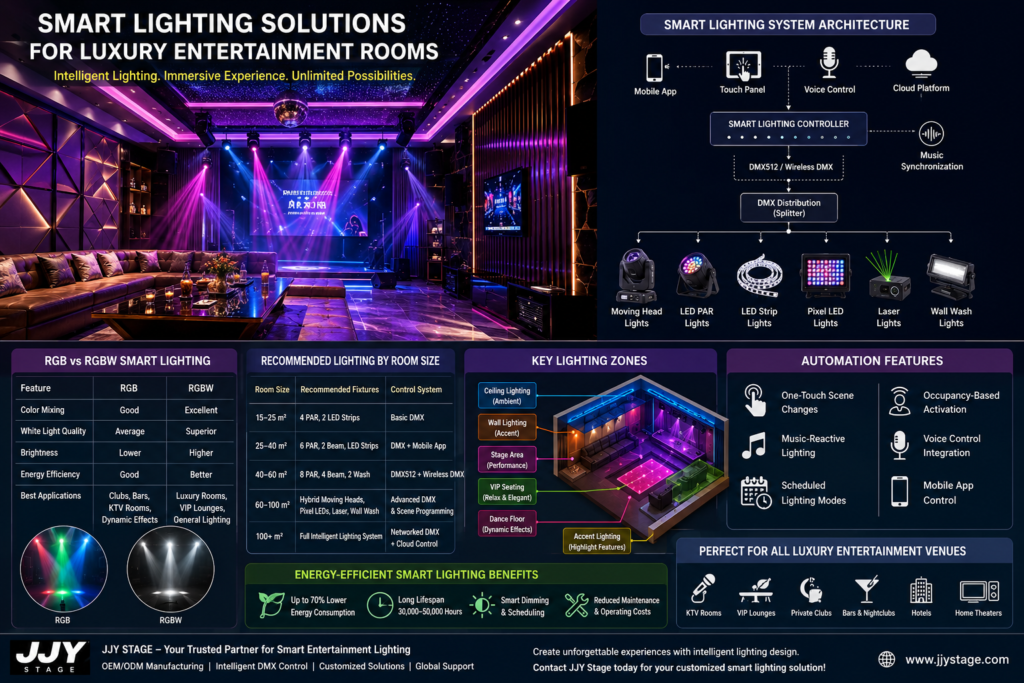
RGB vs RGBW Smart Lighting
One of the most common questions when selecting smart entertainment lighting is whether to choose RGB or RGBW fixtures.
The answer depends on the venue’s design goals, lighting requirements, and desired guest experience.
| Feature | RGB | RGBW |
| Color Mixing | Red, Green, Blue | Red, Green, Blue + White |
| White Light Quality | Simulated White | True White LED |
| Brightness | Good | Excellent |
| Color Accuracy | Very Good | Superior |
| Pastel Colors | Limited | Excellent |
| Energy Efficiency | High | High |
| Ambience | Dynamic Effects | Dynamic + Elegant Lighting |
| Best Applications | Clubs, Dance Floors | Luxury VIP Rooms, Hotels, KTV, Home Theaters |
Which Is Better?
RGB lighting is perfect for energetic entertainment spaces where colorful effects are the primary focus.
RGBW lighting is generally the preferred choice for luxury entertainment venues because it offers both vibrant colors and high-quality white illumination. This versatility allows designers to create everything from intimate lounge settings to energetic party scenes using the same fixtures.
For most premium projects, lighting professionals recommend RGBW technology.
Expert Recommendation: Use RGBW fixtures for ambient lighting and combine them with beam and laser effects for maximum flexibility.
How DMX Controllers Power Smart Lighting Systems
No intelligent lighting system is complete without an effective control platform. DMX512 is the industry-standard protocol used to coordinate entertainment lighting with precision and reliability.
A DMX controller communicates with every compatible fixture, sending digital commands that control brightness, color, movement, effects, timing, and synchronization.
What Is DMX512?
DMX512 (Digital Multiplex 512) is a communication protocol developed specifically for entertainment lighting.
A single DMX universe can control up to 512 channels, with each fixture using one or more channels depending on its capabilities.
This allows hundreds of intelligent fixtures to work together as one synchronized lighting system.
Scene Programming
One of the greatest advantages of DMX lighting control is scene programming.
Instead of adjusting every light individually, operators can save complete lighting scenes.
Examples include:
- Welcome Mode
- Lounge Mode
- Karaoke Mode
- Party Mode
- Dance Mode
- Performance Mode
- Cleaning Mode
- Closing Mode
Changing the atmosphere becomes as simple as pressing one button.
Music Synchronization
Music synchronization allows lighting effects to respond automatically to audio.
Effects may include:
- Color changes
- Beam movements
- Pulse effects
- Pixel animations
- Strobe timing
- Laser sequences
This creates immersive entertainment experiences that feel natural and exciting.
Automated Lighting Schedules
Professional venues often automate daily operations.
Examples include:
- Morning maintenance lighting
- Afternoon demonstration mode
- Evening entertainment mode
- Midnight energy-saving mode
Automation improves consistency while reducing staff workload.
Wireless DMX
Wireless DMX eliminates many traditional control cables while maintaining reliable communication.
Benefits include:
- Faster installation
- Cleaner ceiling design
- Easier renovations
- Greater flexibility
- Simplified fixture relocation
Wireless systems are especially valuable in luxury venues where exposed cabling would compromise interior aesthetics.
Mobile App Control
Many intelligent lighting systems now support smartphone and tablet control.
Venue managers can:
- Adjust colors remotely
- Select scenes
- Dim fixtures
- Schedule lighting
- Monitor fixture status
- Control multiple rooms
This flexibility is particularly useful for hotels, private clubs, and entertainment complexes.
Multi-Room Synchronization
Large entertainment venues often contain multiple VIP rooms.
Modern DMX systems allow managers to:
- Synchronize lighting across several rooms
- Operate each room independently
- Apply venue-wide lighting themes
- Schedule centralized updates
This improves operational efficiency while maintaining a consistent brand experience.
Expert Tip
For luxury entertainment venues, combine DMX512 controllers, wireless DMX, RGBW LED fixtures, and mobile app control to build a scalable lighting system that is easy to manage, highly reliable, and ready for future expansion.
Designing Smart Lighting Layouts
A luxury entertainment room should never rely on a single light source. Instead, professional lighting designers create layered lighting, where multiple fixture types work together to provide ambient illumination, accent lighting, performance effects, and interactive visual experiences.
The goal is to ensure every area—from the entrance to the VIP seating—has the right lighting for both aesthetics and functionality.
Key Lighting Zones
1. Ceiling Lighting
Ceiling lighting provides the primary ambient illumination and establishes the overall mood of the room.
Recommended Fixtures:
- RGBW LED PAR Lights
- Recessed Smart LED Downlights
- LED Strip Lights
- Ceiling Pixel LEDs
Design Tips:
- Use indirect cove lighting for a premium appearance.
- Avoid harsh overhead lighting.
- Divide the ceiling into independently controlled DMX zones.
2. Wall Lighting
Wall lighting adds depth, highlights architectural features, and enhances interior finishes.
Recommended Fixtures:
- Wall Wash Lights
- RGBW LED Strips
- Pixel LED Bars
Best Applications:
- Decorative wall panels
- Acoustic wall treatments
- Stone or wood finishes
- Artwork and feature walls
Layering wall lighting with ceiling effects creates a more immersive environment.
3. Stage or Performance Area
If the room includes a karaoke stage or DJ area, this becomes the visual focal point.
Recommended Fixtures:
- Moving Head Beam Lights
- Moving Head Spot Lights
- LED PAR Lights
- Laser Lights
Suggested Effects:
- Performer spotlighting
- Dynamic beam movements
- Music-synchronized lighting
- Animated gobos
4. Dance Floor
The dance floor should feel energetic and interactive.
Recommended Fixtures:
- Beam Lights
- Pixel LED Fixtures
- Laser Lights
- LED Floor Panels
- Strobe Lights
Using multiple fixture types ensures dynamic visual effects that react to music and movement.
5. VIP Seating Area
Luxury seating areas require comfortable, elegant lighting rather than dramatic effects.
Recommended Fixtures:
- RGBW LED Strip Lights
- Wall Wash Lights
- Smart Accent Lighting
Use warm white lighting during conversations and subtle color transitions during entertainment.
6. Accent Lighting
Accent lighting highlights premium interior details.
Examples include:
- Wine displays
- Decorative shelving
- Bar counters
- Sculptures
- Luxury furniture
- Architectural niches
Proper accent lighting increases the perceived value of the interior.
Layered Lighting Strategy
Professional entertainment venues generally combine four lighting layers:
| Lighting Layer | Purpose | Recommended Fixtures |
| Ambient Lighting | General illumination | LED PAR, Ceiling Lights |
| Accent Lighting | Highlight architectural details | LED Strips, Wall Wash Lights |
| Task Lighting | Performance visibility | Spot Lights |
| Dynamic Effects | Entertainment | Beam, Laser, Pixel LEDs |
Layered lighting ensures the room remains attractive during every activity, from quiet gatherings to high-energy performances.
Recommended Smart Lighting by Room Size
| Room Size | Recommended Fixtures | Suggested Control |
| 15–25 m² | 4 RGBW PAR Lights, 2 LED Strips | Basic DMX Controller |
| 25–40 m² | 6 PAR Lights, 2 Beam Lights, LED Strips | DMX + Mobile App |
| 40–60 m² | 8 PAR Lights, 4 Beam Lights, 2 Wash Lights | DMX512 + Wireless DMX |
| 60–100 m² | Hybrid Moving Heads, Pixel LEDs, Laser Lights, Wall Washes | Advanced DMX with Scene Programming |
| 100+ m² | Full Intelligent Lighting System | Networked DMX + Cloud Control |
Expert Tip: Leave additional DMX channels and electrical capacity for future expansion. Luxury venues often upgrade their lighting systems as entertainment concepts evolve.
Smart Lighting System Architecture (Text Description)
A well-designed smart lighting system integrates hardware, software, and networking into one coordinated platform.
Typical System Flow:
Mobile App / Touch Panel / Voice Assistant
│
Smart Lighting Controller
│
DMX512 Control Interface
│
Wireless DMX Transmitter (Optional)
│
DMX Distribution Splitter
│
┌──────────┬──────────┬──────────┬──────────┐
│ │ │ │ │
LED PAR Beam Wash Pixel Laser
Lights Lights Lights LEDs Lights
│
Music Synchronization System
│
Sensors & Automation Devices
This architecture allows every fixture to respond instantly to commands while supporting centralized control, automation, and future scalability.
Automation Features That Improve Guest Experiences
Automation is one of the defining advantages of smart lighting solutions for luxury entertainment rooms. By reducing manual intervention, it creates consistent experiences and simplifies venue management.
One-Touch Scene Changes
Instead of adjusting individual fixtures, operators can recall pre-programmed scenes with a single tap.
Example presets:
- Welcome Mode
- Relaxation Mode
- Karaoke Party
- Live Performance
- Birthday Celebration
- Dance Mode
- Cleaning Mode
- Closing Mode
This ensures smooth transitions between different activities.
Music-Reactive Lighting
Smart lighting systems can synchronize effects with live or recorded music.
Possible reactions include:
- Beat-synchronized color changes
- Beam movements
- Pixel chases
- Strobe bursts
- Laser animations
Music synchronization enhances immersion and keeps guests engaged.
Scheduled Lighting Modes
Lighting schedules automate routine operations.
Example schedule:
| Time | Scene |
| 10:00 AM | Maintenance Lighting |
| 4:00 PM | Venue Preparation |
| 6:00 PM | Guest Welcome |
| 8:00 PM | Entertainment Mode |
| 11:00 PM | Dance Scene |
| Closing | Cleaning Mode |
Scheduling saves staff time while maintaining consistent presentation.
Occupancy-Based Activation
Motion and occupancy sensors automatically activate or dim lighting based on room usage.
Benefits include:
- Reduced energy consumption
- Improved convenience
- Longer fixture lifespan
- Lower operating costs
This feature is especially useful for corridors, private rooms, and rest areas.
Voice Control Integration
Many modern intelligent lighting systems integrate with voice assistants or custom control platforms.
Examples:
- “Activate Karaoke Mode.”
- “Dim VIP Lounge Lights.”
- “Start Performance Scene.”
Voice control improves convenience for both operators and guests.
Smartphone and Tablet Control
Mobile applications enable venue managers to control lighting from anywhere within the property.
Typical functions include:
- Brightness adjustment
- Color selection
- Scene activation
- Fixture monitoring
- Scheduling
- Group control
- Multi-room management
This flexibility is particularly valuable for hotels and entertainment complexes.
Personalized Lighting Presets
Luxury venues can create custom lighting profiles for different clients or event types.
Examples:
- Corporate events
- Wedding receptions
- Birthday parties
- VIP karaoke sessions
- Themed celebrations
Personalized presets help deliver memorable and consistent guest experiences.
Energy-Efficient Smart Lighting
High-performance lighting does not have to result in high operating costs. Modern smart lighting systems are designed to maximize efficiency without compromising visual quality.
LED Technology
LED fixtures consume significantly less electricity than traditional halogen or discharge lighting while delivering higher brightness and better color control.
Key Benefits:
- Lower power consumption
- Reduced heat output
- Longer lifespan (typically 30,000–50,000 hours)
- Minimal maintenance
Smart Dimming
Dimming fixtures when full brightness is unnecessary can significantly reduce energy usage and extend LED lifespan.
Examples:
- Lounge mode at 40–50% brightness
- Cleaning mode at 100%
- Ambient scenes at 30–60%
Occupancy Sensors
Automatically turning lights off in unoccupied areas reduces wasted energy and maintenance costs.
RGBW Efficiency
RGBW fixtures often produce high-quality white light more efficiently than RGB fixtures attempting to mix white from colored LEDs.
Reduced Maintenance
LED technology minimizes lamp replacements and downtime, lowering maintenance costs and improving venue reliability.
Sustainability
Energy-efficient lighting supports sustainability initiatives by reducing electricity consumption and carbon emissions—an increasingly important consideration for hotels, clubs, and commercial entertainment venues.
Estimated Operational Benefits
| Feature | Estimated Benefit |
| LED Fixtures | Up to 70% lower energy use compared to traditional lighting |
| Smart Scheduling | Reduces unnecessary operating hours |
| Occupancy Sensors | Minimizes wasted energy in unused spaces |
| DMX Scene Programming | Optimizes fixture output for each activity |
| LED Lifespan | 30,000–50,000+ operating hours |
| Preventive Monitoring | Reduces unexpected maintenance and downtime |
✔ Energy-Saving Checklist
- Use high-efficiency RGBW LED fixtures.
- Program lighting scenes instead of manual operation.
- Install occupancy sensors in low-traffic areas.
- Divide fixtures into independent lighting zones.
- Schedule automatic shutdown after business hours.
- Perform regular maintenance to maintain fixture efficiency.
- Choose DMX-compatible equipment that supports future expansion.
Common Mistakes When Installing Smart Lighting
Even premium lighting equipment cannot deliver the desired results if the system is poorly planned or installed. Avoiding these common mistakes helps maximize performance, reliability, and return on investment.
1. Poor Fixture Placement
Installing fixtures without considering beam angles, ceiling height, or room layout often creates uneven lighting, dark spots, or excessive glare.
Solution:
- Create a lighting plan before installation.
- Simulate beam coverage using lighting design software.
- Position fixtures to complement furniture, stages, and seating areas.
2. Ignoring DMX Programming
Some venues invest in advanced fixtures but use only basic manual controls, limiting the system’s capabilities.
Solution:
- Program lighting scenes for different events.
- Train staff to use DMX controllers effectively.
- Schedule regular updates to lighting presets.
3. Weak Wi-Fi or Network Coverage
Smart lighting systems that rely on mobile apps or cloud management require a stable network.
Solution:
- Use commercial-grade networking equipment.
- Separate lighting traffic from guest Wi-Fi.
- Provide wired Ethernet where possible for controllers.
4. Choosing Incompatible Devices
Mixing fixtures or controllers that do not fully support DMX512 or the same communication protocols can lead to synchronization issues.
Solution:
- Select compatible fixtures from trusted manufacturers.
- Verify protocol support before purchasing.
- Standardize equipment across multiple rooms.
5. Over-Lighting the Room
Too many high-output fixtures can make a luxury room feel uncomfortable and reduce the impact of lighting effects.
Solution:
- Focus on layered lighting instead of maximum brightness.
- Use dimming and zoning to balance illumination.
- Match fixture output to room size.
6. Lack of Maintenance
Dust, improper cooling, and neglected firmware updates can reduce fixture performance and shorten equipment lifespan.
Solution:
- Clean fixtures regularly.
- Inspect DMX cables and wireless connections.
- Update controller firmware when recommended.
- Perform routine system checks.
7. Poor Cable Management
Exposed cables not only affect aesthetics but also increase maintenance challenges and safety risks.
Solution:
- Use cable trays and conduits.
- Label DMX and power cables.
- Plan cable routes during the design phase.
- Consider Wireless DMX where appropriate.
✔ Smart Lighting Installation Checklist
- Create a detailed lighting design before installation.
- Select DMX-compatible fixtures and controllers.
- Divide the room into independent lighting zones.
- Test all lighting scenes before opening.
- Ensure stable network connectivity.
- Leave capacity for future expansion.
- Schedule preventive maintenance.
- Train staff on system operation.
Expert Tip: A professionally commissioned system with proper DMX programming often delivers better long-term results than simply purchasing higher-priced fixtures without a coordinated lighting design.
Future Trends in Luxury Entertainment Lighting
Smart entertainment lighting continues to evolve rapidly, offering more intelligent, immersive, and energy-efficient solutions.
AI-Powered Lighting
Artificial intelligence is beginning to optimize lighting automatically based on music, occupancy, event type, and user preferences.
Potential applications include:
- Automatic scene selection
- Adaptive brightness
- Intelligent color recommendations
- Predictive maintenance alerts
IoT Integration
Internet of Things (IoT) technology connects lighting with other building systems, including:
- Audio systems
- HVAC controls
- Security systems
- Booking platforms
- Energy management systems
This integration enables seamless venue automation.
Advanced Wireless DMX
New generations of Wireless DMX provide:
- Lower latency
- Greater signal stability
- Improved range
- Better resistance to interference
These improvements simplify installations, particularly in luxury spaces where visible cabling is undesirable.
Cloud-Based Lighting Management
Cloud platforms allow venue managers to:
- Monitor multiple locations
- Update lighting scenes remotely
- Track energy usage
- Diagnose system issues
- Schedule firmware updates
This is especially beneficial for hotel chains and entertainment groups with multiple venues.
Interactive Lighting
Interactive systems respond to guest actions through:
- Motion sensors
- Pressure-sensitive floors
- Cameras
- Wearable devices
- Gesture recognition
These technologies create memorable and engaging experiences.
Pixel Mapping
Pixel mapping enables precise control of thousands of individual LEDs, allowing designers to display animations, branded content, and synchronized visual effects across walls, ceilings, and architectural features.
Human-Centric Lighting
Human-centric lighting adjusts brightness and color temperature to support comfort and well-being.
In entertainment spaces, this can help transition smoothly between relaxed lounge settings and energetic performances.
Immersive Entertainment Technologies
Future luxury venues are expected to combine:
- Smart lighting
- Spatial audio
- Projection mapping
- Interactive displays
- AI-driven automation
- Augmented reality experiences
Together, these technologies will create highly personalized and immersive entertainment environments.
Frequently Asked Questions (FAQ)
1. What is smart lighting?
Smart lighting uses programmable LED fixtures, digital controllers, and automation to adjust brightness, color, movement, and lighting scenes remotely or automatically.
2. How does smart lighting work?
A controller communicates with intelligent lighting fixtures—typically using DMX512 or wireless protocols—to manage colors, effects, timing, and synchronization across the entire system.
3. Is DMX required for smart entertainment lighting?
While small systems may use app-based controls, DMX512 is the industry standard for professional entertainment venues because it provides precise, synchronized control of multiple fixtures.
4. What are the benefits of RGBW lighting?
RGBW fixtures produce vibrant colors while also delivering high-quality white light, making them ideal for luxury entertainment rooms that require both dynamic effects and elegant ambient lighting.
5. Can smart lighting sync with music?
Yes. Music-reactive lighting analyzes audio signals or receives programmed cues to synchronize colors, movement, and effects with the rhythm of the music.
6. Are smart lighting systems energy-efficient?
Yes. Modern LED fixtures consume less power than traditional lighting, and features such as dimming, scheduling, and occupancy sensors further improve energy efficiency.
7. How much does a smart lighting system cost?
Costs vary depending on room size, fixture quantity, control systems, and customization. Professional venues should request a tailored quotation based on their project requirements.
8. Which fixtures are best for luxury entertainment rooms?
A balanced system typically includes RGBW LED PAR lights, moving head beam and wash lights, LED strip lights, pixel LEDs, and laser lights, all managed through a DMX512 control system.
9. Can smart lighting be controlled by a mobile app?
Yes. Many intelligent lighting systems support smartphone and tablet apps for adjusting brightness, colors, scenes, and schedules.
10. What is the lifespan of smart LED lighting?
Most professional LED fixtures offer an operational lifespan of approximately 30,000 to 50,000 hours, depending on usage and maintenance.
11. Is Wireless DMX reliable?
Modern Wireless DMX systems are highly reliable when installed correctly, making them an excellent option for venues where minimizing visible cabling is important.
12. How do I choose the right smart lighting system?
Consider your room size, venue type, lighting goals, future expansion plans, control requirements, and budget. Working with an experienced lighting manufacturer helps ensure the system is properly designed and scalable.
Conclusion
Smart lighting solutions for luxury entertainment rooms have become an essential investment for modern hospitality and entertainment venues. By combining intelligent control systems, high-performance LED fixtures, DMX512 technology, automation, and thoughtful lighting design, venue owners can create immersive environments that elevate guest experiences while improving operational efficiency.
Whether you’re designing a VIP karaoke suite, a luxury hotel lounge, a private club, or a premium home theater, the right lighting system enhances ambiance, supports flexible event programming, and reduces long-term operating costs.
Contact JJY Stage
At JJY Stage, we specialize in designing and manufacturing professional smart entertainment lighting systems tailored to your project requirements. From OEM/ODM production to turnkey lighting solutions, our team provides high-quality LED fixtures, DMX control systems, and expert support for luxury entertainment spaces worldwide.
Contact JJY Stage today to discuss your project and discover how our customized intelligent lighting solutions can transform your venue into an unforgettable entertainment destination.