
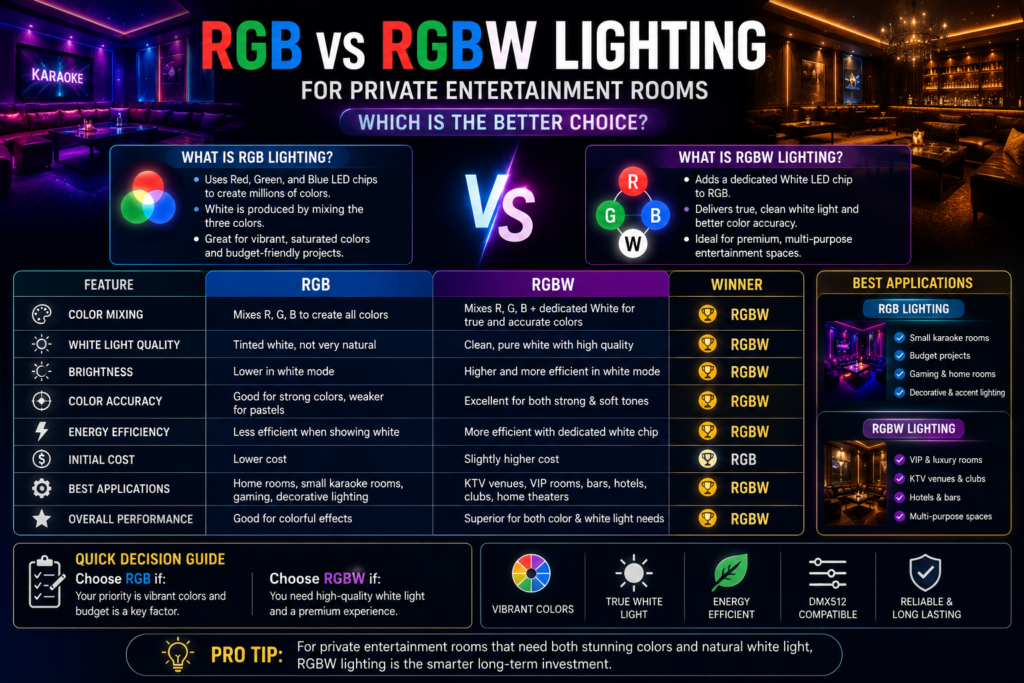
Choosing between RGB vs RGBW lighting for private entertainment rooms is one of the most consequential decisions a venue owner will make before opening night. Get it right, and the room feels vivid, controlled, and premium under every scene. Get it wrong, and you end up with washed-out whites, muddy color transitions, or a lighting bill that outpaces the effect it delivers.
This comparison matters because private entertainment spaces, such as KTV rooms, karaoke venues, VIP lounges, private clubs, bars, hotel suites, and home theaters, rely on light to do double duty. It has to look spectacular during a music-driven moment and still function as clean, usable illumination when the room needs to feel normal again. RGB and RGBW LED fixtures approach that dual job differently, and the difference shows up in color accuracy, white light quality, energy use, and long-term cost.
This guide breaks down exactly how RGB and RGBW lighting work, where each performs best, and how to decide which technology fits your venue, your budget, and your entertainment goals with comparison tables, a decision checklist, and expert-level detail throughout.
Want to create a premium entertainment experience? Explore our Professional Private Room Lighting guide to learn how to design immersive lighting for VIP rooms, KTV suites, karaoke lounges, private theaters, and luxury hospitality spaces using LED stage lights, DMX control systems, and intelligent lighting solutions that enhance ambiance, guest satisfaction, and venue value.
What Is RGB Lighting?
RGB lighting uses three LEDs red, green, and blue packed into a single fixture. By varying the intensity of each diode, an RGB fixture can produce millions of color combinations, from deep saturated reds to vivid blues and everything in between.
How RGB LEDs work. The three color channels are individually dimmable, and a DMX controller (or built-in program) blends their output in real time to create a target color, including white, which is approximated by running all three channels at full or near-full intensity simultaneously.
Advantages. RGB fixtures are typically less expensive than RGBW equivalents, simpler to manufacture, and widely available across nearly every price tier of entertainment lighting. They excel at producing bold, saturated colors for dance floors and party lighting.
Limitations. Because white is a mixed color rather than a true diode output, RGB white tends to carry a slight color cast, often a cool blue or greenish tint, rather than clean, neutral white. This becomes noticeable the moment a room needs functional lighting for dining, conversation, or general use.
Common applications. RGB lighting works well in home entertainment rooms, small karaoke booths, decorative accent lighting, gaming rooms, and budget-conscious installations where saturated color matters more than white light precision.
What Is RGBW Lighting?
RGBW lighting takes the same red, green, and blue diode structure and adds a fourth, dedicated white LED diode to the fixture.
How RGBW LEDs differ from RGB. Instead of approximating white by mixing three colored diodes, an RGBW fixture activates its dedicated white channel, producing a genuinely neutral, high-quality white output independent of the color-mixing process.
The purpose of the dedicated white LED. This fourth diode exists specifically to solve RGB’s biggest weakness inconsistent, tinted white light by giving the fixture a true white source that doesn’t rely on combining colored channels.
Improved color accuracy. With a separate white channel available, RGBW fixtures can also produce pastel tones and desaturated colors more accurately, since white can be blended into a color mix without pulling equally from all three RGB channels.
Better white illumination. RGBW fixtures deliver a cleaner, brighter, more usable white light output, which matters enormously in venues that switch between colorful entertainment scenes and functional white lighting throughout the night.
Enhanced lighting quality. Together, these improvements give RGBW lighting a noticeably more polished, professional look one of the main reasons commercial-grade entertainment lighting has increasingly standardized on RGBW over the past several years.
RGB vs RGBW Lighting: Key Differences
| Feature | RGB | RGBW |
| Color Mixing | Mixes red, green, and blue to create all colors, including white | Mixes RGB for color, plus a dedicated white diode for true white output |
| White Light Quality | Tinted, inconsistent white; often appears cool or slightly colored | Clean, neutral, high-quality white independent of color mixing |
| Brightness | Slightly lower perceived brightness in white mode due to mixed-channel output | Higher effective brightness in white mode thanks to the dedicated white diode |
| Color Accuracy | Good for saturated colors, weaker for pastels and subtle tones | Stronger across the full spectrum, including pastels and desaturated shades |
| Energy Efficiency | Slightly less efficient when producing white light | More efficient for white output since it doesn’t rely on mixing three channels |
| Power Consumption | Marginally lower per fixture due to fewer diodes | Marginally higher per fixture, offset by better efficiency in white-heavy use |
| Lighting Effects | Strong for bold, saturated color effects and party lighting | Strong for both saturated color effects and refined, layered mood lighting |
| Installation Cost | Generally lower upfront fixture cost | Slightly higher upfront fixture cost |
| Maintenance | Comparable LED lifespan; simpler diode structure | Comparable LED lifespan; four-diode structure adds minor complexity |
| Best Applications | Home rooms, small karaoke booths, budget installs, gaming rooms | VIP rooms, KTV venues, private clubs, bars, hotels, home theaters |
The core takeaway: RGB is a capable, budget-friendly option for color-driven spaces, while RGBW is the stronger all-around choice whenever a room needs both vivid color and dependable white light in the same fixture.
Expert Tip: If your venue only ever uses colored lighting and never needs functional white illumination from the same fixtures, RGB can be a perfectly reasonable, cost-effective choice. The moment white light quality matters dining areas, reception zones, dual-purpose rooms RGBW earns its price premium quickly.
Why RGBW Lighting Is Becoming the Industry Standard
Across professional entertainment lighting, RGBW has steadily displaced RGB as the default specification for new commercial installations, and several factors explain why.
Premium lighting quality. Guests notice the difference between a slightly tinted white wash and a clean, neutral one, even without knowing the technical reason. RGBW consistently reads as more polished and intentional.
Natural white light. Venues that transition between entertainment scenes and normal operating light a KTV room going from party mode to standard lighting between songs, for example — need a white output that doesn’t clash visually with the room’s design.
Better atmosphere creation. RGBW’s ability to blend true white into color mixes allows for more nuanced, layered moods soft warm ambiance, pastel accent tones, and richer gradients than RGB fixtures typically achieve.
More versatile scenes. A single RGBW fixture can cover both a vivid party scene and a clean, functional white scene, reducing the need for separate fixture types dedicated to each purpose.
Improved customer experience. Because lighting shapes perceived value so strongly in entertainment venues, the incremental cost of RGBW frequently pays for itself through better guest impressions and repeat visits.
Professional appearance. For venues competing on presentation luxury VIP rooms, upscale KTV suites, hotel entertainment spaces RGBW has become something close to an expected baseline rather than a premium add-on.
Best Applications for RGB Lighting
RGB lighting still has a legitimate place in entertainment lighting design, particularly where budget and simplicity outweigh the need for precise white output.
- Home entertainment rooms: where colorful mood lighting is the primary goal and functional white light is handled by separate room lighting.
- Small karaoke rooms: compact booths where budget constraints make cost-effective RGB fixtures the practical choice.
- Decorative lighting: accent strips, backlighting, and architectural highlights where color impact matters more than white precision.
- Budget installations: new venues testing an entertainment concept before committing to a larger lighting investment.
- Gaming rooms: spaces built around vivid, saturated color schemes rather than functional white illumination.
- Ambient lighting: secondary lighting layers where a slight white tint is not a visible or practical concern.
Best Applications for RGBW Lighting
RGBW lighting is generally the stronger choice for commercial and premium private entertainment spaces.
- Luxury VIP rooms: where guests expect polished, high-end presentation in every lighting mode.
- KTV venues: rooms that regularly switch between colorful performance lighting and clean white illumination between songs.
- Private clubs: spaces needing both dramatic color effects and clean white light for service moments.
- Bars: dual-purpose lighting for ambiance during service hours and vivid color for later, high-energy hours.
- Hotels: VIP suites and entertainment lounges where guest experience and perceived quality directly affect brand reputation.
- Home theaters: spaces that benefit from RGBW’s more accurate color rendering during ambient scene lighting.
- High-end entertainment venues: any commercial space where lighting quality is part of the value proposition.
RGBW is often preferred in commercial environments because these venues need lighting systems that perform reliably across many different use cases in a single night something a dedicated white diode makes far easier to achieve consistently.
Lighting Effects Comparison
Both RGB and RGBW support a wide range of entertainment lighting effects, but the quality and consistency of those effects differ.
- Static colors: both technologies produce strong static color output; RGBW achieves slightly more accurate pastel and desaturated tones.
- Dynamic effects: both support color chases and transitions; RGBW blends more smoothly through subtle color shifts.
- Mood lighting: RGBW’s true white channel allows warmer, more natural mood tones that RGB struggles to replicate cleanly.
- Beam effects: both perform comparably in beam fixtures, since beam effects rely more on intensity and movement than white accuracy.
- Wash effects: RGBW washes look noticeably cleaner in white or near-white tones compared to RGB washes.
- Scene transitions: RGBW transitions between colored and white scenes more seamlessly, without the visible tint shift RGB can introduce.
- Music synchronization: both technologies sync equally well with a DMX512 controller and music-reactive programming.
- White light performance: this is where RGBW clearly outperforms RGB, delivering a neutral, bright, dependable white that RGB cannot fully replicate.
Energy Efficiency and Maintenance
Both RGB and RGBW rely on LED technology, which already offers major efficiency advantages over legacy halogen or incandescent stage lighting.
LED lifespan. Both RGB and RGBW fixtures typically offer comparable rated lifespans, often in the tens of thousands of hours, when sourced from reputable manufacturers.
Heat generation. RGBW fixtures include a fourth diode, which can marginally increase heat output, though well-engineered fixtures manage this without meaningfully affecting reliability.
Power consumption. RGB fixtures may draw marginally less power per unit, but RGBW’s efficiency advantage in white-heavy use often narrows or closes that gap over an operating night.
Maintenance costs. Maintenance requirements are broadly similar between the two technologies, since both use standard LED components with comparable failure rates.
Reliability. Fixture quality and build standards affect reliability far more than the RGB-versus-RGBW distinction itself sourcing from an established manufacturer matters more than the color-mixing method.
Long-term ROI. For venues that rely on consistent white light alongside color effects, RGBW’s improved versatility often delivers better long-term value, even if the initial fixture cost is somewhat higher.
RGB and RGBW with DMX Lighting Systems
Regardless of whether a venue chooses RGB or RGBW fixtures, a DMX512 control system is what turns individual lights into a coordinated, professional lighting environment.
DMX512 compatibility. Both RGB and RGBW fixtures are widely available with standard DMX512 control, allowing precise, addressable control over color, intensity, and effects.
Wireless DMX. Wireless DMX transmitters reduce cabling complexity, making retrofits and multi-room installations significantly easier to manage.
Intelligent lighting. Modern intelligent lighting systems combine DMX control with programmable logic, allowing fixtures to respond automatically to time of day, occupancy, or music input.
Automation. Preset lighting scenes reduce the need for manual adjustment, letting staff switch a room from dining mode to party mode with a single command.
Scene programming. Both RGB and RGBW fixtures support saved scene presets, though RGBW scenes typically look more refined when white or near-white tones are involved.
Mobile app control. Many current DMX systems offer smartphone or tablet control, giving venue managers scene control without a dedicated lighting console.
Music synchronization. DMX-linked audio synchronization works equally well across both technologies, making beat-reactive lighting effects achievable regardless of RGB or RGBW selection.
How to Choose Between RGB and RGBW
The right choice depends on how your venue actually uses light, not just on abstract technical specifications.
- Budget: if upfront cost is the primary constraint and functional white light is secondary, RGB may be the pragmatic choice.
- Room size: larger commercial rooms generally justify RGBW’s higher quality output across more fixtures and more use cases.
- Venue type: home and small-scale installs often suit RGB; commercial and premium venues generally benefit from RGBW.
- Desired atmosphere: if the room needs to shift convincingly between colorful entertainment and clean functional lighting, RGBW is the stronger fit.
- Lighting goals: pure color-and-effect spaces can lean RGB; multi-purpose rooms should lean RGBW.
- Long-term investment: venues planning multi-year operation often find RGBW’s versatility offsets its higher initial cost.
- Future upgrades: RGBW fixtures integrate more easily into evolving lighting designs that may later demand higher white-light quality.
Decision-Making Checklist
- [ ] Does the room need true white light for any function (dining, reception, service)?
- [ ] Will the space regularly switch between color scenes and white scenes?
- [ ] Is the venue commercial, premium, or guest-facing?
- [ ] Is budget the single deciding factor, or is long-term quality prioritized?
- [ ] Will the lighting system need to scale or upgrade in future years?
- [ ] Does the venue already use a DMX512 control system that supports both fixture types?
If most answers point toward commercial use, dual-purpose lighting, and long-term investment, RGBW is generally the better choice. If the room is small, budget-driven, and purely color-focused, RGB remains a reasonable option.
Common Mistakes When Choosing Entertainment Lighting
Even experienced venue owners run into avoidable lighting mistakes.
- Choosing RGB when white light is needed: leads to tinted, unconvincing white scenes; solution: assess white-light needs honestly before selecting fixture type.
- Ignoring lighting control systems: fixtures without proper DMX integration become difficult to manage at scale; solution: plan the control system alongside the fixture selection, not after.
- Buying low-quality fixtures: inconsistent color output and premature failure are common with unbranded, low-cost units; solution: source from established manufacturers with warranty support.
- Poor fixture placement: even high-quality RGBW fixtures underperform if spacing and beam angles aren’t planned properly; solution: design placement around room dimensions and ceiling height.
- Overlooking maintenance: dust, heat, and firmware neglect degrade performance over time; solution: schedule routine fixture checks and cleaning.
- Focusing only on initial cost: the cheapest fixture upfront isn’t always the cheapest option long-term; solution: weigh total cost of ownership, including energy use and expected lifespan.
Future Trends in RGBW Entertainment Lighting
RGBW lighting continues to evolve alongside broader smart lighting technology.
- AI-powered lighting that adjusts color temperature and scene selection automatically based on music, time, or occupancy.
- Pixel mapping across RGBW LED walls and strips for high-resolution animated effects.
- Interactive lighting that responds to guest movement or app-based input in real time.
- Wireless DMX systems simplifying installation in retrofit and multi-room venues.
- Smart control systems integrating RGBW fixtures into broader venue automation platforms.
- IoT integration linking lighting with audio, climate, and security systems for unified venue management.
- Human-centric lighting that adjusts white color temperature throughout the day to support guest comfort and mood.
- Cloud-based lighting management allowing multi-venue operators to monitor and program RGBW systems remotely.
Frequently Asked Questions (FAQ)
What is the difference between RGB and RGBW lighting?
RGB lighting mixes red, green, and blue diodes to create all colors, including white, while RGBW lighting adds a fourth, dedicated white diode for cleaner, more accurate white output alongside full-color capability.
Is RGBW better than RGB?
RGBW generally outperforms RGB in white light quality, color accuracy, and versatility, making it the stronger choice for most commercial and premium entertainment spaces, though RGB remains a reasonable budget option for purely color-driven rooms.
Which lighting is best for KTV rooms?
RGBW lighting is typically the better choice for KTV rooms, since these venues regularly switch between vivid party lighting and clean white illumination between performances.
Does RGBW consume more electricity?
RGBW fixtures may draw marginally more power due to the added white diode, but improved efficiency in white-heavy use often narrows this difference over a full operating night.
Is RGBW worth the extra cost?
For commercial venues needing both color effects and dependable white light, RGBW’s improved versatility and guest experience generally justify its modest price premium.
Can RGB and RGBW lights use DMX controllers?
Yes, both RGB and RGBW fixtures are widely available with standard DMX512 compatibility, allowing precise scene programming and music synchronization.
Which is better for VIP rooms?
RGBW lighting is generally preferred for VIP rooms, since these spaces need premium, versatile lighting that performs well in both colorful entertainment scenes and clean, functional white light.
How long do RGBW LEDs last?
RGBW LEDs typically offer a comparable lifespan to RGB LEDs, often rated in the tens of thousands of hours, when sourced from reputable manufacturers.
Are RGBW lights suitable for home theaters?
Yes, RGBW lighting works well in home theaters, since its improved color accuracy and clean white output support both ambient mood lighting and functional room lighting.
How do I choose the right entertainment lighting?
Start by evaluating your venue’s need for functional white light, budget, room size, and long-term goals, then use a size- and use-case-based comparison to decide between RGB and RGBW before finalizing your DMX control system.
Conclusion
The debate over RGB vs RGBW lighting for private entertainment rooms ultimately comes down to how a venue actually uses light throughout a night of operation. RGB remains a capable, cost-effective option for smaller, color-driven, budget-conscious spaces, while RGBW has become the preferred standard for commercial venues that need both vivid entertainment lighting and clean, dependable white illumination in the same fixtures.
For KTV rooms, VIP lounges, private clubs, bars, hotels, and other premium entertainment spaces, RGBW lighting generally delivers the stronger long-term investment better color accuracy, more natural white light, and a more polished guest experience across every scene.
If you’re planning a new installation or upgrading an existing venue, JJY Stage offers expert guidance and customized RGB and RGBW lighting solutions, including OEM/ODM manufacturing, intelligent DMX lighting controls, and complete turnkey entertainment lighting systems. Contact JJY Stage today to get a tailored recommendation built around your venue’s exact needs.