
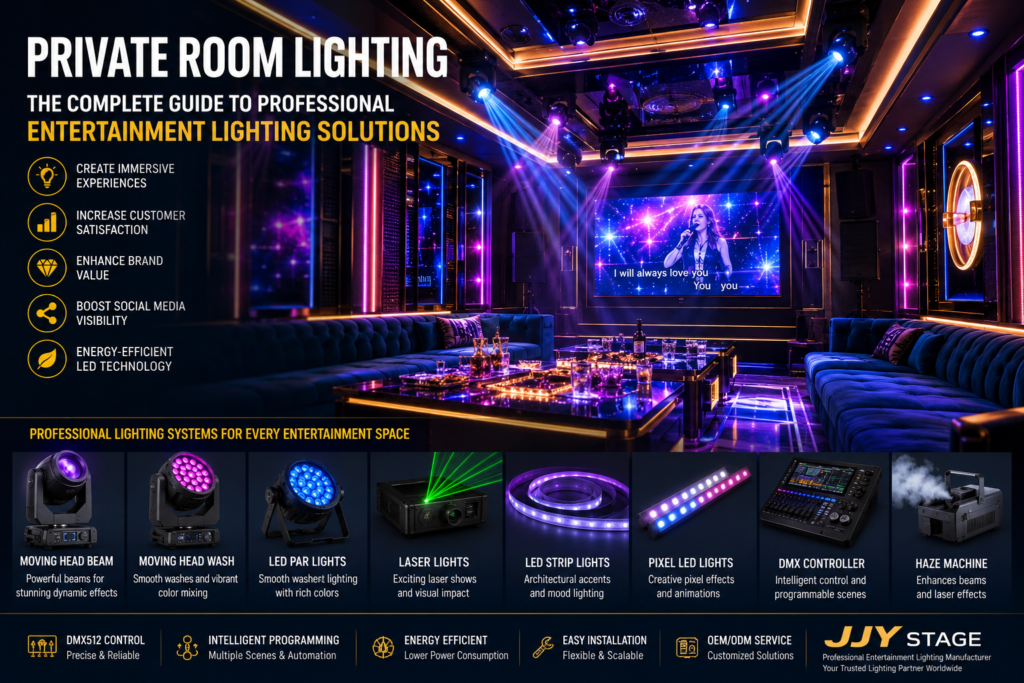
Private Room Lighting: The Complete Guide to Professional Entertainment Lighting Solutions
Modern entertainment venues compete on more than premium interiors and high-quality sound systems. Guests expect immersive experiences that stimulate every sense, and lighting plays a central role in creating those memorable moments. Whether visitors enter a luxury KTV suite, an exclusive VIP lounge, a private karaoke room, or a hotel entertainment space, the lighting environment immediately influences their emotions, comfort, and overall impression.
Professional private room lighting goes far beyond simple illumination. It combines intelligent LED fixtures, programmable control systems, dynamic color effects, and synchronized lighting scenes to transform ordinary rooms into engaging entertainment destinations. A carefully planned lighting system can encourage guests to stay longer, share their experiences on social media, and return for future visits.
This comprehensive guide explains everything venue owners, architects, lighting designers, AV integrators, and project developers need to know about designing modern private room lighting solutions. You’ll also learn how JJY Stage delivers customized lighting systems that combine performance, reliability, and flexible OEM/ODM manufacturing for entertainment projects worldwide.
What Is Private Room Lighting?
Private room lighting refers to professionally designed lighting systems installed in enclosed entertainment spaces where guests enjoy exclusive experiences. Unlike standard residential or office lighting, these systems focus on atmosphere, visual effects, flexibility, and intelligent control.
Typical applications include:
- KTV room lighting
- Karaoke room lighting
- VIP room lighting
- Private club lighting
- Lounge lighting
- Hotel entertainment lighting
- Gaming rooms
- Home theaters
- Private cinemas
- Premium restaurant VIP areas
Rather than relying on a single ceiling fixture, professional entertainment spaces integrate multiple lighting layers that work together. These may include LED PAR lights for ambient illumination, moving head fixtures for dynamic beam effects, laser systems for visual excitement, LED strip lighting for architectural accents, and pixel lighting for creative animations.
Why Entertainment Venues Need Specialized Lighting
Entertainment spaces have very different requirements from residential environments. Guests expect changing colors, dramatic effects, synchronized lighting, and immersive scenes that match music or special events. A static lighting setup quickly becomes monotonous and fails to deliver the premium experience customers associate with modern venues.
Professional systems also allow operators to create multiple lighting scenes for different activities, including welcoming guests, karaoke performances, celebrations, dance sessions, and quiet conversations. This flexibility helps maximize room utilization throughout the day.
Commercial vs. Residential Lighting
| Feature | Commercial Entertainment Lighting | Residential Lighting |
| Purpose | Immersive experiences | General illumination |
| Control | DMX512, smart automation | Standard switches or smart home apps |
| Effects | Dynamic, programmable scenes | Static or limited color changes |
| Brightness | Adjustable for multiple events | Designed for daily living |
| Scalability | Supports future expansion | Usually fixed after installation |
Benefits of Immersive Lighting
Professional LED private room lighting provides several long-term advantages:
- Creates memorable guest experiences
- Enhances room aesthetics
- Supports themed events
- Increases perceived venue value
- Encourages repeat visits
- Strengthens brand identity
- Produces social-media-friendly environments
- Improves operational flexibility
Why Private Room Lighting Matters
Lighting directly influences how customers perceive a venue. Before guests notice furniture or décor, they instinctively respond to the atmosphere created by color, brightness, and movement.
Creating the Right Mood
Warm tones encourage relaxation, while vibrant RGB and RGBW effects generate excitement. Intelligent room lighting allows operators to switch between calm lounges and energetic party scenes within seconds.
Improving Customer Experience
Guests increasingly expect immersive environments where lighting reacts to music, performances, and celebrations. Music synchronized lighting creates stronger emotional engagement and transforms ordinary karaoke sessions into memorable entertainment experiences.
Increasing Business Profitability
Professionally designed lighting contributes to higher customer satisfaction, which often translates into longer bookings, repeat business, and positive online reviews. Premium lighting can also justify higher room rates in luxury entertainment venues.
Building a Strong Brand Identity
Distinctive lighting helps entertainment businesses establish a recognizable visual identity. Coordinated colors, dynamic scenes, and architectural accents reinforce a venue’s image and create memorable first impressions.
Enhancing Social Media Appeal
Modern customers frequently share photos and videos online. Well-designed nightclub lighting and lounge lighting create visually striking backgrounds that encourage user-generated content and expand a venue’s digital reach.
Expert Tip: Design lighting with both the guest experience and smartphone cameras in mind. Balanced RGBW lighting produces vibrant visuals while maintaining natural skin tones in photos and videos.
Types of Private Rooms That Need Professional Lighting
Almost every entertainment venue benefits from intelligent lighting systems, but each environment has unique design priorities.
KTV Rooms
KTV room lighting requires dynamic color changes, beam effects, and programmable scenes that enhance singing performances while maintaining guest comfort.
Karaoke Rooms
Smaller karaoke spaces benefit from compact moving head lights, LED strip lighting, and adjustable ambient illumination that complements music without overwhelming guests.
VIP Rooms
VIP room lighting emphasizes elegance and exclusivity. RGBW fixtures, premium wall washing, and programmable mood lighting create luxurious environments suitable for executive clients and private celebrations.
Private Clubs
Private clubs require flexible lighting capable of adapting to networking events, live performances, themed parties, and exclusive member gatherings.
Bars and Luxury Lounges
Modern lounge lighting balances comfort with visual excitement. Accent lighting highlights architectural features while intelligent lighting systems create changing atmospheres throughout the evening.
Hotels
Hotel entertainment lighting often connects private karaoke suites, executive lounges, and multifunction event spaces under centralized control systems for consistent operation and simplified management.
Home Theaters
Luxury home entertainment spaces increasingly adopt professional LED stage lighting concepts, including hidden LED strips, programmable scenes, and architectural accent lighting.
Gaming Rooms
Gaming environments benefit from immersive RGB lighting, pixel LED effects, and synchronized lighting that reacts to gameplay or streaming content.
Private Cinemas
Professional lighting enhances movie experiences through dimmable indirect lighting, programmable scenes, and subtle architectural illumination.
Restaurants with VIP Areas
Exclusive dining rooms use intelligent lighting to create intimate atmospheres while maintaining enough brightness for comfortable dining and conversation.
Entertainment Centers
Large entertainment complexes integrate multiple room types using centralized DMX controllers, allowing operators to manage different lighting scenes efficiently across the entire venue.
Essential Lighting Fixtures for Private Rooms
Selecting the right fixtures is the foundation of any successful entertainment lighting project. Each fixture serves a specific purpose, and combining them strategically creates a balanced, immersive environment.
LED PAR Lights
LED PAR lights provide the primary ambient illumination in many entertainment spaces. Their energy efficiency, rich color mixing, and long lifespan make them ideal for creating welcoming atmospheres, highlighting stages, or washing walls with vibrant color.
Moving Head Beam Lights
Moving head beam lights produce sharp, concentrated beams that sweep across the room, creating dramatic visual effects. They are particularly popular in KTV rooms, private clubs, and VIP entertainment suites where high-impact performances are desired.
Moving Head Wash Lights
Wash lights generate broad, even illumination that covers large areas smoothly. They are ideal for mood lighting, stage coverage, and creating soft transitions between different entertainment scenes.
Moving Head Spot Lights
Spot fixtures project crisp patterns, logos, and gobos while providing precise highlighting for performers or focal points. Their versatility makes them valuable additions to multipurpose entertainment venues.
Laser Lights
Laser lighting introduces spectacular aerial effects, geometric patterns, and synchronized visual shows. Proper programming and safety compliance ensure they deliver maximum impact while protecting guests and staff.
LED Strip Lights
LED strip lights define architectural features such as ceilings, seating, steps, bars, and wall panels. They provide continuous indirect illumination that adds depth and sophistication to luxury room lighting.
Pixel LED Lights
Pixel lighting allows each LED segment to be individually controlled, enabling animated patterns, flowing effects, and creative visual storytelling that enhances immersive entertainment experiences.
Wall Wash Lights
Wall wash fixtures illuminate large surfaces evenly, making rooms appear larger while emphasizing premium interior finishes and decorative textures.
Strobe Lights
Used sparingly, strobe lights add excitement during performances, celebrations, and high-energy music sessions. Adjustable intensity ensures they complement rather than overwhelm the overall lighting design.
Blinder Lights
Blinder fixtures deliver powerful bursts of light for dramatic stage moments, audience interaction, and special event highlights in larger entertainment spaces.
Atmospheric Effect Lights
Fog, haze, and other atmospheric effects enhance the visibility of beam lights and laser projections, adding depth and dimension to dynamic lighting scenes. When integrated with intelligent lighting systems, these effects significantly increase the visual impact of performances and themed events.
How Different Lighting Effects Transform Private Rooms
Professional private room lighting is about creating experiences rather than simply making a room visible. By combining multiple fixture types and intelligent programming, venue owners can tailor the atmosphere to different events, customer preferences, and entertainment styles.
Color-Changing Effects
RGB and RGBW LED fixtures can instantly transform a room from a calm lounge into a vibrant party environment. Warm amber tones create a relaxed atmosphere for conversations, while saturated blues, reds, and purples energize karaoke performances and nightclub settings.
Beam Effects
Moving head beam lights project narrow, high-intensity beams that sweep across the room in synchronized patterns. These effects add excitement during performances, celebrations, and DJ sessions, making even compact VIP rooms feel like professional stages.
Wash Lighting
Wash fixtures spread soft, even illumination over walls, ceilings, and seating areas. They reduce harsh shadows, improve visual comfort, and provide a colorful backdrop without distracting guests.
Music-Synchronized Lighting
Modern intelligent lighting systems can synchronize effects with music through DMX programming or audio-triggered modes. Instead of random flashing, professionally programmed lighting follows rhythm, tempo, and scene transitions, creating a more immersive entertainment experience.
Laser Shows
Laser lights produce geometric patterns, tunnels, fans, and aerial effects that enhance high-energy entertainment spaces. When paired with haze or fog machines, laser beams become more visible and dramatic.
Pixel Mapping
Pixel LED lighting allows individual LEDs to display different colors simultaneously. Designers can create animated waves, flowing patterns, digital graphics, or custom branding that enhances a venue’s identity.
Dynamic Lighting Scenes
One of the greatest advantages of programmable lighting is the ability to store multiple scenes. Operators can instantly switch between presets such as:
- Guest arrival mode
- Karaoke performance mode
- Dance party mode
- Birthday celebration mode
- Relaxed lounge mode
- Closing mode
Mood Lighting
Luxury lounges and hotel VIP suites often prioritize subtle mood lighting rather than dramatic effects. Carefully balanced indirect lighting improves comfort while maintaining an elegant appearance.
Interactive Lighting
Advanced systems integrate motion sensors, touch panels, or mobile apps that allow guests or staff to control lighting scenes, colors, and brightness for a more personalized experience.
RGB vs RGBW Lighting
Choosing between RGB and RGBW fixtures is one of the most important decisions when designing LED private room lighting.
RGB fixtures combine red, green, and blue LEDs to create millions of colors. RGBW fixtures add a dedicated white LED, significantly improving white light quality, pastel shades, and color accuracy.
RGB vs RGBW Comparison
| Feature | RGB Lighting | RGBW Lighting |
| LED Colors | Red, Green, Blue | Red, Green, Blue + White |
| White Light Quality | Simulated white | True pure white |
| Color Accuracy | Good | Excellent |
| Brightness | Moderate | Higher |
| Pastel Colors | Limited | Excellent |
| Energy Efficiency | High | High |
| Best Application | Clubs, gaming rooms | VIP rooms, hotels, luxury lounges |
| Cost | Lower | Higher but more versatile |
Which One Should You Choose?
RGB lighting works well for budget-conscious entertainment projects focused on colorful visual effects. RGBW fixtures are better suited for premium venues where both vibrant colors and high-quality white illumination are required.
For most commercial projects, lighting designers recommend RGBW technology because it provides greater flexibility and creates a more refined customer experience.
Expert Tip: If your venue hosts multiple event types—from business gatherings to karaoke parties—RGBW fixtures provide the versatility needed to adapt lighting for every occasion.
DMX Lighting Control Systems
Professional entertainment venues rely on DMX512 to coordinate multiple lighting fixtures with precision and reliability.
What Is DMX512?
DMX512 is the industry-standard digital communication protocol used to control stage and entertainment lighting. It allows dozens—or even hundreds—of fixtures to operate together through a single controller.
Instead of adjusting each light individually, operators can manage colors, brightness, movement, effects, and timing from one interface.
Benefits of DMX Lighting
A professional DMX controller offers several advantages:
- Centralized lighting management
- Consistent lighting scenes
- Accurate synchronization
- Faster event setup
- Easy future expansion
- Reduced operating complexity
Lighting Scene Programming
Operators can save multiple lighting presets for different situations, including:
| Event | Recommended Lighting Scene |
| Guest Welcome | Warm white with soft accent lighting |
| Karaoke Session | Color-changing wash with moving beams |
| Birthday Party | Dynamic RGB effects with strobes |
| DJ Performance | Beam lights, lasers, haze effects |
| Relaxation | Soft ambient RGBW lighting |
Automation
DMX programming allows lighting scenes to change automatically based on schedules, playlists, or event timelines. Staff no longer need to manually adjust fixtures throughout the evening.
Wireless DMX
Wireless DMX technology reduces cable requirements and simplifies installation in existing venues. It is especially useful during renovations where running additional control cables is difficult.
Mobile App Control
Many modern controllers integrate with smartphones and tablets, allowing operators to monitor and adjust lighting remotely.
Intelligent Synchronization
Professional controllers synchronize:
- Moving head fixtures
- LED PAR lights
- Laser systems
- Pixel lighting
- Fog machines
- Atmospheric effects
This coordination creates seamless entertainment experiences while simplifying operation.
Smart Lighting Technologies
Entertainment lighting continues to evolve beyond traditional DMX programming. Smart technologies improve convenience, efficiency, and customization.
Mobile App Control
Venue managers can adjust lighting scenes, brightness, colors, and schedules directly from mobile devices, reducing setup time and improving operational flexibility.
AI Automation
Artificial intelligence is beginning to optimize lighting based on room occupancy, music style, and customer preferences. Future systems may automatically recommend or adjust lighting scenes without manual intervention.
Voice Control
Some entertainment venues integrate voice assistants or custom control systems that allow staff to activate lighting scenes using simple voice commands.
Smart Scheduling
Lighting schedules can automatically adjust according to operating hours, private bookings, or special events, reducing energy consumption while ensuring rooms are always prepared.
Motion Sensors
Motion detection helps conserve energy by activating lighting only when rooms are occupied, making it particularly useful for VIP suites and hotel entertainment areas.
Cloud-Based Management
Cloud-connected systems allow operators to monitor multiple venues remotely, update programming, and troubleshoot lighting systems without being on-site.
IoT Integration
Internet of Things (IoT) technology enables lighting systems to communicate with audio equipment, HVAC systems, security platforms, and booking software, creating smarter entertainment venues.
How to Design the Perfect Private Room Lighting Layout
Every room requires a lighting design tailored to its size, purpose, and customer expectations.
Recommended Layout by Room Size
| Room Type | Recommended Fixtures |
| Small Rooms (10–20 m²) | LED PAR lights, LED strips, compact moving heads |
| Medium Rooms (20–40 m²) | Moving head beams, wash lights, wall washers, laser |
| Large VIP Rooms (40–70 m²) | Multiple moving heads, pixel LEDs, RGBW fixtures, haze machine |
| Luxury Entertainment Suites | Full intelligent lighting system with programmable scenes |
| Multi-Purpose Rooms | Modular DMX-controlled fixtures with flexible layouts |
Design Recommendations
Small Rooms
- Avoid excessive fixture counts.
- Use indirect lighting to create depth.
- Prioritize compact fixtures with wide coverage.
Medium Rooms
- Layer ambient, accent, and effect lighting.
- Install moving heads in room corners for balanced beam coverage.
- Include programmable wall washing.
Large VIP Rooms
- Divide fixtures into separate DMX zones.
- Use ceiling and architectural lighting together.
- Integrate haze effects to enhance beam visibility.
Luxury Entertainment Suites
- Combine RGBW lighting, pixel mapping, lasers, and premium architectural lighting.
- Store multiple preset scenes for different events.
- Provide intuitive touch-panel or app-based control.
Multi-Purpose Rooms
- Design for flexibility.
- Choose fixtures capable of multiple functions to accommodate changing entertainment needs.
Choosing the Right Lighting Fixtures
Selecting professional private room lighting solutions involves balancing performance, aesthetics, and long-term value.
Consider the following factors before purchasing:
- Room dimensions
- Ceiling height
- Audience capacity
- Entertainment style
- Desired lighting effects
- Fixture brightness
- Beam angle
- Installation space
- Budget
- Future expansion plans
Quick Buying Checklist
✔ Measure room dimensions accurately.
✔ Match beam angles to room size.
✔ Select energy-efficient LED fixtures.
✔ Ensure DMX512 compatibility.
✔ Consider wireless DMX for easier installation.
✔ Choose RGBW fixtures for premium venues.
✔ Allow capacity for future fixture additions.
✔ Purchase from an experienced manufacturer offering technical support and OEM/ODM customization.
Common Private Room Lighting Mistakes
Even high-quality fixtures cannot compensate for poor planning. Avoid these common mistakes during project design and installation.
| Mistake | Solution |
| Over-lighting the room | Use layered lighting with dimming control. |
| Poor fixture placement | Plan beam coverage before installation. |
| Incorrect beam angle | Match beam width to room dimensions. |
| Choosing low-quality fixtures | Invest in commercial-grade products with reliable performance. |
| Poor DMX programming | Create organized lighting scenes and test thoroughly. |
| Ignoring maintenance access | Leave sufficient clearance for servicing fixtures. |
| Inadequate ventilation | Ensure proper airflow around lighting equipment. |
| Weak overall lighting design | Combine ambient, accent, and effect lighting for balanced results. |
Professional planning at the beginning of a project reduces maintenance costs, improves reliability, and delivers a more immersive guest experience. Working with an experienced manufacturer such as JJY Stage also helps ensure the lighting system is scalable, easy to maintain, and tailored to the unique requirements of each entertainment venue.
Installation Best Practices
Even the most advanced private room lighting system will underperform if it is installed incorrectly. Proper installation ensures consistent performance, extends fixture lifespan, simplifies maintenance, and improves overall safety. Whether you’re designing a new KTV venue or upgrading an existing VIP lounge, following industry best practices will help you maximize the return on your lighting investment.
Plan the Installation Before Mounting Fixtures
Begin with a detailed lighting layout that identifies the location of every fixture, power source, DMX line, and control device. Planning ahead reduces installation errors and makes future upgrades much easier.
A complete installation plan should include:
- Fixture locations
- Mounting heights
- Beam directions
- DMX addressing
- Power distribution
- Emergency access points
- Ventilation requirements
Use Secure Fixture Mounting
All lighting fixtures should be mounted using professional-grade brackets, clamps, and safety cables that comply with local regulations. Never rely solely on mounting clamps when installing overhead fixtures.
Best practices include:
- Use certified trusses or structural mounting points.
- Install independent safety cables on every suspended fixture.
- Verify load ratings before installation.
- Keep fixtures level and securely tightened.
Organize Power and DMX Cables
Poor cable management not only looks unprofessional but also increases maintenance time and creates potential safety hazards.
For cleaner installations:
- Separate power cables from signal cables where possible.
- Label every DMX cable and connector.
- Use cable trays or protective conduits.
- Avoid excessive cable tension.
- Leave service loops for future maintenance.
A well-organized wiring system makes troubleshooting significantly easier.
Configure DMX Correctly
Incorrect DMX addressing is one of the most common causes of lighting problems.
Before opening the venue:
- Assign unique DMX addresses.
- Verify fixture personalities.
- Test communication between every fixture.
- Install DMX terminators at the end of each signal chain.
- Back up controller programming.
Ensure Proper Ventilation
LED fixtures generate less heat than traditional lighting, but they still require adequate airflow.
Avoid:
- Installing fixtures inside enclosed ceiling cavities.
- Blocking cooling fans.
- Positioning fixtures directly against insulation or decorative panels.
Proper ventilation helps maintain consistent brightness and extends component life.
Perform Complete System Testing
Before the venue begins operation, test every lighting function.
Check:
- Color mixing
- Beam movement
- Dimming
- Gobos
- Strobes
- Laser synchronization
- Pixel mapping
- DMX communication
- Emergency shutdown procedures
Testing under actual operating conditions helps identify issues before guests arrive.
Private Room Lighting Installation Checklist
Use this checklist during installation and project handover.
| Task | Status |
| Lighting layout approved | ✓ |
| Fixture mounting inspected | ✓ |
| Safety cables installed | ✓ |
| Power distribution tested | ✓ |
| DMX addresses configured | ✓ |
| Wireless DMX tested (if applicable) | ✓ |
| Lighting scenes programmed | ✓ |
| Beam alignment completed | ✓ |
| Emergency shutdown verified | ✓ |
| Operator training completed | ✓ |
Maintenance Checklist
Routine maintenance keeps private room lighting solutions operating reliably and reduces unexpected downtime.
Weekly
- Clean fixture lenses.
- Check cooling fans.
- Inspect visible cables.
- Test programmed lighting scenes.
Monthly
- Verify DMX communication.
- Tighten mounting hardware.
- Clean air vents.
- Update controller backups.
Every Six Months
- Inspect truss structures.
- Replace damaged cables.
- Check power connections.
- Test emergency procedures.
- Review fixture alignment.
Preventive maintenance is significantly less expensive than emergency repairs and helps maintain a professional guest experience.
Energy-Efficient Lighting Solutions
Energy efficiency has become a major consideration for entertainment venues. Rising electricity costs and sustainability goals make modern LED technology the preferred choice for commercial lighting projects.
Why LED Technology Leads the Industry
Compared with conventional discharge lamps, LED fixtures offer:
- Lower power consumption
- Longer operating life
- Reduced maintenance
- Instant startup
- Better color consistency
- Less heat generation
These advantages lower operating costs while improving lighting quality.
Choose RGBW Fixtures
RGBW fixtures combine vibrant colors with high-quality white illumination, reducing the need for separate white lighting fixtures and improving overall efficiency.
Intelligent Dimming
Modern controllers automatically reduce output when full brightness is unnecessary.
Examples include:
- Lounge mode
- Cleaning mode
- Standby operation
- Background ambiance
Smart dimming can significantly reduce daily energy usage without affecting guest comfort.
Motion Sensors
Private karaoke rooms and VIP suites are not occupied continuously.
Installing occupancy sensors allows lighting to:
- Turn off automatically
- Reduce brightness when rooms are empty
- Resume programmed scenes when guests enter
This approach minimizes unnecessary power consumption.
Long Fixture Lifespan
Commercial LED fixtures often provide operating lifespans exceeding 30,000–50,000 hours, reducing replacement costs and minimizing venue downtime.
Sustainable Lighting Design
Sustainability is becoming increasingly important for hotels, entertainment centers, and commercial developers.
Professional lighting design supports sustainability by:
- Reducing electricity usage
- Lowering cooling requirements
- Minimizing waste through longer fixture life
- Supporting environmentally responsible building certifications
An efficient lighting system benefits both the environment and long-term operating budgets.
Future Trends in Private Room Lighting
Entertainment lighting continues to evolve as digital technologies become more intelligent, connected, and immersive.
AI-Powered Lighting
Artificial intelligence is beginning to automate scene selection based on occupancy, event type, music style, and customer behavior.
Future systems may adjust lighting automatically throughout an event without operator intervention.
Wireless DMX Expansion
Wireless DMX continues to improve in reliability and range, making renovations faster and reducing installation costs in existing entertainment venues.
Advanced Pixel Mapping
High-resolution pixel lighting is enabling increasingly sophisticated animations, interactive effects, and architectural displays within VIP entertainment spaces.
Projection Mapping
Projection mapping combines lighting with digital content to transform walls, ceilings, and decorative surfaces into immersive visual environments.
Hotels, luxury clubs, and premium entertainment venues are increasingly adopting this technology for themed events.
Interactive Lighting Experiences
Future entertainment venues will feature lighting that responds to:
- Music
- Audience movement
- Touch interfaces
- Mobile applications
- Live performances
These interactive systems create memorable customer experiences that encourage repeat visits.
Cloud-Based Lighting Management
Venue owners operating multiple locations will increasingly manage lighting remotely through cloud platforms.
Benefits include:
- Centralized monitoring
- Remote programming
- Software updates
- Performance analytics
- Faster technical support
IoT Integration
Lighting systems are becoming part of larger smart-building ecosystems.
Future intelligent entertainment venues may integrate lighting with:
- Audio systems
- HVAC controls
- Booking software
- Security systems
- Digital signage
- Energy management platforms
This level of integration improves operational efficiency while delivering more personalized guest experiences.
Expert Insight: Entertainment venues that invest in scalable, intelligent lighting today will be better positioned to adopt emerging technologies such as AI automation, cloud management, and immersive interactive experiences without replacing their entire infrastructure.
Frequently Asked Questions
1. What is private room lighting?
Private room lighting is a professional lighting system designed for enclosed entertainment spaces such as KTV rooms, karaoke venues, VIP lounges, private clubs, hotel entertainment suites, and luxury lounges. It combines ambient lighting, dynamic effects, intelligent controls, and programmable scenes to create immersive guest experiences.
2. Which lights are best for karaoke rooms?
The ideal karaoke room lighting combines LED PAR lights for ambient illumination, moving head beam lights for dynamic effects, LED strip lights for architectural accents, and laser lights for exciting visual shows. A DMX-controlled system allows operators to switch between different lighting scenes effortlessly.
3. What lighting is commonly used in KTV rooms?
Modern KTV room lighting typically includes RGBW LED fixtures, moving head beam lights, wash lights, pixel LED lighting, laser effects, haze machines, and DMX512 controllers. These components work together to create synchronized lighting effects that enhance music performances.
4. Are RGBW lights better than RGB lights?
For most commercial entertainment venues, RGBW fixtures offer greater versatility. The additional white LED produces cleaner white light, improved pastel colors, and better color rendering, making them ideal for VIP rooms, hotels, and premium lounges. RGB fixtures remain a cost-effective choice for venues focused primarily on colorful visual effects.
5. What is a DMX controller?
A DMX controller is the central device that manages professional lighting fixtures using the DMX512 communication protocol. It allows operators to control brightness, colors, movement, gobos, strobe effects, and stored lighting scenes from a single interface.
6. How many lighting fixtures does a VIP room need?
The number depends on room size, ceiling height, and the desired visual effects. A compact VIP room may only require several LED PAR lights and two moving heads, while a luxury entertainment suite could incorporate multiple moving heads, pixel lighting, wall washers, laser systems, and atmospheric effects. A professional lighting design ensures balanced coverage without overcrowding the space.
7. What beam angle is best for private room lighting?
Wide beam angles are generally used for ambient lighting and wall washing, while narrow beam angles create dramatic aerial effects and focused highlights. Selecting the appropriate beam angle depends on room dimensions, ceiling height, and the intended lighting application.
8. Are LED lighting systems energy-efficient?
Yes. LED stage lighting consumes significantly less power than traditional lighting technologies while producing minimal heat and offering long service life. Intelligent dimming and occupancy-based control further improve energy efficiency and reduce operating costs.
9. How much does a private room lighting system cost?
Project costs vary depending on the room size, fixture selection, control system, installation requirements, and level of customization. Small karaoke rooms require fewer fixtures than luxury entertainment suites with advanced DMX programming, pixel mapping, and synchronized effects. Requesting a tailored quotation from an experienced manufacturer ensures the system matches both technical requirements and budget.
10. How do I choose professional private room lighting?
Evaluate your venue’s room size, ceiling height, entertainment style, audience capacity, and future expansion plans. Choose commercial-grade LED fixtures with DMX512 compatibility, reliable performance, and professional technical support. Working with an experienced manufacturer helps ensure proper fixture selection, programming, and long-term reliability.
11. Can private room lighting be upgraded later?
Yes. A well-designed DMX-based system is highly scalable. Additional moving heads, LED strips, pixel lighting, laser fixtures, and wireless DMX components can typically be integrated without replacing the existing infrastructure.
12. Why should I choose JJY Stage for entertainment lighting?
JJY Stage provides professional entertainment lighting solutions for KTV venues, karaoke rooms, VIP lounges, private clubs, hotels, bars, and commercial leisure projects. With OEM/ODM manufacturing capabilities, intelligent lighting controls, strict quality standards, and customized project support, JJY Stage helps customers build reliable and visually impressive entertainment environments.
Conclusion
Professional private room lighting is far more than decorative illumination—it is a strategic investment that enhances customer satisfaction, strengthens brand identity, and increases the commercial value of entertainment venues. Whether you are developing a KTV room, upgrading a VIP lounge, designing a luxury hotel entertainment suite, or building a modern private club, a carefully planned lighting system transforms ordinary spaces into immersive destinations.
By selecting the right combination of LED PAR lights, moving head fixtures, laser effects, pixel lighting, RGBW technology, and intelligent DMX512 control, venue owners can create flexible lighting environments that adapt to every event and deliver memorable guest experiences.
Working with an experienced manufacturer ensures every element—from fixture selection and layout planning to programming and long-term support—is tailored to your project’s unique requirements. Investing in high-quality, scalable lighting today also prepares your venue for future innovations such as AI automation, wireless DMX, cloud-based management, and interactive lighting technologies.
Build Your Next Entertainment Lighting Project with JJY Stage
Whether you are planning a new entertainment venue or upgrading an existing installation, JJY Stage delivers complete private room lighting solutions designed for performance, reliability, and long-term value.
Our solutions include:
- Customized private room lighting systems
- KTV and karaoke room lighting
- VIP lounge and private club lighting
- Professional moving head lights
- Beam, wash, and spot lighting
- LED PAR lights and pixel lighting
- Laser lighting systems
- Intelligent DMX512 control solutions
- Wireless lighting integration
- OEM/ODM manufacturing services
- Project design consultation
- Technical support for global entertainment projects
Contact JJY Stage today to discuss your entertainment lighting requirements and discover how our experienced engineering team can help you create immersive, intelligent, and energy-efficient lighting systems tailored to your venue.