
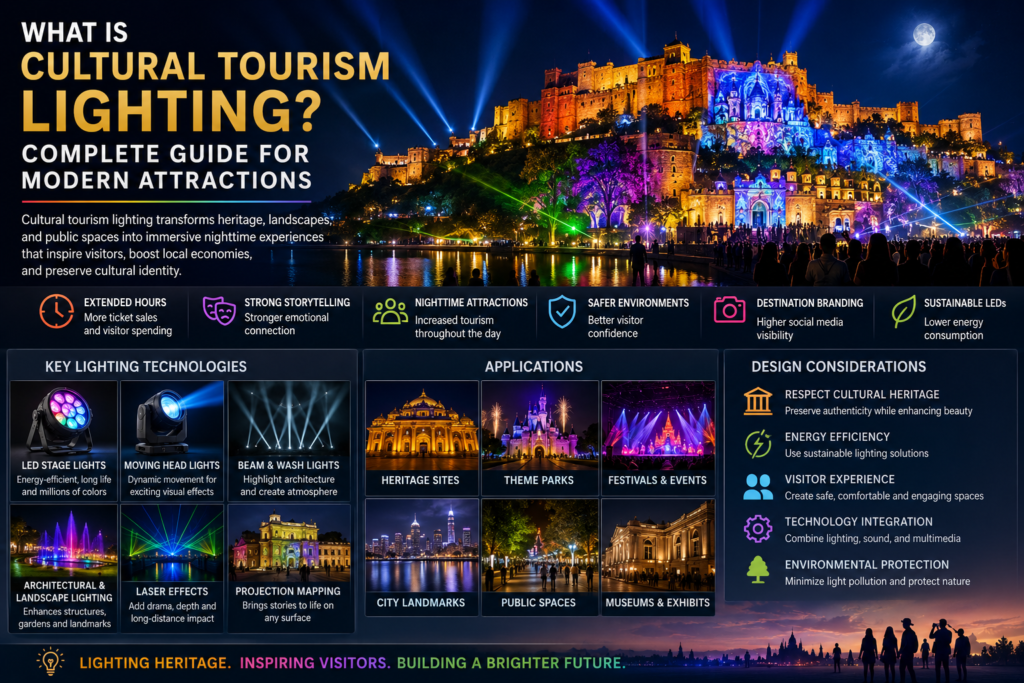
What Is Cultural Tourism Lighting?
Imagine visiting a centuries-old fortress during the day. You admire the architecture, take a few photos, and leave within an hour. Now imagine returning after sunset. The walls glow with carefully designed colors, projection mapping tells stories from history, synchronized music fills the air, and intelligent lighting transforms the entire site into a living performance. That transformation is exactly what cultural tourism lighting is designed to achieve.
Modern destinations no longer rely solely on historical value or natural beauty. Visitors increasingly expect immersive, interactive, and memorable experiences that extend well beyond daylight hours. Governments, tourism boards, architects, and attraction developers are investing heavily in lighting technology because it allows destinations to remain vibrant long after sunset. According to UNESCO, cultural tourism remains one of the world’s largest and fastest-growing tourism segments, with roughly four out of every ten travelers choosing destinations because of their cultural offerings.
Today’s lighting systems combine LED stage lighting, intelligent stage lighting, architectural lighting, moving head lights, landscape lighting, laser effects, and projection mapping into unified experiences that educate, entertain, and inspire visitors. These technologies not only create spectacular visual environments but also strengthen local economies by encouraging longer stays, increasing visitor spending, and supporting the expanding night-time economy. Cities worldwide are investing in illuminated heritage districts, interactive public spaces, and multimedia performances that redefine how people experience culture after dark.
This guide explores everything you need to know about cultural tourism lighting, including its technologies, applications, benefits, design considerations, and emerging trends that are shaping the future of tourism attractions.
Why Cultural Tourism Lighting Has Become Essential
For decades, tourism largely revolved around daytime sightseeing. Attractions closed at sunset, limiting visitor engagement and reducing revenue opportunities. Today, that model is rapidly changing.
Night tourism has become a major growth strategy across the globe. Cities are transforming waterfronts, heritage buildings, museums, parks, and public squares into vibrant evening destinations through professional lighting design. Rather than simply installing brighter fixtures, successful projects create emotional journeys that connect visitors with local history, traditions, architecture, and culture.
UNESCO highlights that governments increasingly recognize cultural tourism as an important driver of sustainable development and economic recovery. Investments in heritage preservation and visitor experiences are helping destinations remain competitive while protecting cultural identity.
Professional tourism lighting solutions contribute by:
| Benefit | Impact |
| Extended operating hours | More ticket sales and visitor spending |
| Improved storytelling | Stronger emotional connection |
| Nighttime attractions | Increased tourism throughout the day |
| Safer public spaces | Better visitor confidence |
| Destination branding | Higher social media visibility |
| Sustainable LEDs | Lower energy costs |
Lighting also changes visitor behavior. People naturally spend more time in environments that feel comfortable, safe, and visually engaging. A beautifully illuminated historical district encourages dining, shopping, photography, and repeat visits. This creates a multiplier effect that benefits hotels, restaurants, retailers, transportation providers, and local communities alike.
Key Components of Cultural Tourism Lighting
Behind every spectacular nighttime attraction is a carefully designed combination of professional lighting technologies. Each fixture performs a unique function, and together they create immersive experiences that would be impossible using conventional illumination alone.
LED Stage Lighting
Modern LED stage lighting forms the backbone of nearly every cultural tourism project. Compared with traditional lighting technologies, LEDs consume significantly less energy while producing brighter output, longer operational life, and millions of color combinations.
Professional LED fixtures also generate less heat, reducing maintenance costs and improving reliability for installations that operate every evening throughout the year. For outdoor heritage sites and theme parks, this efficiency translates into substantial long-term savings.
Today’s RGBW LED technology enables designers to shift seamlessly between warm historical tones, vibrant festival colors, dramatic theatrical scenes, and subtle architectural highlights—all through digital programming.
Moving Head Lights
Few fixtures create excitement like moving head lights. These intelligent luminaires rotate, tilt, zoom, and change colors automatically under computer control.
Their flexibility makes them ideal for:
- Live cultural performances
- Theme park spectaculars
- Opening ceremonies
- Tourism festivals
- Landmark celebrations
- Interactive evening shows
Because they can continuously reposition themselves, a relatively small number of fixtures can create hundreds of unique lighting scenes throughout a single performance.
Beam Lights and Wash Lights
Although they often work together, beam lights and wash lights serve different purposes.
Beam lights generate narrow, concentrated shafts of light that project across long distances. They are perfect for highlighting monuments, creating dramatic aerial effects, and directing audience attention.
Wash lights, meanwhile, spread soft and even illumination across buildings, stages, landscapes, or performance areas. Their broader coverage produces natural-looking environments while enhancing architectural details.
Lighting designers frequently combine both fixture types to achieve depth, contrast, and visual balance.
Projection Lighting and Laser Systems
Projection mapping has transformed how cultural stories are presented. Instead of static floodlighting, digital projectors convert castles, temples, museums, and historical buildings into animated storytelling canvases.
Research published in Heritage Science notes that projection mapping enhances interpretation, attracts new audiences, and creates engaging educational experiences at cultural heritage sites.
Laser lighting complements projection by introducing dynamic movement, geometric effects, and synchronized aerial visuals. Together, these technologies enable destinations to create unforgettable multimedia productions that visitors eagerly share across social media platforms.
DMX Lighting Systems
A remarkable lighting display is never the result of individual fixtures operating independently. Behind every synchronized beam, perfectly timed color transition, and immersive visual sequence is a sophisticated control network. The most widely used standard for professional cultural tourism stage lighting is the DMX lighting system. DMX, which stands for Digital Multiplex, allows hundreds of lighting fixtures to communicate with a central controller. Instead of manually adjusting each light, designers can create detailed lighting scenes, automate transitions, and synchronize lighting with music, video, water effects, and live performances.
For tourism attractions, this level of control is invaluable. Imagine a historical castle where the lighting gradually shifts from warm amber tones representing the building’s early history to vibrant blue and purple hues as a multimedia presentation unfolds. Every spotlight, moving head, projector, and LED fixture changes precisely at the programmed moment. This seamless coordination creates an emotional experience that captivates visitors while reinforcing the attraction’s narrative. Without a DMX lighting system, achieving this level of precision would be nearly impossible.
Modern DMX systems are also highly scalable. A small museum may require only a few dozen fixtures, while a large-scale theme park or cultural district may operate thousands of intelligent lights across multiple locations. Advanced software enables operators to monitor fixture health, schedule shows automatically, and quickly adapt lighting scenes for seasonal festivals or special events. Integration with touchscreen interfaces and cloud-based monitoring has further simplified operations, allowing staff to manage complex installations efficiently.
Another major advantage is reliability. Professional DMX infrastructure is designed for continuous operation, making it ideal for attractions that host nightly performances throughout the year. Combined with intelligent stage lighting, the system provides exceptional flexibility, allowing designers to refresh visitor experiences regularly without replacing physical equipment. This adaptability helps destinations remain exciting and encourages repeat visits.
Intelligent Lighting Control
Lighting has evolved far beyond simply switching fixtures on and off. Today, intelligent stage lighting uses software, sensors, and automation to create dynamic environments that respond to time, events, and audience interaction. Intelligent control systems allow lighting designers to program thousands of scenes, each tailored to different occasions, weather conditions, or visitor flows. Instead of a static display, attractions become living environments that continuously change throughout the evening.
One of the defining characteristics of intelligent lighting is automation. Timed schedules ensure that lighting transitions occur smoothly as daylight fades, while sensors can adjust brightness based on ambient light levels or weather conditions. In busy public spaces, motion detection and occupancy sensors help optimize energy consumption without compromising the visitor experience. These smart features make tourism lighting solutions both visually impressive and operationally efficient.
Artificial intelligence and data analytics are also beginning to influence lighting design. AI-powered control systems can analyze visitor patterns, identify peak attendance periods, and recommend optimized lighting scenes that improve crowd movement or highlight specific attractions. Some venues even integrate lighting with ticketing systems, allowing special effects to activate during scheduled performances or premium events. This creates personalized experiences while maximizing operational efficiency.
Remote management has become another essential feature. Operators can oversee entire lighting networks from centralized control rooms or mobile devices, reducing maintenance costs and minimizing downtime. Firmware updates, diagnostics, and performance monitoring can often be completed without visiting each fixture individually. As tourism destinations become increasingly connected through smart city infrastructure, intelligent lighting control will continue playing a central role in creating sustainable and immersive visitor experiences.
Applications of Cultural Tourism Lighting
Professional cultural tourism lighting is incredibly versatile. It enhances destinations of every size, from small community heritage sites to internationally recognized tourism landmarks. Each project requires a unique combination of architectural lighting, landscape lighting, outdoor stage lighting, and interactive technologies to complement the environment while preserving its cultural significance.
Heritage Sites and Historical Buildings
Historic buildings tell powerful stories, but many architectural details become invisible after sunset. Carefully designed heritage site lighting reveals textures, craftsmanship, and structural features without damaging delicate materials. Warm lighting tones often emphasize authenticity, while projection mapping can bring historical narratives to life through carefully animated visual storytelling.
Respect for preservation remains essential. Lighting designers work closely with conservation specialists to ensure installations are reversible, minimally invasive, and compliant with heritage protection guidelines. Low-heat LED fixtures and precise beam control help protect sensitive surfaces while delivering exceptional visual impact.
Museums and Cultural Centers
Museums increasingly extend their operating hours through immersive evening exhibitions. Lighting transforms static displays into engaging experiences by highlighting artifacts, directing visitor attention, and creating emotional atmospheres that support educational storytelling. Interactive lighting systems can even respond to visitor movement, making exhibitions feel more personal and memorable.
Outdoor museum spaces benefit equally from intelligent lighting. Sculpture gardens, archaeological parks, and open-air exhibitions become accessible during evening hours, increasing attendance while offering visitors a completely different perspective on familiar collections.
Theme Parks and Cultural Parks
Theme parks have long recognized the value of lighting in creating unforgettable entertainment experiences. Modern attractions combine moving head lights, projection mapping, synchronized fountains, lasers, and immersive audio to create spectacular nighttime productions. These shows often become headline attractions in their own right, encouraging guests to stay longer and increasing food, retail, and accommodation spending.
Cultural parks similarly use lighting to celebrate regional traditions, folklore, and performing arts. Rather than relying solely on physical exhibits, designers create immersive environments where visitors experience culture through light, sound, architecture, and interactive performances.
Festivals and Outdoor Performances
Festivals rely heavily on professional stage lighting to establish atmosphere and enhance audience engagement. Concerts, theatrical productions, seasonal celebrations, and community events all benefit from intelligent lighting systems that adapt to different performances. Portable outdoor fixtures with weather-resistant enclosures allow organizers to stage high-quality productions in parks, plazas, and open landscapes regardless of environmental conditions.
Tourism Streets, Public Squares, and Waterfronts
Urban tourism increasingly focuses on creating attractive public spaces after dark. Decorative lighting enhances walkability, improves safety, and encourages visitors to explore shopping districts, restaurants, and entertainment venues. Interactive lighting installations often become social media landmarks, attracting additional visitors through user-generated content and online exposure.
Benefits of Modern Cultural Tourism Lighting
Investing in professional tourism lighting solutions delivers benefits that extend well beyond visual appeal. Well-designed lighting contributes to economic growth, environmental sustainability, visitor satisfaction, and long-term destination competitiveness. These advantages explain why governments, developers, and private investors continue expanding nighttime tourism initiatives worldwide.
Enhanced Visitor Experience
Exceptional lighting transforms passive sightseeing into active participation. Visitors become emotionally engaged as lighting reveals architectural details, guides movement, and supports storytelling through carefully choreographed visual sequences. Interactive technologies encourage exploration, photography, and social sharing, increasing the attraction’s visibility both online and offline.
Comfort and safety also improve significantly. Well-lit pathways, entrances, and gathering spaces help visitors navigate confidently while reducing perceived risk. Families, elderly visitors, and international tourists all benefit from environments that feel welcoming and secure after dark.
Increased Tourism Revenue
One of the strongest business cases for cultural tourism lighting is its ability to generate additional income. Attractions that once closed at sunset can now operate evening experiences, extending visitor stays and increasing ticket sales. Restaurants, hotels, transportation providers, and local retailers similarly benefit from higher nighttime activity.
| Benefit | Business Impact |
| Extended opening hours | Higher ticket revenue |
| Nighttime events | More visitor spending |
| Improved destination branding | Increased tourism demand |
| Longer visitor stays | Higher local economic impact |
| Seasonal programming | Year-round attraction appeal |
Many destinations now consider night tourism an essential part of their long-term development strategy because it distributes visitor traffic more evenly throughout the day while creating new employment opportunities within local communities.
Sustainability and Energy Efficiency
Modern LED stage lighting significantly reduces electricity consumption compared with traditional lighting technologies. Long fixture lifespans minimize replacement costs, while intelligent dimming systems optimize energy use based on occupancy and environmental conditions. These efficiencies support sustainability goals without compromising visual performance.
Solar-powered lighting, renewable energy integration, and smart scheduling further reduce environmental impact. As governments adopt stricter energy regulations, sustainable lighting solutions are becoming an increasingly important consideration during project planning.
Flexible Creative Possibilities
Professional lighting systems are designed for adaptability. Operators can create different themes for holidays, festivals, national celebrations, or promotional campaigns using the same infrastructure. Software updates and programming changes enable attractions to introduce fresh experiences regularly, encouraging repeat visitation without major capital investments.
The ability to evolve over time ensures that destinations remain relevant in a highly competitive tourism market. Rather than becoming static installations, lighting systems continue supporting innovation year after year.
How Intelligent Lighting Creates Immersive Experiences
Modern cultural tourism lighting is no longer limited to illuminating buildings after dark. It has evolved into a sophisticated storytelling tool that combines lighting, audio, video, architecture, and interactive technologies into one seamless experience. Visitors no longer simply observe a monument—they become part of the story. Whether it’s a heritage fortress, a cultural village, or a waterfront attraction, intelligent lighting transforms static spaces into dynamic environments that evoke emotion and encourage exploration.
At the heart of these experiences is the DMX lighting system, which synchronizes multiple lighting fixtures, projection mapping, lasers, fountains, music, and special effects. Every lighting cue is programmed to occur at the perfect moment, ensuring that color changes, beam movements, and visual effects complement the narrative. Projection mapping has become especially important for heritage attractions, allowing architectural façades to serve as digital canvases while preserving the physical structure. Recent research also emphasizes that well-designed projection mapping should enhance cultural storytelling rather than simply create visual spectacle.
Interactive technology is becoming increasingly common. Motion sensors, mobile applications, and IoT-enabled control systems allow lighting to respond to visitor movement, creating personalized experiences that feel unique for every guest. Combined with RGBW LEDs, beam lights, wash lights, and laser effects, these technologies create immersive visitor journeys that encourage longer stays and increased social media engagement.
Choosing the Right Cultural Tourism Lighting Solution
Selecting the right tourism lighting solutions requires careful planning. Every attraction has different architectural characteristics, visitor expectations, environmental conditions, and operational goals. Rather than focusing only on fixture specifications, successful projects begin by defining the visitor experience that the destination wants to create.
Several important factors should guide the selection process:
| Selection Factor | Why It Matters |
| Project Scale | Determines fixture quantity and control capacity |
| Indoor vs Outdoor | Influences weather protection requirements |
| IP Rating | Essential for outdoor reliability |
| Brightness (Lumens) | Ensures visibility across different viewing distances |
| Beam Angle | Controls focus or wide-area illumination |
| Energy Efficiency | Reduces operating costs |
| Maintenance Requirements | Minimizes downtime |
| Control System | Enables synchronization and automation |
| Budget | Balances performance with investment |
| Long-Term Reliability | Supports years of continuous operation |
Outdoor projects should prioritize weather-resistant fixtures with appropriate IP ratings, corrosion-resistant housings, and professional-grade cooling systems. Attractions operating every evening require equipment specifically designed for continuous use rather than consumer-grade lighting products.
Future scalability is equally important. Tourism destinations evolve over time through seasonal festivals, new attractions, and expanded visitor programs. Choosing modular lighting systems allows additional fixtures, projectors, and intelligent controllers to be integrated without replacing the original infrastructure.
Latest Trends in Cultural Tourism Lighting
The lighting industry continues to evolve rapidly, driven by advances in digital technology, sustainability, and visitor expectations. Today’s most successful destinations combine artistic creativity with intelligent automation to deliver memorable nighttime experiences.
Some of the most significant trends include:
- AI-assisted lighting control for optimizing scenes and visitor flow.
- IoT-connected lighting systems for remote monitoring and maintenance.
- RGBW LED technology for richer colors and improved efficiency.
- Projection mapping integrated with permanent tourism infrastructure.
- Interactive lighting using motion sensors and mobile devices.
- Energy-saving technologies that reduce operational costs.
- Smart dimming and scene programming for flexible event scheduling.
- Augmented reality integration that combines digital content with physical environments.
Industry exhibitions continue to highlight how intelligent dimming, projection mapping, and scene programming are reshaping urban and cultural tourism lighting while extending the appeal of destinations well into the evening.
Another growing trend is the shift from temporary lighting shows to permanent multimedia infrastructure. Cities increasingly invest in reusable lighting systems capable of supporting seasonal festivals, cultural celebrations, and tourism campaigns throughout the year rather than installing temporary equipment for one-time events.
Why Choose Professional Stage Lighting Equipment
Although consumer lighting products may appear attractive because of their lower initial cost, they rarely meet the demands of professional tourism environments. Attractions often operate every evening for many years under varying weather conditions, requiring equipment specifically engineered for reliability, precision, and continuous operation.
Professional stage lighting equipment offers several advantages:
- Superior brightness and optical performance.
- Longer operational lifespan.
- Advanced DMX and network control compatibility.
- Outdoor durability with certified weather protection.
- Lower maintenance costs.
- Better color consistency.
- Flexible programming options.
- Easy scalability for future expansion.
Professional manufacturers also provide technical support, lighting design consultation, software updates, spare parts, and system integration services. These services significantly reduce project risk while ensuring consistent performance throughout the system’s lifecycle.
Conclusion
Cultural tourism lighting has become one of the most powerful tools for transforming destinations into immersive, memorable, and economically sustainable attractions. Through the intelligent use of LED stage lighting, moving head lights, architectural lighting, projection mapping, DMX lighting systems, and interactive technologies, tourism destinations can extend operating hours, strengthen cultural storytelling, improve visitor satisfaction, and generate new revenue opportunities.
As night tourism continues to expand worldwide, professional lighting design will play an increasingly important role in helping destinations remain competitive. Investing in reliable, energy-efficient, and scalable lighting systems not only enhances the visitor experience but also supports long-term sustainability and operational efficiency.
Whether you are developing a heritage site, theme park, museum, waterfront, cultural district, or public landmark, choosing professional cultural tourism lighting solutions is an investment in unforgettable experiences that visitors will remember—and share—for years to come.
Frequently Asked Questions
1. What is cultural tourism lighting?
Cultural tourism lighting combines professional lighting technologies with storytelling to enhance tourism attractions, heritage sites, museums, parks, and public spaces during evening hours.
2. What lighting is best for outdoor attractions?
Weatherproof LED fixtures with high IP ratings, intelligent controls, moving head lights, and architectural lighting are commonly used for outdoor attractions.
3. What is intelligent stage lighting?
Intelligent stage lighting uses programmable fixtures controlled through DMX or network-based systems to automate movement, color, brightness, and special effects.
4. How does a DMX lighting system work?
DMX transmits digital control signals from a controller to multiple lighting fixtures, allowing synchronized lighting shows with precise timing.
5. What are moving head lights?
Moving head lights are automated fixtures capable of rotating, tilting, zooming, changing colors, and producing dynamic lighting effects.
6. What lighting is suitable for heritage sites?
Low-heat LED architectural lighting, projection mapping, and carefully controlled beam lighting are commonly used to protect historic structures while enhancing their appearance.
7. Is LED stage lighting energy efficient?
Yes. LED technology consumes significantly less electricity, generates less heat, and offers much longer operating life than traditional lighting sources.
8. How does lighting improve visitor experiences?
Professional lighting enhances storytelling, improves safety, encourages longer visits, supports interactive experiences, and creates memorable nighttime attractions.
9. What is the difference between beam lights and wash lights?
Beam lights produce narrow, concentrated light for dramatic effects, while wash lights provide broad, even illumination across large areas.
10. How do I choose the right cultural tourism lighting system?
Consider project size, environmental conditions, fixture quality, control systems, energy efficiency, maintenance requirements, scalability, and long-term reliability.