
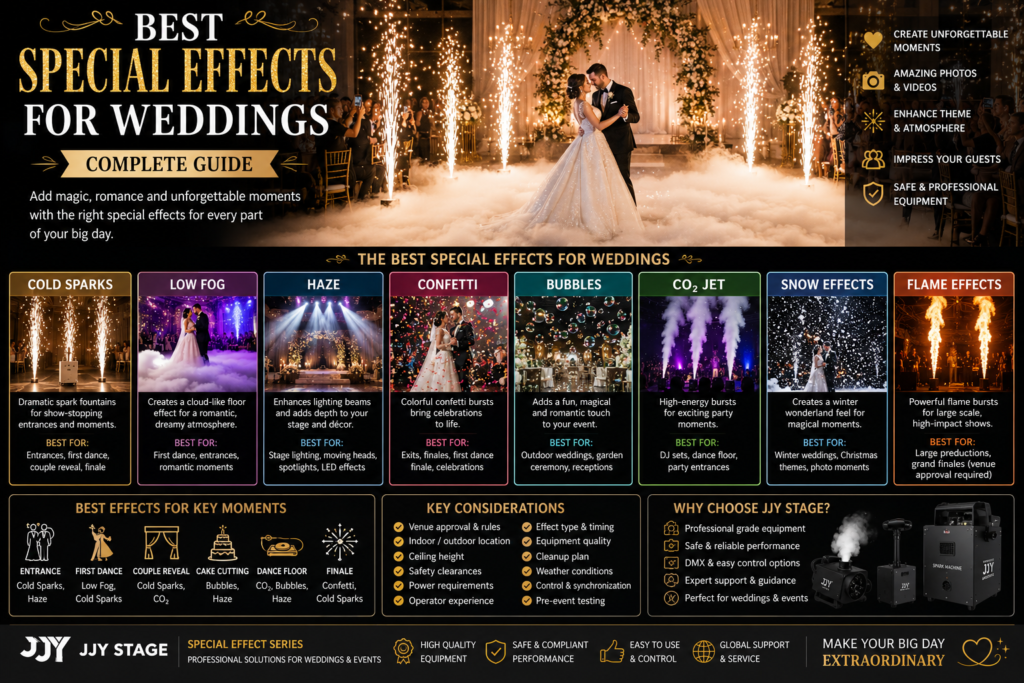
A wedding is one of the most visually important events a couple will ever host, and the right wedding special effects can turn a simple entrance or first dance into a moment guests talk about for years. From a shower of cold sparks as the couple walks in, to a soft blanket of low fog swirling around their first dance, to a burst of confetti at the close of the reception special effects give wedding planners and venues a powerful way to add atmosphere, drama, and emotion to the day.
Popular options include cold sparks, low fog, fog, haze, confetti, bubbles, snow effects, CO₂ effects, and for larger professional productions flame effects. But there’s no single “best” wedding effect. The right choice depends on the venue, the stage design, the specific moment in the event, and the atmosphere the couple wants to create.
This guide walks through the most popular special effects for weddings, where each one works best, and how to choose the right wedding special effects equipment for a ceremony, reception, or full wedding production.
What Are Wedding Special Effects?
Wedding special effects are equipment-driven visual elements that add movement, atmosphere, or drama to a wedding beyond what standard lighting and décor can achieve on their own. They’re designed to complement:
- Stage lighting, adding texture and depth to color washes and beams
- Music, timed to key moments like an entrance or first dance
- Wedding décor, reinforcing a theme such as romantic, rustic, or winter
- LED screens, layering physical effects with visual content
- DJ performances, adding energy to the reception dance floor
- Couple entrances, creating a memorable first visual impression
It’s worth distinguishing between decorative effects and high-impact professional effects. Decorative touches like simple bubble machines or fairy-light haze are subtle and low-intensity, meant to sit quietly in the background. High-impact effects, such as cold sparks or CO₂ jets, are designed to command attention at a specific, planned moment. Most wedding productions blend both: a soft atmospheric layer running throughout the event, punctuated by one or two higher-impact moments.
Best Special Effects for Weddings
Here’s a quick comparison of the most commonly used wedding stage effects:
| Effect | Best Wedding Moment | Visual Impact |
| Cold Sparks | Entrance/first dance | Very High |
| Low Fog | First dance | High |
| Haze | Stage lighting | High |
| Confetti | Finale/celebration | Very High |
| Bubbles | Outdoor/casual weddings | Medium |
| CO₂ | DJ/party moments | Very High |
| Snow | Winter/Christmas weddings | High |
| Flame | Large professional productions | Very High |
Cold sparks and confetti tend to deliver the biggest “wow” moments, making them popular for entrances and finales. Low fog and haze work more subtly, shaping the romantic atmosphere around a first dance or ceremony lighting. Bubbles and snow lean into theme and setting garden weddings and winter weddings, respectively while CO₂ and flame effects are generally reserved for higher-energy reception moments or larger professional productions.
Cold Spark Machine for Weddings
Few effects create the same dramatic impact as cold sparks. A cold spark machine produces a tall, glittering fountain of spark-like particles, and it has become one of the most popular wedding entrance effects for couples who want a striking visual moment.
Common wedding applications include:
- Bride and groom entrance — framing the couple’s first appearance
- First dance — bookending the dance with a dramatic spark moment
- Couple reveal — unveiling the newlyweds after the ceremony
- Cake-cutting — adding a celebratory visual accent
- Wedding finale — closing the night on a high note
- Photography moments — creating striking backdrop images
Cold spark machines create their effect through a fountain-style vertical burst that reads dramatically in photos and video. That said, “cold spark” describes the effect’s temperature profile relative to traditional pyrotechnics it does not mean the equipment is risk-free. Any wedding cold sparks setup requires venue approval, appropriate clearance from guests and décor, trained operation, and full compliance with manufacturer requirements and local safety regulations. Always confirm with the venue before assuming cold sparks are permitted.
For a full breakdown of how these systems work, see our Cold Spark Machine: Complete Guide to Indoor Spark Effects.
Low Fog for Weddings
Low fog creates a dense, cloud-like layer that stays close to the floor, giving the couple the appearance of standing or dancing on a bed of clouds. It’s one of the most romantic and photogenic effects available, which is why low fog for weddings has become especially popular for first dances.
Best applications include:
- First dance — creating a soft, dreamlike floor effect
- Couple entrance — a gentle, elegant way to introduce the newlyweds
- Romantic stage moments — enhancing quieter, more intimate segments of the reception
- Wedding photography — producing striking, editorial-style images
Because low fog stays close to the ground rather than filling the room, it doesn’t obscure the couple, guests, or lighting — making it a flexible option for venues with lower ceilings or more intimate settings.
Read more in our guide to the Low Fog Machine: How to Create a Cloud-Like Stage Effect.
Fog & Haze Effects for Wedding Stages
Fog and haze are often used interchangeably in conversation, but they create very different effects on a wedding stage.
- Fog produces a stronger, more visible atmospheric cloud, ideal for adding drama or depth to a stage or dance floor.
- Haze produces a much finer, more even atmosphere designed primarily to make lighting visible rather than to be seen on its own.
Haze is especially useful for enhancing:
- Moving heads, giving beam movement a visible trail
- Spotlights, highlighting the couple during key moments
- Beam lights, adding structure to the stage’s overall look
- LED lighting, deepening color and texture across the room
For couples and planners focused on getting the most out of their lighting design, haze is often the quieter, more foundational choice, while fog is reserved for a specific dramatic moment.
Confetti Effects for Weddings
Confetti brings an instant sense of celebration, making it one of the most popular finale effects across wedding ceremonies and receptions alike. Common uses include:
- Couple entrance — a joyful, celebratory welcome
- Ceremony exit — a classic confetti send-off as the couple leaves the ceremony
- First dance finale — closing the dance with a burst of color
- Reception finale — ending the night on a high-energy note
- Wedding announcements — punctuating toasts or special reveals
Before booking a wedding confetti machine, it’s worth thinking through a few practical details:
- Indoor vs outdoor use — wind can affect outdoor confetti dispersal
- Confetti type — material and size should suit the venue and photography style
- Cleanup — many venues have specific confetti policies and cleanup expectations
- Venue restrictions — some venues restrict or prohibit certain confetti materials entirely
Always confirm the venue’s confetti policy well ahead of the wedding date, since restrictions vary widely between locations.
See our full guide: Confetti Machine for Events: Complete Buying Guide.
Bubble Machine for Weddings
Bubbles bring a light, playful, and romantic quality that suits more relaxed, outdoor, or garden-style wedding settings. A bubble machine for weddings is a popular choice for:
- Outdoor weddings — bubbles catch natural light beautifully
- Garden weddings — complementing a soft, natural setting
- Fun receptions — adding a playful, lighthearted touch
- Couple entrances — a gentler alternative to higher-intensity effects
- Photography — bubbles photograph well in both daylight and evening light
Bubbles are generally a lower-intensity, ambient effect rather than a single dramatic cue, making them well suited to running throughout a portion of the event rather than being triggered at one specific moment.
Learn more in the Bubble Machine for Events: Complete Guide to Choosing the Right Bubble Machine.
CO₂ Effects for Wedding Parties
CO₂ jets are a high-energy effect best suited to the more festive parts of a wedding, rather than the romantic ceremony moments. They’re generally more appropriate for the reception and dance floor than for a first dance or ceremony entrance.
Common uses include:
- Dance-floor drops — timed to a DJ set or key song moment
- DJ performances — adding energy to the reception
- Reception entrances — announcing the couple’s arrival at the party portion of the evening
- Party finales — closing out the reception with a high-impact burst
Because CO₂ effects are sharp and immediate, they work best when the couple wants their reception to feel more like a party than a formal ceremony.
Read more in our CO₂ Jet Machine for Concerts: Complete Guide to CO₂ Stage Effects.
Snow Effects for Winter Weddings
Artificial snow adds an unmistakable seasonal atmosphere that pairs beautifully with winter and holiday-themed weddings. Common applications include:
- Christmas weddings — reinforcing a festive, holiday atmosphere
- Winter weddings — adding seasonal texture regardless of actual weather
- Holiday-themed receptions — tying the effect into broader décor
- Themed photography — creating a distinctive, memorable visual backdrop
Snow effects tend to work best as a sustained, ambient layer during a first dance or key reception segment, rather than a single quick burst.
See our guide: Snow Machine for Events: Complete Guide to Stage Snow Effects.
Flame Effects for Wedding Productions
For larger, professionally produced weddings, flame effects can create genuinely dramatic moments a burst of fire behind the couple during a finale, for instance, or as part of a large-scale stage production. However, flame effects require significantly more careful planning than most other wedding effects.
Flame effects should only be used where explicitly permitted by the venue, and always with professional, trained operators managing the equipment. This isn’t an effect to add casually to a wedding timeline it requires dedicated planning, clearances, and safety oversight from the earliest stages of production.
Learn more in our guide: Stage Flame Machines: How Professional Fire Effects Work.
Best Wedding Effects for Different Moments
Here’s a practical starting point for matching effects to specific wedding moments:
| Wedding Moment | Recommended Effects |
| Bride & Groom Entrance | Cold sparks, haze |
| First Dance | Low fog, cold sparks |
| Couple Reveal | Cold sparks, CO₂ |
| Cake Cutting | Bubbles, subtle haze |
| Dance Floor | CO₂, bubbles |
| Wedding Finale | Confetti, cold sparks |
| Outdoor Photos | Bubbles, low fog |
| Winter Wedding | Snow effects |
As with any event, the final selection should always be adjusted based on the venue’s specific rules, the couple’s preferences, and the overall production plan.
Indoor vs Outdoor Wedding Special Effects
Indoor and outdoor weddings come with very different considerations for special effects planning:
- Ceiling height — a significant factor indoors; less relevant outdoors
- Venue approval — essential in both settings, though the process differs
- Flooring — indoor flooring type may restrict certain effects; outdoor ground conditions vary by site
- Drainage — more relevant for outdoor setups, particularly with fluid-based effects
- Wind — a major factor for outdoor confetti, bubbles, and fog dispersal
- Weather — controlled indoors, but must be actively monitored outdoors
- Electrical equipment — power access and protection needs differ significantly between settings
- Fire-safety requirements — apply in both settings but are often stricter or more tightly enforced indoors
- Cleanup — indoor venues often have specific, time-sensitive cleanup requirements
An effect that works beautifully at an outdoor garden wedding may not be appropriate — or even permitted — inside a ballroom or historic venue, so it’s worth confirming venue-specific rules early in the planning process rather than assuming based on past events.
How Wedding Special Effects Work With Lighting
Special effects become far more powerful when they’re planned alongside the stage lighting design rather than added separately. A few common combinations:
- Haze + Moving Heads → makes light beams visible as they sweep across the room
- Cold Sparks + Stage Lighting → intensifies the drama of an entrance
- Low Fog + Soft Lighting → builds a romantic, dreamlike first dance
- Confetti + Color Wash → adds vibrancy and energy to a finale
- Bubbles + Outdoor Lighting → creates a soft, playful atmosphere as the sun sets
This is where working with a production or lighting team pays off coordinating effect timing with lighting cues turns a simple visual trick into a genuinely memorable moment, and it’s an area where a full wedding special effects machines and lighting package can make planning significantly easier.
How to Choose Wedding Special Effects Equipment
Choosing the right equipment starts with a clear picture of the event itself. Key factors to consider:
- Wedding venue — its layout, rules, and physical constraints
- Indoor/outdoor location — shapes both effect choice and equipment protection needs
- Guest count — affects coverage area and audience separation requirements
- Stage size — determines how much equipment can be placed and where
- Ceiling height — particularly important for cold sparks, confetti, and fog
- Desired effect — romantic, high-energy, festive, or a mix across the event
- Event moment — ceremony, first dance, reception, or finale
- Power requirements — confirm availability and capacity at the venue
- Equipment control — manual, remote, or integrated with a broader production system
- Setup and transportation — logistics for delivery, installation, and breakdown
- Cleanup — plan for post-effect cleanup, especially for confetti and snow
- Venue approval — confirm permissions well in advance
- Operator experience — trained, experienced operators for higher-impact effects
- Safety requirements — reviewed and confirmed before the event, not on the day of
Avoid relying on assumed specifications for any piece of equipment — always confirm actual capabilities, control options, and requirements directly rather than guessing.
Wedding Special Effects Safety
Safety should be built into wedding effects planning from the start, not treated as an afterthought. Key areas to cover:
- Venue permission for every effect planned
- Manufacturer instructions, followed precisely
- Professional operation, especially for higher-impact effects
- Required clearances around all equipment
- Electrical safety, including proper power supply
- Fire-safety requirements, particularly for sparks and flame effects
- Audience separation from equipment and discharge zones
- Combustible decorations — kept clear of any spark or flame effect
- Ceiling clearance — confirmed for the specific space
- Emergency exits — kept unobstructed at all times
- Weather conditions — actively monitored for outdoor weddings
- Cleanup — planned and scheduled in advance
No special effect should ever be presented or treated as completely risk-free, and venue safety systems or alarms should never be disabled or bypassed to accommodate an effect.
Common Mistakes When Choosing Wedding Effects
Some of the most frequent planning missteps include:
- Choosing effects based only on how they look in photos or videos online
- Ignoring venue rules until it’s too late to adjust plans
- Forgetting to check ceiling clearance
- Using too many effects simultaneously, diluting their impact
- Not coordinating effects with the music or event timeline
- Ignoring cleanup requirements and timing
- Buying or booking equipment without checking actual specifications
- Failing to rehearse effect cues before the event
- Using unapproved consumables not specified by the manufacturer
- Hiring inexperienced operators for higher-impact effects like cold sparks or flame
Wedding Special Effects Buying Checklist
Use this checklist when planning wedding special effects:
- ☐ Venue approval
- ☐ Indoor/outdoor location
- ☐ Stage size
- ☐ Ceiling height
- ☐ Effect type
- ☐ Event moment
- ☐ Required coverage
- ☐ Power requirements
- ☐ Control method
- ☐ Safety clearances
- ☐ Operator
- ☐ Consumables
- ☐ Cleanup plan
- ☐ Transportation
- ☐ Pre-event testing
Frequently Asked Questions
What are the best special effects for weddings?
Cold sparks, low fog, haze, and confetti are among the most popular, each suited to different moments from entrances and first dances to finales.
What is the best effect for a wedding first dance?
Low fog is one of the most popular choices, creating a romantic, cloud-like effect around the couple. Cold sparks are also used, particularly at the start or end of the dance.
Are cold sparks suitable for weddings?
Cold sparks can be a striking choice for weddings, but they require venue approval, proper clearances, trained operation, and compliance with manufacturer and local safety requirements never assume they’re automatically permitted.
What is the best wedding stage effect?
There’s no single best option the right effect depends on the specific moment, venue, and desired atmosphere. Many weddings combine several effects across the ceremony and reception.
Can you use fog machines at weddings?
Fog machines can be used at many venues, but always confirm venue policies, ceiling clearance, and any smoke-detector considerations before booking.
What is low fog for weddings?
Low fog is a dense, ground-hugging fog effect that stays close to the floor, creating a soft, cloud-like look often used for first dances and entrances.
Are bubble machines good for weddings?
Yes, particularly for outdoor or garden weddings, where bubbles add a light, playful atmosphere and photograph well in natural light.
Can CO₂ effects be used at wedding receptions?
CO₂ effects are generally better suited to high-energy reception or dance-floor moments than to romantic ceremony moments, and they should be planned with venue approval in mind.
What special effects are best for outdoor weddings?
Bubbles, low fog, and confetti (where venue and weather conditions allow) tend to work particularly well outdoors, though wind and weather should always be considered.
How much do wedding special effects cost?
Cost varies significantly depending on the equipment used, event duration, venue requirements, operator involvement, number of machines, and overall production needs there’s no fixed price that applies across all weddings.
Conclusion
There is no single best wedding special effect the ideal choice depends on the wedding style, venue, specific event moment, stage design, lighting plan, budget, and safety requirements involved. Cold sparks and confetti bring drama to entrances and finales, low fog and haze shape a romantic atmosphere for ceremonies and first dances, and bubbles, snow, and CO₂ each bring their own character to different parts of the celebration.
Explore JJY Stage’s Special Effect Series to find professional equipment for creating memorable wedding entrances, first dances, receptions, and stage moments.